Ferrari 275 GTB/4: The Four-Cam V12 Ferrari Made Customers Wait For
1967 Ferrari 275 GTB/4 by Scaglietti





Images: Neil Fraser / RM Sotheby's
Enzo Ferrari was in no hurry to hand his road-car customers everything his engineers already knew how to build. By the early 1950s, Aston Martin, Jaguar and Maserati were all selling twin-cam engines to anyone with the money, and Ferrari’s own competition department had been fielding double-overhead-camshaft V12s since the 290 Sport of 1957. For nearly a decade afterwards, that technology stayed locked inside the race shop, reserved for cars that wore numbers on their doors rather than number plates. The 275 GTB/4, unveiled at the Paris Motor Show in October 1966, was the moment that finally changed: the first roadgoing Ferrari a private customer could simply order with four camshafts, a five-speed transaxle and a dry-sumped V12 whose architecture had already proved itself on the track, built and sold as a catalogue model rather than smuggled out for a favoured privateer.
The GTB/4 did not appear from nothing. It was the third and final act of the 275 line, which had begun at the 1964 Paris Salon as the replacement for the 250 GT Lusso. That original two-cam 275 GTB introduced two technologies that would define Ferrari road cars for years afterwards: independent rear suspension in place of the old live axle, and a rear-mounted transaxle combining gearbox and differential in a single unit, a layout borrowed in principle from the 250 Testa Rossa racer. It was also the first roadgoing Ferrari in more than a decade to offer five forward gears. Power came from a familiar all-aluminium, single-overhead-cam-per-bank Colombo V12, its lineage traceable back to the 1947 125 S, now bored and stroked to 3,286cc and producing 280bhp, a healthy 40bhp over the outgoing 250. Styled by Francesco Salamone at Pininfarina and built by Scaglietti, the two-cam GTB’s flowing lines carried more than a passing resemblance to the 250 GTO and shared its 2,400mm wheelbase, though Pininfarina never publicly confirmed direct inspiration. Reception at launch was not universally warm: motorsport historian Doug Nye later recorded that period opinion found the design’s more purposeful, less flamboyant shape a step down from the swept elegance of the Lusso it replaced. Time has judged it more kindly than the contemporary press did.
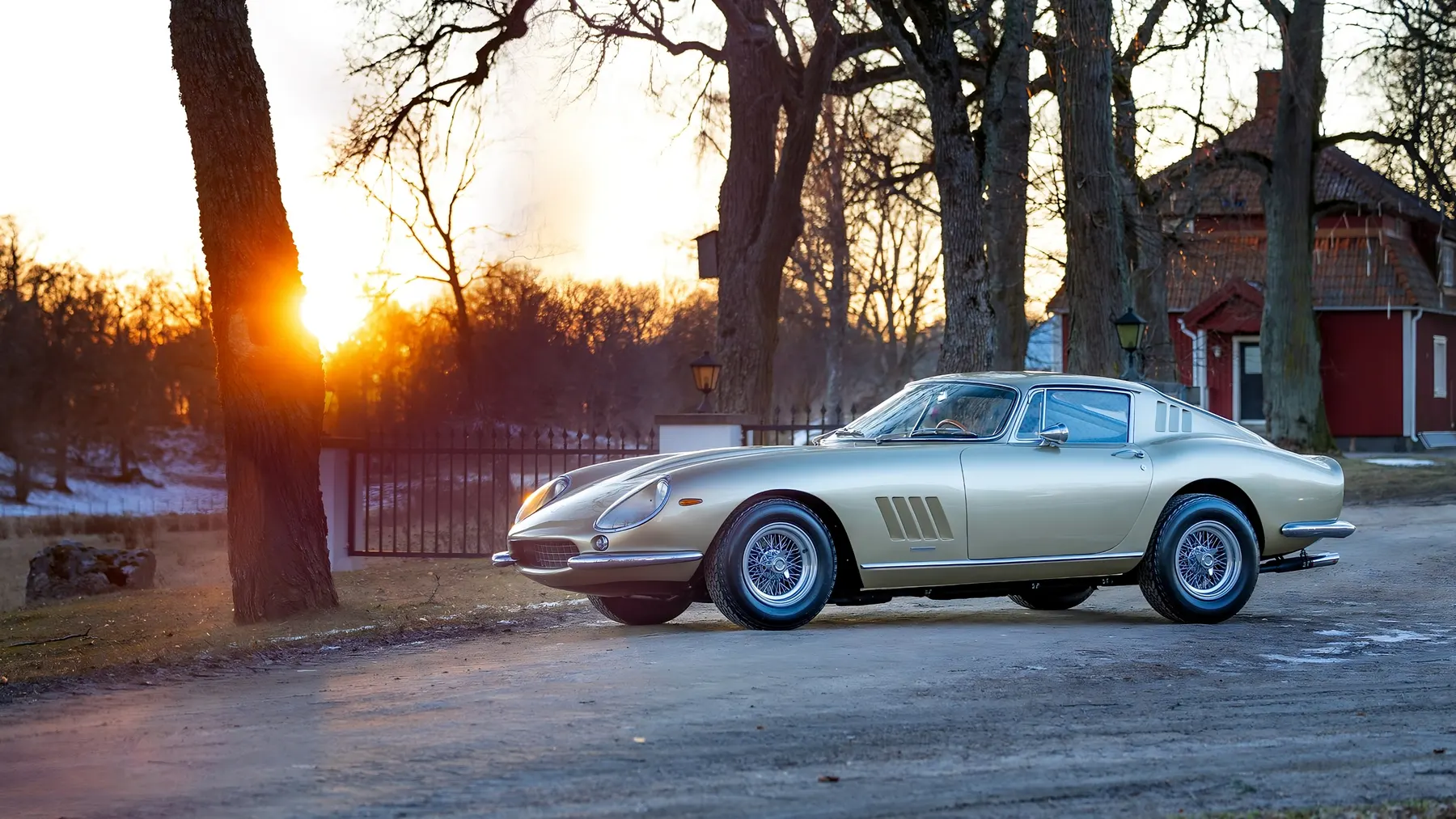
Two years and a mid-production facelift later, the four-cam engine arrived to turn the GTB into the GTB/4. That facelift had already brought a longer nose to cure high-speed front-end lift, along with a larger rear screen and external bootlid hinges to free up luggage space, and the GTB/4 simply continued on that long-nose body. Mechanically, the new engine retained the same short-block dimensions as before, with a 77mm bore and 58.8mm stroke giving an identical 3,286cc displacement, but the cylinder heads were comprehensively redesigned. Each bank now carried two camshafts rather than one, driven from a central gear mounted on needle-roller bearings at the front of the head; Ferrari narrowed the valve angle from 57 to 54 degrees in the process, improving gas flow and freeing up room for a better inlet tract. A dry-sump lubrication system replaced the old wet sump, its more compact crankcase housing twin scavenge pumps fed from an external reservoir of roughly nine litres, with an oil cooler mounted ahead of the radiator. The previously optional six-carburettor set-up, Weber 40 DCN units in 9, 17 and 18 specification across the production run, became standard, and single spark plugs per cylinder were fired by a twin-coil ignition system. Ferrari gave the reworked unit its own factory type reference, 226, and quoted a claimed 300bhp at 8,000rpm, 20bhp up on the outgoing two-cam engine’s six-carburettor form. As with most Italian manufacturers’ figures of the period, that number is worth treating with a little scepticism; gross power claims of the mid-1960s rarely survived contact with a dynamometer unscathed. Torque is harder still to pin down with confidence: reputable sources disagree, with peak figures quoted anywhere from around 217 to 232 lb-ft, generally cited as arriving at 6,000rpm, a meaningfully higher and later peak than the two-cam car’s roughly 188 lb-ft at 5,500rpm, whichever precise number is correct.
The more significant change was invisible from outside the car entirely. Owners of the original 275 GTB had complained about vibration transmitted through the propshaft connecting engine to transaxle, a legitimate consequence of mounting a rigid five-speed unit at the opposite end of the chassis from the engine, joined only by a spinning shaft with limited support. For the GTB/4, Ferrari wrapped that shaft in a 75mm torque tube, creating a solid mechanical link between engine and transaxle, with the whole assembly rubber-mounted to the chassis at just two points. The effect, according to those who have driven both cars back to back, is a four-cam car that shifts gears through its open, chrome-gated lever with a noticeably more fluid, positive action than the looser two-cam original, and that feels altogether more secure and biddable at speed, if slightly less razor-sharp through fast direction changes than a lightly specified two-cam GTB. It was, in effect, the piece of engineering that let Ferrari later stretch this same platform into the 365 GTB/4 Daytona; more than one observer has noted that the GTB/4’s underlying revisions look very much like a running test-bed for what was already being planned as its successor.
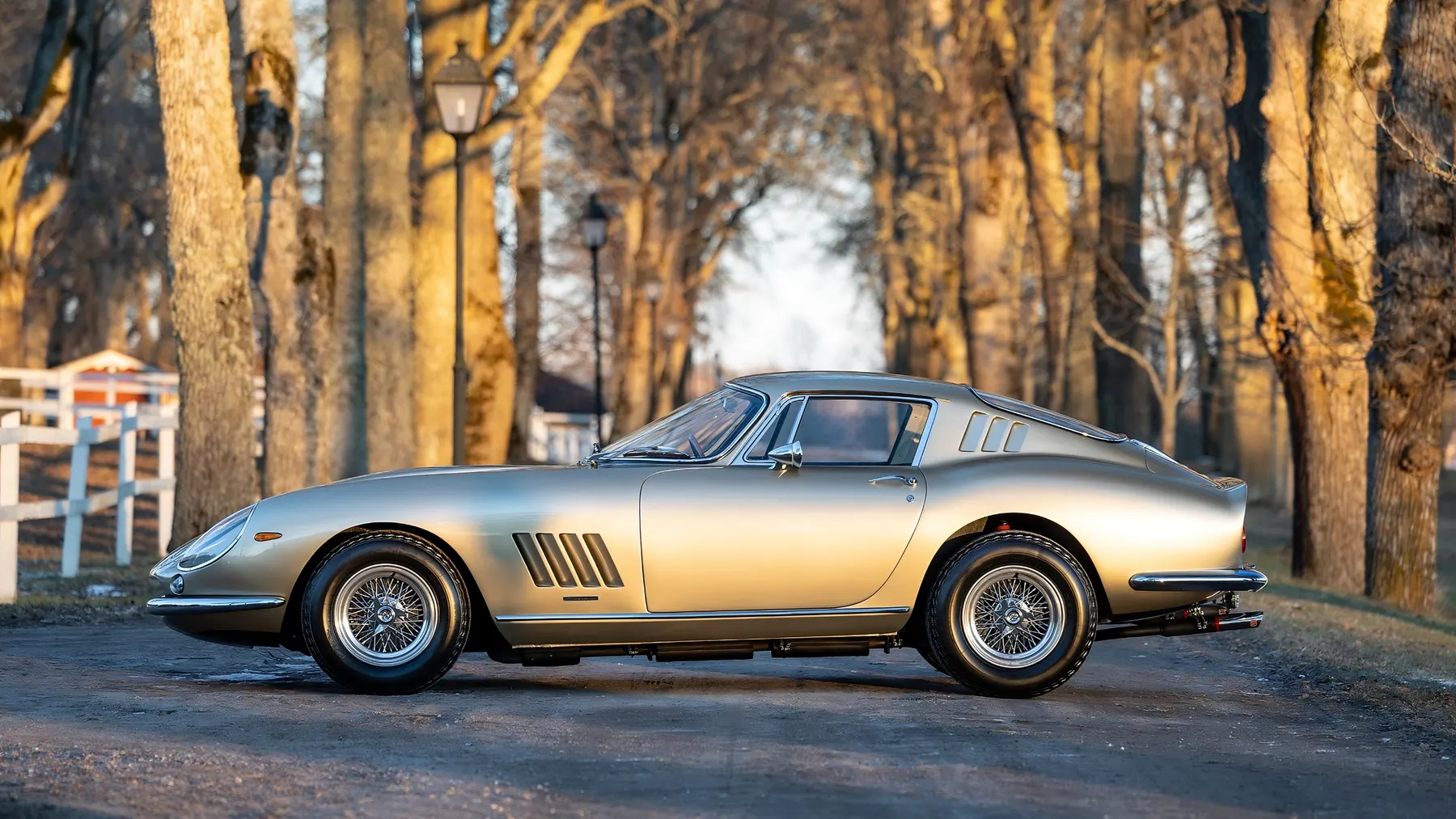
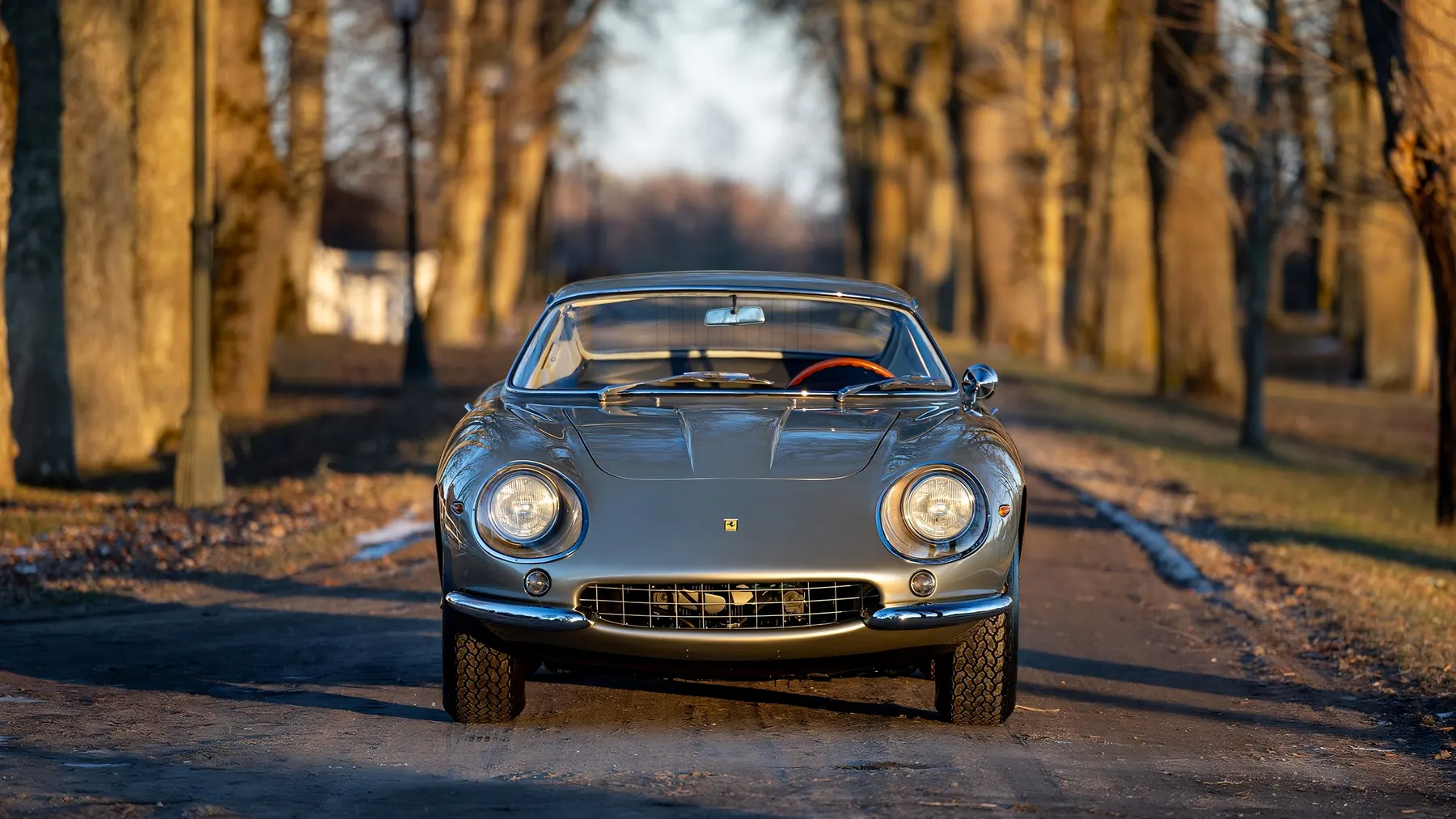
Visually, Ferrari changed almost nothing. Pininfarina’s design, round headlamps under bulged Plexiglas covers, a long bonnet running back to a cab-rearward glasshouse, a Kamm-cut tail with slim wraparound bumpers and three ventilation slots cut into each C-pillar, carried over from the long-nose GTB essentially unaltered, and the two cars are all but indistinguishable at a glance. The one reliable tell, short of opening the bonnet, is a slim, shallow central bulge running the length of the GTB/4’s hood, needed to clear the taller engine and its enlarged air-cleaner housing; earlier two-cam cars instead carried a wider, flatter raised section. Bodies were built by Scaglietti in Modena, generally in steel with aluminium doors, bonnet and boot lid, though a small number, fewer than 20 of the eventual 330 cars built, received full aluminium bodywork; a comparable weight saving on the closely related two-cam car was reported at over 100kg. Inside, little changed beyond a plain black dashboard and revised trim replacing the teak inserts that had been gradually phased out; leather covered the bucket seats, transmission tunnel and door panels, with straps provided in the boot to lash down extra luggage, and buyers could now specify electric windows, headrests, a radio and, for the first time on the model, air conditioning.

Behind the wheel, the GTB/4 rewards patience before it rewards commitment. Cold, the V12’s six twin-choke Webers meter fuel hesitantly and the unassisted steering needs real effort at parking speeds; give the oil-temperature gauge time to climb and the whole car sharpens up, the throttle responding cleanly and the gearchange loosening into something genuinely fluid. The engine note is the defining sensation: cultured and deep-chested through the mid-range, hardening into a spine-tingling wail above 5,000rpm that period road testers and modern owners alike single out as one of the great automotive soundtracks of any era. Road & Track’s September 1967 test of the closely related NART Spyder called it “the most satisfying sports car in the world,” and while that verdict concerned the open two-seater rather than the closed berlinetta, the underlying mechanical package, engine, transaxle, chassis, was shared between them. The GTB/4’s steering sits between its two closest relatives: lighter and more immediate than the effort-heavy low-speed steering of the front-engined Daytona that succeeded it, yet a shade heavier than the delicate, ultra-light helm of the two-cam GTB it replaced. Braking, via disc brakes at all four corners, is strong and progressive, and the ride, on period-correct Michelin rubber, manages to be both supple over poor surfaces and well controlled at speed, with a touch of initial understeer giving way to a neutral, rear-biased stance once power is applied.

None of this came without real compromises, and it is worth being honest about them rather than filing them away as charming period quirks. The additional plumbing needed for the dry sump, oil cooler and torque tube added meaningful weight over the two-cam car, and that extra mass, combined with the more secure, less immediate feel of the rigid drivetrain, cost the GTB/4 some of the featherweight agility that made a lightly specified, aluminium-bodied two-cam 275 GTB such a sharp, tactile steer; back-to-back tests have judged the four-cam car the more stable and confidence-inspiring machine, but also the less pointy one through a fast, technical road. The engine itself, for all its glorious noise, is a genuinely demanding thing to own properly: six Weber carburettors need careful, regular synchronisation to run cleanly, the dry-sump system and gear-driven cam train add real cost and complexity to any rebuild, and marque specialists commonly flag worn second-gear synchromesh as a weak point on cars that have not been sympathetically maintained through their working lives. Ferrari’s broader commercial strategy around the platform also misjudged its market at least once: when US importer Luigi Chinetti persuaded Enzo Ferrari to approve an open four-cam Spyder, later nicknamed the NART Spyder after Chinetti’s North American Racing Team, he ordered a batch of 25 cars from Scaglietti, priced at more than 50 per cent above a standard GTB/4. Buyers simply did not materialise in those numbers; only ten were built before the project was quietly abandoned, a rare and expensive miscalculation within an otherwise commercially sound model line. None of this makes the GTB/4 a bad car, very much the opposite, but it is a complicated, demanding and expensive one to keep properly sorted, then and now.

Competition use was limited but not absent. The 275 GTB/4 was never homologated as a dedicated racer in the way the earlier two-cam 275 GTB/C had been, but a handful of privately entered cars did compete. Ferrari’s Swiss importer, Scuderia Filipinetti, prepared four examples, three of them for Peter Baumberger’s “Three Bears” team; their best result was a class win at the 1967 Ollon-Villars hillclimb, driven by Baumberger’s son-in-law, Bennett Dorrance. In the United States, Chinetti was persuaded to enter an aluminium-bodied GTB/4, owned by NART co-founder Jan de Vroom, at the 1969 Daytona 24 Hours, where Ricardo Rodriguez and Sam Posey brought it home 23rd overall and second in the five-litre GT class. The NART Spyder’s own sole competitive outing came at the 1967 Sebring 12 Hours, where Denise McCluggage and Marianne “Pinkie” Windridge finished 17th overall in the prototype example. None of this amounted to anything like a serious works effort, by 1966 and 1967 Ferrari’s competition energy was concentrated on purpose-built prototypes rather than road-car derivatives, but it demonstrated that the GTB/4 was more than a boulevard cruiser dressed up with a race-bred engine.
Exactly 330 GTB/4s were built between 1966 and the end of 1968, of which 27 left the factory right-hand drive, before the model gave way to the visually very different 365 GTB/4 Daytona, a car that inherited the GTB/4’s torque-tube layout and much of its engineering, wrapped in Leonardo Fioravanti’s sharper, distinctly 1970s Pininfarina shape. That handover makes the GTB/4 the last of Ferrari’s classic front-engined V12 GT berlinettas built in the idiom that had defined the marque since the war, round headlamps, flowing bonnet, cab-rearward glasshouse, before the company’s road cars turned decisively towards the wedge-profiled, aerodynamically driven look of the following decade. It also arrived at a pointed moment for Ferrari’s reputation: Lamborghini had unveiled its 345bhp Miura prototype at Geneva earlier in 1966, and the extra power and refinement built into the GTB/4’s four-cam engine were as much a response to that new mid-engined threat as a natural evolution of the 275 line.
The car’s cultural afterlife has, if anything, outgrown its mechanical one. Steve McQueen drove a 275 GTB/4 during the filming of Bullitt and reportedly used it to commute to set; a McQueen-connected example later sold at auction for a reported $10.18 million, a record for the model at the time. Today the GTB/4 sits among the most quietly coveted of the classic V12 Ferraris, less extroverted than the GTO that inspired its lines, less headline-grabbing than the Daytona that followed it, but arguably the most complete expression of what a front-engined Ferrari berlinetta of that era could be: the last one built before the company let go of everything the 250 series had taught it, and finally handed its customers the twin-cam engineering its own racing department had known about for a decade.
Technical data
Performance Specifications
| Specification | Detail |
|---|---|
| Engine | 3,286cc (3.3-litre) 60° V12, Tipo 226, dual overhead camshafts per bank |
| Bore x stroke | 77mm x 58.8mm |
| Compression ratio | 9.2:1 |
| Fuel system | Six Weber 40 DCN carburettors (9, 17 or 18 spec); dry-sump lubrication |
| Power | 300bhp @ 8,000rpm (claimed) |
| Torque | c. 217–232 lb-ft @ 6,000rpm* |
| Transmission | 5-speed manual transaxle with torque tube; ZF limited-slip differential |
| Chassis | Tubular steel ladder frame, Tipo 596 |
| Suspension | Independent all round; unequal-length wishbones, coil springs, telescopic dampers, anti-roll bars f/r |
| Brakes | Disc brakes, all four corners |
| Wheels | 14in Borrani wheels (7x14); wire wheels optional |
| Wheelbase | 2,400mm |
| Length | c. 4,325mm* |
| Width | c. 1,725mm* |
| Height | c. 1,245mm* |
| Weight | c. 1,200–1,300kg dry (steel body); alloy-bodied cars reported over 100kg lighter* |
| Fuel tank | 94 litres (twin tanks) |
| 0–60mph | c. 6.1 seconds* |
| Top speed | c. 166mph* |
| Production | 330 units, 1966–1968 (27 right-hand drive; fewer than 20 full-aluminium bodies) |
| Price new (UK, 1967) | £6,515* |
Sources
- RM Sotheby’s - 1967 Ferrari 275 GTB/4 by Scaglietti, Monterey 2025
- RM Sotheby’s - 1967 Ferrari 275 GTB/4 by Scaglietti, Monterey 2023
- Ferrari.com - 275 GTB4 (1966) Official Archive
- Ferrari.com - 275 GTB (1964) Official Archive
- Classic & Sports Car - “Ferrari 275 at 60: live fast, die young”
- Supercar Nostalgia - “Ferrari 275 GTB/4 & 275 GTS/4 Guide”
- Hagerty Media - “Ferrari 275 GTB/4 prototype heads to auction”
- Forza Magazine - “One for the Road” (Issue 81)
- Wikipedia - Ferrari 275
Join the discussion
Comments
Loading comments…
Leave a comment
Share a detail, memory, or perspective. Every comment is reviewed before publication.