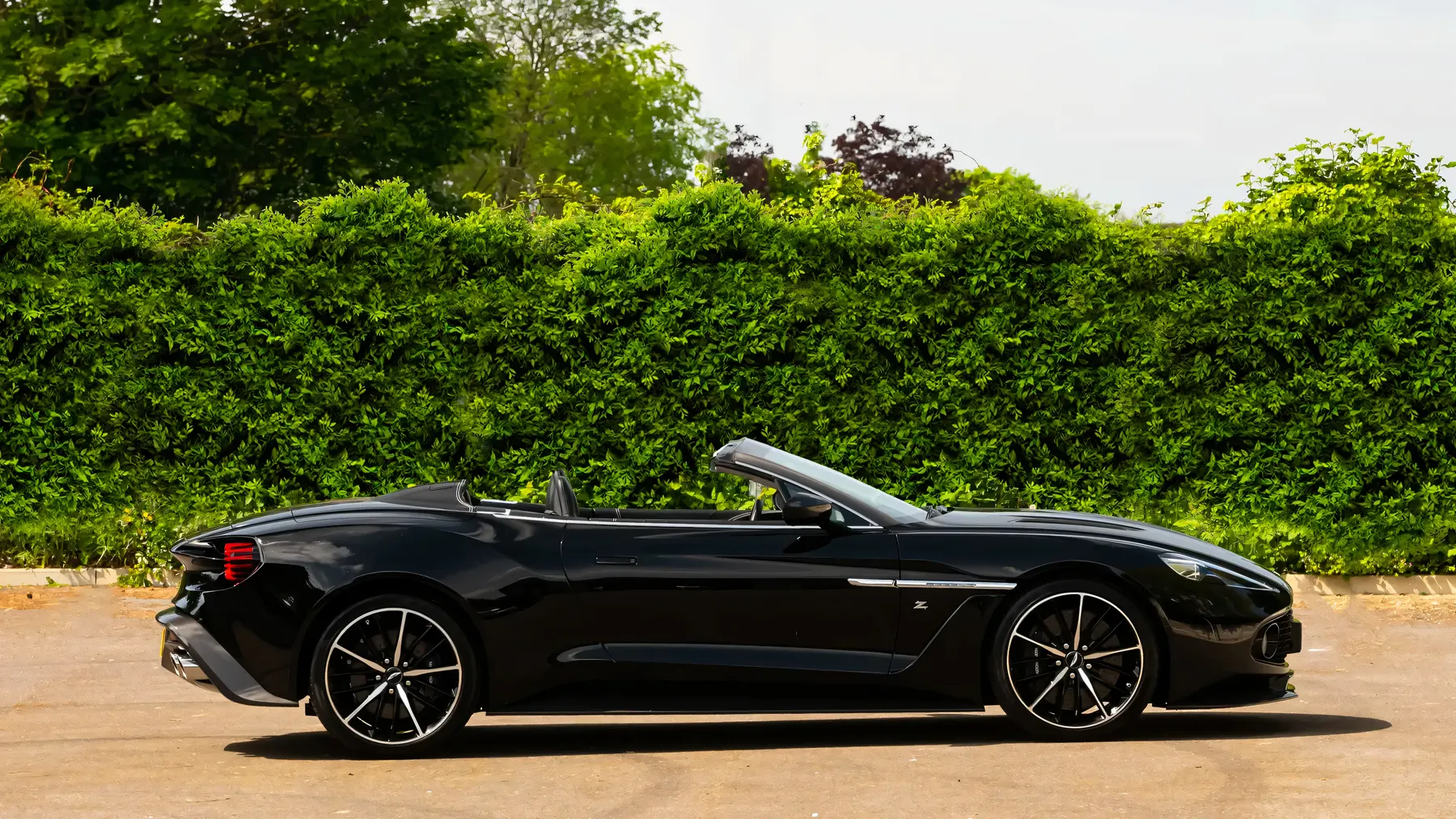
2018 Aston Martin Vanquish Zagato Volante
Nineteen. It’s a number that follows Zagato around like a phantom, encoded into the very DNA of the Italian carrozzeria. Founded in Milan on 19 April 1919 by Ugo Zagato, the house built only 19 examples of its legendary first partnership with Aston Martin — the DB4 GT Zagato, a car so achingly beautiful it still commands eight-figure sums at auction. So when the two companies rekindled their collaboration for the modern era, the symbolism of choosing 99 as the production limit for the Vanquish Zagato Volante felt less like marketing and more like numerology.
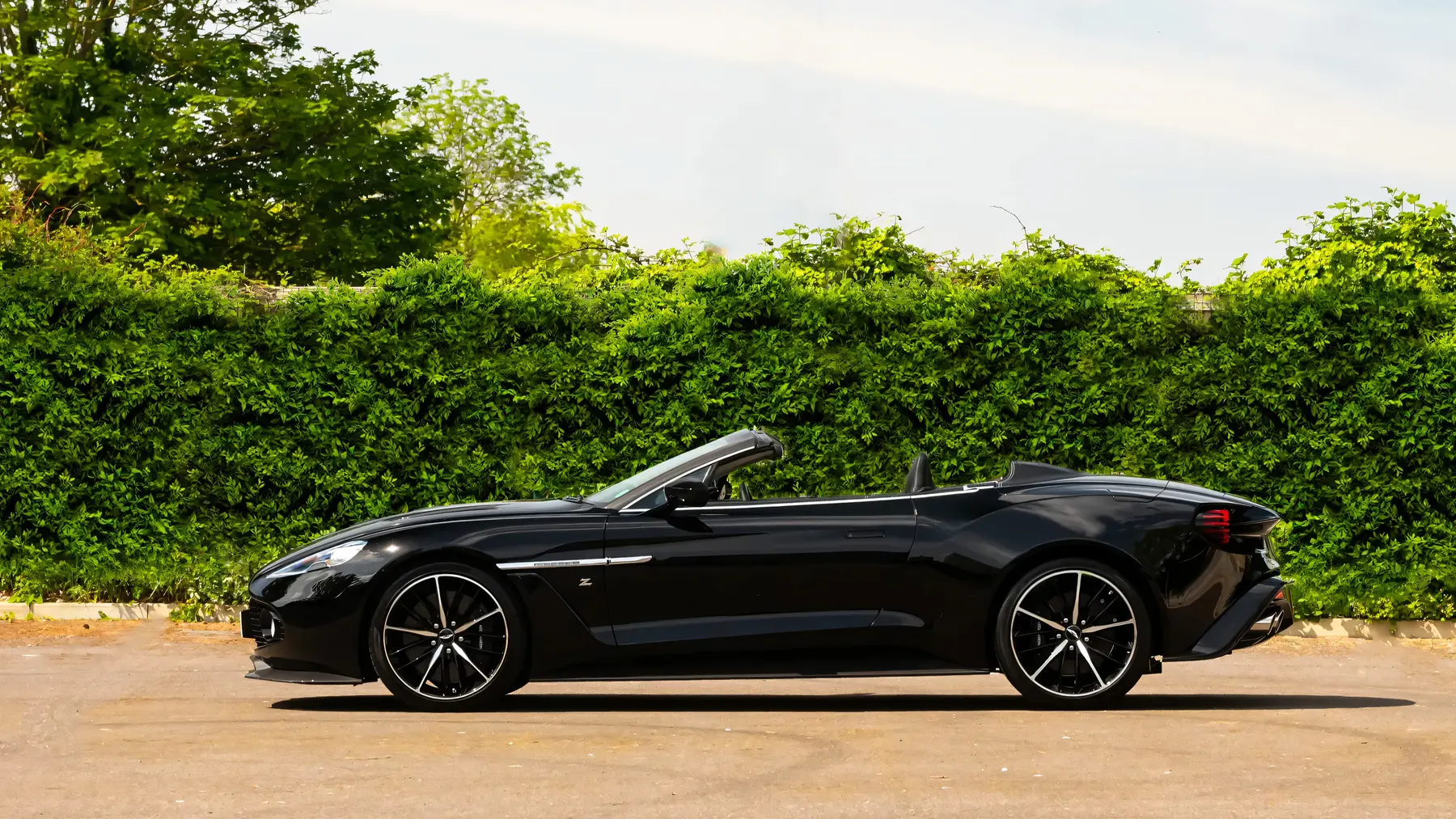
The Volante arrived at Pebble Beach in August 2016, three months after the coupe concept had seduced the crowd at Villa d’Este, both debuts unmistakably deliberate. The shores of Lake Como and the 18th fairway at Pebble Beach represent two of the most rarefied stages in the automotive calendar, and Aston Martin understood exactly what it was presenting: not merely a variant of an existing car, but a statement of coachbuilding ambition in an age when most supercar manufacturers had long abandoned the practice. The open-top counterpart to the Coupe, the Volante was one of four body styles in the Vanquish Zagato family — alongside the Coupe, Shooting Brake, and the strictly limited 28-unit Speedster — but it carries its own distinct personality, its twin-cowled rear deck giving the car a silhouette the closed variants simply cannot replicate.
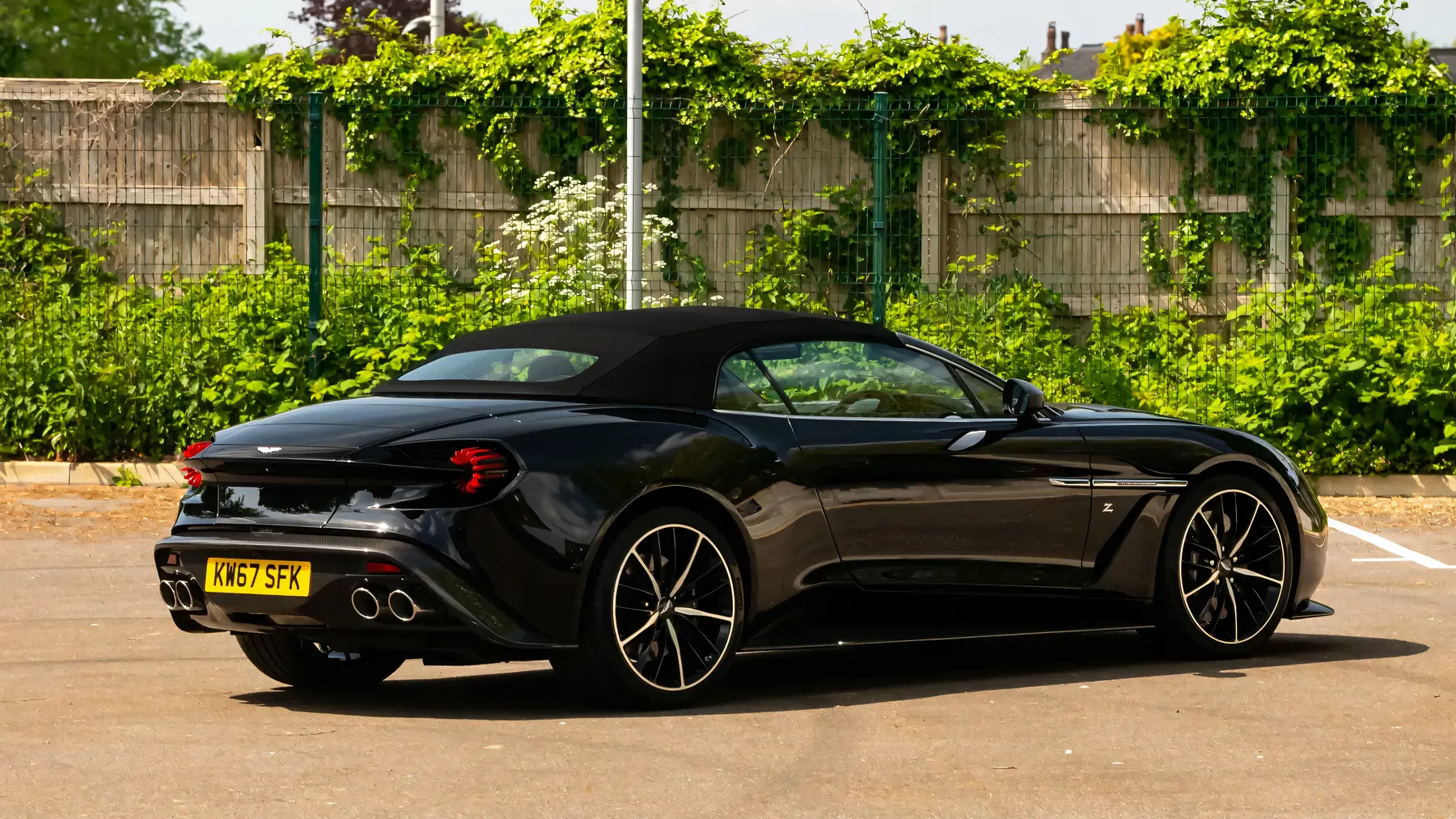
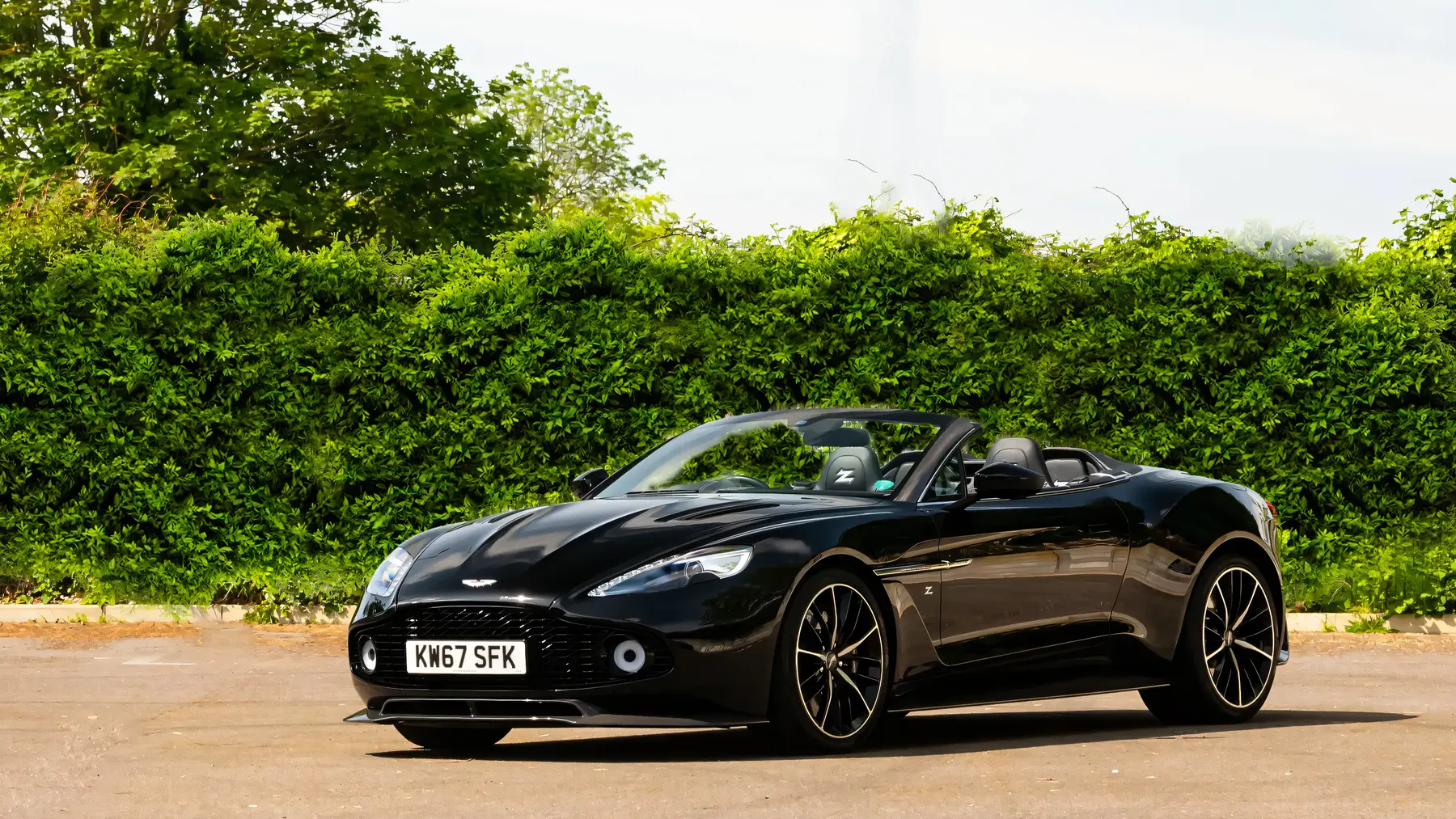
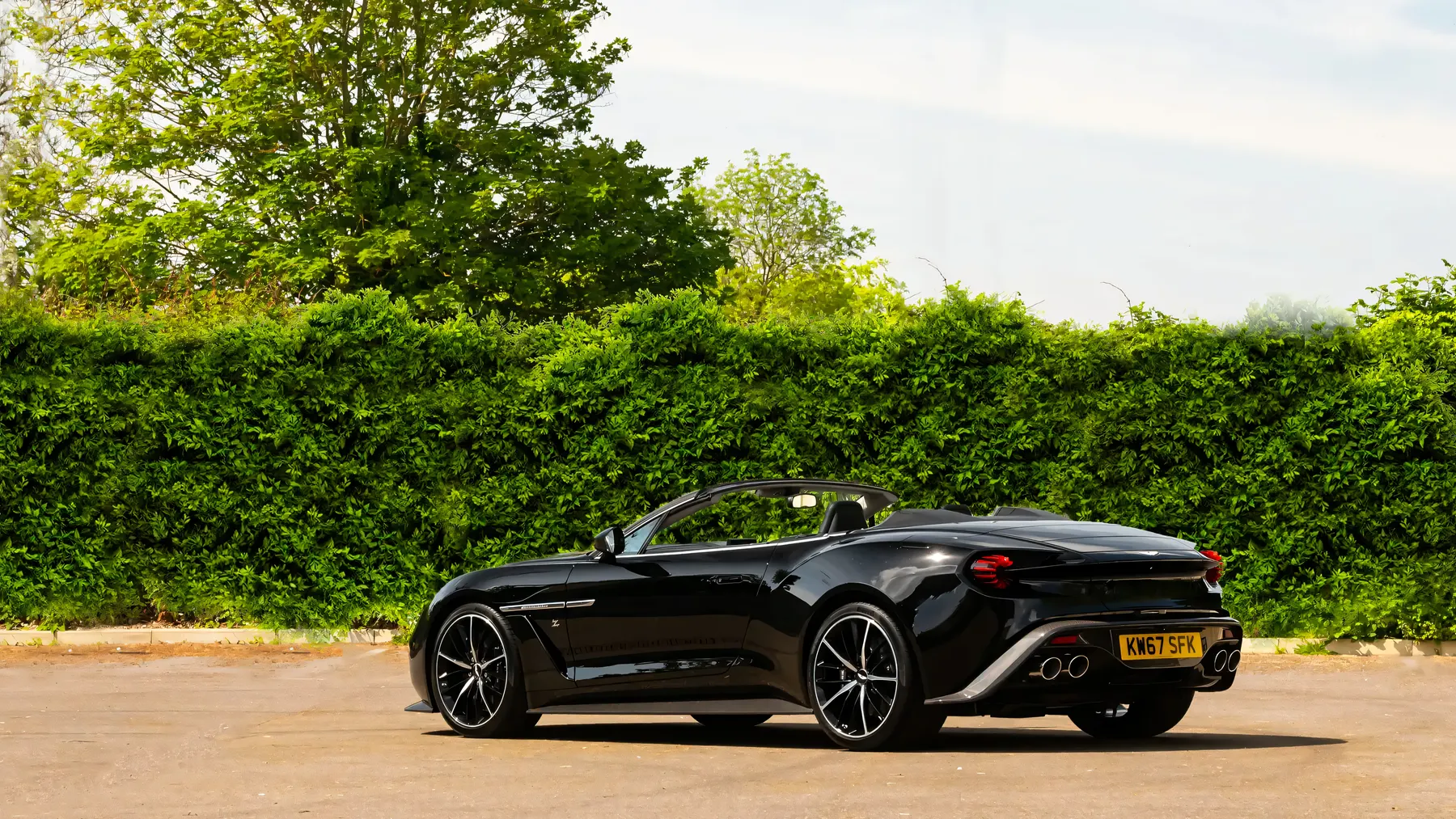
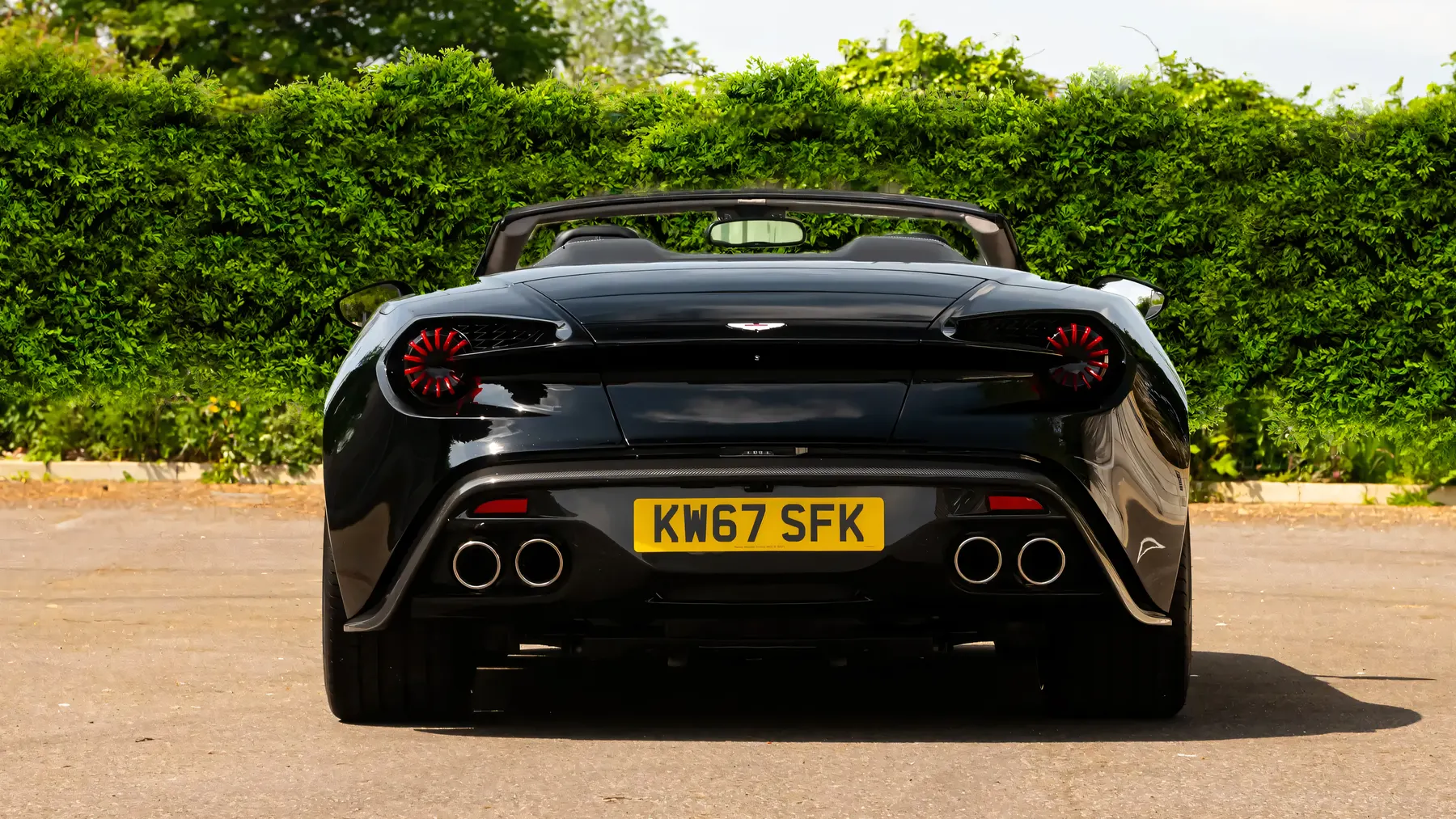
Production was capped at 99 units, with deliveries beginning in 2017, and the price of entry was appropriately stratospheric, reflecting both the Vanquish S mechanical package beneath and the bespoke bodywork layered over it. That bodywork is where Zagato’s contribution is most tangible and most compelling. The front grille is larger and more aggressive than the standard Vanquish’s, incorporating integrated fog lamps into a face that manages to look both ancient and futuristic at once. The rear LED lights take their design language directly from the track-only Aston Martin Vulcan, adopting a blade-like treatment that was genuinely new for a road car. Three-dimensional “Z” motifs appear on the grille mesh and rear vent covers — a signature you will either find tastefully restrained or slightly self-congratulatory, depending on your tolerance for monograms.
Underneath all of that Italian coachwork sits the architecture of the Vanquish S — specifically Aston Martin’s long-serving VH platform, the same modular backbone the DB9 introduced at the 2003 Frankfurt Motor Show. It is a structure whose bonded aluminium construction is 30 percent stiffer and lighter than the DBS it replaced, further reinforced by a carbon fibre subframe that delivered 25 percent greater torsional rigidity than the predecessor, and bolstered at the Zagato’s open extremities by carbon fibre bodywork chosen precisely to manage the structural demands of a convertible without adding mass. Double-wishbone suspension at all four corners, a three-stage adaptive damping system spanning Normal, Sport, and Track modes, and ventilated carbon-ceramic disc brakes on Pirelli P Zero rubber round out a chassis that, by the mid-2010s, had been thoroughly refined across a decade of development. With the engine front-mid mounted and the gearbox positioned at the rear transaxle, the weight distribution is as close to ideal as the format allows.
The heart of the Vanquish Zagato Volante is Aston Martin’s naturally aspirated 5.9-litre V12, producing 592 brake horsepower and mated to the eight-speed Touchtronic III automatic transmission that was introduced during the 2014 Vanquish updates. Zagato claimed a 0–60 mph sprint of 3.7 seconds. What numbers cannot convey, though, is the particular quality of that engine. Naturally aspirated V12s were already becoming a dying breed in 2017, and Aston’s unit — breathing freely, without the flattening effect of forced induction — builds its power through the rev range with an almost operatic intensity that turbocharged successors struggle to replicate. Evo, reviewing the Zagato coupe, described the steering as “beautifully well-weighted and responsive, so that it seems alive even around the straight-ahead,” with a suspension that communicates “almost as though it has all been rose-jointed” — the kind of tactile honesty that money increasingly struggles to buy.
The driving experience occupies a very particular sweet spot for a grand tourer. The Vanquish S underpinnings are not an apologetic base — they are genuinely capable, and the rear-biased weight distribution resulting from the transaxle layout gives the car a balance that rewards committed driving. In Sport mode, the adaptive dampers stiffen usefully without descending into punishment; in Normal mode, the car is genuinely comfortable, soaking up road imperfections with the composure you want on a cross-country run. The Touchtronic III responds quickly enough to paddle commands that you rarely feel the urge to fight it, and the V12’s broad torque band means it rarely needs to be rushed toward its upper registers. But rev it out anyway — because that is where the engine stops being a mechanism and becomes an event.
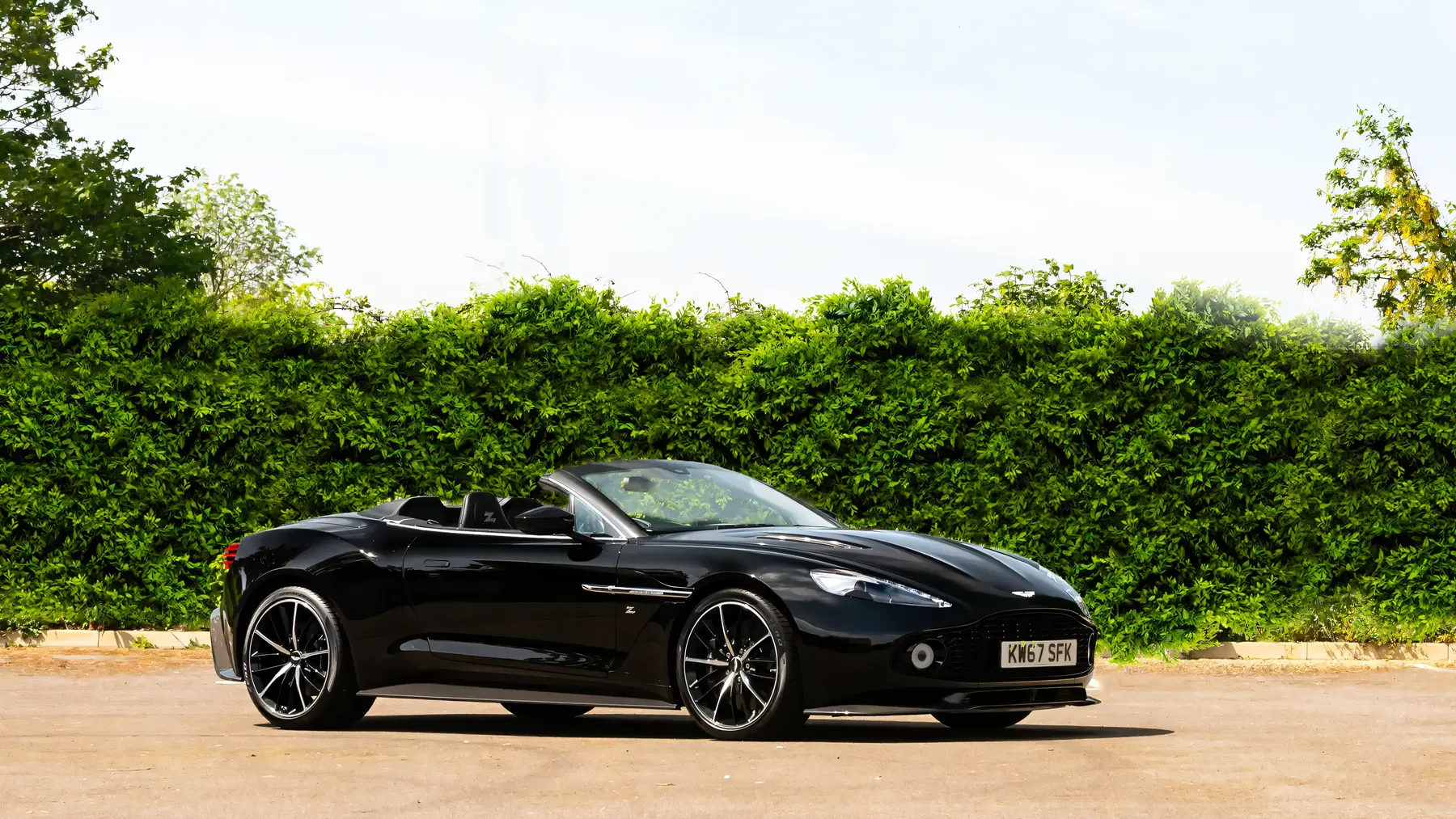
What Zagato brought to this collaboration is worth examining honestly. The carbon fibre bodywork is both a genuine engineering contribution and an aesthetic achievement — Zagato has always understood aerodynamic efficiency as inseparable from visual design, a philosophy dating back to Ercole Spada’s work on the original DB4 GT Zagato, whose curvaceous design reduced weight by 45 kilograms over the standard car while improving its aerodynamic profile. The twin-cowl rear deck on the Volante references that lineage without resorting to pastiche, framing the bespoke folding roof mechanism with genuine sculptural intent. The interior offers differentiation unavailable on standard cars — the “waterfall” facia available in herringbone carbon fibre, a squared-off steering wheel inspired by the One-77 flagship, ventilated front seats with embroidered headrests, carbon-finish paddle shifters — representing coachbuilding in its truest contemporary sense: genuine hand-crafted personalisation, painstakingly executed.
Yet the Vanquish Zagato Volante is not without its compromises. By the time deliveries began in late 2017, the underlying Vanquish S platform was approaching the end of its natural life — the DBS Superleggera replaced the Vanquish entirely in 2018. The cabin technology, while luxurious in appointments, lagged behind rivals in connectivity and driver interface, with infotainment criticised as dated in a manner that plagued Aston Martins of this entire era. The Touchtronic III, while smooth and fast, denied the car a manual option that a vocal segment of the market continues to mourn. And at over £590,000 new — for a car built on a platform that was, at heart, a decade-old development — the value equation required a certain philosophical acceptance of the coachbuilt premium over pure performance per pound. The fuel consumption of around 15 mpg on the US cycle, with CO₂ emissions of 298 grams per kilometre, was equally unapologetic in its indifference to efficiency.
The significance of the Vanquish Zagato Volante sits beyond its specifications or even its scarcity. It represents the most recent expression of an alliance that produced the DB4 GT Zagato in 1960, the DB7 Zagato in 2002, and the V12 Vantage Zagato in 2011 — a lineage arguably the most consistently celebrated of any coachbuilder-manufacturer partnership in modern motoring history. The 2016 revival came when Aston Martin was consciously repositioning itself upmarket, and the Zagato collaboration served as proof of intent: that the Gaydon company remained capable of producing objects of genuine rarity and craft in an industry increasingly dominated by volume-led luxury.
Critical reception acknowledged both the car’s obvious emotional appeal and its underlying tensions. Reviewers consistently praised the V12’s character and the tactile pleasure of the driving experience, while the Zagato’s visual drama earned near-universal admiration, even from those who found the Z-motif detailing a touch heavy-handed. The familiar complaints were present: the aging electronics, the premium demanded over the mechanically near-identical Vanquish S, and the inevitable question of whether bespoke bodywork alone could justify the price differential. The market answered that question decisively — all 99 Volantes sold almost immediately upon announcement, which says something both about the appetite for genuine automotive rarity and about the enduring trust that Aston Martin’s loyal clientele places in the Zagato name.
What the Vanquish Zagato Volante leaves behind is a car that understood its purpose with unusual clarity. It was never designed to be the fastest, the most technologically advanced, or the most rationalist choice at its price point. It was designed to be the last of a kind — a naturally aspirated, coachbuilt, open-top grand tourer conceived when such things were already growing scarce — and in that very specific ambition, it succeeded completely. In a world that has since moved decisively toward turbocharged, electrified, and algorithmically optimised performance cars, the Volante’s unhurried confidence in its own V12 heartbeat feels, in retrospect, like something worth preserving.
Related Notes
- 2018 Aston Martin Vanquish Zagato Speedster
- 1989 Aston Martin V8 Vantage Volante ‘X-Pack’
- 1965 Aston Martin DB5 Convertible
- Aston Martin DB Vantage
- Italian Coachbuilding Houses
- Modern Materials Carbon Fiber and Aluminum
- Tadek Marek and the Engine That Built Aston Martin
- Aston Martin Q by AM Personalization Program