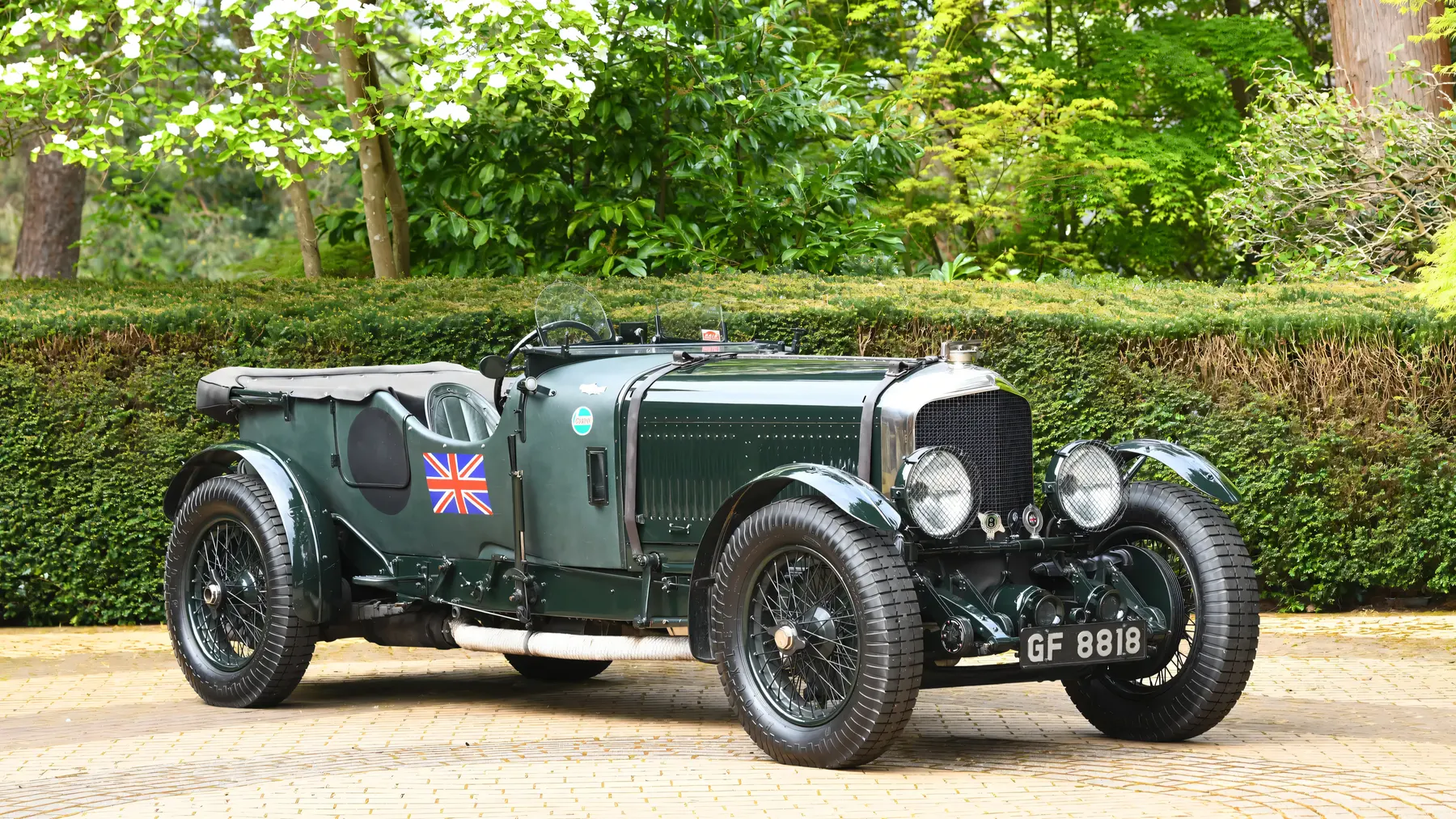
1930 Bentley 6½-Litre Le Mans Tourer in the style of Vanden Plas
W. O. Bentley was trying to keep a secret somewhere near Lyon in the summer of 1924, and failing spectacularly. His development mule - a disguised prototype registered as a “Sun,” fitted with a large, wedge-shaped radiator to throw journalists off the scent - was barrelling along the French routes nationales at speeds that left no doubt something significant was under that unfamiliar hood. The trip had been combined with a visit to that year’s French Grand Prix, and on the return leg to Dieppe, Bentley encountered another car at a three-way junction. The driver, it turned out, was a Rolls-Royce test engineer, equally determined to keep his own machine’s identity obscured. Recognition was mutual. The impromptu race that followed only ended when the Rolls-Royce driver’s hat blew off and he had to stop to retrieve it. Bentley’s tyres were nearly ruined by the time he reached the ferry. More critically, he understood what the encounter meant: his 4¼-litre straight-six had no measurable advantage over whatever Rolls-Royce was developing. That single humbling afternoon of road racing prompted one of the most consequential engineering decisions in British automotive history.
The answer was displacement. W.O. increased the cylinder bore from 80 millimetres to 100 millimetres, and with a stroke of 140 millimetres, the resulting engine displaced 6,597 cubic centimetres - a number that would define the Bentley range for the next six years. The six-cylinder architecture itself had deep roots, derived from the four-cylinder engine that had made the 3-Litre’s reputation, but substantially reimagined. Bentley retained the overhead camshaft and four valves per cylinder from the smaller unit, and committed to something genuinely clever in its construction: the engine block and cylinder head were cast as a single piece in iron, eliminating the need for a head gasket entirely. In an era when head gasket failures could strand a motorist fifty miles from anywhere, that monobloc approach was not merely elegant - it was practically significant. The base engine, fed by a single Smiths 5-jet carburettor with twin ignition magnetos and a compression ratio of 4.4:1, produced 147 horsepower at 3,500 rpm. That was enough to make the standard 6½-Litre the most refined car in the Bentley range - a capable grand tourer that could absorb the heavy limousine coachwork preferred by wealthy Edwardian-minded customers without complaint.
The standard car wore wheelbases ranging from 132 to 152.5 inches, with 150 inches being the most favoured for road use. Its mechanical improvements over the 3-Litre went beyond the engine: the old cone-type clutch gave way to a dry-plate design incorporating a clutch brake to facilitate fast gear changes. The four-wheel brakes - power-assisted, fitted with finned drums and four leading shoes per drum at the front - included a patented compensating device allowing the driver to equalise brake wear on all four corners while the car was in motion, a feature that proved particularly valuable in competition. On the road, the 6½-Litre was immediately recognised as something special: smoother and more tractable than any Bentley before it, yet still possessed of the marque’s characteristic willingness to be driven hard.
It was the Speed Six, though, that translated the 6½-Litre’s potential into something approaching legend. Introduced in 1928 at the behest of Woolf Barnato - racing driver, millionaire, and the man whose money was keeping the entire Bentley enterprise alive - the Speed Six took the same monobloc engine and sharpened everything about it. A high-performance camshaft, a compression ratio raised to 5.3:1, and twin SU carburettors with a single-port block pushed power to 180 horsepower at 3,500 rpm. The racing versions went further still, with compression up to 6.1:1 and outputs touching 200 horsepower. These cars sat on the shortest available wheelbase of 132 inches, stripped of everything superfluous, and wore the body style that has since become so visually synonymous with the era that its silhouette alone can stop conversation at a concours.
That body is the Vanden Plas Le Mans Tourer, and it warrants careful attention. Vanden Plas, the Belgian-descended coachbuilder operating from Kingsbury in North London, had been building bodies on Bentley chassis since the early 1920s, and their open four-seater tourer had become the default uniform for works racing cars. The construction was Weymann-type: an ash frame assembled with special flexible joints designed to absorb vibration without squeaking or transmitting stress to the outer panels. Over this framework went layers of muslin and a synthetic leather outer skin - initially a product called Dupont Zapon Vinyl - giving the car its distinctive fabric-covered appearance and contributing genuinely to sound deadening. The whole assembly was dramatically light, which mattered enormously on a car already carrying a substantial iron engine. Cycle-wing mudguards, a steeply raked windscreen, a long flowing bonnet, and the purposeful stance of a car built with a specific destination in mind gave the Vanden Plas Le Mans Tourer a presence that more conventionally bodied Bentleys of the period simply could not match.
On the road - or rather, on the 13.5-kilometre circuit at La Sarthe - the Speed Six in Le Mans trim was something close to unstoppable. The 1929 24 Hours produced an Bentley 1-2-3-4 finish, with Barnato and Tim Birkin taking outright victory in what would become known as Old Number One, averaging 73.62 miles per hour over the full 24 hours. The following year, Barnato was back at Le Mans, and the Speed Six returned to the top step again - this time with Frank Clement, in what proved to be Bentley’s fourth consecutive Le Mans victory. The works team car had chased down and dispatched a supercharged 7-litre Mercedes-Benz to claim the win, a detail that rather neatly illustrates both the Speed Six’s pace and the adversarial context in which it was racing. By 1930, the Speed Six in Le Mans specification was achieving competitive speeds somewhere around 125 miles per hour, from a pushrod-free, naturally aspirated straight-six of Depression-era vintage.
The Blue Train episode of March 1930 deserves its own paragraph, because it tells you something instructive about the kind of driving these cars inspired. Barnato wagered that he could beat the Calais Express - the celebrated Blue Train - from Cannes to London. The train departed at 17:45; Barnato arrived at his London club before it reached Calais. This was not a carefully planned stunt but the impulsive wager of a man who genuinely believed his Speed Six could do it, which says something about the car’s real-world character as much as its circuit performance. The Vanden Plas Le Mans Tourer was not a car that encouraged timid inputs.
None of which should obscure the genuine compromises involved. The 6½-Litre was heavy - somewhere around 1.5 tonnes in road trim - and the drum brakes, however sophisticated for their era, required real physical effort and genuine anticipation at speed. The four-speed gearbox was a manual demanding respect; the oil consumption of these long-stroke, large-capacity engines was significant by any standard. Reliability was excellent for competition use, but maintenance complexity was real, and access to the properly-trained hands required to keep one in condition has never been trivial. The Weymann fabric body, for all its acoustic virtues, was susceptible to deterioration in ways that steel or aluminium are not, and a great many surviving examples have been re-bodied at some point in their history - a consequence that blurs the line between original and evocation, and which has spawned an entire cottage industry of sympathetic replicas. The 362 standard 6½-Litre chassis and 182 Speed Six chassis produced between 1926 and 1930 have generated far more Vanden Plas Le Mans Tourer configurations than the works team ever commissioned.
The critical reception, both contemporary and subsequent, has been almost uniformly admiring, though not without qualification. The 6½-Litre was immediately acknowledged as the finest Bentley yet offered, more civilised and capable than the 3-Litre it superseded, and the Speed Six’s racing record gave it an authority that marketing could never have manufactured. Historians of the period have consistently placed the Speed Six at the pinnacle of pre-war British motor racing achievement, with its eight wins or second places from eleven races between 1929 and 1930 representing a competitive record that no contemporary British manufacturer could approach. Rolls-Royce’s famous putdown - that their cars were built to the standard of the finest engineering in the world, and Bentleys were merely the fastest lorries - stings rather less convincingly when one considers that a Bentley Speed Six just beat everything on offer in 1929 and 1930 at one of the world’s most demanding races.
The depth of the original car’s reputation can be measured in the present day by what Bentley’s own Mulliner division committed to building a Speed Six continuation series - twelve cars, constructed to 1930 Le Mans specification, requiring over 600 individually fabricated new parts per car including a new engine block casting, each taking eight months to complete and priced at £1.5 million. The continuation engines, dyno-tested, produce 205 horsepower - just five more than the original race specification - because the target was authenticity rather than any modern performance benchmark. That Bentley considered the Speed Six worthy of such an exercise, nearly a century on, is the clearest possible statement of what the 6½-Litre Le Mans Tourer means to the marque’s identity. This was the car that made Bentley’s reputation not merely as a luxury brand but as a force capable of winning races against the world’s best machinery, wearing a lightweight fabric body over an ash frame, driven by men in goggles who genuinely did not know when they set off whether they would finish. The monobloc six is still turning.
Related Notes
- The Bentley Boys
- Le Mans and the Pre-War Racing Era
- Monobloc Engine Construction
- Bentley Mulliner Continuation Series
- Italian Coachbuilding Houses
- Modern Materials Carbon Fiber and Aluminum
- William Towns Bodywork