1995 Ferrari F50
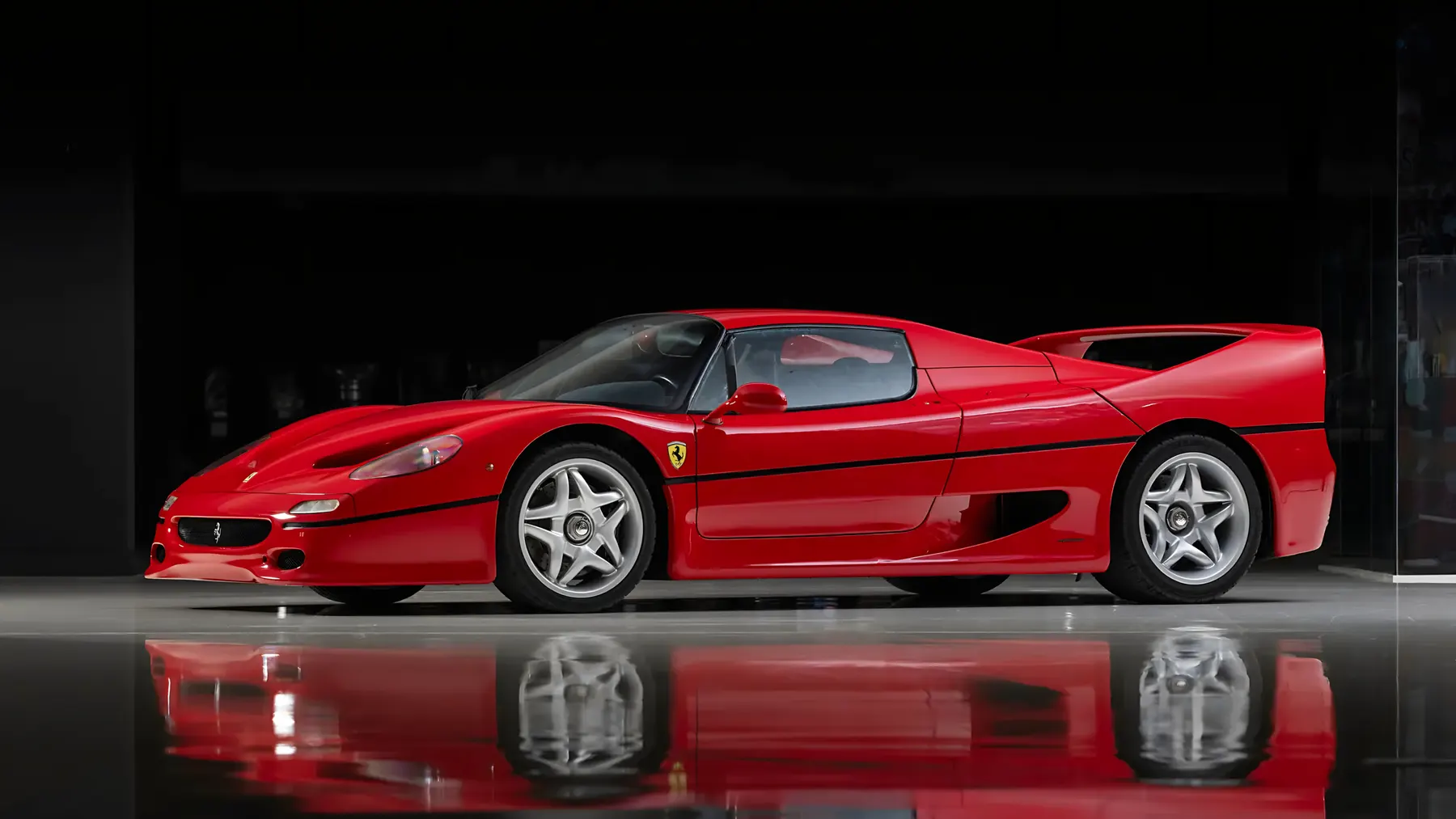
The Ferrari F50 occupies an uncomfortable position in the hierarchy of the Prancing Horse’s most celebrated cars. Sandwiched between the mythologised F40 and the later Enzo, it has spent three decades being evaluated against predecessors and successors rather than on its own considerable terms — an injustice that time and rapidly appreciating values are steadily correcting. Built to celebrate Ferrari’s 50th anniversary, the F50 delivered something its successor could not: the closest approximation to a Formula 1 car that road regulations of its era would permit.
The centrepiece was the engine. Ferrari’s Type 043 unit was a 4.7-litre, naturally aspirated V12 derived directly from the 1990 Ferrari 641 Formula 1 car driven by Alain Prost and Nigel Mansell. Unlike the turbocharged V8 that powered the F40, the F50’s V12 was mounted directly to the carbon-fibre tub as a structural element — the same philosophy used in Formula 1 monocoques, eliminating the need for a separate rear subframe. At 520 brake horsepower and 383 pound-feet of torque, it produced a power-to-weight ratio that few naturally aspirated road cars of the period could approach, and a sound at full throttle that no subsequent Ferrari has quite matched.
The body, designed by Pietro Camardella at Pininfarina, divided opinion in ways that the F40’s uncompromising shape never had. Where the F40 looked purposeful to the point of aggression, the F50 possessed more flowing, organic lines — wider, lower, and more curvaceous than its predecessor. The removable hardtop allowed it to be driven as either a closed coupe or a fully open barchetta, though Ferrari’s intention was clearly the latter. The chassis was a carbon-fibre and Nomex honeycomb monocoque, with pushrod-activated inboard suspension derived from the 641’s geometry, all of it communicating road surface information through the wheel and pedals with a directness that contemporary road cars simply did not offer.
Ferry production was limited to 349 examples, all built in 1995 and 1996. Ferrari offered the car not for sale but on a two-year lease arrangement, requiring buyers to return the car at the end of the lease period. Very few actually did so, and Ferrari did not enforce the terms. Each example cost roughly $500,000 new — a figure that, in today’s market, represents extraordinary value for what is now universally regarded as one of the great naturally aspirated V12 road cars.
The F50 appeared alongside a Lamborghini LM002 in Bashar al-Assad’s presidential collection in Damascus, a pairing that became one of the more remarkable footnotes in automotive provenance history when the palace was opened following the fall of his regime. Whatever context brought those two cars together, the F50’s presence confirmed what its auction results had already suggested: that despite three decades of relative critical neglect, the market had long since recognised what the journalists initially missed.