1946–48 Buick Roadmaster Convertible: Prewar Design, Dynaflow Debut
1948 Buick Roadmaster Convertible




Images: Darin Schnabel / RM Sotheby's
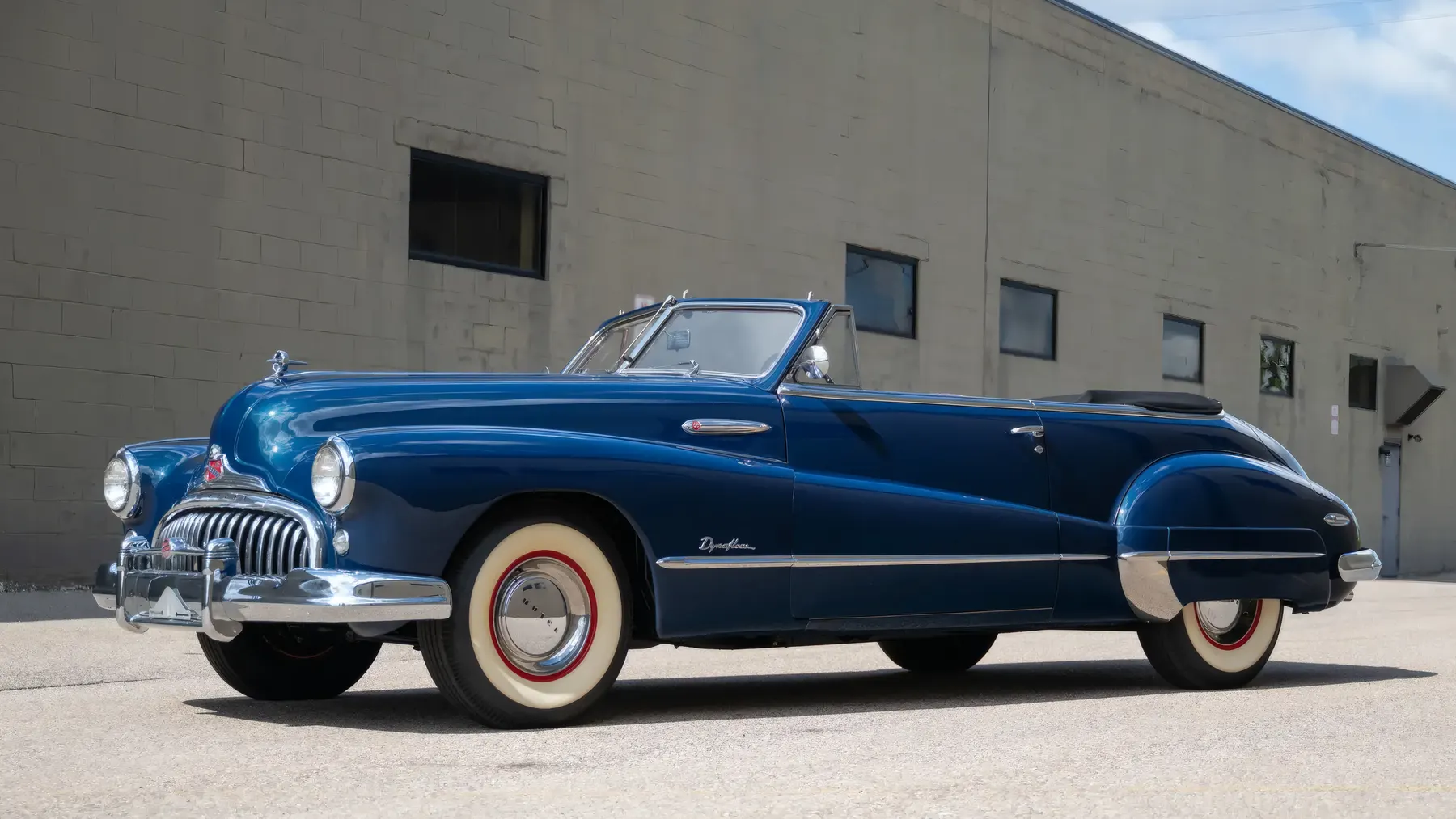
The postwar Buick Roadmaster convertible was drawn before America entered the Second World War, sold afterwards to buyers who would have taken almost anything new, and fitted in its final year with a transmission that deliberately never changed gear. That awkward timeline explains most of the car. What many catalogues count as the fourth-generation Roadmaster is really two chapters with a gap in the middle: the 1942 model year, which stopped when civilian production did, and the 1946–48 cars that put the same basic body back on sale. Numbering differs from one reference to the next, so to be precise, the open car discussed here is the Series 70 Model 76C Convertible Coupe, and it should not be confused with the 1949 Roadmaster that appears in Rain Man, which belongs to the restyled generation that followed.
Within Buick’s range the Roadmaster was the flagship, riding the longest wheelbase the division offered: 129 inches, or 3,277 mm, under a body roughly 5.5 metres long. Its junior stablemates made do with a smaller 248 cu in straight-eight, while the Roadmaster got Buick’s 320. Demand did the rest. The Roadmaster accounted for about four per cent of Buick sales in 1941 and around a fifth of them in 1946, and by 1947 and 1948 it was selling at a rate of roughly 80,000 cars a year, more than four times any prewar season, although tallies for 1948 range from just under 80,000 to about 87,000 depending on who is counting. Body styles comprised a four-door sedan, the fastback Sedanet, the convertible and, from 1947, an Ionia-built Estate wagon that found only around 300 takers. The convertible was the glamour choice and not a cheap one. It listed at $2,650 in 1947, with output put at about 12,000 that year (one compilation says 11,947, another 12,074 including export cars) and about 11,500 in 1948. That put it in the same neighbourhood as the Cadillac Series 62 range, which ran from roughly $2,445 to $2,900 in 1947, and postwar inflation kept pushing the price upward: the Sedanet’s base price rose from $2,130 in 1947 to $2,618 a year later.
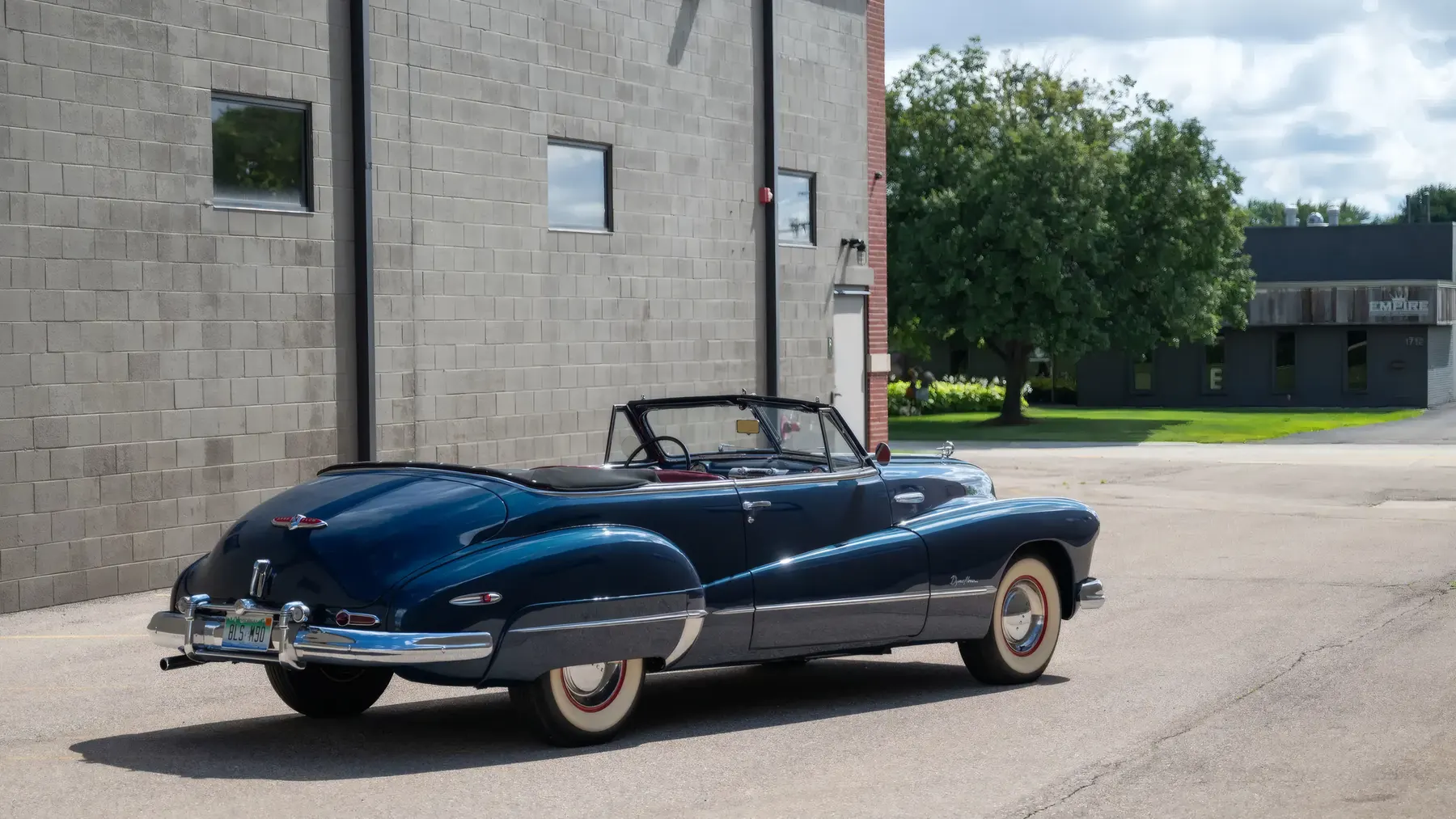
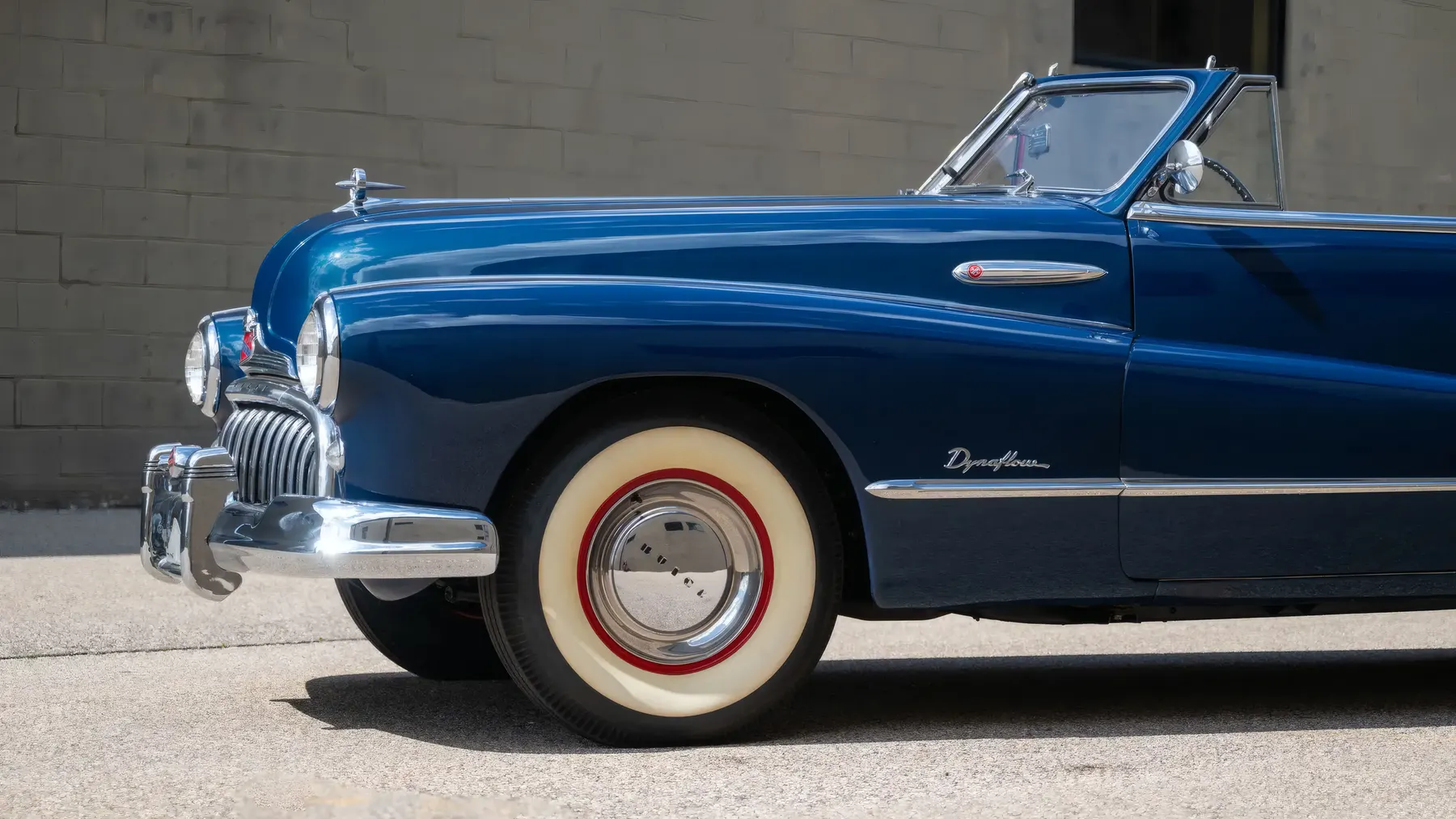
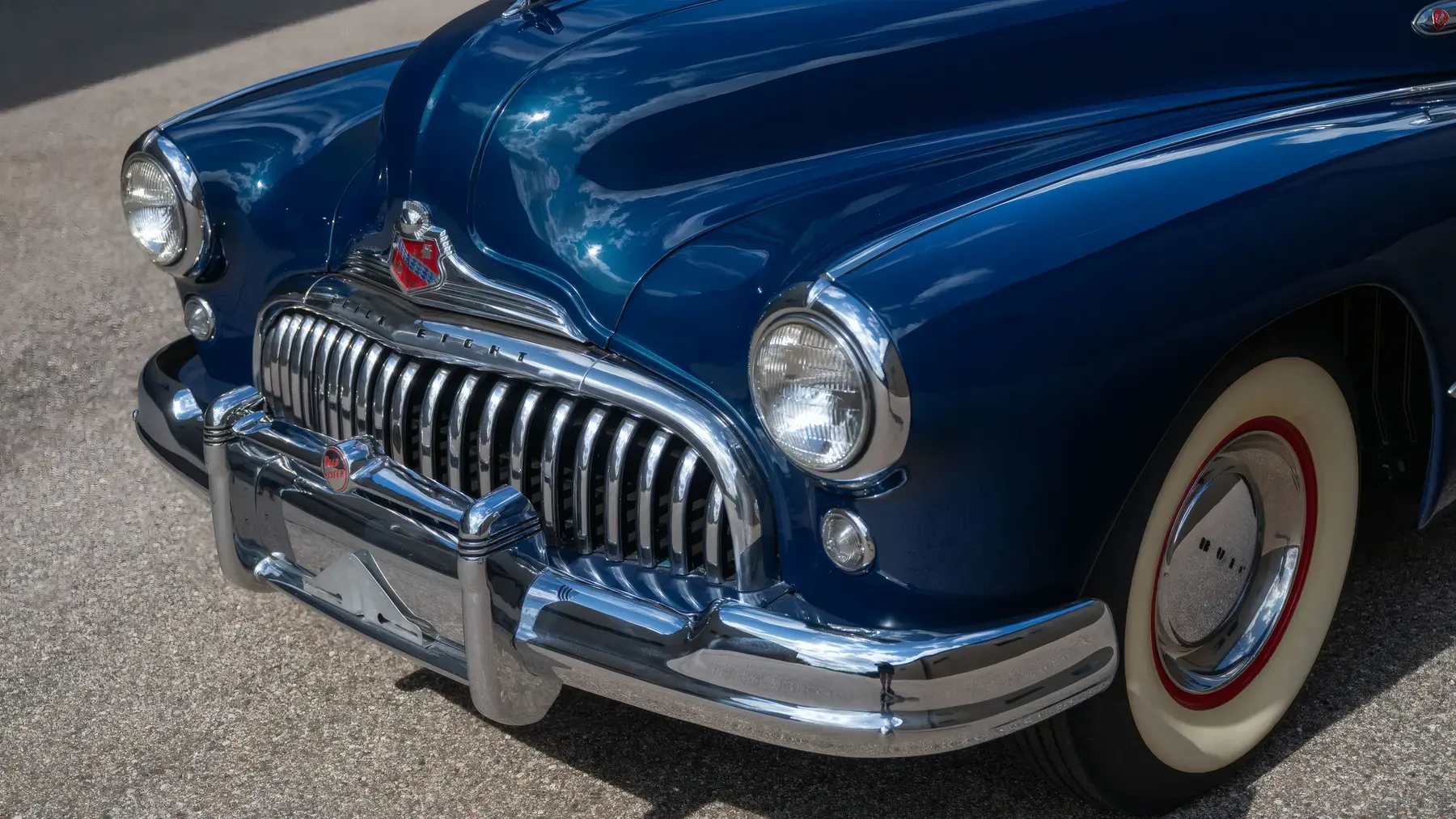
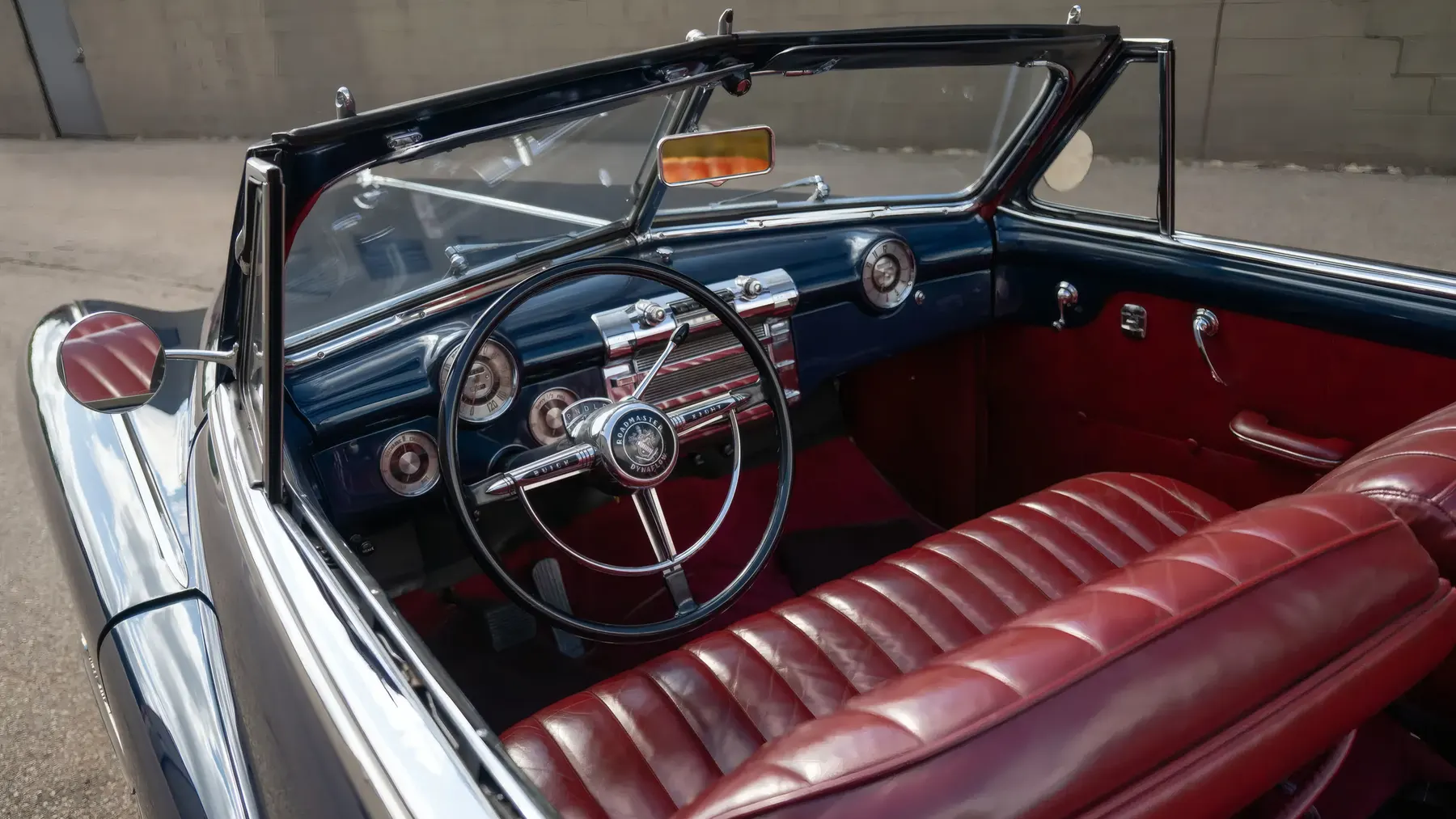
The body was Harley Earl’s, drawn for 1942 as a longer, lower, wider and roomier car with a vertical-bar grille and “Airfoil” fenders that swept back along the flanks, themes that trace back to Buick’s Y-Job show car and later hardened into the Sweepspear side trim. There is a pleasing irony in that lineage, because the Y-Job was also an early showcase for a power-retractable top and electric windows, and by 1948 the production Roadmaster convertible came with power operation of its windows, front seat and top. Postwar changes were sparing. Chrome was applied more thinly in 1946, a war-inspired bombsight hood ornament arrived, a new stamped grille followed in 1947, and the white Tenite steering wheel gave way to a black one in 1948. Convertibles also had body-coloured dashboards in place of the woodgrain facings found in the closed cars, which keeps an open cabin looking cohesive when the top is down.
Under the bonnet sat Buick’s big Fireball straight-eight, badged in period as the Dynaflash Eight: 320.2 cu in (5.2 litres), valve-in-head, with a bore of about 87 mm and a stroke of about 110 mm, five main bearings and a two-barrel carburettor. Postwar it was rated at 144 bhp at 3,600 rpm on 6.6:1 compression, down from the 165 bhp the 1941–42 engine claimed with Compound Carburetion, a pair of two-barrels working in sequence that Buick did not carry over after the war. It used mechanical rather than hydraulic lifters, which only reached the big eight in 1950. The engine’s appeal lay elsewhere, in the smoothness and quiet on which Buick built its reputation, and in a muscular, low-revving torque delivery that suited a heavy, soft-sprung carriage. The standard transmission was a three-speed manual with a column shift, the only gearbox Buick offered in 1947. Everything else about the car was about doing less work, which made a clutch pedal and a column lever feel like the odd ones out.
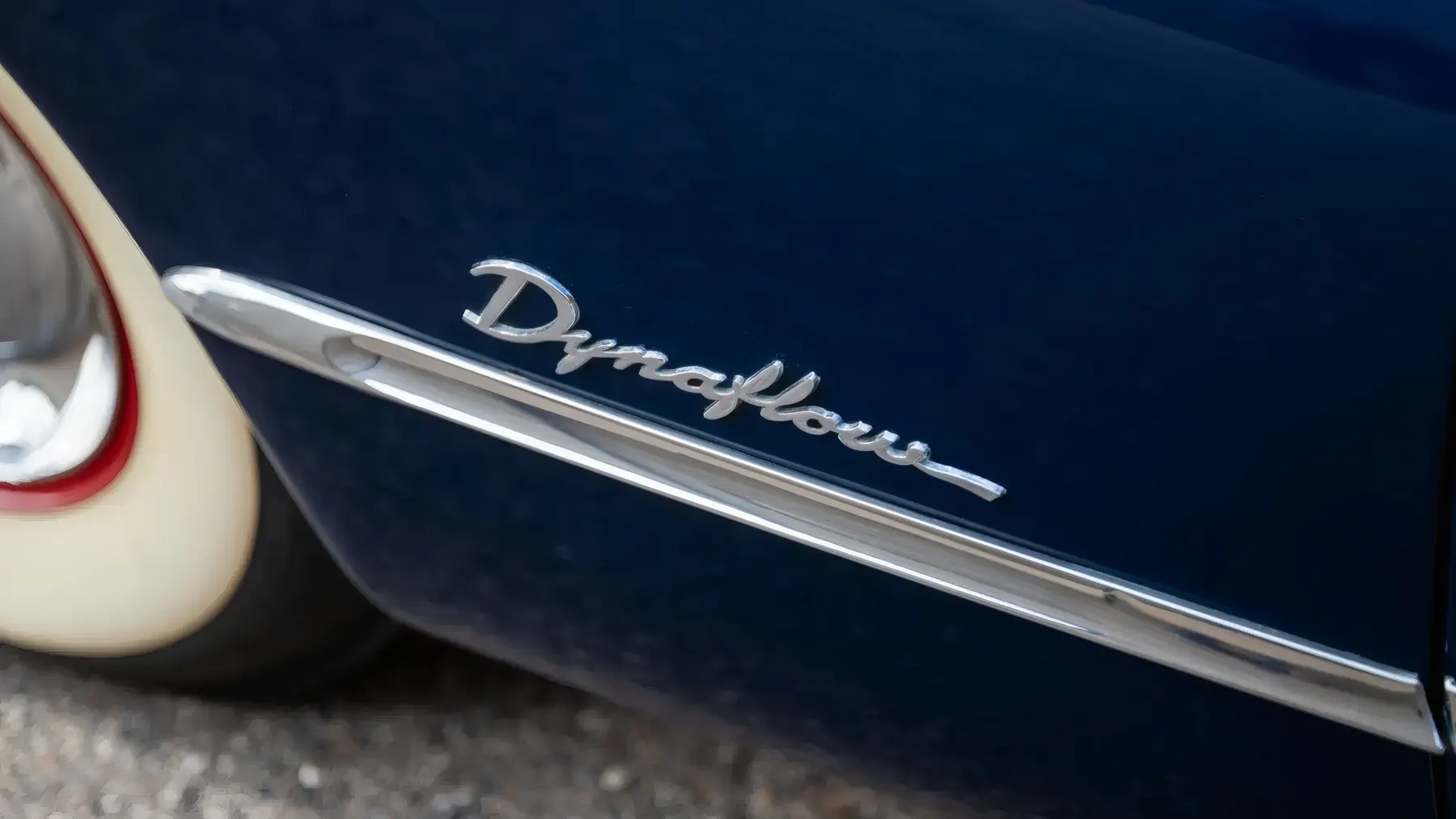
Dynaflow was Buick’s answer, and the Roadmaster was its showcase. Announced in January 1948 and on sale from March, it was an option available only on Roadmasters that year, priced at $206 by one account and $244 by another. Its roots lay in the torque-converter work done for the M18 Hellcat tank destroyer that Buick built during the war, and chief engineer Charles Chayne preferred it to General Motors’ Hydra-Matic, which he is said to have nicknamed Hydra-Jerk. The explanation is the driveline. Buick used a torque tube, a single rigid assembly of enclosed propshaft and rear axle, so every firm gearchange of a Hydra-Matic would have thumped through the whole structure. Dynaflow sidestepped the problem by not shifting. A five-element torque converter did all the work in Drive, with a planetary low gear that the driver could select by hand, and Buick compensated with a higher-compression engine worth 150 bhp rather than 144. Roadmasters so equipped wore Dynaflow badges where “Buick Eight” would otherwise have been, and relatively few were sold in that first partial year. The transmission became standard on the Roadmaster for 1949 and spread so quickly that, by Hagerty’s account, around 85 per cent of Buicks had it within two years.
What does it feel like? Everything between road and driver was tuned for isolation: independent front suspension on coil springs, a live rear axle on coils, a long wheelbase and that torque-tube driveline. Buick’s advertising promised “the ride that’s wrapped in velvet”, and Hagerty’s description of these cars is blunter, calling them spacious and comfortable with a rather soft ride. With the power top lowered and the straight-eight murmuring ahead of you, the Roadmaster convertible is a car that makes its case at an unhurried gait. It rewards a long, steady cruise and punishes anyone who expects it to change direction with enthusiasm. In a Dynaflow car the unhurried part is literal, because acceleration is seamless but stately, with none of the interruptions that other automatics of the day delivered.
None of this adds up to a well-rounded car by modern standards, and several of its limitations mattered at the time. The Dynaflow’s seamlessness was paid for in sloth. It moved off in direct drive using only the converter’s torque multiplication, so the car felt lazy at the pedal unless the driver selected Low by hand, and doing that habitually worsened already heavy fuel consumption and wore a band and clutch that Buick intended only for occasional use. The nickname Dyna-slush was not kind, but it was not undeserved. Ownership adds its own tax. Hagerty calls the transmission the car’s Achilles heel, prone to leaking from its rear seal, and because the torque-tube rear axle has to be unbolted to get at it, the repair is labour-intensive. The engine was heavy, too: when Buick’s compact 322 cu in V8 replaced the straight-eight in 1953, it was 340 mm shorter, 100 mm lower and 82 kg lighter, a measure of how much iron the Roadmaster carried ahead of its front axle. Hagerty’s shipping weights for closed Roadmasters run from about 1,850 kg for the Sedanet to just over 2,000 kg for the Estate wagon. Power steering did not arrive until 1952 and power brakes were not standard until 1953, so these cars steered and stopped largely on muscle and four-wheel drums. Against that background the sofa-soft suspension looks less like pure luxury and more like compensation. Then there is age. Buick’s 1949 Roadmaster was the first all-new postwar Buick, and it made a body drawn in 1941 look elderly almost overnight, a risk that the seller’s market of 1946–48 had allowed the division to ignore.
The sales ledger is the fairest guide to how the car was received. Buyers kept coming, and Dynaflow, for all its slowness, suited the postwar Buick’s emphasis on plushness over performance, finding favour with traditional Buick owners and remaining a Buick exclusive through 1963. The convertible left a larger mark on the next generation than its modest production suggests. The 1949 Roadmaster Riviera hardtop was conceived by welding a steel roof onto the convertible body, and the VentiPorts that defined Buick styling for the next decade grew out of the flashing amber lights that styling chief Ned Nickles fitted to his own 1948 Roadmaster. The straight-eight itself lingered only a few more years; the V8 arrived for 1953. The nameplate later returned for 1991–96 on a rear-drive sedan and Estate wagon, neither of which was offered as a convertible, so the open Roadmaster properly belongs to this era and to the 1949–58 cars that followed.
Collectors today treat the Convertible Coupe as the body style to chase, with the Sedanet the cheaper way into the same chassis. Parts for the 320 straight-eight remain available through Buick specialists, which helps, and the cars reward owners who accept them on their own terms. The 1946–48 Roadmaster convertible is the clearest record of the moment Buick’s old formula met its new one. It still has the straight-eight, the torque tube and a body shaped in 1941, yet in its last year it also carries the transmission that would define the brand for fifteen years. Within five years the engine would be replaced too, and the Roadmaster would be a different kind of car.
Technical data
Performance Specifications
| Specification | 1946–47 (manual only) | 1948 (Dynaflow optional from March) |
|---|---|---|
| Engine | 320.2 cu in (5.2 L) overhead-valve straight-eight | Same |
| Bore × stroke | approx. 87 × 110 mm | Same |
| Power | 144 bhp at 3,600 rpm | 144 bhp (manual); 150 bhp (Dynaflow) |
| Compression ratio | 6.6:1 | 6.6:1 (manual); higher on Dynaflow cars, figure not established |
| Torque | Not established | Not established |
| Transmission | Three-speed manual, column shift | Three-speed manual standard; Dynaflow optional |
| Wheelbase | 3,277 mm | 3,277 mm |
| Overall length | 5,514 mm | 5,524 mm |
| Suspension | Independent front, coil springs; live rear axle, coil springs; torque-tube drive | Same |
| Brakes | Four-wheel hydraulic drums | Same |
| Reference weight (closed bodies) | Not established for the convertible | Sedanet about 1,845 kg; Estate wagon about 2,020 kg (Hagerty shipping weights) |
| Convertible output | About 11,947–12,074 (1947; sources differ) | About 11,503 (1948; single source) |
| Convertible list price | $2,650 (1947) | Not established |
| Top speed / 0–60 mph / fuel economy | Not established | Not established |
Sources
- Wikipedia – Buick Roadmaster
- Wikipedia – Buick straight-8 engine
- Conceptcarz – 1947 Buick Roadmaster Series 70
- Conceptcarz – 1949 Buick Series 70 Roadmaster
- Hagerty Valuation Tools – 1948 Buick Roadmaster Model 79
- Hagerty Valuation Tools – 1948 Buick Roadmaster Model 76S
- RM Sotheby’s – 1948 Buick Roadmaster Sedanet (model background)
- RM Sotheby’s – 1948 Buick Roadmaster Convertible (model background)
- RM Sotheby’s – 1947 Buick Roadmaster (model background)
- Ate Up With Motor – Dynaflow, Turboglide, Roto Hydra-Matic, and Other Early GM Automatics
- Mac’s Motor City Garage – Inside the Buick Dynaflow
- Mac’s Motor City Garage – Inside the 1931–53 Buick Straight Eight
- The Globe and Mail – 1948 Buick Roadmaster with Dynaflow
- Old Cars Weekly – Inside the Dynaflash
- BangShift – The 320ci Buick Straight Eight
- Buick Heritage Alliance – Buick Straight 8 Engines
- CarAdvice – Design Review: Buick Y-Job (1938)
Join the discussion
Comments
Loading comments…
Leave a comment
Share a detail, memory, or perspective. Every comment is reviewed before publication.