BMW E30 M3 Convertible: The Touring Car Hero That Lost Its Roof
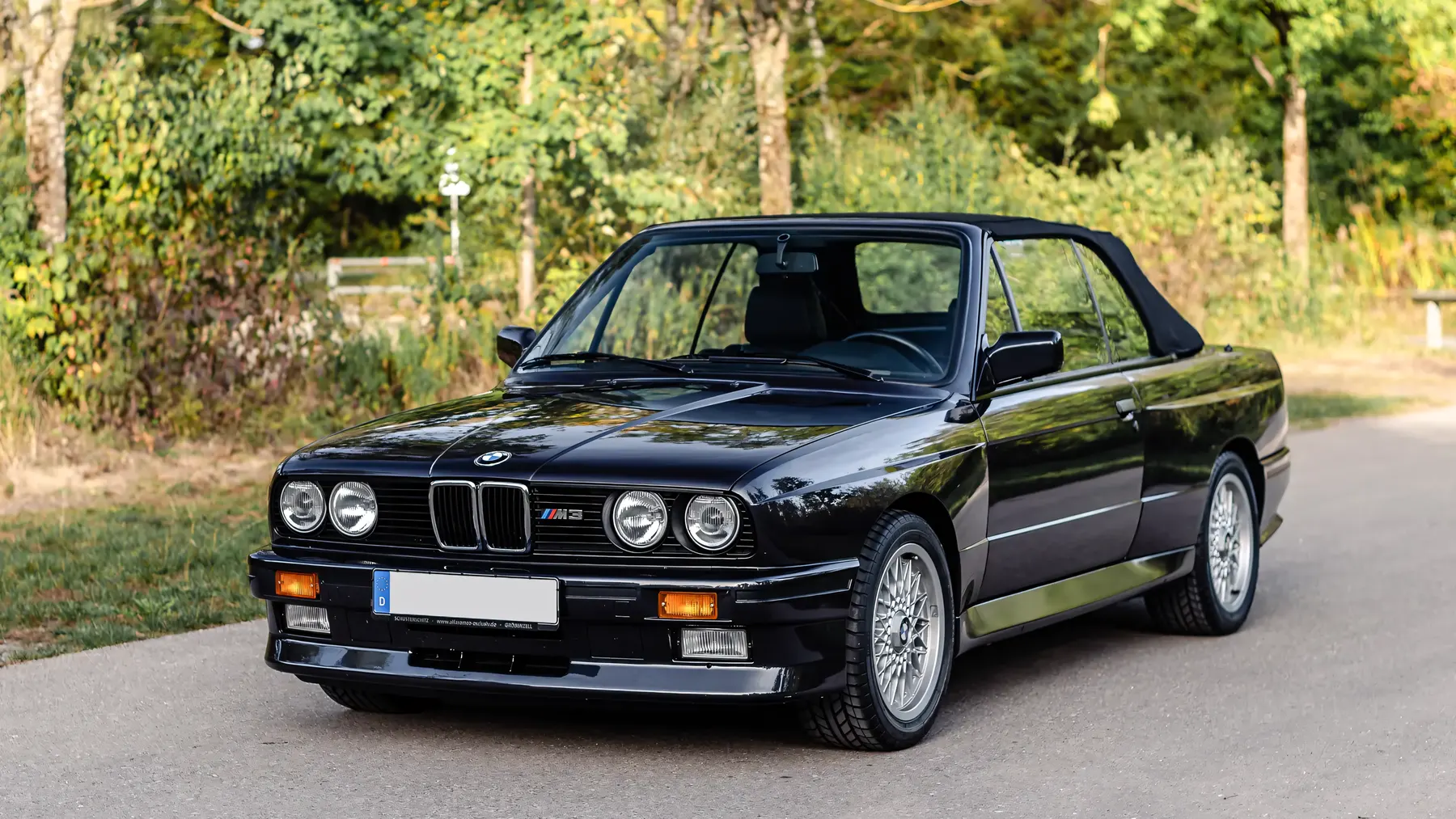
1989 BMW M3 Cabriolet




Images: Maximilian Vogl / RM Sotheby's
Almost everything that separated the E30 M3 coupe from an ordinary 325i was decided from the roofline backwards. The rear window was raked more shallowly, the boot lid was raised, and a spoiler sat on top of it so that air leaving the roof had somewhere purposeful to go, because BMW Motorsport wanted that shape for the Group A touring car the road car existed to legalise. Together with reshaped wings and bumpers, those changes cut the coupe’s drag coefficient from 0.38 to 0.30. Which makes the version that arrived in 1988 faintly absurd. It threw away the roof and, in BMW M’s own description, the large rear spoiler as well. Yet the E30 M3 Convertible, also known as the M3 Cabriolet, was a genuine factory model: the first M car with a folding roof, and by BMW’s account the only DTM homologation special of its era that you could also order with the sky overhead.
The reason any M3 existed was a rule. Group A required 5,000 road-legal cars to be built in the first twelve months before a model could race, and BMW M used the obligation to create a road car with real substance, aimed at rivals that included Mercedes-Benz’s Cosworth-powered 190E 2.3-16. A prototype appeared at the Frankfurt show in September 1985, and production began a year later, not at Garching but at BMW’s Munich-Milbertshofen plant, simply because so many cars had to be built so quickly. Paul Rosche, then technical director of BMW M, picked a four-cylinder engine over a six because it could rev higher and weigh less; the six’s crankshaft suffered vibrations at mid to high revs. The resulting S14 started with the iron block of BMW’s production two-litre four, a design with roots in the 1500 of the 1960s, gained a long-stroke crank and larger bores to reach 2,302cc, and was topped with a shortened version of the four-valve head from the M1 and M635CSi, under Bosch Motronic injection. BMW’s heritage line is that the engine descends from the one that took Nelson Piquet to the 1983 Formula 1 title; the more careful reading, which Classic & Sports Car also offers, is that the block shares ancestry with the four-cylinder that underpinned BMW’s turbocharged F1 engines. Results were immediate. In 1987 an M3 won the inaugural World Touring Car Championship in the hands of Roberto Ravaglia, while Eric van de Poele took the overall DTM title and Winfried Vogt the European Touring Car Championship.
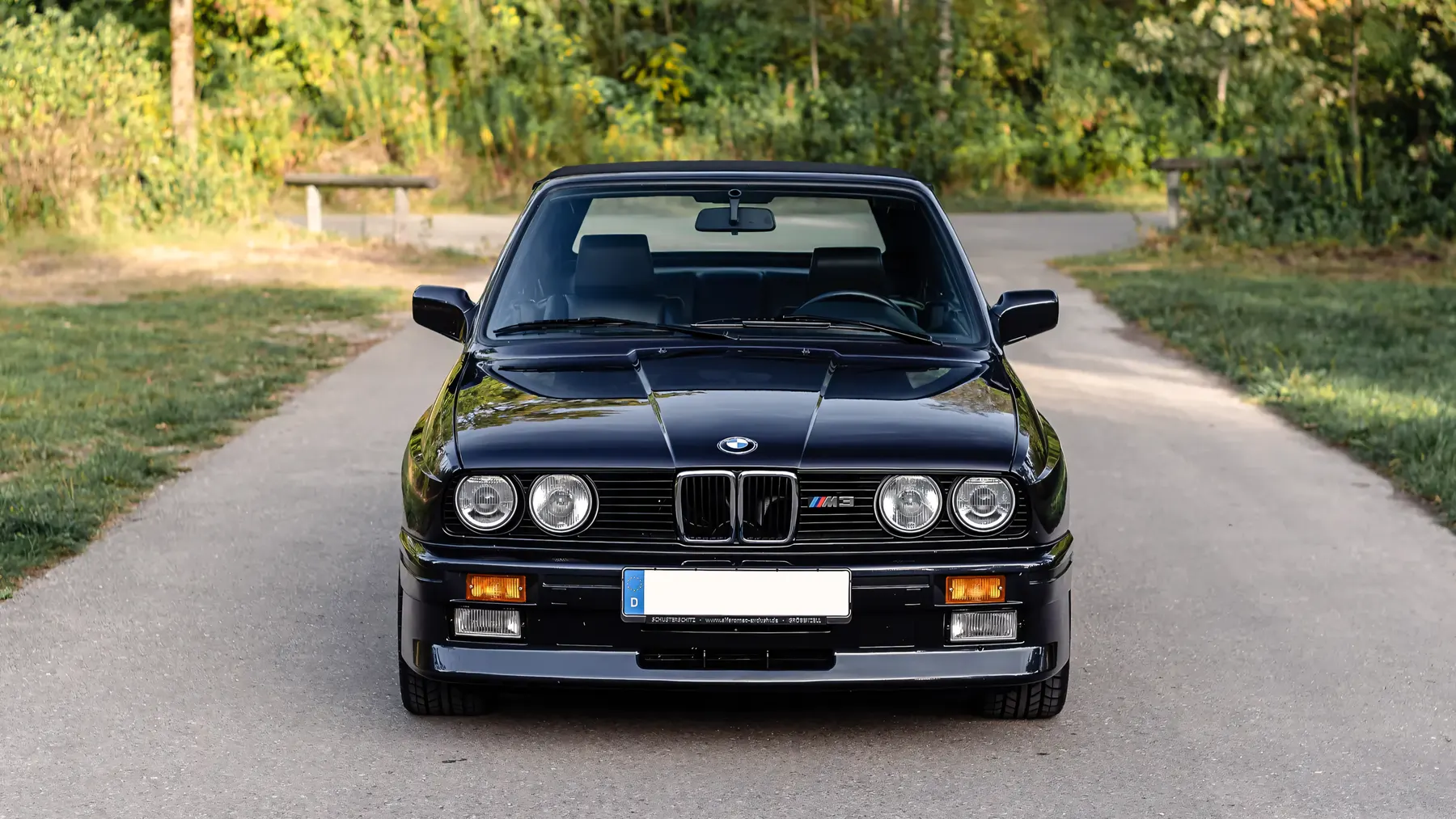
Demand outran the homologation figure by a wide margin. Nearly 18,000 M3s were built before production ended in 1991, including the Evolution models and other special editions, and the Convertible was one more way of feeding a market that kept asking for variations. That demand came despite a price that looked steep on paper: the coupe cost £22,750 in Britain in early 1987, roughly £6,000 more than a 325i Sport and only £2,500 below a Porsche 944S, and CAR noted it seemed questionable value beside Ford’s quicker and cheaper Sierra Cosworth. The Convertible is reportedly priced above even that, though a verified launch figure is hard to pin down.
The Convertible reached customers in 1988 and, according to BMW M, only 786 were made, a figure RM Sotheby’s repeats, which makes it a little over four per cent of the total. One Australian auction house’s catalogue essay adds 137 catalyst-free cars on top of those 786 and describes hand assembly by M, so the breakdown is not perfectly settled, and 786 remains the number BMW itself uses. The shell underneath was BMW’s own factory E30 Convertible rather than a coachbuilder’s conversion. BMW had used Baur for earlier open 3 Series, but its in-house convertible, launched in the mid-1980s, hid its hood completely beneath a panel on the rear deck and kept four proper seats, which is why Classics World compares it favourably with the Mercedes SL for practicality. Making that shell stiff enough for M3 duty meant adding structure, and structure meant mass: BMW M quotes 1,360 kg for the Convertible at launch, against roughly 1,200 kg that CAR gave for the coupe, while another write-up puts the gap nearer 200 kg.
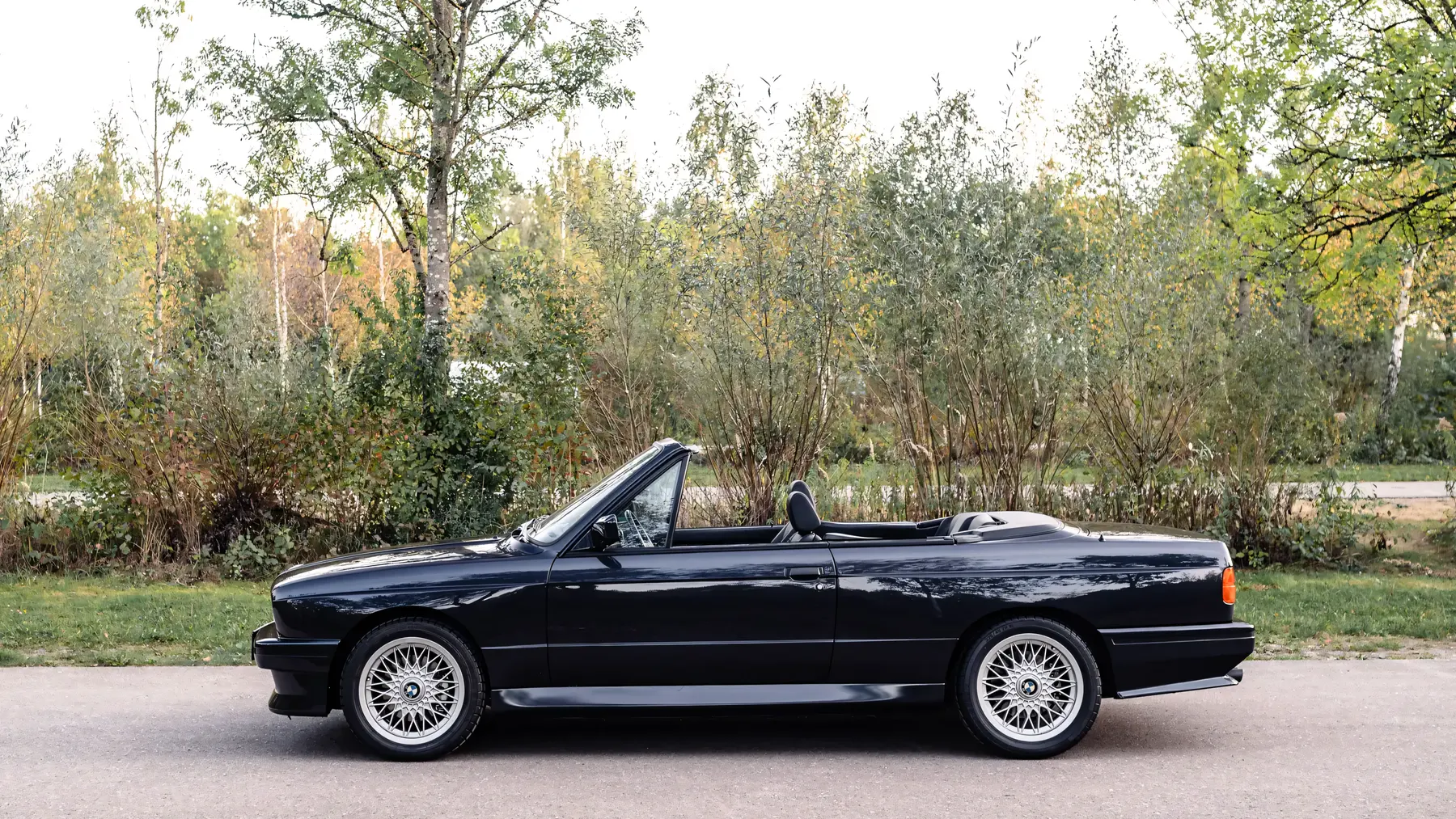
Visually it is the discreet M3. The wide arches remain, and BMW M insists they exist because the wider wheels and track needed the room rather than to look aggressive, but with no big spoiler the Convertible reads more like a well-bred 325i Convertible with unusually muscular wheel arches than a racing car in civilian clothes. Inside, buyers could choose black, silver or natural interiors in fabric or leather, with Walk Nappa leather available for the door panels and centre tunnel, an M Technic leather steering wheel and M Sport seats with adjustable thigh support. The hood was electrically operated, as on the 325i Convertible. And the gear lever kept the layout that makes an M3 feel purposeful before you have moved an inch: first gear sits low and to the left on a dogleg, which BMW M points out shortens the throws between second and fifth.
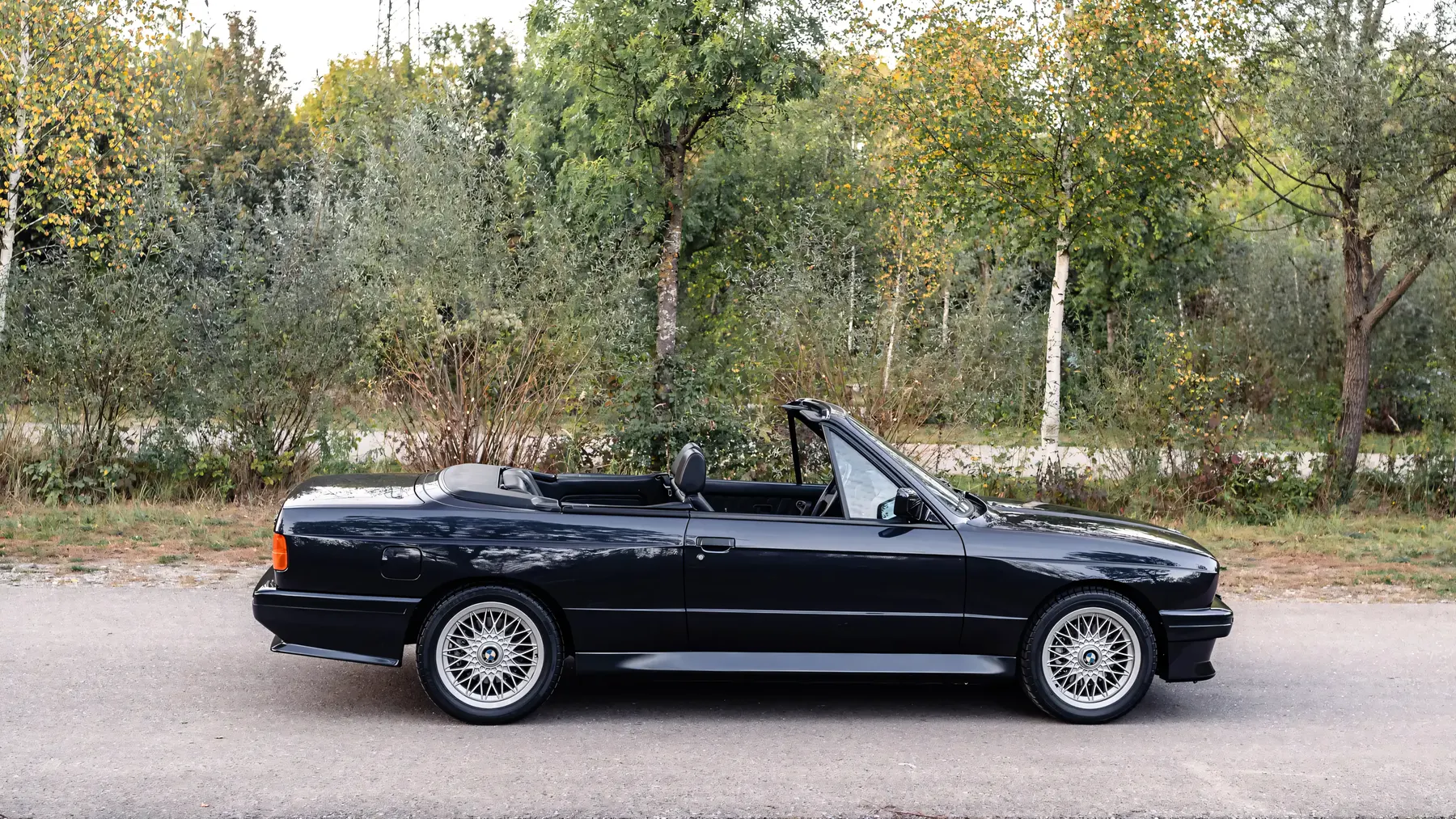
At launch BMW M quoted around 192 bhp, a top speed of about 142 mph and 0-62 mph in 7.5 seconds. From the summer of 1989 power rose by roughly 20 bhp to about 212 bhp, with top speed climbing to about 149 mph, which BMW M rightly calls outstanding for a four-seat convertible of the period. Depending on market and catalyst fitment, early power is quoted anywhere from about 192 to 197 bhp, so treat the launch figure as a representative one. The torque figure, around 170 lb-ft, tells you more about the engine’s character than the power does: it arrives high in the rev range, and the rev limit is around 7,300 rpm. CAR described the S14 as surging in two stages, first around 5,000 rpm and then again at 6,000, and a BMW specialist quoted in the same piece reminded readers that what you are buying is a brilliant chassis rather than straight-line speed. evo’s testers found much the same: the car needs to be driven hard before it comes alive.
Most of the famous praise for the E30 M3’s driving was written about the coupe, and it would be dishonest to pretend the open car has an equally deep body of testimony. The mechanical recipe, though, is shared. The M3’s chassis changes included stiffer springs, new Boge dampers, thicker anti-roll bars, more caster for stability and steering response, a limited-slip differential, vented front and solid rear discs of 280 mm and 282 mm with ABS, and five-stud BBS wheels. The Convertible reportedly used the coupe’s brake hardware with spring and damper rates altered for the extra weight, though the detail is thinly documented. What testers found in the coupe was a car about carrying speed rather than raw acceleration: evo’s deputy editor called it one of the most neutral cars he had driven in a long time and described light but precise steering, and CAR found the same steering full of feel, if slightly long-geared. Expect the Convertible to feel similar in kind but softer in focus.
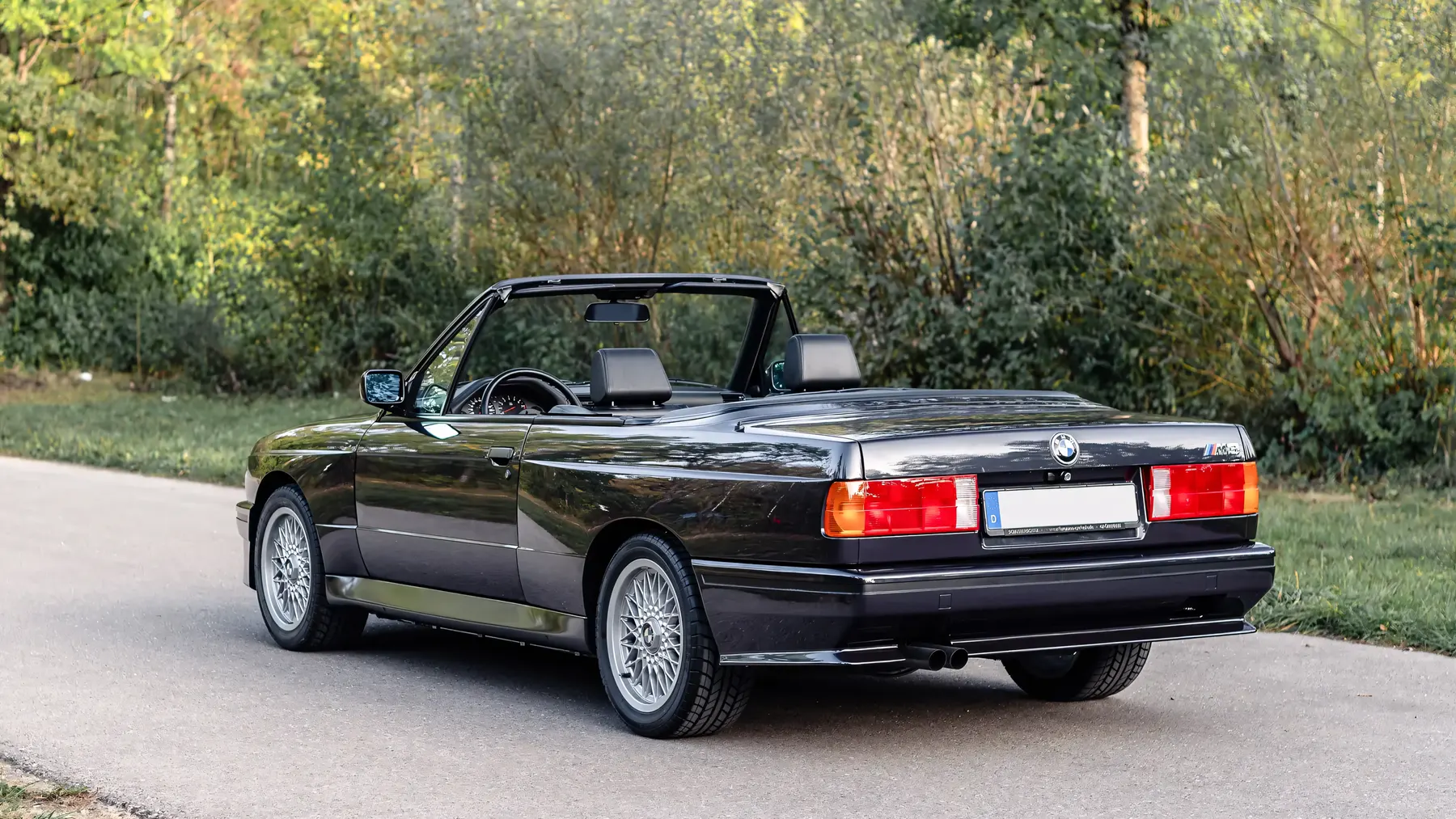
None of this makes the Convertible the best way to buy an E30 M3, and its drawbacks are specific rather than sentimental. The first is mass. Somewhere between 160 and 200 kg of extra weight, depending on whose figures you trust, lands on an engine whose useful torque arrives high up the rev range; testers found even the coupe none too quick, and the Convertible’s own 7.5-second sprint to 62 mph does little to change that picture. The second is structural. Classic & Sports Car’s guide records that BMW’s extra stiffening made the ordinary E30 Convertible heavier and that some scuttle shake was inevitable with the firmer set-up usually fitted, and its testers also complained of wind noise with the hood raised. Classics World judges BMW’s shell impressively solid for a drop-top but concedes it is not as rigid as the tin-top. It is reasonable to expect the M3’s firmer springs and dampers to expose that flex more readily than a 325i’s, although documented back-to-back comparisons are scarce. The third is philosophical: the M3 was shaped by aerodynamics and homologation, and the open car could not carry the raked rear window the coupe’s story depended on, and it dropped the big rear spoiler. It was the one M3 nobody was ever going to race. Nor was it a commercial hit; it is reported to have been sold only in Europe and was never a strong seller, which is part of why so few exist.
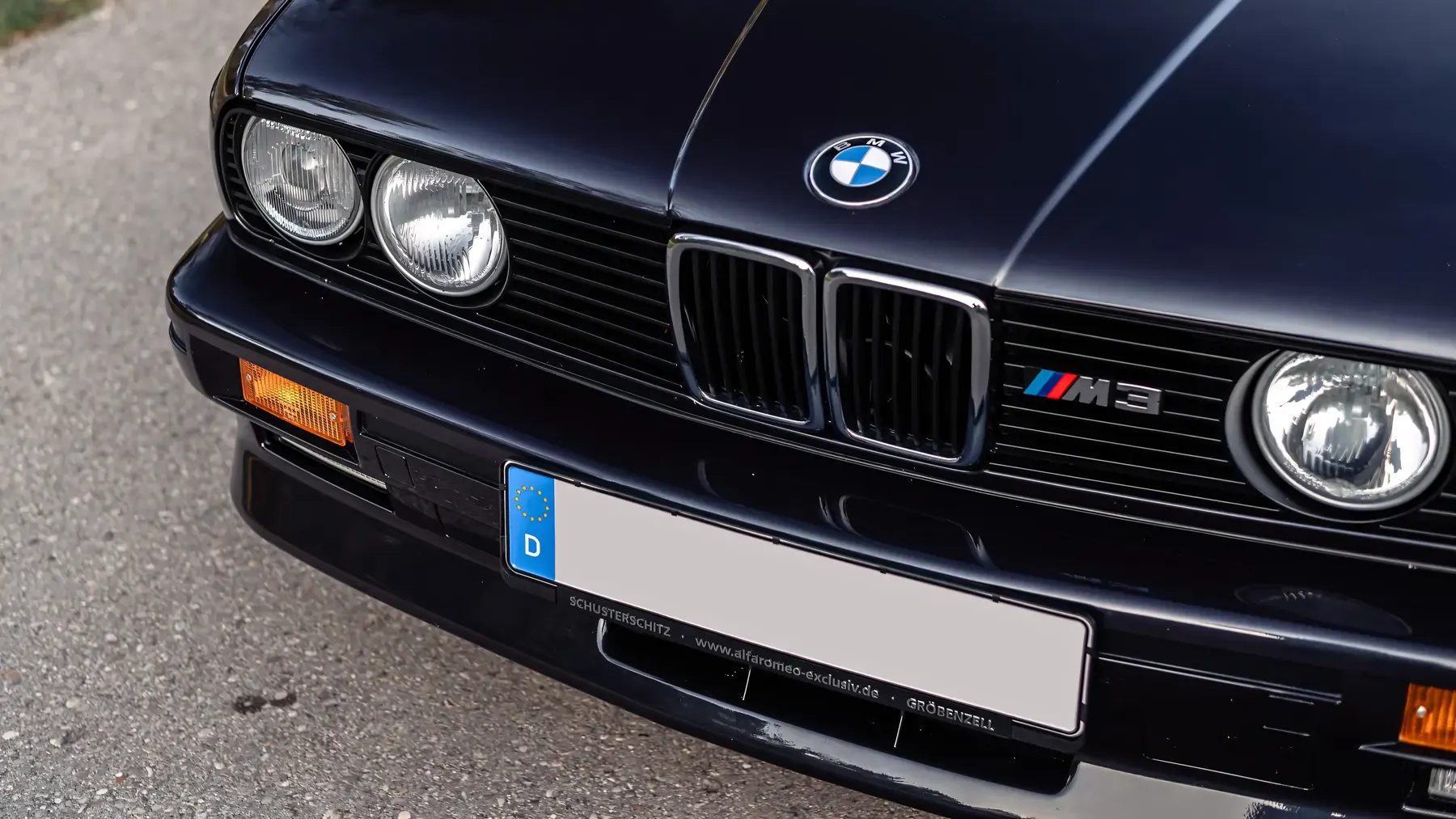
Owning one raises a second set of problems. Specialists quoted by Classic Motorsports say the S14 is very expensive to rebuild and that parts made only for it are pricey, and they warn of porous cylinder head castings that can leak into the exhaust ports, exhaust manifold studs that loosen and snap if neglected, and labour-intensive valve adjustments. That advice concerns the engine in coupes, but the engine is the same. The open body adds its own worries. Classic & Sports Car advises checking the carpets for damp, especially in convertibles, and notes that BMW offers a kit to convert electric or hydraulic hoods to manual; Classics World says the E30’s power hood was never the most reliable system and that the plastic rear window tends to cloud. Underneath, it is still an E30, and rust remains a real threat, in the boot, rear quarters and cowl.
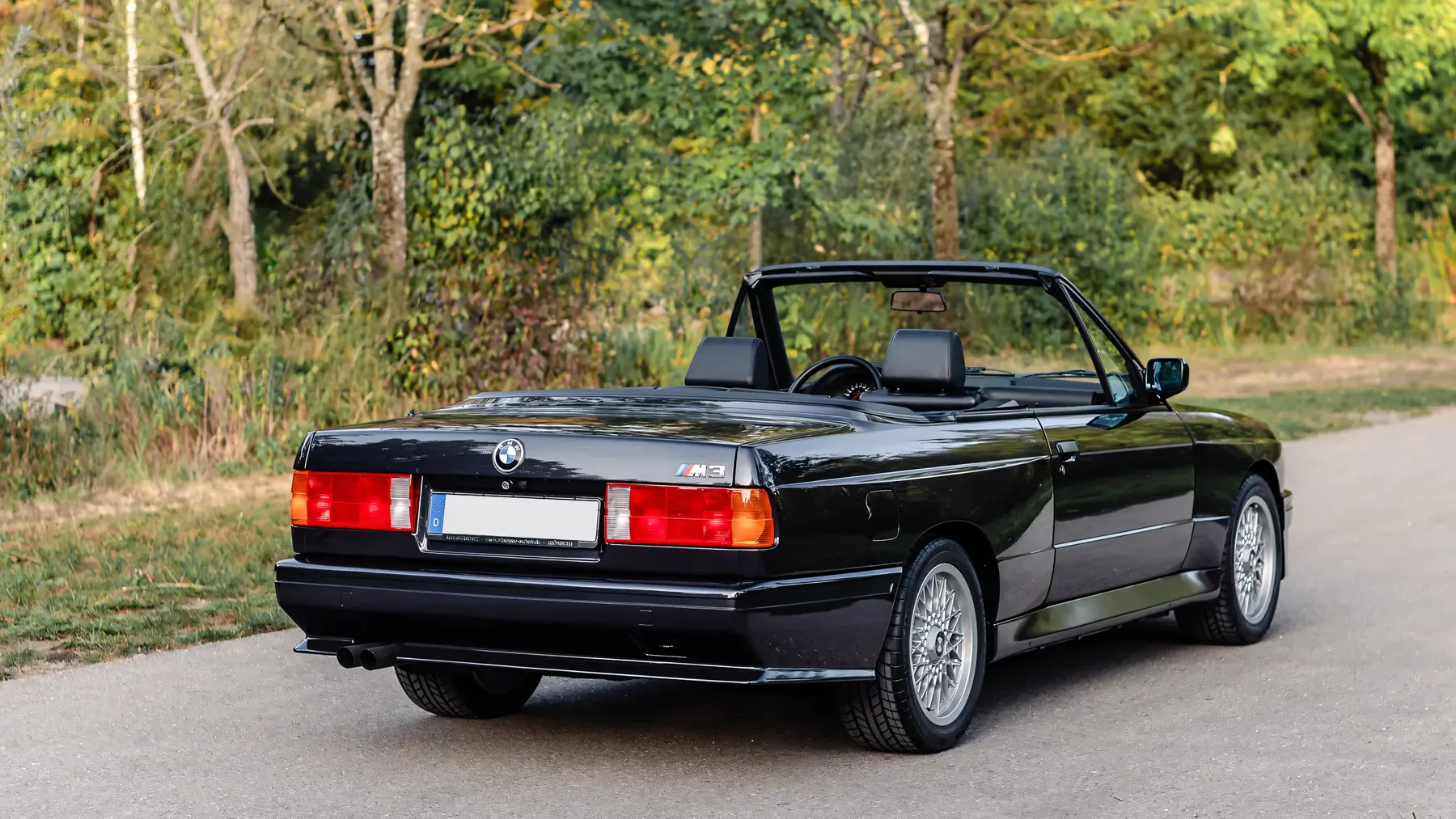
Prices have taken the E30 M3 away from nearly everyone. evo puts ordinary coupes at over £50,000 and the best Sport Evolutions at around £150,000, and Classic & Sports Car’s guide observed that regular E30 convertibles already cost roughly twice as much as saloons before an M badge enters the discussion. One write-up claims M3 Convertibles often fetch about double a coupe; given the small numbers involved, that deserves scepticism as a rule of thumb, though the car’s rarity is undeniable. What the Convertible genuinely earned is a place in the family tree. BMW M describes it as the first M convertible and the first series-production M car with a fabric roof, and later M3 generations, the E36 among them, went on to offer open versions as a matter of course.
That is the right way to place it. As a way to understand why the E30 M3 became a legend, the Convertible is the wrong car; the coupe, and especially the Evolution cars, answer that question more directly. What the open car offers is a different proposition: the same high-strung four, the same dogleg and the same flared arches, in a body that trades some rigidity and a good deal of single-mindedness for a hood that disappears and rear seats that can actually be used. It shows BMW M, at a time when it had put its initial on only a handful of road cars, already willing to soften a homologation special for customers who wanted the engine and the sky rather than the lap time.
Technical data
Performance Specifications
| Specification | Early cars (from 1988) | Later cars (from mid-1989) |
|---|---|---|
| Engine | 2,302cc DOHC 16-valve inline-four (S14), Bosch Motronic | Same |
| Power | About 192 bhp | About 212 bhp |
| Torque | About 170 lb-ft* | About 170 lb-ft* |
| Kerb weight | 1,360 kg (BMW M, at launch) | Not separately stated |
| Top speed | About 142 mph | About 149 mph |
| 0-62 mph | 7.5 seconds | Not separately quoted |
| Transmission | Getrag five-speed manual, dogleg first gear | Same |
| Brakes | 280 mm vented front, 282 mm solid rear, ABS** | Same |
| Production | 786 in total (BMW M); split between early and later cars not verified |
Sources
- BMW M Magazine: The BMW M3 E30 Convertible
- RM Sotheby’s: 1989 BMW M3 Cabriolet (model background only)
- evo: BMW M3 (E30, 1986-1990) review
- CAR magazine: BMW M3 E30, E36 and E46 driven
- Classic Motorsports: BMW E30 M3 buyer’s guide
- Classic & Sports Car: Buyer’s guide, BMW E30 3 Series
- Classics World: BMW E30 Convertible buyer’s guide
- autoevolution: The BMW M3 E30 Convertible Was the Embodiment of 1980s Open Top Madness
- Shannons: E30 M3 Convertible catalogue essay (model background only)
Join the discussion
Comments
Loading comments…
Leave a comment
Share a detail, memory, or perspective. Every comment is reviewed before publication.