Porsche 964 Carrera RSR 3.8: The Most Developed Air-Cooled Racing 911
1993 Porsche 911 Carrera RSR 3.8
Images: Matthew Jones / RM Sotheby's
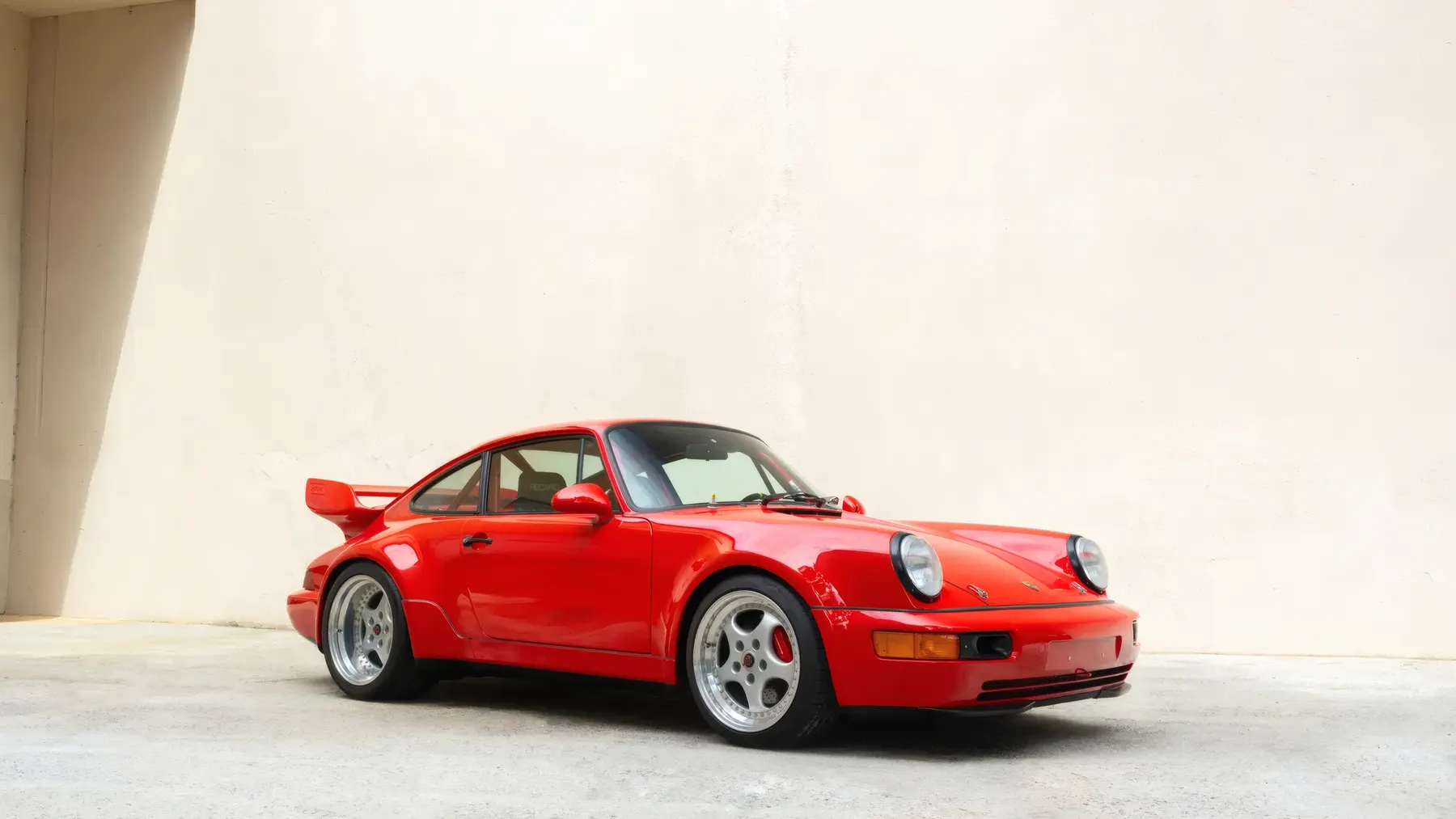
Racing cars built around standard production architectures have a different quality from machines designed on blank sheets. Every engineering decision carries a visible ancestry, and the gap between what the road car was and what the racing version became tells you something precise about how hard the development team pushed and where the formula ran out of room. When Porsche’s competition department stripped a 964 to its essentials, widened its arches to accommodate broad racing slicks, fitted a proper aerodynamic package, and enlarged the air-cooled flat-six to 3.8 litres, the result was the Carrera RSR 3.8 - a thoroughbred GT racing machine whose engine shared its fundamental architecture with cars sitting on suburban driveways across Europe. That continuity between road and track, stretched to the very limit of what development could accomplish within a defined formula, is precisely what defines the 964 RSR 3.8’s character.
The 964 generation had arrived in 1989 as a genuinely significant step forward from the G-series 911 it replaced. Coil springs replaced torsion bars at the front, the rear suspension was redesigned with improved geometry that addressed some of the handling characteristics associated with the old semi-trailing arm arrangement, and ABS became standard equipment. A proper all-wheel drive system appeared as the Carrera 4 variant, and power steering became available. None of this changed the 911’s fundamental identity - the air-cooled flat-six remained behind the rear axle, the silhouette was unmistakably continuous with 1963 - but the 964 was a more sophisticated, more modern car than its predecessor in every measurable respect. Porsche had essentially rebuilt the 911 from within while leaving its outline intact.
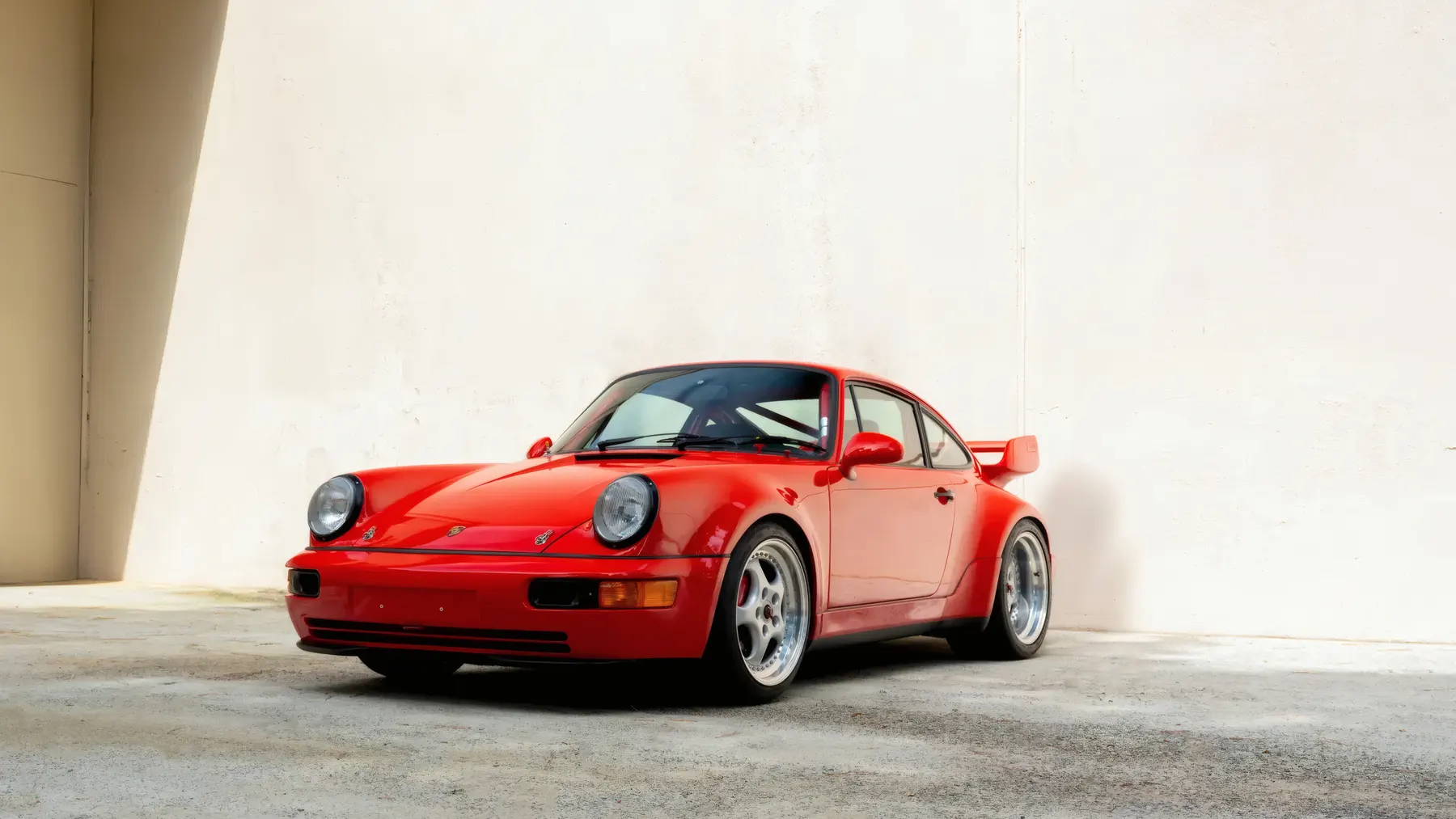
For motorsport purposes, the revised rear suspension geometry gave engineers cleaner parameters to work with when setting up a car for circuit use. The semi-trailing arm arrangement of the G-series had always required careful calibration to manage the rear’s tendency to load up unpredictably under lift-off or hard cornering; the 964’s revised rear axle was a more tractable starting point. But transforming any 964 into a serious GT racing car required substantially more than suspension calibration. It required a complete rethinking of what the platform could carry.
The Carrera RS nameplate has always carried a specific meaning in Porsche’s catalogue. Going back to the 911 Carrera RS 2.7 of the early 1970s - and the 2.8 RSR that directly followed it into racing - the RS tradition established an approach that each subsequent generation would repeat: aggressive weight reduction, specifically increased power, stiffened suspension, and a car conceived to work on both road and circuit without being fatally compromised on either. When the 964 Carrera RS appeared in 1991 with the 3.6-litre engine producing around 260 bhp, it carried those principles forward faithfully. Interior equipment was stripped, lightweight body panels and polycarbonate side glass reduced mass, and the suspension was set up considerably harder than the production Carrera.
But Porsche and the customer teams running 964s in GT competition had bigger ambitions than the 3.6 RS could satisfy. The engine’s displacement, while entirely adequate for a road car, left development potential on the table, and the competition landscape in early 1990s GT racing was demanding more. The solution was to increase the flat-six’s bore, enlarging displacement to 3.8 litres and extracting a more muscular output in the process. This became the foundation for both the Carrera RS 3.8 road car - a strict limited-production model - and, in its most thoroughly developed form, the Carrera RSR 3.8 built specifically for GT racing.
The RS 3.8 road car’s existence was not accidental. GT racing regulations of the period typically required a minimum production run of road-legal variants before a dedicated racing version could be admitted to the relevant class. The limited-run RS 3.8 served that purpose while also being a serious driver’s car in its own right, producing approximately 300 bhp and retaining a degree of road legality that the RSR absolutely did not. The racing car that followed was a completely different proposition: a rollcage, a single racing bucket seat, a fire suppression system, polycarbonate in place of glass, composite body panels where production steel had been, and not a single item retained from the standard car that a racing car could do without. The RSR wore the 964’s identity rather than the 964’s substance.
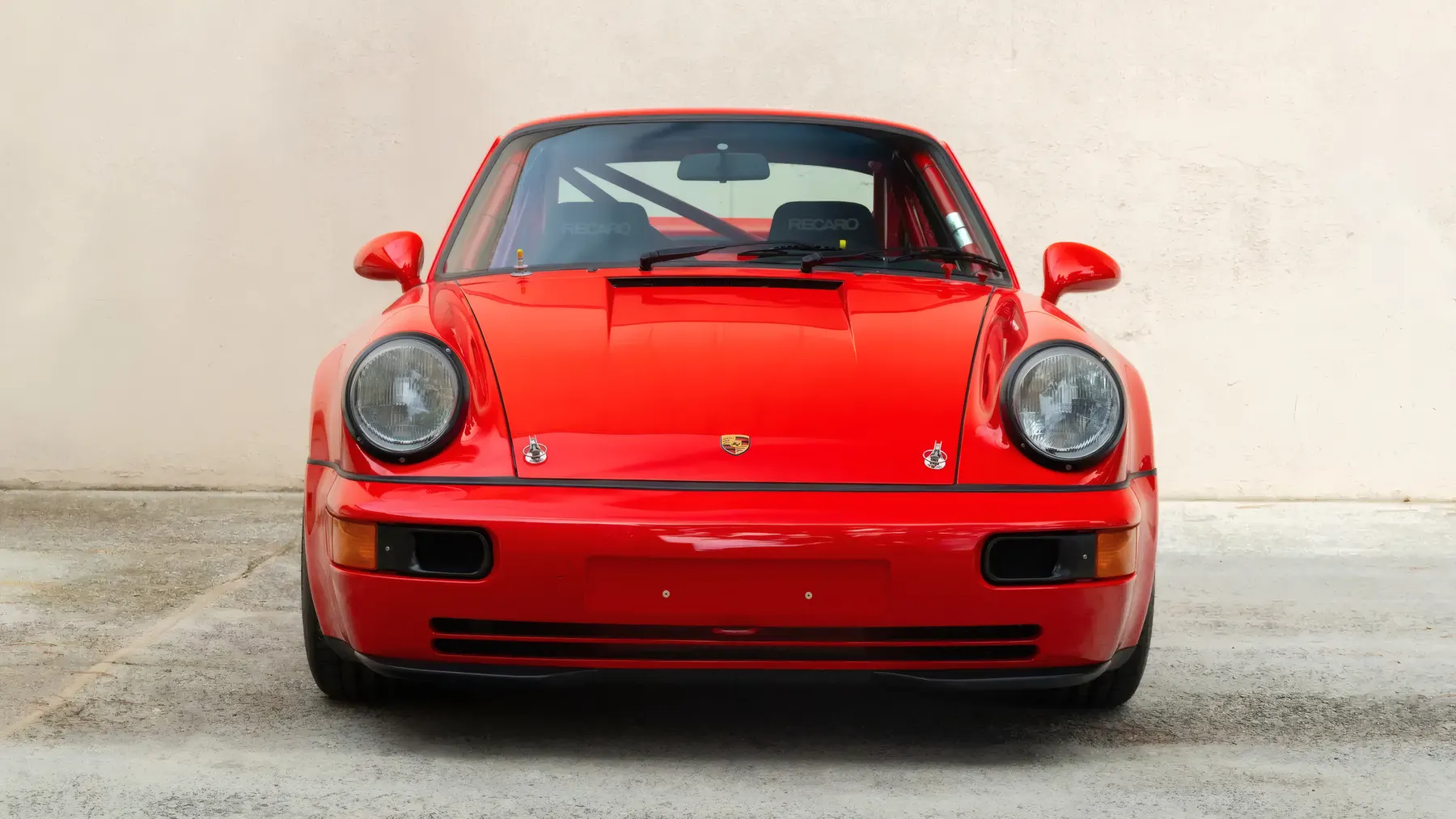
In RSR specification, the 3.8-litre air-cooled flat-six is generally documented as developing around 325 bhp, though specific outputs varied with the state of preparation and the regulations of whichever series a car was entered in. Individual throttle bodies, racing camshaft profiles, and the air-cooled architecture’s inherently direct response to throttle input produced an engine with exceptional mechanical transparency - one that communicated every aspect of its condition through the controls with unusual immediacy. The exhaust note is worth mentioning separately, not for the usual enthusiast reasons but because it was genuinely informative: the hard, flat, climbing shriek of a high-revving air-cooled flat-six under full load carries more information about what the engine is doing than most road car engines manage in normal operation. It was a racing tool, not an aesthetic flourish.
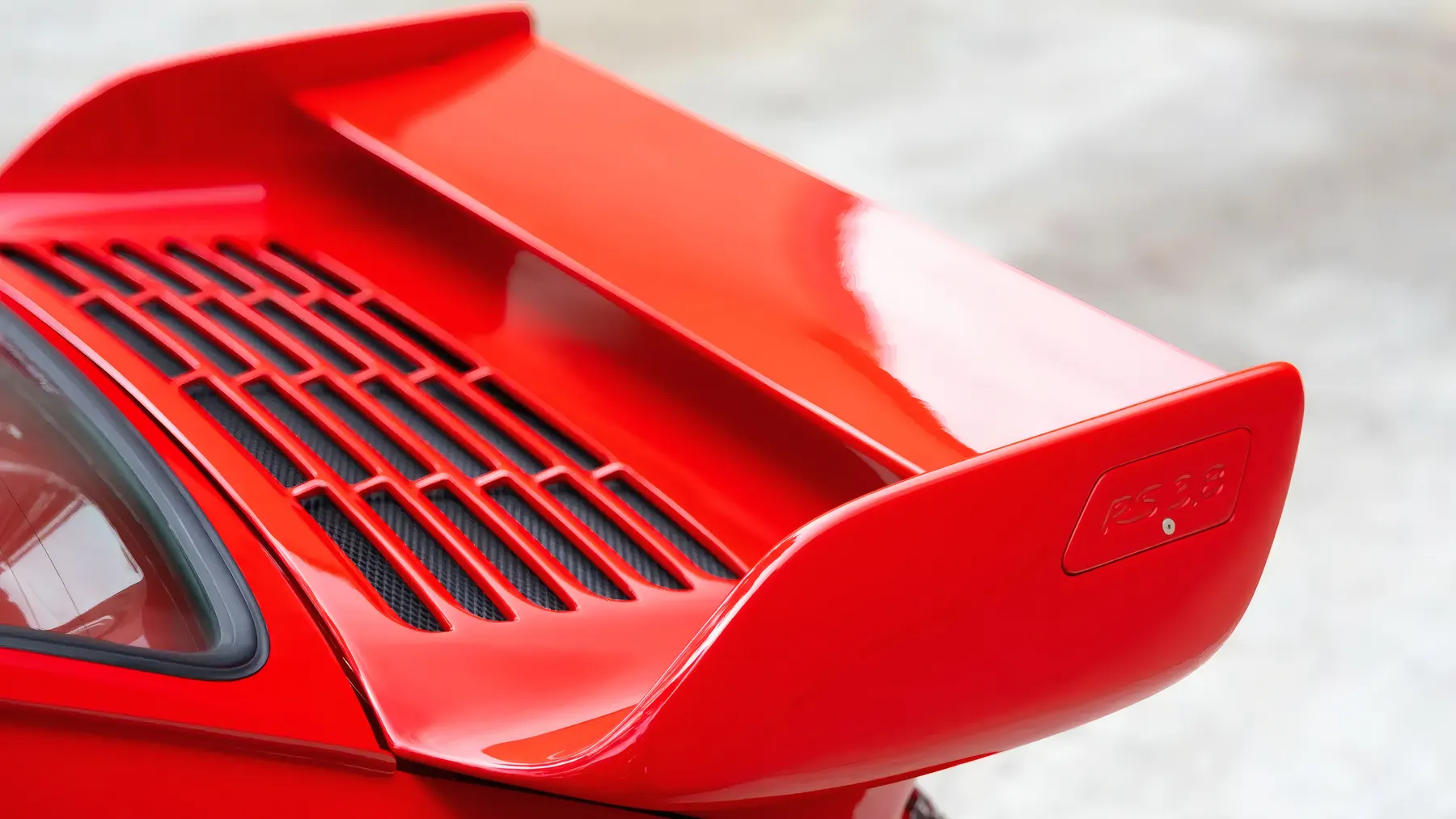
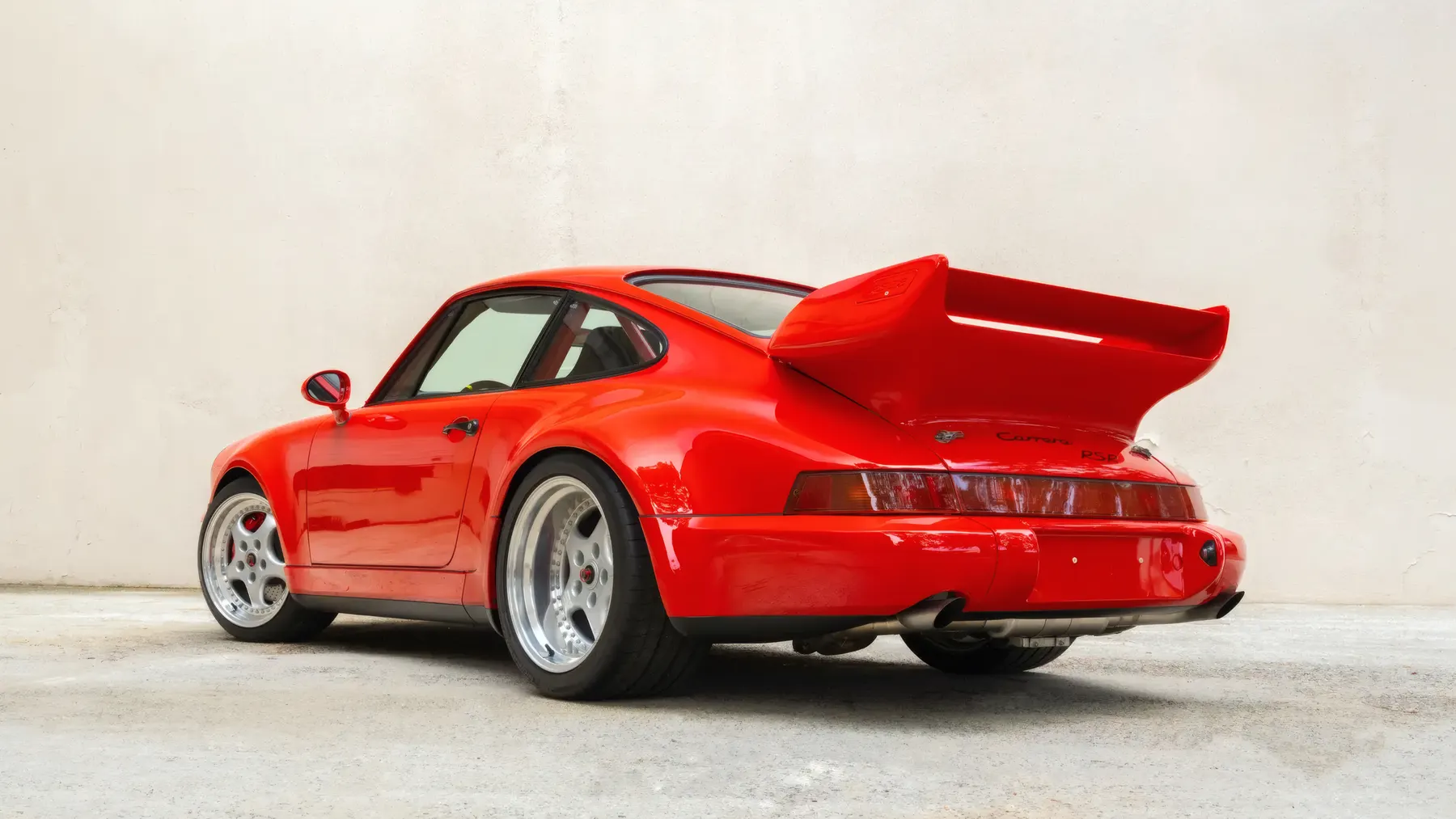
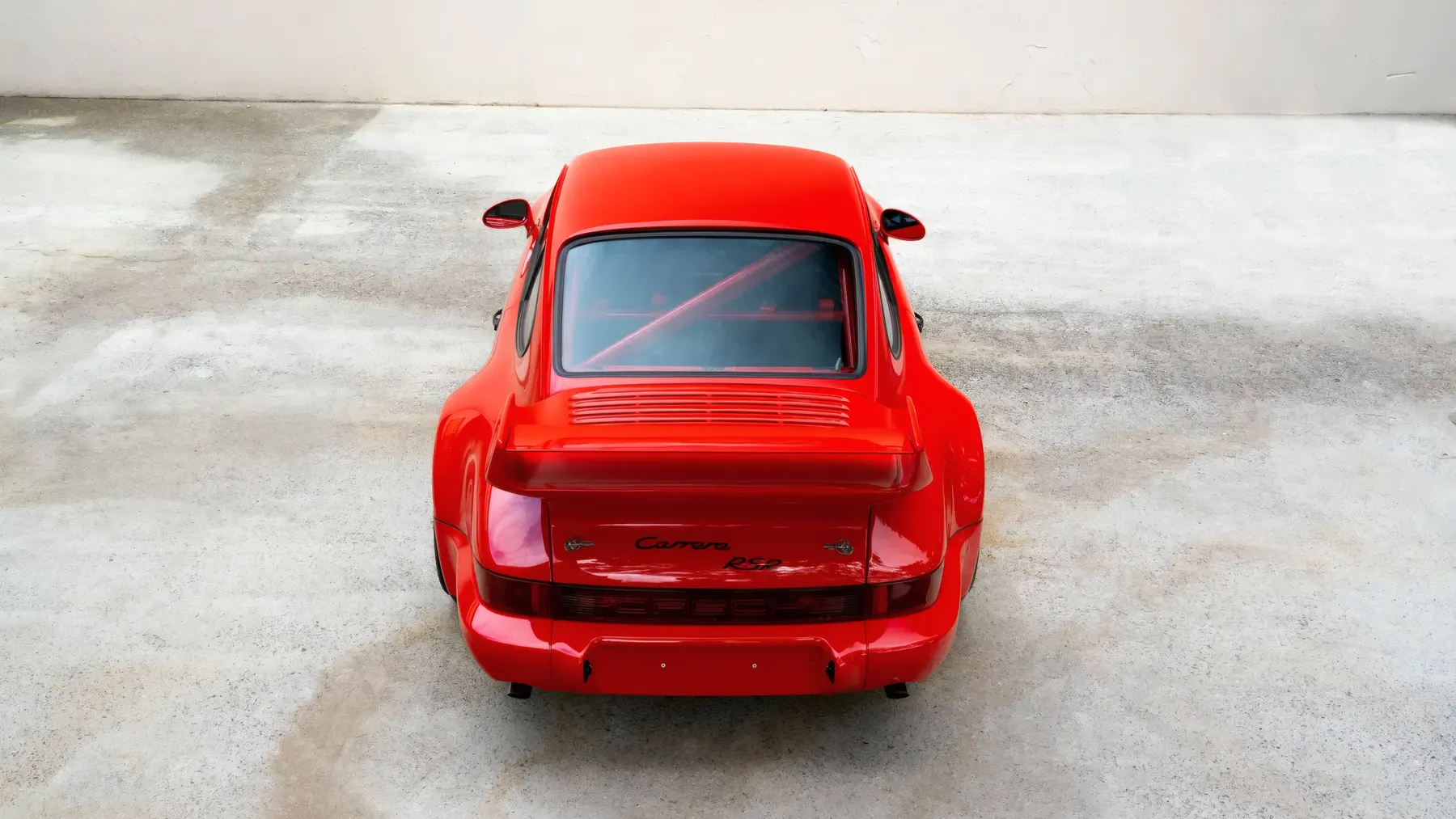
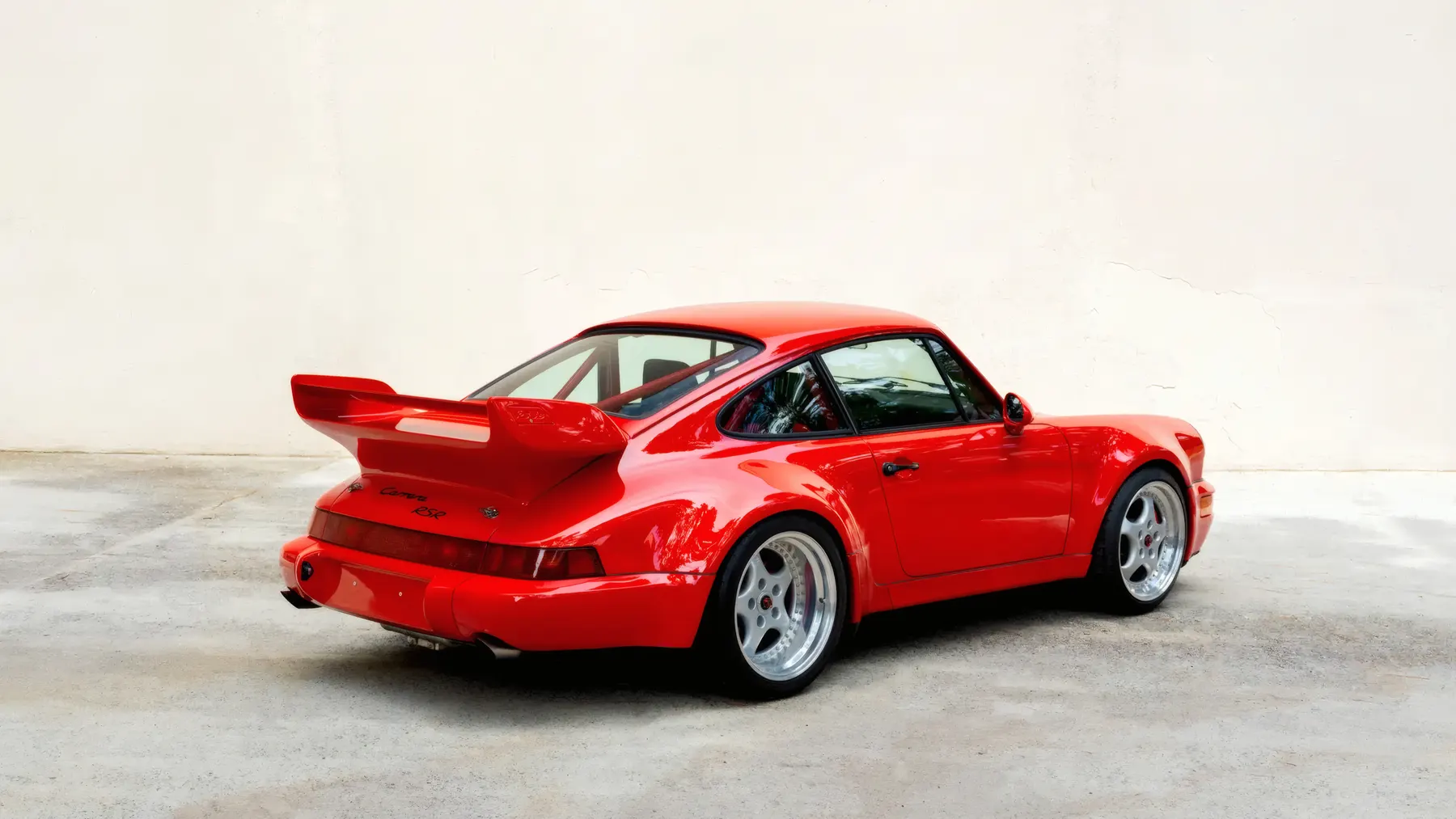
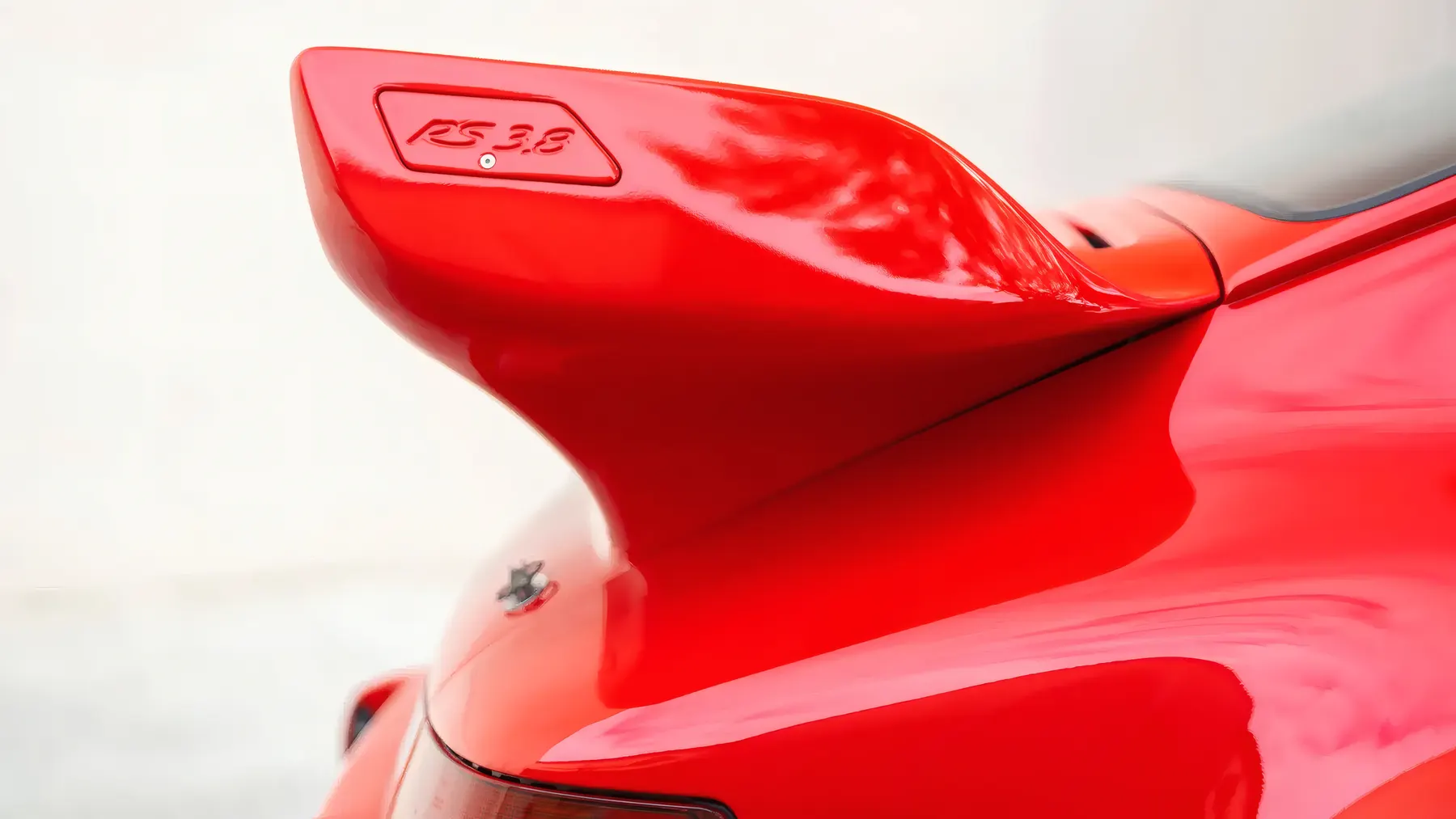
The RSR’s body was substantially wider than the standard 964, with extended front and rear wheel arches accommodating the significant track width increases required to plant racing slicks properly. The front bumper was reshaped around a deeper splitter and improved cooling ducts, while a large adjustable rear wing provided downforce over the driven axle. In overall proportions, the RSR transformed the familiar 911 outline into something considerably more planted and aggressive - the arches pushing outward, the ride height reduced, the whole car sitting purposefully close to the ground. This was not styling exercise. Every dimension had a specific aerodynamic or mechanical function.
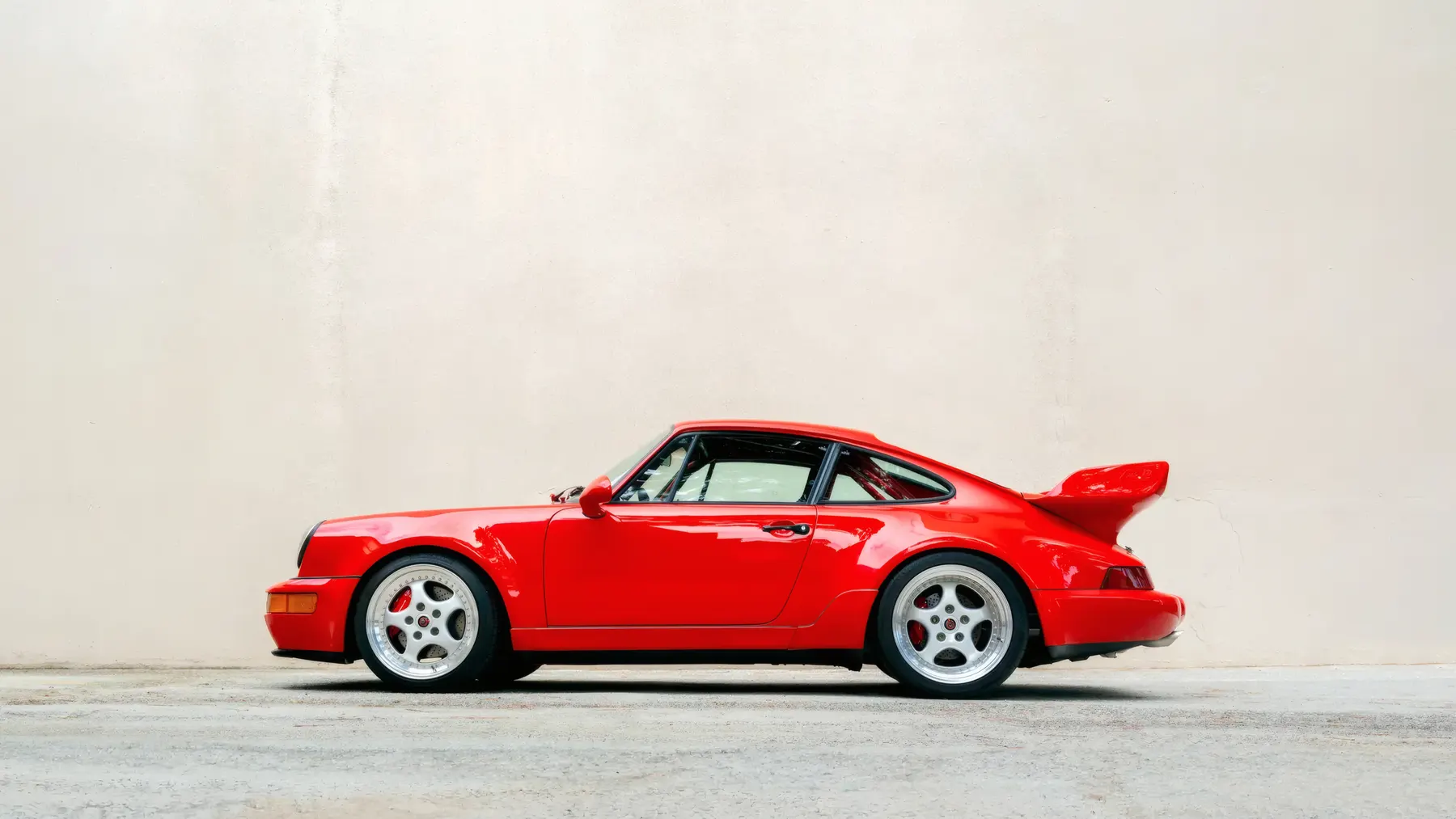
Getting the aerodynamic balance right on this platform was inherently more involved than it would have been on a mid-engined car. The engine and gearbox occupy the space behind the rear axle, biasing mass significantly toward the back of the car, and the aerodynamic package had to account for this at all speeds. The RSR’s rear wing was sized and positioned to generate downforce over the heavily loaded axle, while the front aerodynamic elements were developed carefully to prevent the front end from becoming light at racing speeds. Teams that understood the car found it could be set up with genuine confidence; the balance was manageable and the rear-engine dynamics, when properly understood, offered a degree of mechanical grip at corner exit that could be exploited. But it was never an aerodynamically neutral car, and the package that resulted from working within a rear-engine architecture was not the same as what a clean-sheet mid-engine racing design could deliver.
This constraint was one of the RSR 3.8’s real limitations as GT racing grew more competitive through the mid-1990s. The car’s rear wing was partly compensating for fundamental weight distribution characteristics that no aerodynamic package could entirely neutralise. Against cars designed from the outset for better aerodynamic balance, the RSR’s efficiency was compromised. The gap was manageable in class racing - the car won races and performed credibly across multiple championships - but at the upper reaches of GT competition, the packaging constraint was a genuine and measurable disadvantage.
The air-cooled engine presented a second category of limitation. Its thermal management was more demanding than on water-cooled units, and the architecture’s capacity for continued development was approaching practical limits by this point. Sustained high-revving use in an endurance event placed thermal loads on the engine that required careful and experienced preparation. The flat-six’s response to ambient temperature variation was also less predictable than a water-cooled competitor operating within a controlled temperature range, which added a variable to long-distance reliability planning that well-organised teams had to account for carefully. The 3.8-litre unit was a sophisticated and highly developed piece of engineering - it was not unreliable - but it was working harder, in relative terms, than the road car’s figures implied, and proper preparation was not optional.
Running the RSR 3.8 competitively was accordingly expensive. The engine’s specialised requirements, the demands of keeping it at full performance across a racing season, and the technical knowledge required to prepare an air-cooled flat-six correctly for sustained racing loads placed the total cost of a professional campaign beyond most private teams without strong manufacturer or importer backing. The RSR was not a gentleman driver’s easy proposition. It rewarded investment in qualified preparation, and teams that treated it as a more serious road car in a roll cage found the experience instructive in all the wrong ways.
To drive the RSR 3.8 well requires complete commitment and continuous sensitivity to what the rear end is doing. The engine’s weight behind the rear axle is present in every corner - not as instability, but as something the driver must acknowledge and work with rather than dismiss. The flat-six’s throttle response is immediate and the car rewards a driving style built on precision, smooth inputs, and early commitment rather than the kind of late-braking, hard-correction approach that more neutrally balanced cars can absorb. A driver who understands rear-engine dynamics and builds their technique around what the car is communicating will find the RSR unusually rewarding. The information flow from the rear tyres through the chassis is constant and specific, and the experience of getting a lap right is more satisfying for being less forgiving than in a modern downforce car.
The 964 Carrera RSR 3.8 competed primarily across European GT racing in the early-to-mid 1990s, including entries in the Le Mans 24 Hours, where Porsche’s presence in the GT classes had been established over decades of racing history, and in the sprint and endurance events that would coalesce into the BPR Global GT Series from 1994 onwards. Porsche’s reputation for mechanical durability in long-distance events was well-founded, and the RSR’s air-cooled engine - for all the management demands it placed on preparation teams - was a proven architecture in endurance conditions. Well-organised private teams found it a credible tool; Porsche’s technical support network, established through its customer racing infrastructure, gave those teams access to factory development information that independent operations with other makes typically lacked.
As the decade progressed, the 993 RSR arrived to take the lineage forward, applying similar principles - wide-body construction, developed aerodynamics, a heavily prepared flat-six - to Porsche’s next-generation chassis. The 964 RSR 3.8 transitioned gradually from frontline weapon to respected class participant, its competitive window defined as much by the pace of regulations and new car development as by any specific inadequacy of the car itself. The 993’s arrival did not make the 964 RSR wrong; it made it the previous version of a formula that Porsche understood very well how to develop.
What the 964 Carrera RSR 3.8 achieved was not simply a set of racing results but the establishment of a clear template for how a 911 could be taken seriously as a GT racing platform - not as a homologation curiosity or a privateer’s consolation, but as a systematically prepared, properly aerodynamically developed racing car capable of contending at the front of its class. That template informed the 993 RSR directly, and its logic can be traced through successive generations of 911 GT competition cars into the current era. The 964 RSR 3.8 was where Porsche proved the formula worked completely - where the 964 platform had been fully understood, fully developed, and fully exploited for what GT racing in its era demanded. That it was built from an engine architecture already approaching the end of its competitive development, and still managed to be genuinely effective, is not the least interesting thing about it.