2010 Aston Martin DBS Volante
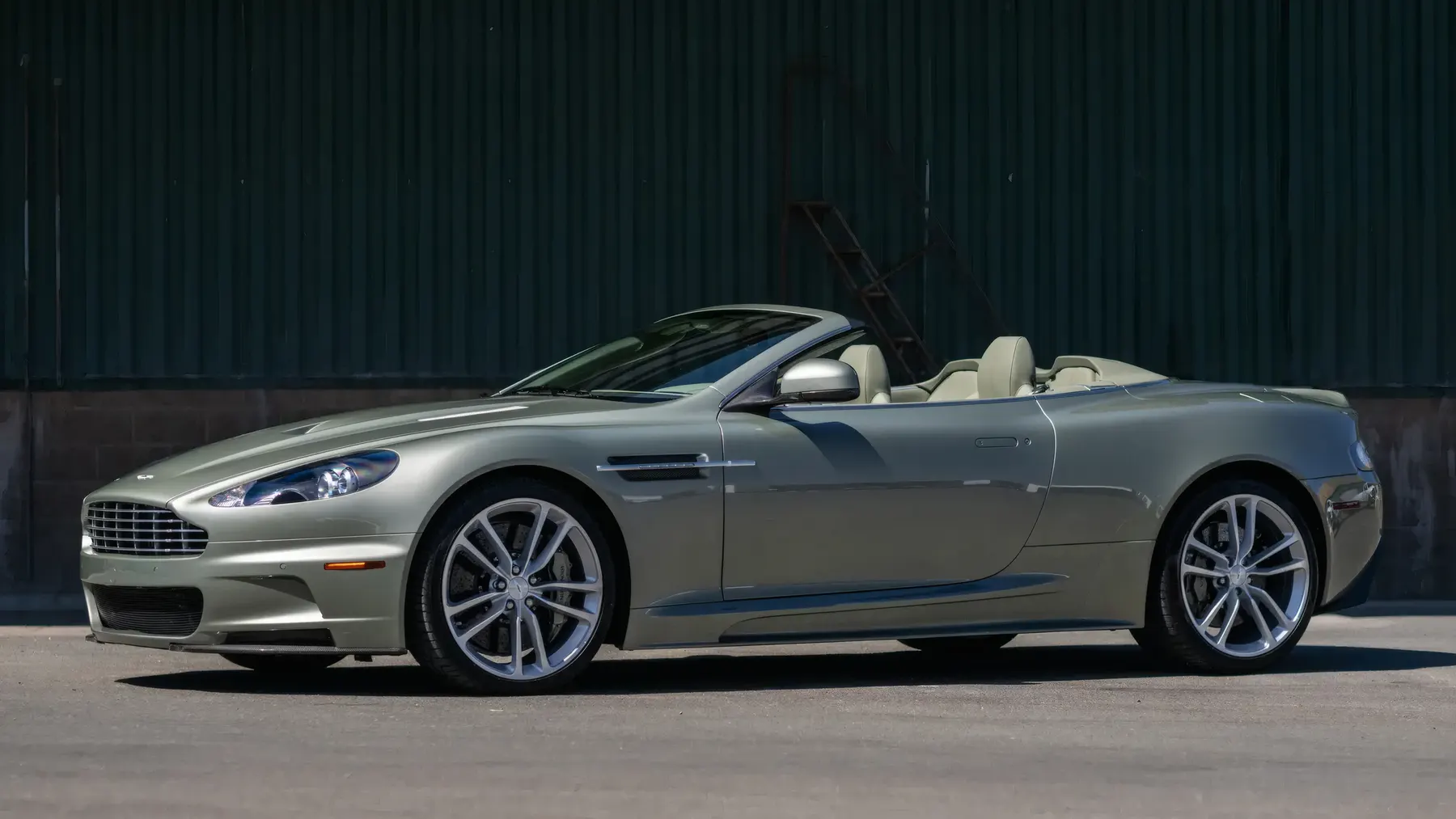
When James Bond climbed out of a silver DBS coupe at Casino Royale’s poker table in 2006, Aston Martin handed the car a cultural appointment it hadn’t quite earned on the road yet. The Volante version, which arrived three years later at Geneva, had no such cinematic shortcut. It had to justify itself on its own terms - as a convertible built around one of the most sonically magnificent engines in production, wearing a body that somehow looked more purposeful with its roof lowered than most cars do with theirs raised.
The DBS itself had been announced in 2007 as the car sitting above the DB9 in Aston Martin’s range - the definitive grand tourer, built around the VH bonded aluminium platform that underpinned the entire Gaydon-era lineup but developed with substantially more focus on driver engagement. It shared its basic architecture and its engine with the DB9, yet the two cars felt genuinely distinct: the DBS used a recalibrated version of the adaptive damping, a stiffer front subframe, and crucially, carbon-ceramic brakes as standard - items so rarely fitted as standard equipment on any road car that their presence signalled Aston Martin’s intent clearly enough. The DBS Volante, unveiled in mid-2009, carried all of that forward into a two-door, four-seat convertible that was theoretically capable of 191 mph with its three-layer fabric hood either raised or lowered.
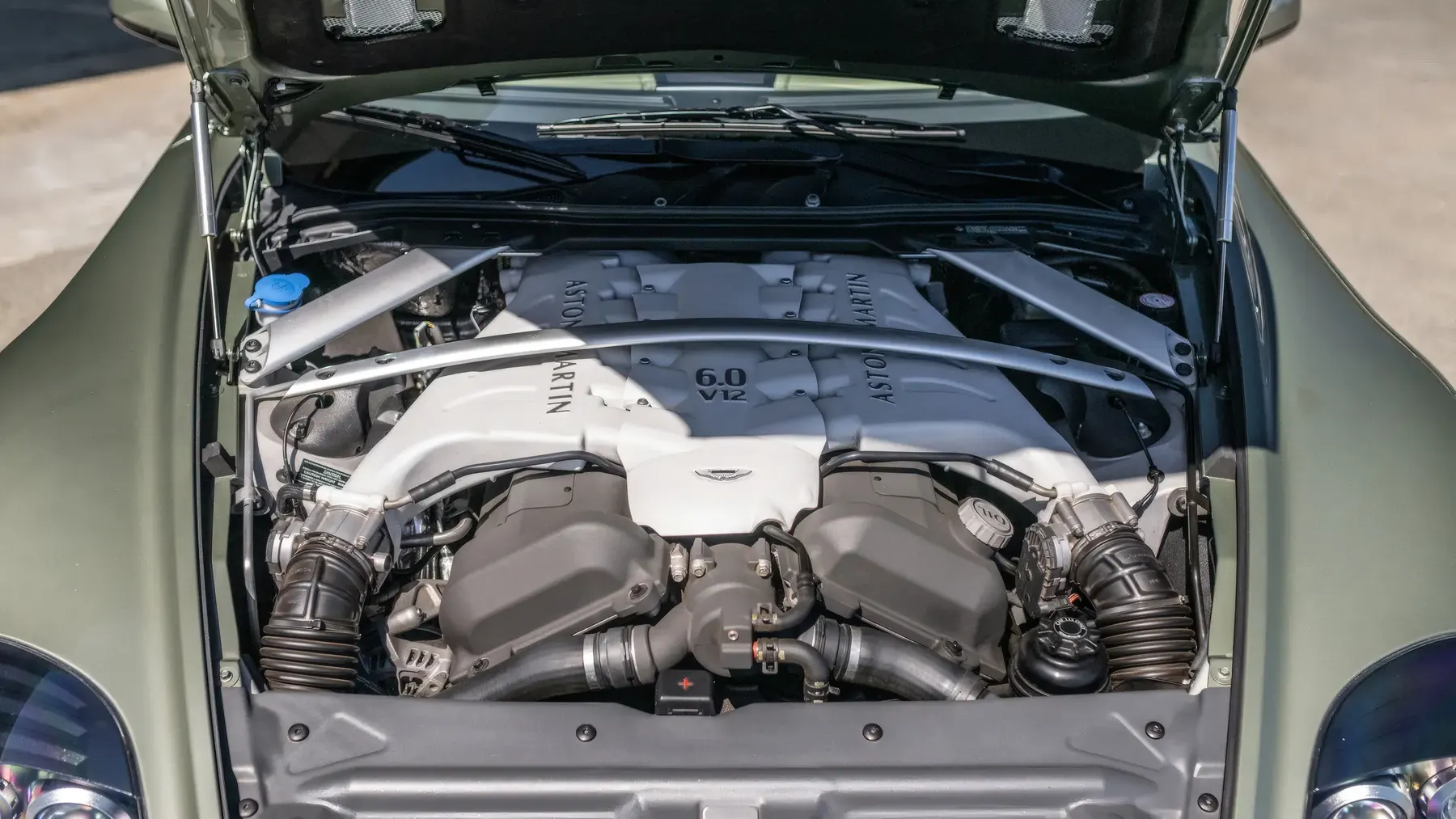
The engine is where any honest account of this car has to begin and end. The 5,935cc all-alloy V12 - quad overhead camshafts, 48 valves, a 10.9:1 compression ratio, bore and stroke of 89mm x 79.5mm - produced 510 bhp at 6,500 rpm and 420 lb-ft of torque at 5,750 rpm. Those numbers describe performance but not character. What the figures cannot convey is the torque curve’s unusual flatness: 85% of that peak torque was available from 1,500 rpm upwards, which meant the engine never felt as though it was withholding anything. At town speeds it was smooth and almost docile; beyond 4,000 rpm it transformed into something genuinely alarming. The exhaust note, uncorked by the fully catalysed stainless steel system and amplified by the open sky above, was the specific sound that this generation of V12-powered Astons made and that no turbocharged successor has convincingly replaced - a rising, orchestrated wail with a metallic edge to it that rewarded the driver for pressing on and made the surrounding countryside acutely aware of their presence.
The transmission choice was loaded with meaning. A six-speed manual was standard, rear-mounted in the transaxle position for weight distribution purposes, and Aston Martin offered the six-speed Touchtronic 2 automated manual as an alternative. The manual was the correct choice and most serious buyers knew it. The clutch was heavy and deliberate, the gearchange requiring genuine effort, and together they made the act of driving the car an engaged, physical negotiation between the machine and the person behind the wheel. When the Touchtronic 2 arrived in 2008, it removed that physical conversation in exchange for greater refinement and accessibility, and Evo magazine reviewed the automatic as something that helped the DBS find its identity as a true grand tourer rather than a car that demanded constant driver input. Both interpretations of what the DBS Volante should be were valid, which is in itself a mark of how well-resolved the underlying machine was.
The VH chassis beneath the Volante had been substantially stiffened compared to the DB9 Volante to compensate for the structural contribution of the absent roof. Aston Martin’s engineers added a bonded aluminium backbone brace and reinforced the sills to restore the torsional rigidity that the coupe’s fixed roof provided naturally. The penalty showed up on the scales: the Volante weighed 1,710 kg, a figure that placed it firmly in the territory of the grand tourer rather than the sports car, and one that required the driver to respect the car’s mass when the road became demanding. The double-wishbone front and rear suspension, tuned in conjunction with the adaptive damping system, offered two modes: a standard setting that was genuinely excellent on real roads, and a Sport setting that stiffened things further for track use. Top Gear’s retrospective review, driven from the standard mode alone, concluded the ride was so good in its default state that the Sport setting felt like a theoretical option.
The carbon-ceramic brake discs - 398mm diameter ventilated items at the front with six-piston monobloc calipers, 360mm at the rear with four-piston units - were among the best-specified anchors on any production car of the DBS’s era. They generated enormous retardation with progressive, readable pedal feel, and their resistance to fade made the Volante’s performance potential accessible even on longer, faster roads where a lesser braking system would have faded into anxiety. Given that the Volante would reach 191 mph in the right circumstances, this was not an academic point.
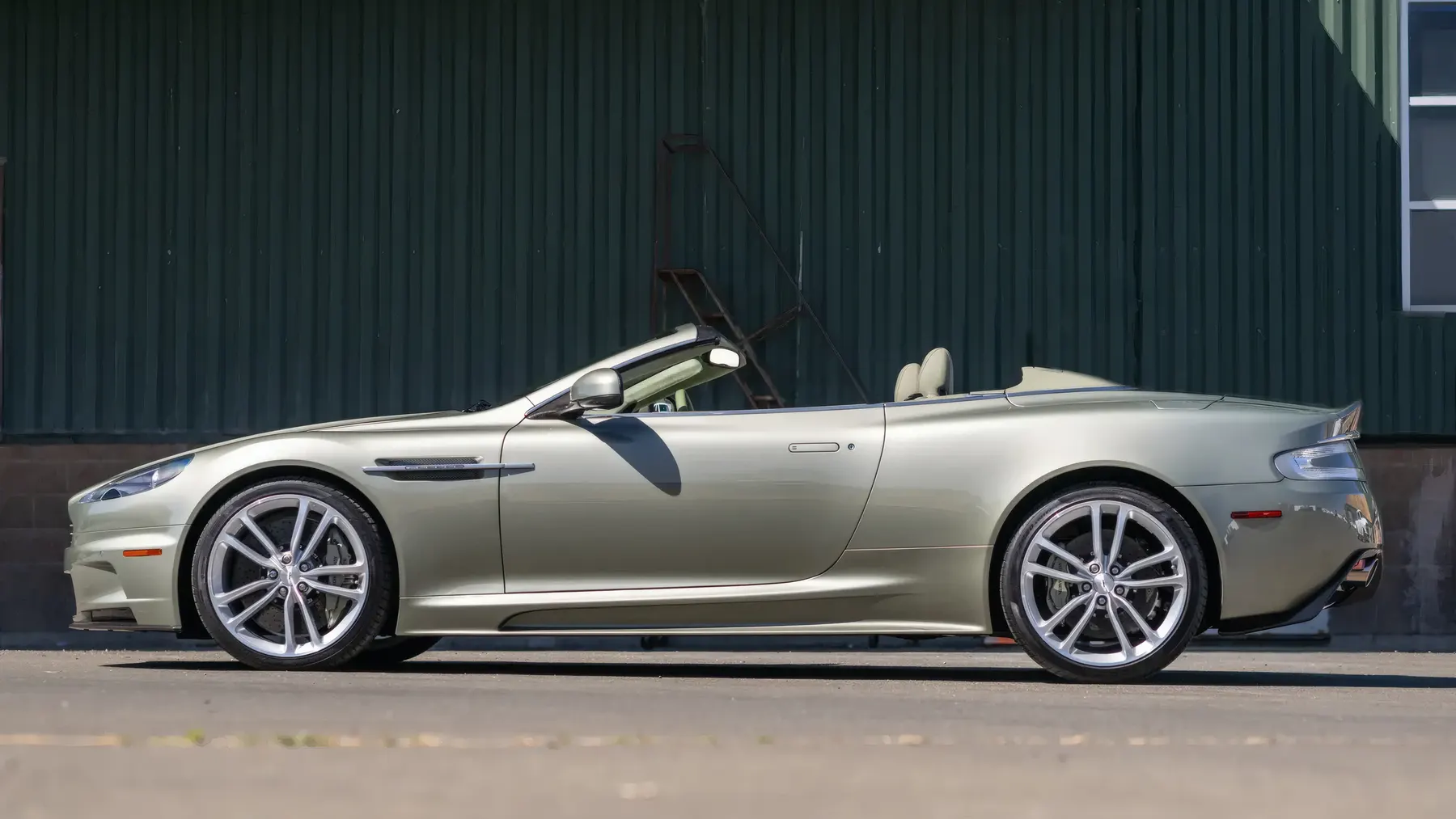
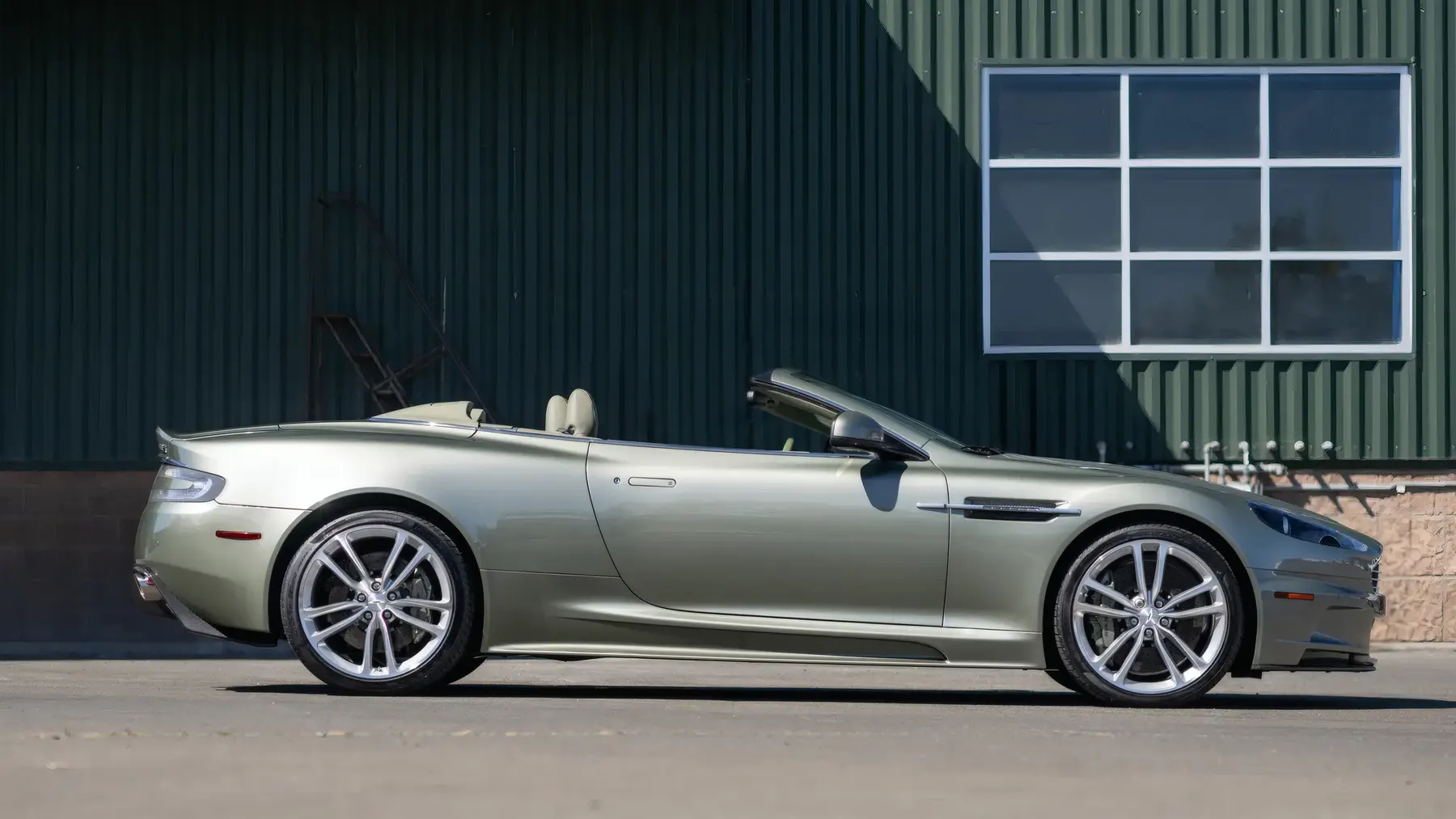
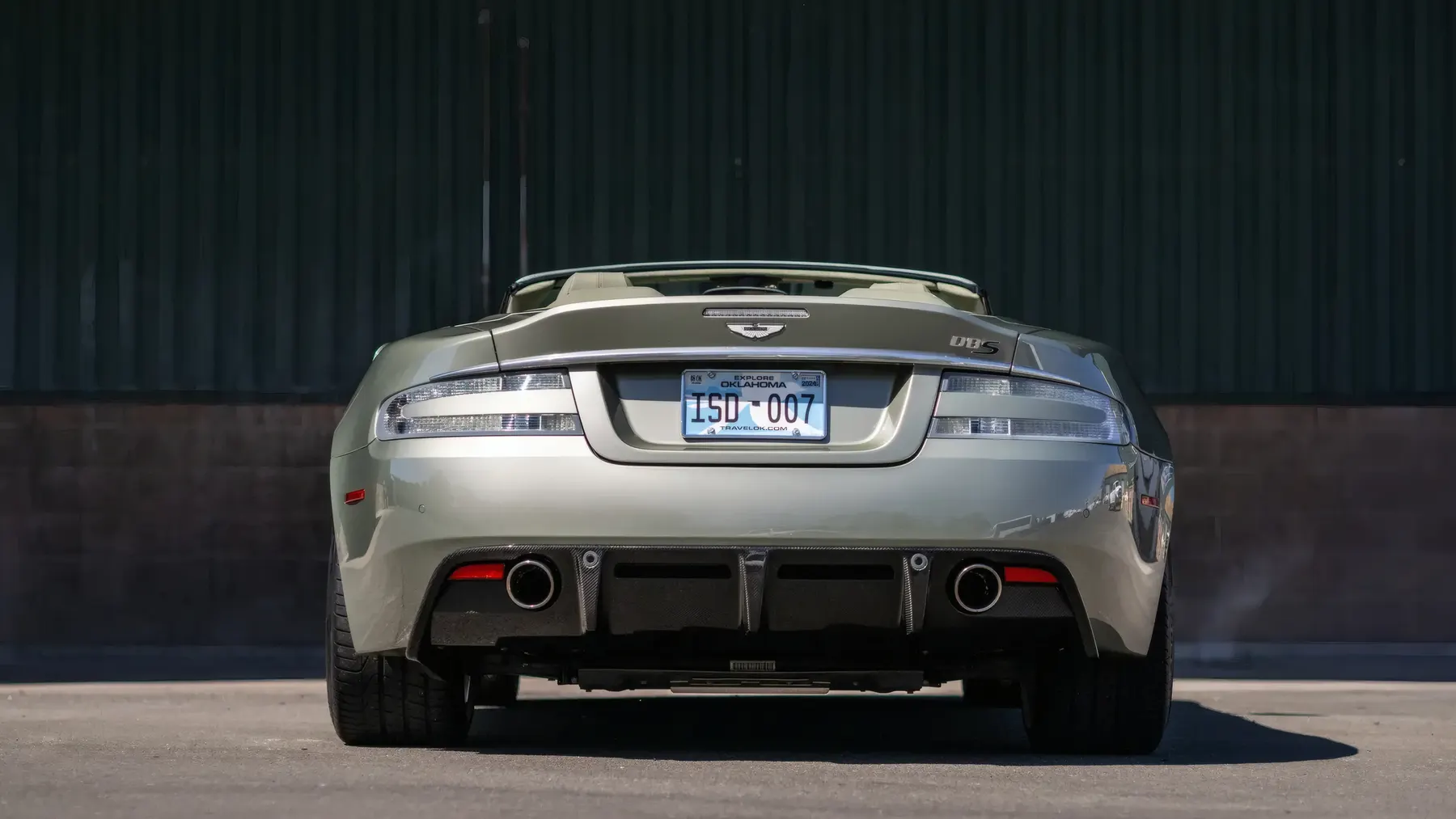
The body measured 4,697mm in length, 1,875mm wide, and 1,270mm tall, on a 2,740mm wheelbase - proportions that sit at the far end of what might be called a traditional grand tourer, generating a visual presence that was difficult to overlook on any road. Marek Reichman’s design for the DBS had sharpened the organic curves of the DB9 into something more angular and purposeful, and the Volante translated this into the open-top idiom without appearing stretched or compromised. The rear haunches were wide enough to fill the arches with conviction, the hood stack sat low enough to preserve the roofline’s slope when raised, and with the hood folded the rear deck presented cleanly without the piled-fabric awkwardness that afflicts less carefully resolved convertibles.
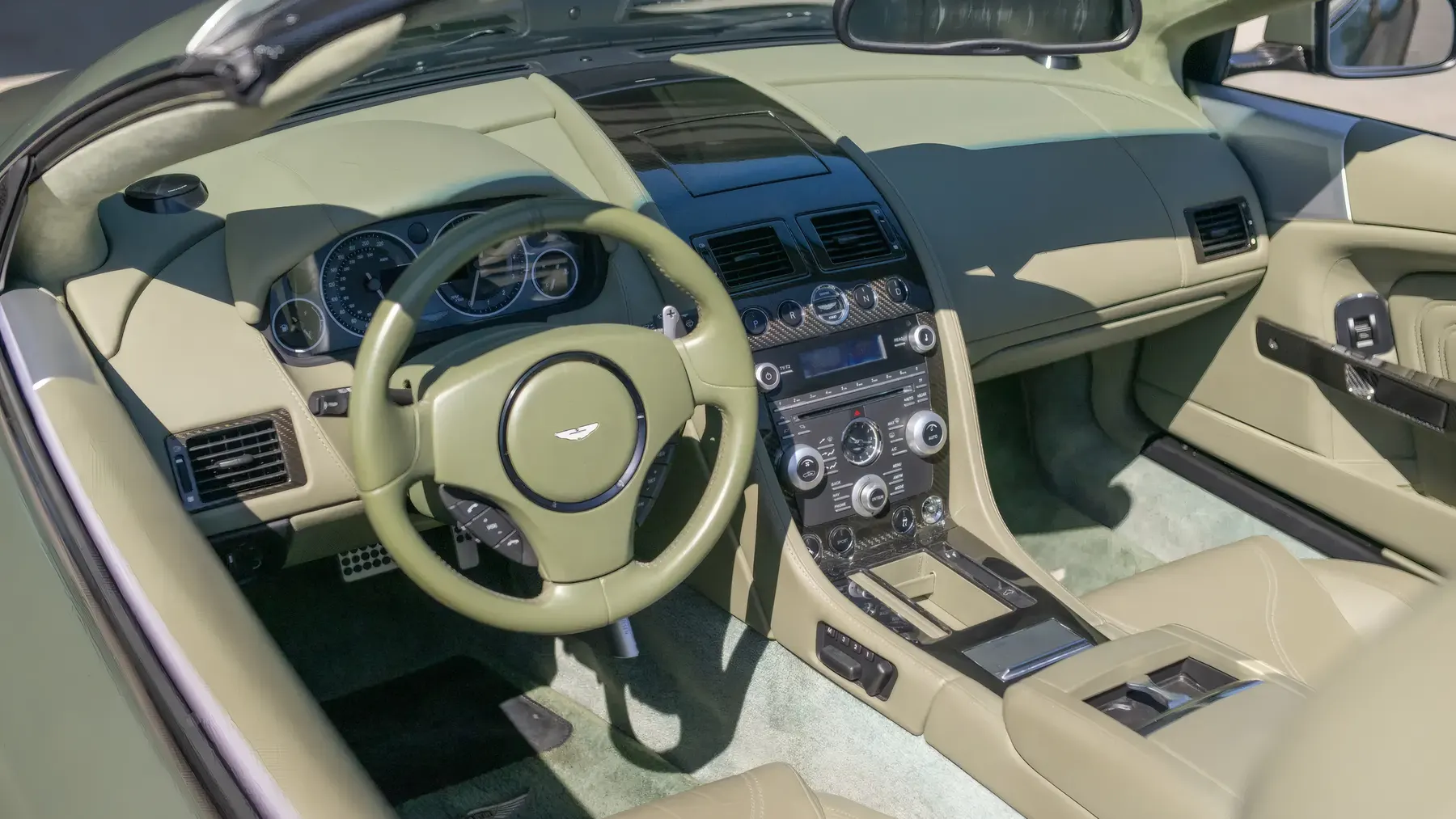
Inside, the DBS Volante made good on the promise of the exterior without pretending to be something it wasn’t. The cabin was trimmed in Bridge of Weir leather with hand-stitched detail throughout; Bang & Olufsen BeoSound audio was standard, an arrangement of exposed aluminium speaker grilles in the fascia that was simultaneously one of the better-sounding and better-looking in-car audio installations of the period. The switchgear attracted criticism - some of the minor controls were shared with Ford and Volvo parts-bin items, a consequence of Ford Motor Company’s ownership of Aston Martin through 2007, and they sat incongruously among the leather and aluminium surrounding them. This was a genuine compromise and a known one, and buyers paying the asking price of approximately £165,000 at launch had reasonable grounds to notice it.
The DBS Volante’s hood operated in approximately 14 seconds and was usable at low speeds in motion, a practical capability that the DB9 Volante also offered and that owners used regularly. Roof down at speed, the three-layer fabric construction kept wind intrusion at bay well enough for genuine motorway use, and the acoustic difference between roof-up and roof-down on a demanding road was, frankly, an argument for keeping it down whenever conditions allowed - the V12’s upper register needed the open sky to be fully heard.
The DBS Volante ran from 2009 to 2012, receiving the Ultimate limited edition treatment in its final year alongside the coupe - 100 final cars divided between the two body styles, each one built to a more complete standard of specification than the regular production car. Throughout its production life it attracted strong reviews from journalists who approached it on its own terms rather than comparing it to track-day machines. Top Gear’s contemporary assessment noted that for something so large, front-engined and open-topped, it was a genuinely focused drive: fast, grippy, and only occasionally daunting rather than permanently intimidating. Auto Express praised the V12 and the handling while duly noting the running costs and the switchgear. The consensus was consistent: this was not a car that flattered the driver by making performance feel effortless. It demanded something in return, and what it gave back in exchange was a driving experience - acoustic, tactile, physical - that more technically sophisticated cars at similar prices could not replicate.
The compromises were real and worth stating plainly. At 1,710 kg the Volante was not a lightweight machine, and on a road with genuine corners it required early planning and confident commitment rather than reactive heroics. The steering, accurate and reasonably communicative without being truly expressive, told the driver where the front wheels were pointing rather than what the front tyres were feeling, a distinction that matters when the road demands precision. Fuel consumption was poor by any measure - a figure in the low teens MPG under any kind of enthusiasm - and the carbon-ceramic brakes, while excellent in operation, carried a replacement cost that concentred the mind at service time.
None of this was hidden, and none of it was the point. The Aston Martin DBS Volante existed because there is a particular kind of driver, and a particular kind of road, that calls specifically for a naturally aspirated V12 in a beautifully built British convertible with a manual gearbox - and because no other car in 2009 answered that specific call in quite the same way. That it did so with a cabin you could genuinely inhabit for a long journey, on a chassis that rewarded the effort of learning its character, and with a body that has aged without looking like it was designed to any particular decade’s taste, means it remains one of the most coherent and unapologetically specific grand tourers the modern Aston Martin era produced.