Bugatti Chiron: The 1,479bhp Hypercar Built to Hold Itself Back
2019 Bugatti Chiron





Images: Keno Zache / RM Sotheby's
Bugatti spent much of the Chiron’s production life proving things its own customers would never be allowed to do. In August 2019, at the end of an 8.8km straight at the Ehra-Lessien test track in Germany, Le Mans-winning test driver Andy Wallace took a near-production Chiron to 304.773mph, the first time any production car had broken the 300mph barrier. Two years earlier, former Formula 1 driver Juan Pablo Montoya had driven a Chiron from a standstill to 249mph and back to zero on the same stretch of tarmac in just under 42 seconds. Yet every Chiron that actually left Molsheim for a customer’s garage was electronically governed to 261mph (420km/h) in road trim, and reaching even that ceiling required a second, physical “Top Speed” key that unlocked the car’s fastest mode beyond a lower, roughly 236mph threshold. It is a strange kind of flagship: one whose entire engineering story is as much about what Bugatti chose to hold back as what it chose to unleash.
That tension sits at the centre of the Chiron, the car built to replace the Bugatti Veyron and, in doing so, to defend a title the Veyron itself had spent a decade establishing as the fastest and most powerful car in series production. Unveiled at the 2016 Geneva Motor Show, the Chiron carried the name of Louis Chiron, a Monégasque racing driver who won a string of grands prix for the marque in the 1920s and 1930s, continuing a habit established with the Veyron (named for racer Pierre Veyron) of naming Bugatti’s flagship after the men who once raced for it. Production was capped from the outset at 500 cars across the entire nameplate family, and demand arrived quickly: by August 2016, five months after the Geneva reveal, Bugatti reported more than 200 orders already on the books.
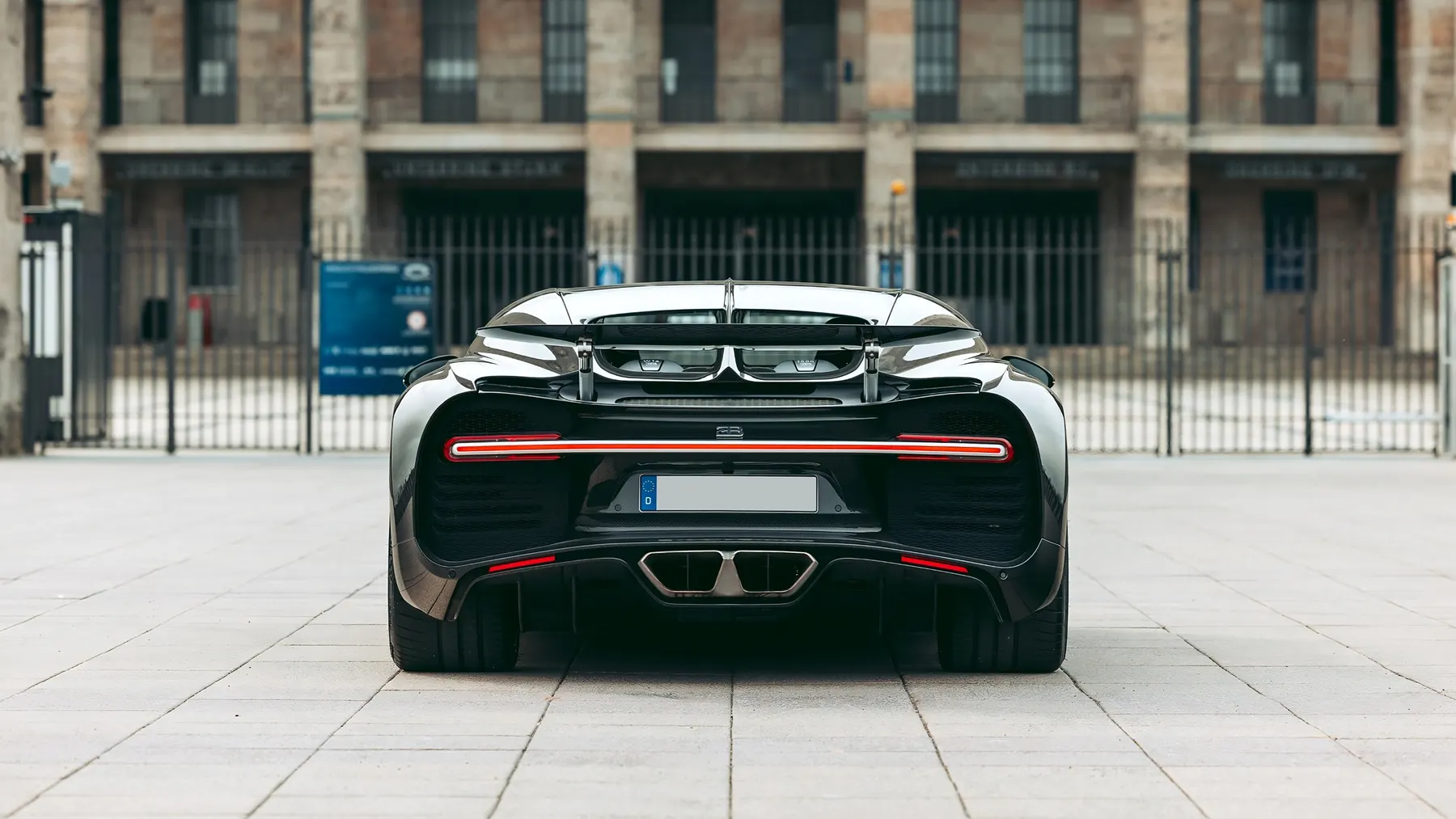
Underneath the spectacle, the Chiron is a thorough reworking of the Veyron’s basic recipe rather than a clean-sheet design. Its 8.0-litre, quad-turbocharged W16 engine - four banks of four cylinders arranged in a double-vee, an architecture essentially unique to Bugatti - carried the concept forward but was redesigned almost in its entirety, gaining a stronger yet no heavier crankshaft, lighter connecting rods, new pistons and a titanium exhaust system with reduced back-pressure. Two-stage turbocharging was the headline engineering idea: the car pulls away from a standstill on only two of its four turbochargers, with the remaining pair spooling in at around 3,800rpm, a strategy Bugatti’s engineers devised specifically to tame the lag that four large turbochargers would otherwise create low in the rev range. The result, in base Chiron form, was 1,479bhp at 6,700rpm and 1,180lb-ft of torque spread across 2,000 to 6,000rpm, sent through a seven-speed dual-clutch gearbox to a Haldex-based all-wheel-drive system. Bugatti quoted 0-62mph in under 2.5 seconds, 124mph in less than 6.5 seconds and 186mph in under 13.6 seconds, figures that at launch comfortably undercut rivals such as the LaFerrari, McLaren P1 and Porsche 918 Spyder over the same benchmarks. The braking hardware was similarly extreme, with eight-piston titanium calipers up front and six-piston items at the rear, each fitted with pistons of varying diameter to even out pad wear across discs of more than 400mm.
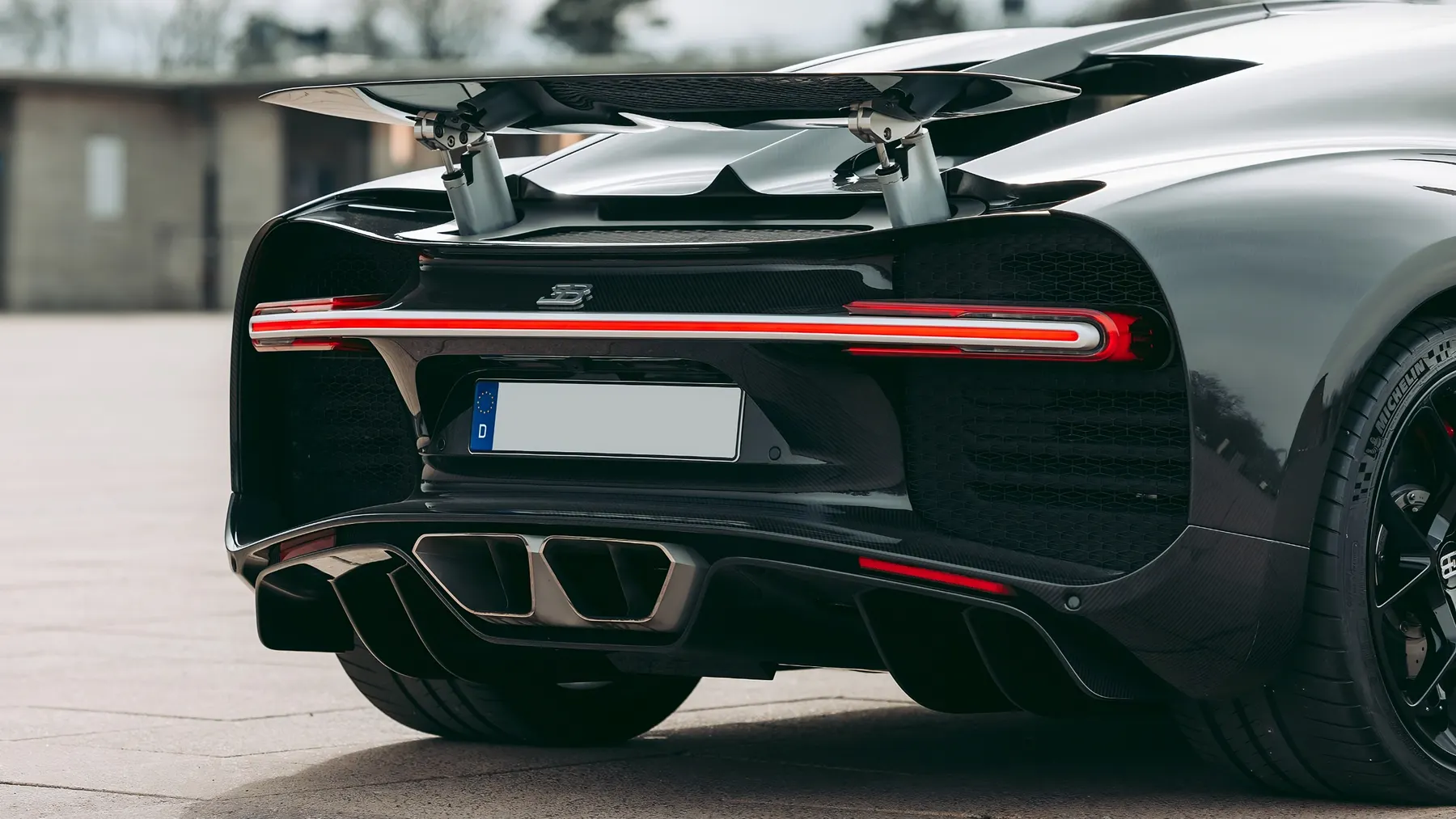
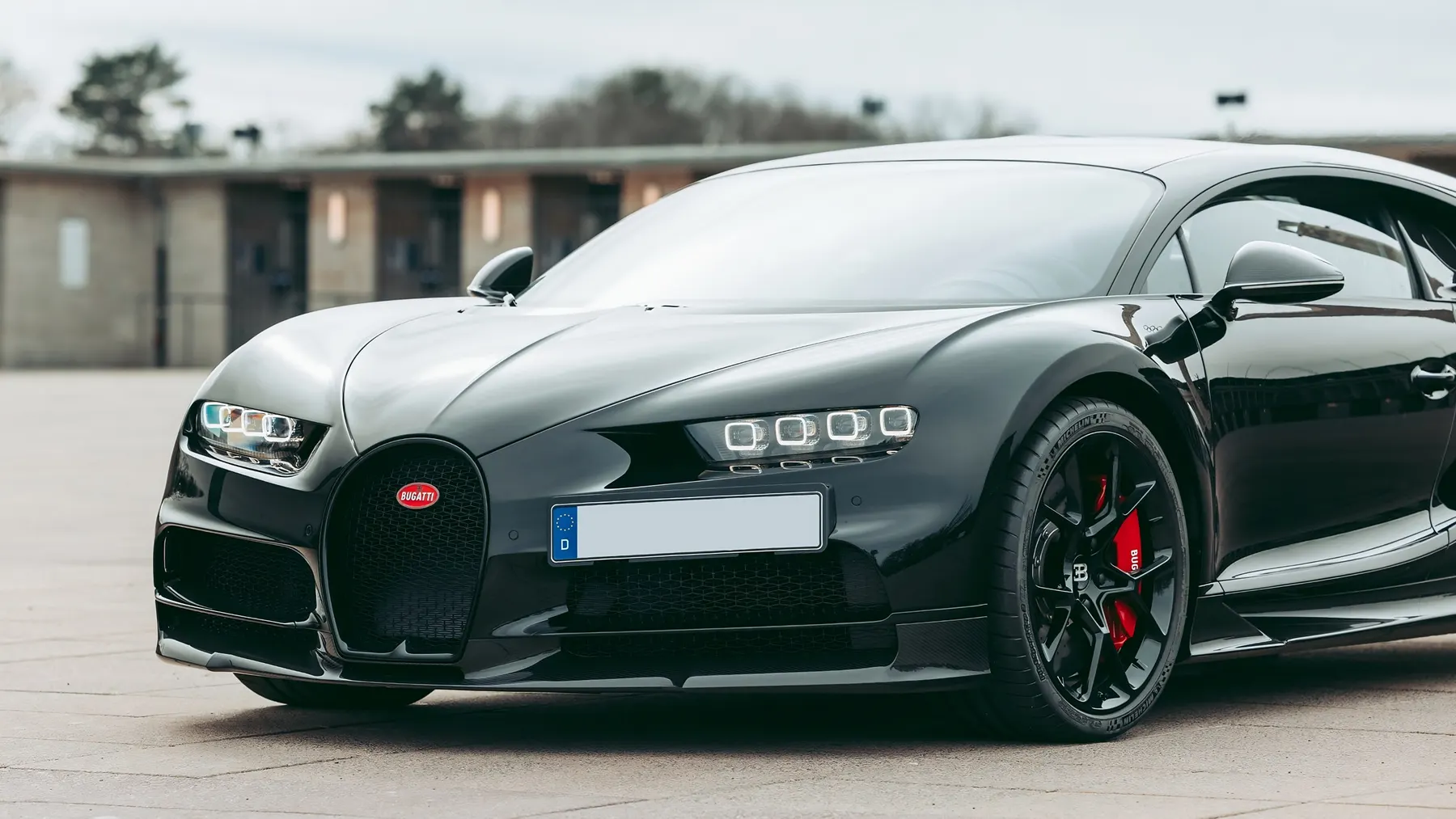
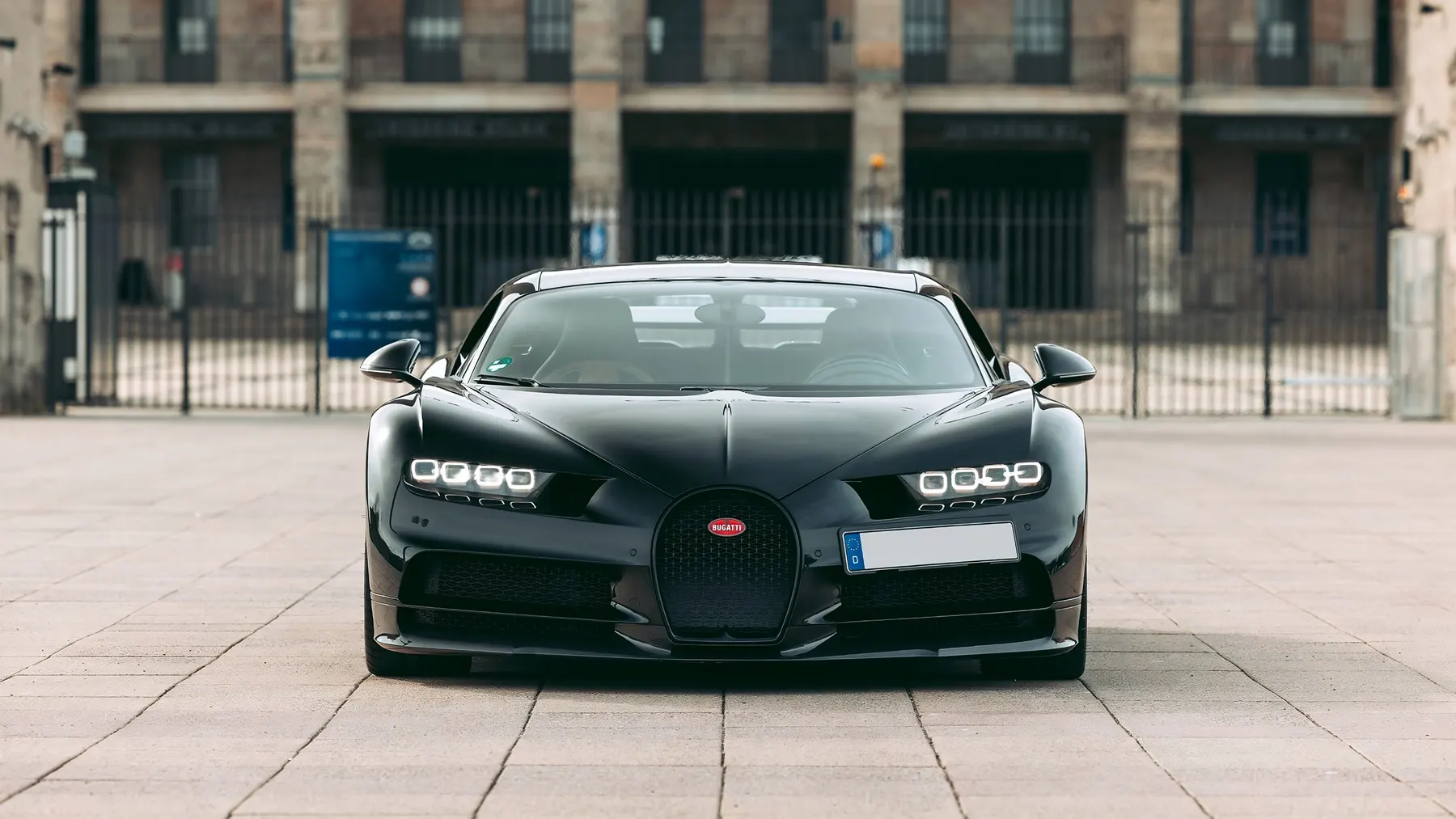
Dimensionally the Chiron grew over its predecessor rather than shrinking, in keeping with a car aiming to be more usable and more comfortable rather than merely faster. Bugatti’s own designers have put the car at roughly 82mm longer, 40mm wider and 53mm taller than the Veyron, on a wheelbase that grew by barely a millimetre, and an estimated 108kg heavier before any of its later performance derivatives clawed weight back out again. That extra presence shows in the styling: the horseshoe grille and the C-line side crease, both drawn from pre-war Bugattis and specifically the Type 57 SC Atlantic, are more pronounced and more sculptural than on the Veyron, and the car reads as a single flowing surface rather than its predecessor’s more obviously two-box silhouette. Inside, interior design director Etienne Salomé pursued what Bugatti called a reduction to the essentials: a cabin built around four analogue-style instruments and a broad, symmetrical centre spline that continues the exterior’s C-line motif up through the roof as what the company describes as the longest illuminated light conductor used in a production car. It is a deliberately minimalist environment for a car this expensive, finished in leather, exposed structural carbon fibre and machined aluminium rather than banks of switchgear and screens, and it succeeds in feeling handmade in a way few modern flagship cars still manage.
The Chiron nameplate expanded steadily rather than being replaced outright, and each derivative nudged its character in a specific direction. The 2018 Chiron Sport shaved 18kg, mostly through lighter wheels, while adding a stiffer chassis, sharper steering, a carbon-fibre anti-roll bar and a torque-vectoring rear differential aimed at drivers who wanted more feel through corners rather than outright pace. The Chiron Pur Sport, launched in 2020 in response to owners who found the standard car too GT-focused, went considerably further: about 50kg lighter, with front springs stiffened by 65 per cent and rear springs by 33 per cent, a shorter final drive, a 6,900rpm redline versus the standard car’s 6,700rpm, magnesium wheels and Michelin Pilot Sport Cup 2R tyres offering roughly 10 per cent more lateral grip alongside an extra 2.5 degrees of negative camber. Its governed top speed dropped to 218mph in exchange for sharper responses, and only 60 were built, priced from around three million euros before tax. At the opposite end of the range, the Chiron Super Sport 300+ - the actual record car, followed by a 30-unit production run built to its specification - pushed output to 1,578bhp and stretched the tail by 25cm to cut aerodynamic stall at extreme speed by more than 40 per cent, a shape later softened slightly for road use in the 2021 Chiron Super Sport, a car Bugatti pitched explicitly as its ultimate grand tourer rather than a track tool, priced from roughly €3.2 million. Even the very end of the line got a coda: the Chiron Profilée, a one-off finale built around a fixed, sweeping tail inspired by Jean Bugatti’s Type 46, closed the nameplate out on the same design language it had opened with.

To drive, contemporary road tests describe a car that is disarmingly easy at low speed and genuinely startling once given room. Autocar’s testers found real turbo lag lower in the rev range, describing “quite a lot of it, usually,” before the engine’s characteristic surge arrives about a second after the throttle is asked for, delivered with a noise they likened to standing beside a departing express train rather than anything conventionally musical. Hagerty’s road test praised a steering rack with real weight to it but no trace of clumsiness, a ride that stayed composed over poor surfaces despite the inherent stiffness of a full carbon-fibre monocoque, and a cabin quiet enough to feel almost sealed off from the outside world at speed. Top Gear, driving the car on the specially developed Michelin Cup 2 tyres that replaced the Veyron’s failure-prone PAX-based rubber, described front-end grip transformed relative to its predecessor, helped by an all-wheel-drive system able to juggle torque front to rear mid-corner. At town speeds, more than one reviewer reached for the same comparison: driven gently, the Chiron behaves like an everyday Volkswagen, right up until it is asked not to.
That everyday manageability sits alongside a set of genuine compromises the Chiron never fully resolved. At just under 2,000kg - Hagerty’s own road test corroborated a figure of roughly 1,995kg - it is a heavy car by hypercar standards, and it shows: evo’s testers, driving a Chiron back-to-back with the fully electric Rimac Nevera, came away thinking the Bugatti felt noticeably more ponderous and slower to react, unable to live with the newer car’s acceleration, a gap that has only widened as more electric and hybrid rivals have arrived. Rear visibility is essentially non-existent, since the engine cover and buttresses that make the Chiron’s midsection so dramatic to look at also block almost everything behind the driver, and Hagerty’s testers found the footwell itself tight even for a driver of average height, a packaging compromise rooted in a cabin built around a transmission tunnel wide enough to house a seven-speed gearbox and all-wheel-drive hardware. Running one is its own kind of commitment: Bugatti’s own WLTP figures for the Pur Sport show combined fuel economy of roughly 11mpg and CO2 emissions of 572g/km, placing the Chiron in the very worst regulatory efficiency band and translating, at sustained full throttle, into a fuel tank that Bugatti has said can run dry in under seven minutes. The Chiron Sport’s 18kg diet, meanwhile, demonstrated that Bugatti’s engineers could sharpen the car’s responses, but Top Gear’s testers also pointed out it amounted to under one per cent of the car’s total mass, an honest illustration of how little scope there was to meaningfully lighten a platform built first around a colossal engine and the cooling, structure and running gear needed to control it. Prices climbed accordingly across the run, from a launch figure around €2.4 million (roughly $2.6 million in period reporting, though exact figures varied by market and specification) to over €3 million for the Pur Sport and Super Sport, pushing the Chiron further from attainable dream and further into pure trophy-asset territory even by hypercar standards.
None of which stopped the Chiron from selling out its entire 500-car allocation, with the final example delivered in 2024 as “L’Ultime,” a send-off edition marking the end of an era rather than a mechanical departure from the rest of the range. By then Bugatti itself had changed hands: Volkswagen Group folded the brand into a new joint venture with Croatian electric-hypercar maker Rimac in November 2021, a reorganisation reported at the time as evidence that a combustion-only halo brand no longer fit comfortably within a group pivoting hard toward electrification. The Chiron’s successor, the Tourbillon, arrived in June 2024 as the first product of that partnership, replacing the W16 with a naturally aspirated 8.4-litre V16 supplemented by hybrid electric motors, retiring after two decades and two model generations the quad-turbo engine architecture that had defined Bugatti’s modern era.
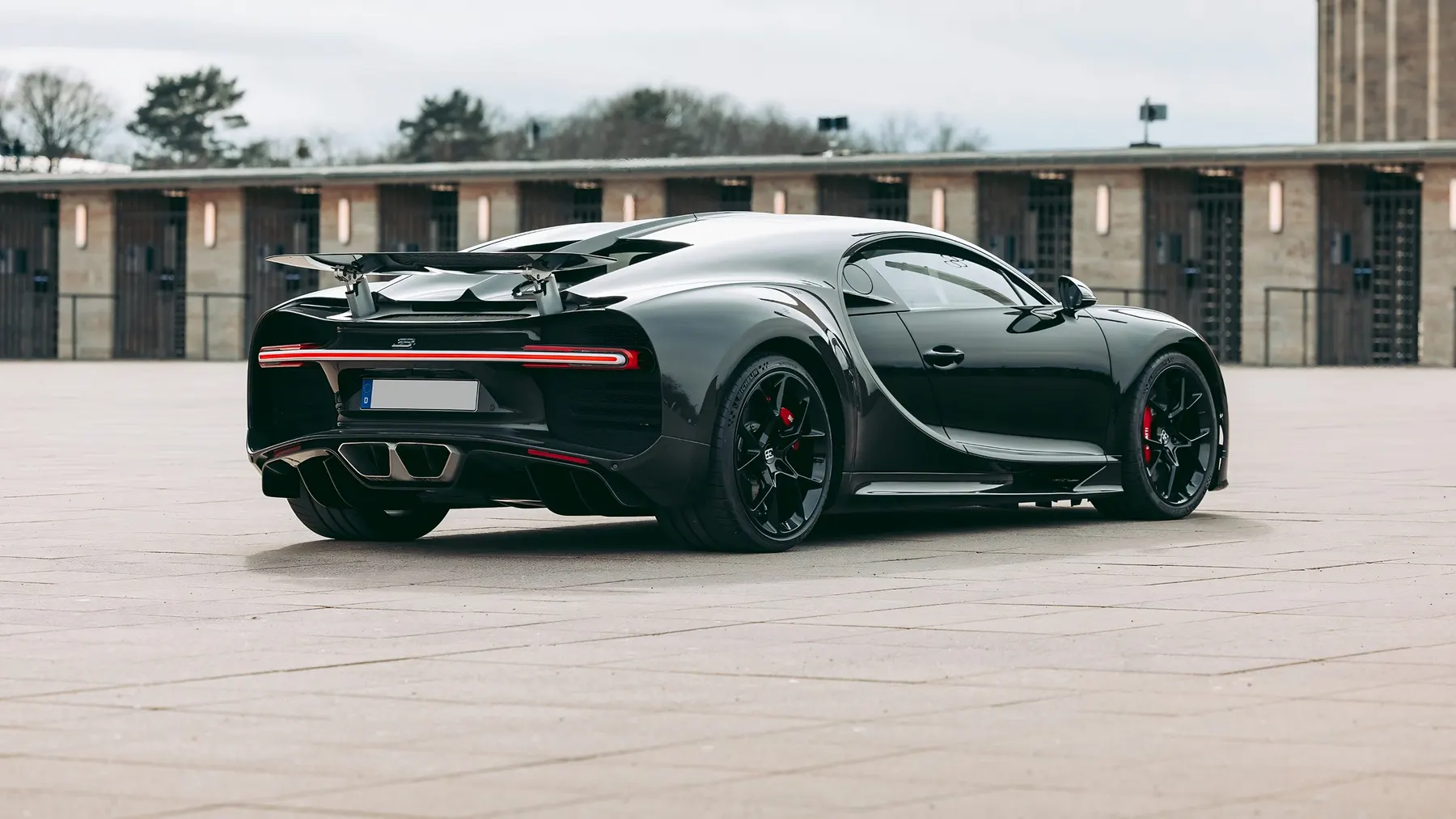
Judged as a piece of engineering, most of the Chiron’s flaws are the product of what it was trying to be rather than any failure of execution. It is heavy because it was built to be composed and stable at nearly twice the speed most supercars ever see; it is thirsty because its engine has to sustain over 1,500bhp for minutes at a time rather than in bursts; its rear view is compromised because the machinery behind the driver is more dramatic than almost anything ahead of them. Bugatti never set out to build the most agile car in its class, and by its own reviewers’ accounts it isn’t one - but as the fullest expression of a W16 engine concept unique in automotive history, and as the car that proved a production vehicle really could exceed 300mph, it closed out its era having done precisely what it set out to do.
Technical data
Performance Specifications
| Variant | Production | Power | Torque | 0–62mph | Top speed | Kerb weight | Units built |
|---|---|---|---|---|---|---|---|
| Chiron | 2016–2024 | 1,479bhp @ 6,700rpm | 1,180lb-ft @ 2,000–6,000rpm | <2.5 sec | 261mph (420km/h, governed) | ~1,995kg | Shares 500-car Chiron family total |
| Chiron Sport | 2018–2021 | 1,479bhp @ 6,700rpm | 1,180lb-ft @ 2,000–6,000rpm | <2.5 sec | 261mph (420km/h, governed) | ~1,977kg* | Shares 500-car Chiron family total |
| Chiron Pur Sport | 2020–2022 | 1,479bhp @ 6,900rpm redline | 1,180lb-ft @ 2,000–6,000rpm | <2.5 sec (unrevised by Bugatti) | 218mph (351km/h, governed) | ~1,945kg* | 60 |
| Chiron Super Sport | 2021–2024 | 1,578bhp @ 7,050rpm | 1,180lb-ft @ 2,250–7,000rpm | 2.4 sec | 273mph (440km/h, claimed)† | ~1,995kg* | Shares 500-car Chiron family total |
| Chiron Super Sport 300+ | Record car 2019; 30-unit run 2021–2022 | 1,578bhp @ 7,050rpm | 1,180lb-ft @ 2,250–7,000rpm | 2.4 sec | 304.8mph record (490.5km/h, unrestricted prototype) | ~1,995kg* | 30 |
Sources
- Bugatti Newsroom: Geneva International Motor Show 2016 press release
- Bugatti Newsroom: Monterey Car Week 2016
- Bugatti Newsroom: Bugatti breaks the 300 mph barrier
- Bugatti Newsroom: Chiron Super Sport 300+ – a gift to celebrate the record
- Bugatti Newsroom: First Bugatti Chiron Super Sport 300+ Ready for Launch
- Bugatti Newsroom: Final World Record-Breaking Chiron Super Sport 300+ Delivered
- Bugatti Newsroom: ‘L’Ultime’ – celebrating the end of the incomparable Chiron era
- Bugatti Newsroom: Chiron Pur Sport – a pure driving machine
- Bugatti Newsroom: Fine-tuning the Chiron Pur Sport on the test track
- Bugatti Newsroom: Interior design – reduction to the essentials
- Bugatti Newsroom: Bugatti Rimac – Bugatti and Rimac begin cooperation in a new company
- Bugatti Newsroom: The Bugatti Chiron Profilée – an automotive solitaire
- evo: Bugatti Chiron review
- Hagerty Media: Driving the Bugatti Chiron is like being launched into luxurious orbit
- Top Gear: Bugatti Chiron Sport first drive review
- Top Gear: Bugatti Chiron – Driving, Engines & Performance
- Autocar: Bugatti Chiron review
- Christian Science Monitor: Bugatti Chiron makes $2.6 million debut at Geneva Motor Show
- carbuzz: 2022 Bugatti Chiron Pur Sport pricing, photos & specs
- carbuzz: Bugatti Chiron Sport first drive review
- autoevolution: Bugatti Chiron – all models by year
- Auto&Design: Bugatti Chiron – forma & performance
- Bloomberg: Bugatti Tourbillon hybrid supercar replaces Chiron
- Bloomberg: Bugatti announces new variant, a $3.9 million Chiron Super Sport
- Gulf News: Dh14.25 million Bugatti Chiron Super Sport makes 1,578bhp
- Cars.co.za: Bugatti unleashes 420 kph Chiron
- SlashGear: Driving the $3m Bugatti Chiron was nothing like I expected
Join the discussion
Comments
Loading comments…
Leave a comment
Share a detail, memory, or perspective. Every comment is reviewed before publication.