The Kaiser-Darrin Roadster: America's First Fiberglass Sports Car Had Doors That Slid Into the Fenders
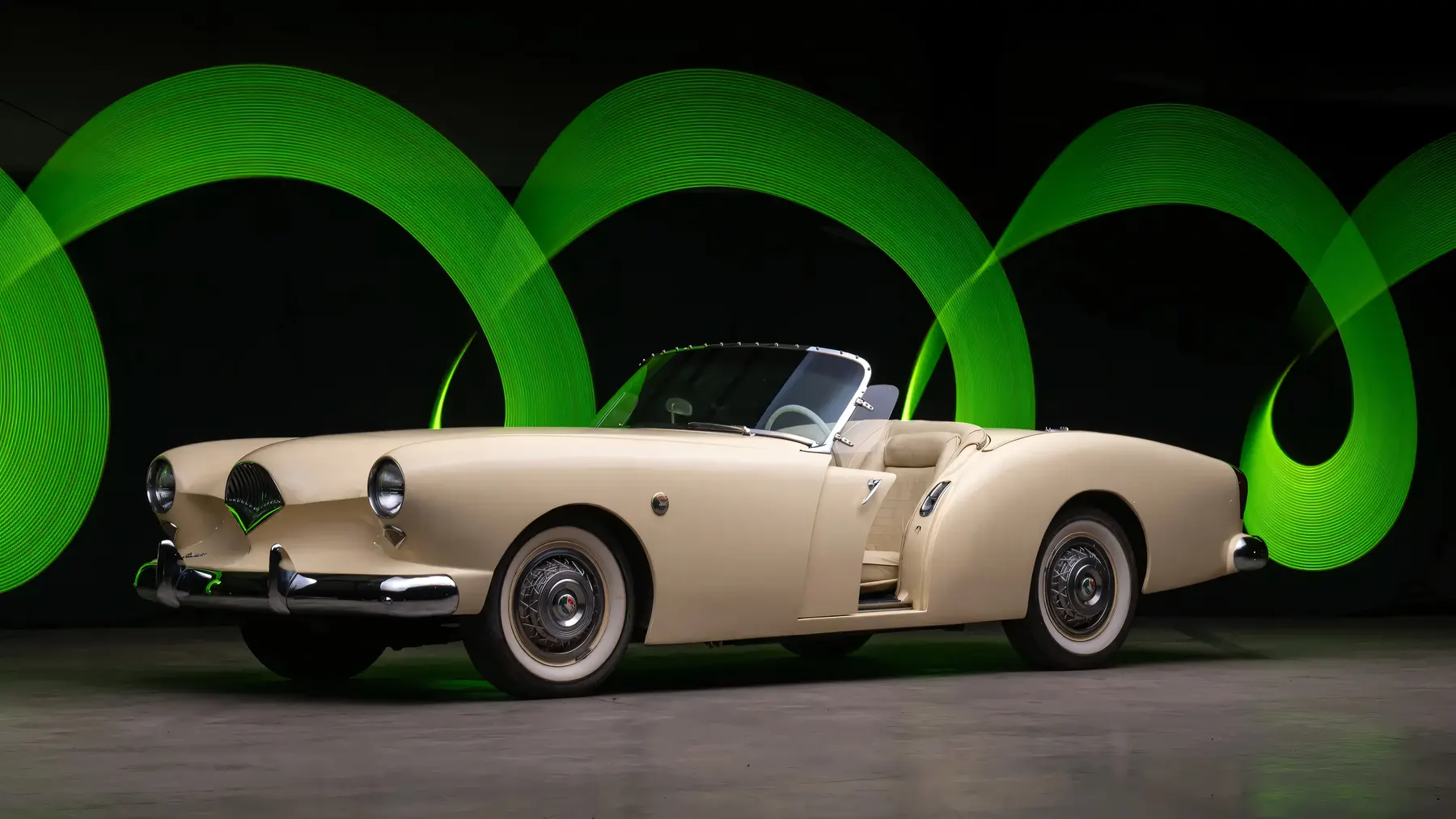
1954 Kaiser-Darrin Roadster




Images: Darin Schnabel / RM Sotheby's
When Howard Darrin unveiled his sliding-door roadster prototype to Henry J. Kaiser in 1952, the industrialist was reportedly furious - not impressed. It took Mrs. Kaiser’s enchantment with the design to convince her husband that the car deserved a chance at production. That single domestic moment of persuasion gave the world one of the most daring, misunderstood, and genuinely beautiful American automobiles of the postwar era: the Kaiser-Darrin.
Born from Darrin’s conviction that Kaiser’s Henry J compact platform was capable of something far more expressive than its boxy production guise, the Darrin was designed entirely on his own initiative and, crucially, with his own money. Darrin - already a legend of coachbuilt design whose pre-war work for Packard and European clientele had established him as one of America’s most visually literate automotive stylists - completed a clay model in early 1952 and engaged Bill Tritt of Glasspar to fabricate a fiberglass prototype body. The resulting car made its formal public debut at the 1953 New York Auto Show and entered production on 6 January 1954, priced at $3,668.
The Darrin sits at a genuinely contested but fascinating historical crossroads. The prototype predated the Chevrolet Corvette’s public appearance, though production timing and the exact sequence of who showed fiberglass to America first has been argued over for decades. What is indisputable is that the Kaiser-Darrin arrived as a production car before Detroit’s big players had truly committed to the idiom - and it did so on the platform of a company already haemorrhaging money. Built on the Henry J’s shortened 2,438mm wheelbase, the Darrin’s Glasspar-made fiberglass body was crafted panel by panel in a process that was still more craft than industry in 1954.
The styling remains one of the great what-ifs of American automotive design. Darrin’s signature “rosebud” grille - a soft, pursed oval rather than the chrome-toothed aggression favoured by his contemporaries - gave the car a face unlike anything else on American roads. The front fenders sweep in long, confident arcs and then drop dramatically behind the door aperture in what became known as the “Darrin dip,” a flourish that owes more to Italian coachbuilding sensibility than anything coming out of Detroit. The three-position Landau convertible top - operable as a full convertible, a coupe de ville, or a closed coupe - deliberately echoed the pre-war coachbuilt tradition that had made Darrin’s early reputation, and it gave the Darrin an elegance that the Corvette, with its far simpler hood arrangement, never quite matched.
Then there are the doors. Sliding forward on tracks into the front fender wells rather than swinging outward in the conventional manner, the Darrin’s “pocket” doors were the car’s most radical engineering choice and the detail that Darrin himself championed with near-evangelical fervour for the rest of his life. His argument was practical as much as aesthetic: doors that disappear into the bodywork cannot swing into traffic, cannot be torn off by passing lorries, and cannot injure cyclists or pedestrians. The mechanism worked, too - though the tracks required precise alignment and the doors were occasionally temperamental in the way that any pioneering engineering tends to be. At speed, the design eliminated the possibility of a door flying open in a corner, a very real concern with the light latches common to 1950s American cars.
The powertrain tells a more modest story. Willys’ 161-cubic-inch inline six - the “Hurricane” engine, shared with the Willys Jeep and various civilian Willys vehicles - produced 90 bhp and was available behind either a three-speed manual (with or without overdrive) or a Hydra-Matic automatic sourced from General Motors. With the Darrin’s lightweight fiberglass body keeping kerb weight in check, the car was a reasonable performer for its era, but no one was going to mistake it for a Ferrari. Contemporary road tests found the manual-overdrive example capable of around 97 mph flat out, with the automatic version notably less spirited. Darrin himself, clearly aware of this limitation, is said to have installed supercharged Cadillac V8 engines in a number of the unsold examples he later purchased - a retrofit that rather proved the original engine’s inadequacy for the sports car brief.
What the car lacked in straight-line performance it compensated for with genuine driving character. The Henry J’s simple but light structure gave the Darrin responsive, if not precisely communicative, handling for an American car of the period. Rack-and-pinion steering was absent - Kaiser was not working with unlimited resources - but the overall package felt tossable and alive compared to the boulevard barges that surrounded it in American showrooms. The ride quality was firm enough to feel sporting without the bone-jarring harshness that afflicted some European contemporaries. As a long-distance open-top companion rather than a circuit-day tool, the Darrin made considerable sense.
The tragedy was institutional rather than automotive. Kaiser-Frazer, the company behind the car, had been struggling against the entrenched might of the Big Three since the late 1940s, and the financial position by 1953 was precarious at best. The Darrin’s production run of 435 units across a single model year was not a reflection of public indifference so much as corporate collapse; Kaiser ceased American car production in 1955, just months after the Darrin reached dealers. The cars that remained unsold when the curtain came down were purchased by Darrin himself, who retailed them from his Los Angeles showroom - sometimes with the aforementioned Cadillac engine transplants for buyers who wanted proper performance to accompany the extraordinary styling.
The critical reception at launch was warm but tinged with the same reservations that followed fiberglass construction generally in the early 1950s. Conservative buyers were suspicious of a body material associated with boats and novelty, and the Henry J underpinnings were well known enough to give some sports car enthusiasts pause. The automotive press admired the design while noting the powertrain’s limitations honestly. In retrospect, however, the Darrin has gathered a reputation that far exceeds what those 435 production numbers might suggest. It occupies a singular position as a car that was technically audacious, visually distinctive, and commercially unlucky in equal measure - qualities that tend to generate reverence rather than indifference as the decades pass.
Howard Darrin was inducted into the Automotive Hall of Fame, a recognition that acknowledges his broader career but that also implicitly validates the Darrin roadster as his most complete and personal statement. The car he designed without permission, funded himself, and eventually had to sell himself out of a California dealership is now regarded as one of the essential American automobiles of the 1950s - not despite its obscurity, but in some ways because of it. It never had the marketing muscle of the Corvette or the celebrity of the Thunderbird; it survived on the strength of the design alone.
Join the discussion
Comments
Loading comments…
Leave a comment
Share a detail, memory, or perspective. Every comment is reviewed before publication.