The 1955–57 Ford Thunderbird: A Sports Car That Refused to Be One
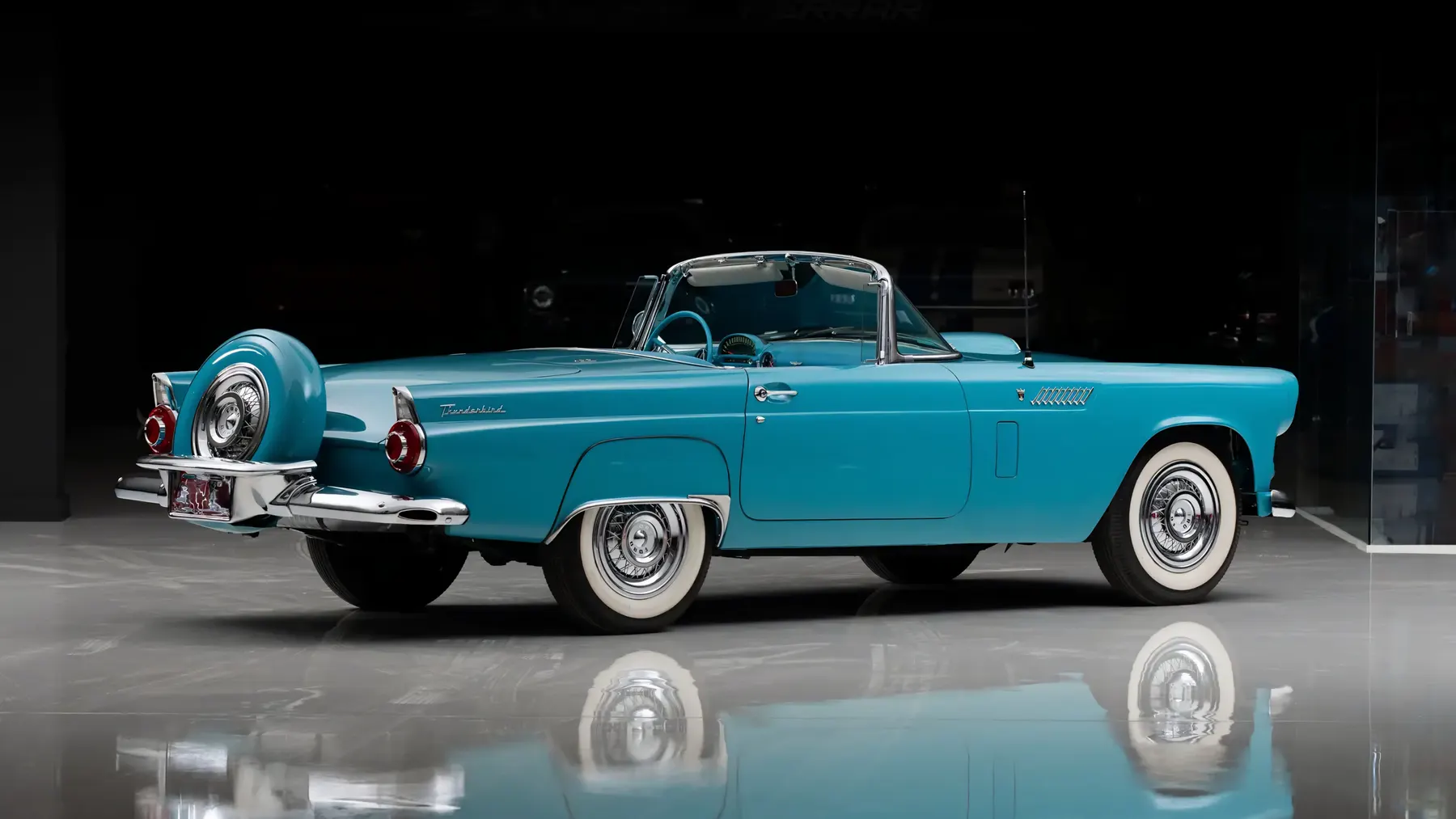
1956 Ford Thunderbird
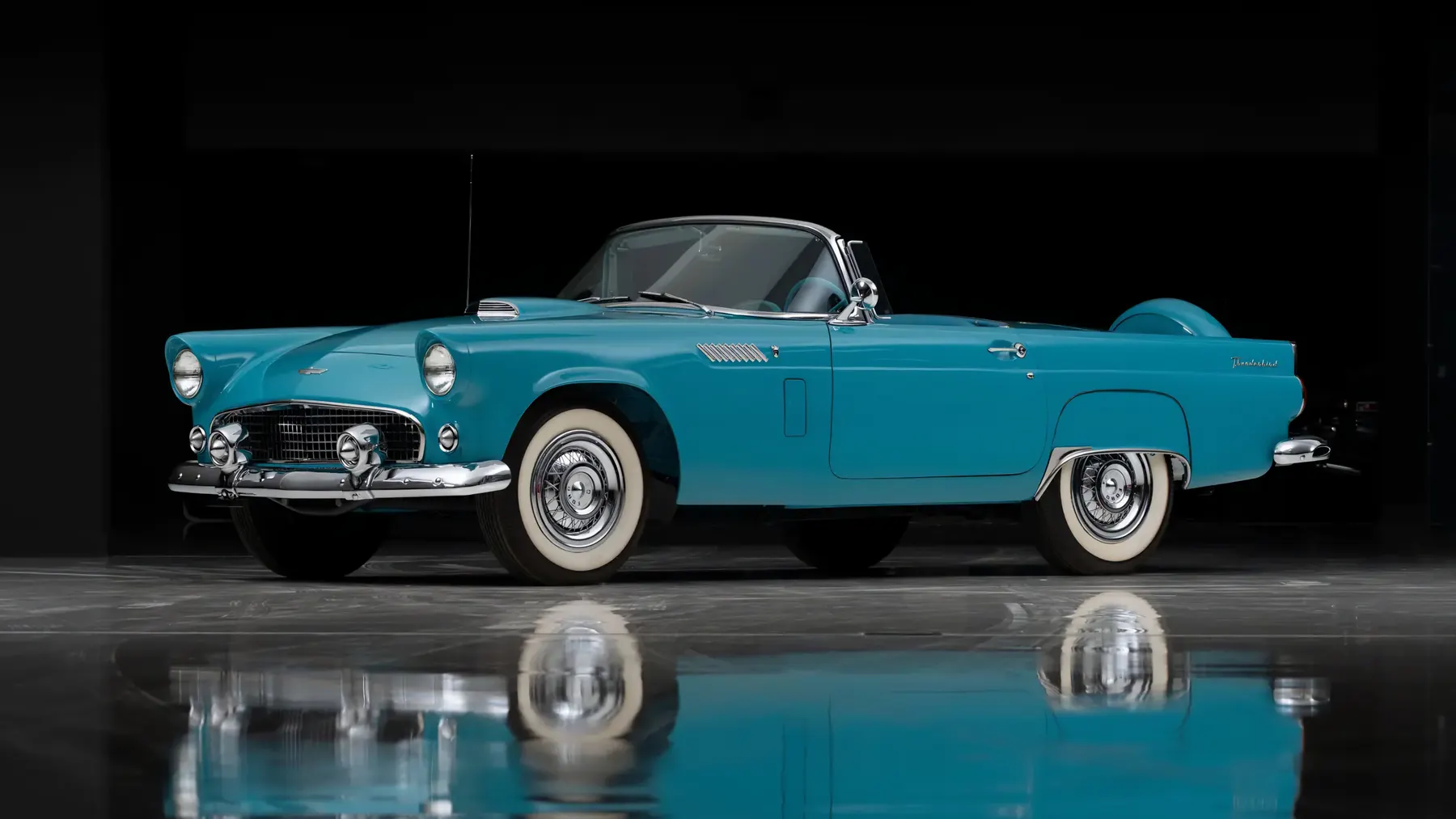
Images: Darin Schnabel / RM Sotheby's
The Ford Thunderbird arrived in 1955 carrying a label that Ford’s own marketing team insisted was not “sports car.” It was a personal car - a phrase that sounds like corporate hedging until you examine what Ford actually built and why that distinction proved more commercially and culturally significant than anyone in Dearborn could have predicted. In three model years, across three modest visual evolutions and roughly 53,000 examples, the first-generation Thunderbird established a definition of American automotive desirability that the sports car, at that precise moment in history, could not provide.
The context begins with the Corvette. Chevrolet launched its fibreglass two-seater in 1953 to modest press interest and disappointing sales. Early Corvettes came with a six-cylinder engine, clumsy plastic side curtains instead of glass windows, and a character that was closer to auto-show exhibit than genuine sports car. Ford watched the Corvette’s struggle and drew a different conclusion from it than Chevrolet did: not that American buyers did not want a stylish two-seater, but that they wanted one that worked as a proper car. When stylist Bill Boyer and design director George Walker’s team developed the project through 1953 and 1954, the brief explicitly included roll-up glass windows, a properly trimmed interior, a working heater, and provision for air conditioning. Power steering and power brakes would be available options. This was a performance-adjacent vehicle for someone who wanted to look as though they drove with intent, without actually having to suffer for it.
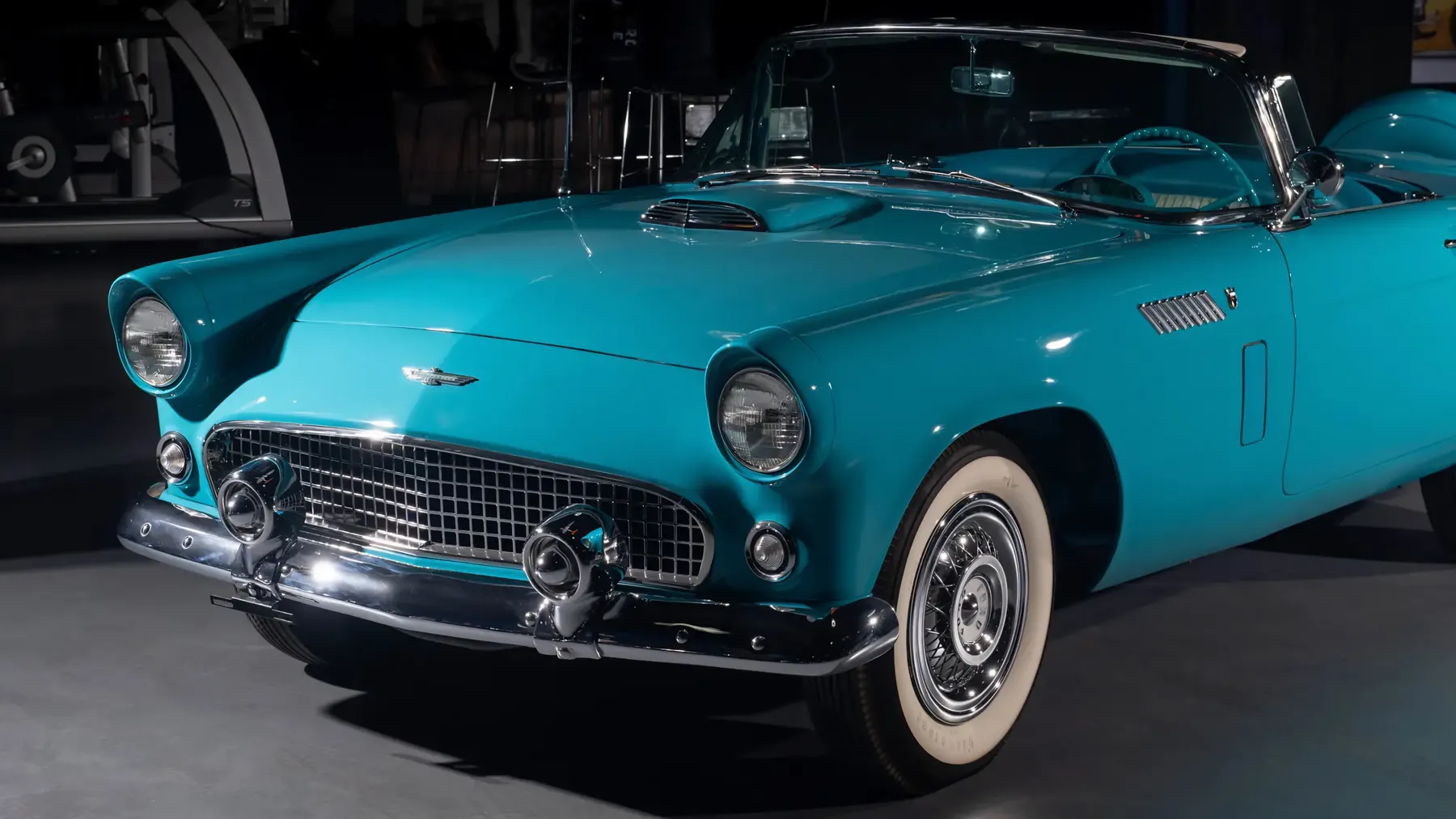
The 1955 Thunderbird rode on a 2,591mm wheelbase and was powered by Ford’s 292 cubic inch Y-block V8. In standard trim this produced approximately 193 bhp, rising to around 198 bhp with the optional Power Pack - a combination of four-barrel carburettor and dual exhausts. The Y-block designation referred to the engine’s deep-skirted block, in which the cylinder walls extended substantially below the crankshaft centreline, giving it a distinctive Y-profile in cross-section when viewed from the front. Ford had introduced the overhead-valve Y-block in 1954 to replace the long-lived flathead V8, and it was a genuinely modern piece of engineering for its moment. In a car weighing around 1,360 kg, the 292 delivered relaxed, flexible performance rather than anything ragged or demanding. A three-speed manual gearbox was available, though the Ford-O-Matic automatic outsold it significantly - a fact that told you everything about who was actually buying these cars and what they expected from them.
The styling was the thing, and it was excellent. The long bonnet, the circular taillights, the egg-crate grille, and the clean flanks gave the Thunderbird a coherent, confident identity that felt neither derivative of European sports car conventions nor simply a shortened American saloon. The optional removable hardtop transformed the car’s silhouette entirely, and the ability to swap between it and the soft top gave owners a flexibility that felt considered rather than compromised. Commercially, the gamble paid off immediately: the Thunderbird outsold the Corvette with little difficulty in 1955, Ford delivering approximately 16,155 cars against Chevrolet’s 700. Ford’s fundamental bet had been vindicated within twelve months of launch.
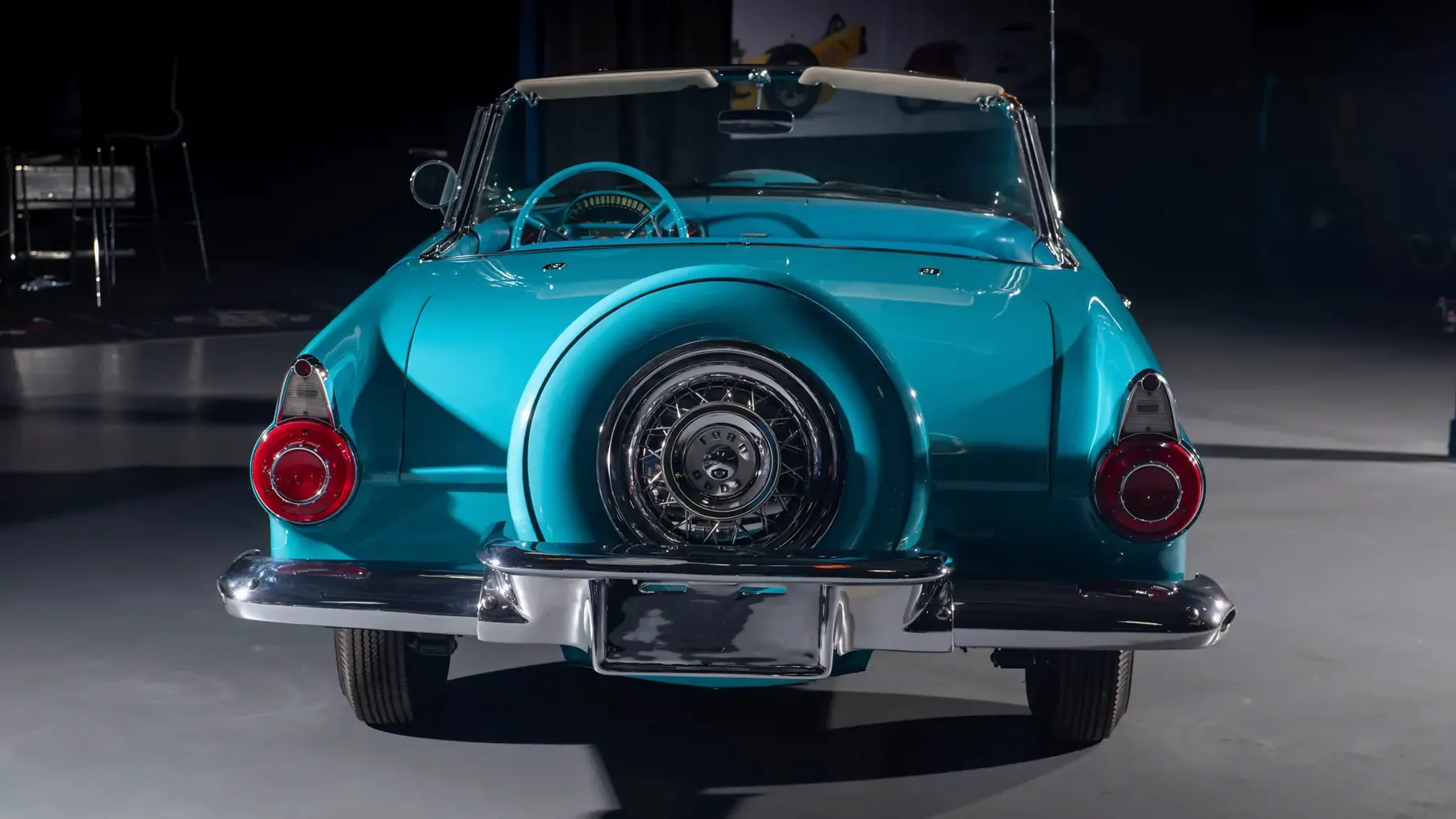
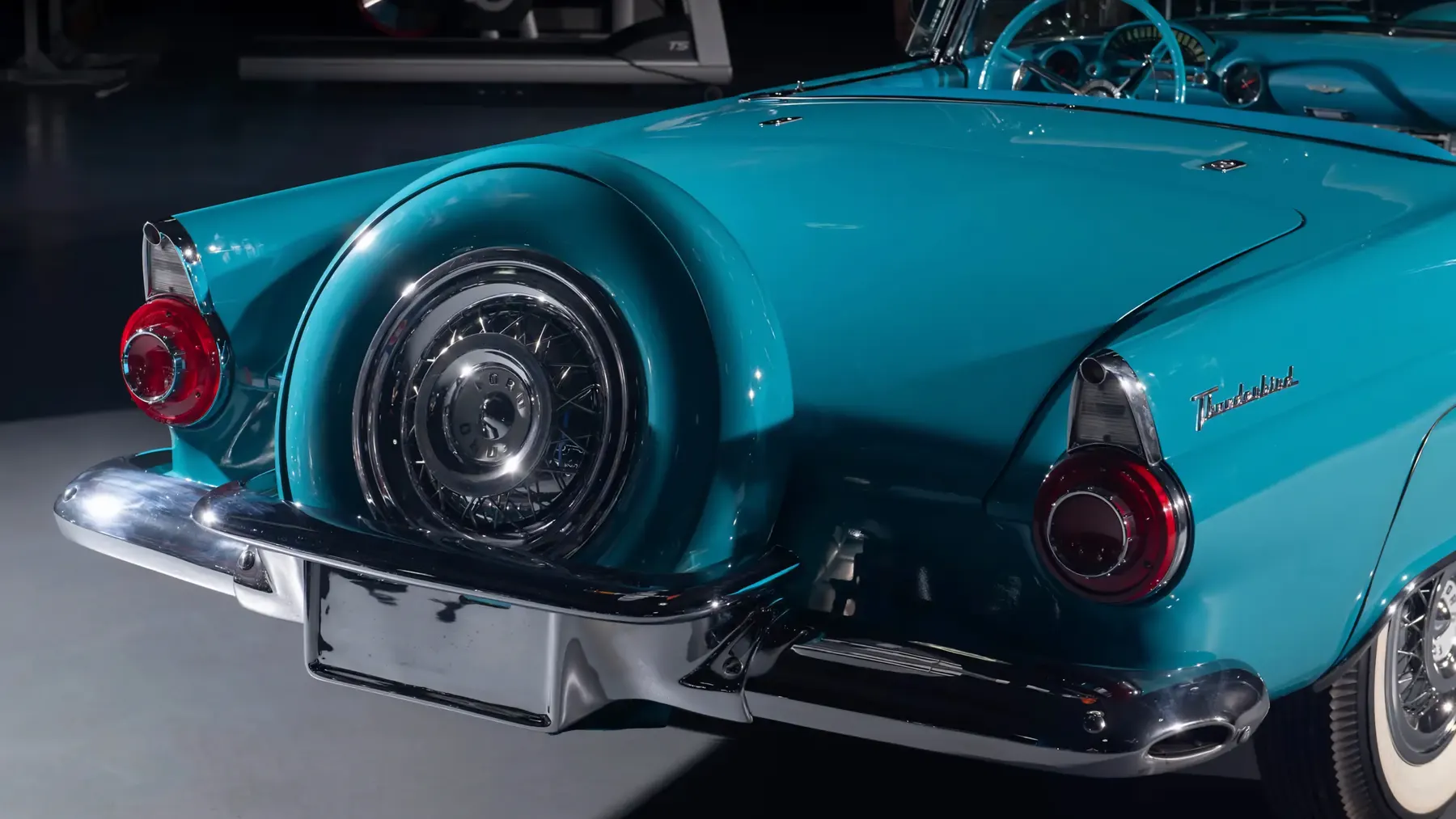
The 1956 revisions were modest but significant in what they acknowledged. The original hardtop had attracted immediate criticism for poor rearward visibility - the thick sail panels created substantial blind spots - and Ford’s solution was to cut circular porthole windows into the hardtop on either side. It solved the visibility problem and looked, if anything, better than the original, a rare case of a fix improving the car aesthetically as well as practically. That year also introduced the external continental spare tyre kit as an option. The spare wheel’s home inside the boot had left so little luggage space that Ford offered to relocate it outside, mounted above the rear bumper on a decorative bracket. It was period-correct in appearance and gave buyers back their boot, but it was fundamentally a packaging workaround dressed in chrome, adding length and mass to address a problem that should have been designed out earlier. The 312 cubic inch version of the Y-block joined the options list for 1956, broadening the performance range and making the car feel more genuinely brisk in its upper states of tune.
By 1957, the Thunderbird’s styling had found its most assured expression. The rear fins had grown more pronounced, the front end was revised with a wider and lower grille, and the overall proportions carried the settled confidence that the 1955 original, attractive as it was, had not quite achieved. Power outputs increased across the board, and the 312 V8 was available in several configurations. The most potent was the supercharged F-code, using a Paxton centrifugal supercharger to produce approximately 300 bhp - the most performance-oriented machine the first-generation range offered. There were also dual four-barrel carburettor variants, and for a brief, troubled period Ford offered a fuel injection option on the 312, though this proved unreliable in service and very few were produced. The 1957 car is now the most consistently collectible of the three first-generation years, with F-code supercharged examples sitting at the apex of any serious appreciation.
Understanding what the Thunderbird actually felt like to drive requires separating it firmly from the sports car template it superficially resembled. The front suspension was conventional and the steering - recirculating ball, with power assistance available - provided limited feedback. Body roll was generous in corners. The drum brakes on all four wheels were adequate in period but offered nothing in reserve under real load, and the car’s appetite for exploring a corner quickly was simply not great. This was by design as much as by circumstance: the Thunderbird was built on a full-length ladder frame derived from Ford’s passenger car architecture, sharing its fundamental engineering with vehicles that were never intended to attack a mountain road. In a straight line the 312-engined cars felt strong, and with the supercharger fitted the 1957 F-code was legitimately rapid by any standard of the era, but lateral dynamics were never the point. Contemporary European alternatives - a Triumph TR3, an Austin-Healey 100 - offered more driving involvement at the cost of comfort, weather protection, and mechanical sophistication. Ford knew this and considered the trade explicitly worthwhile.
The Y-block V8 brought its own complications, and these deserve honest treatment. Ford’s engine family had a documented tendency toward oil sludge accumulation in the valve covers, caused by poor drain-back geometry that allowed oil to pool rather than return cleanly to the sump. Pushrod wear was a known consequence of deferred maintenance, and the issue was not a hidden factory secret but a recognised characteristic among knowledgeable owners. These were predictable problems rather than catastrophic failures - manageable for diligent owners and correctable in restoration - but they complicate the car’s reputation as an effortless period classic. Cars that passed through neglectful ownership chains could arrive with Y-blocks in variable condition, and restorers today know to inspect the oiling system carefully before assuming anything about engine health.
The deepest criticism of the first-generation Thunderbird is inseparable from what Ford chose to do next. After three years of building something with a genuine and distinctive character - a two-seat American car with cultural cachet, commercial success, and a clear identity - Ford moved the Thunderbird to a four-seat platform for 1958. The logic was rational: surveys suggested buyers wanted a rear seat, and a broader car could serve a broader market. The 1958 Squarebird did indeed sell in greater numbers than any single first-generation year. But the 1958 car weighed substantially more, rode on a wheelbase roughly 280mm longer, and abandoned everything that had made the original feel personal in the literal sense of the word. What had been an intimate two-seat proposition became a roomy, squared-off personal luxury saloon. Ford’s commercial instincts were correct - the Squarebird found buyers and the Thunderbird nameplate survived for decades - but the qualitative case is harder to argue. The decision to expand the car into a four-seater was profitable and rational, and it was also the end of what the name had originally meant.
That original meaning, though, left a trace well beyond the three years it lasted. The personal car concept the Thunderbird pioneered - style, presence, and comfort coexisting in a two-door package without demanding sporting commitment from its driver - became one of the defining generative ideas of American car culture through the 1960s. The Thunderbird did not invent the pony car, but it posed the question that made one inevitable, and the direct line from its success to the 1964 Mustang’s development brief is clearly visible in Ford’s own product planning history. The beach culture and early rock-and-roll era absorbed the T-Bird into its visual language almost immediately, and the car’s silhouette - particularly the hardtop with its porthole windows - became a shorthand for a specific kind of mid-century American optimism that photographs and films of the period still communicate effortlessly.
In the current classic market, first-generation Thunderbirds circulate with reasonable frequency, and the Y-block engine community is well supported for parts and rebuilding knowledge. The 1957 cars attract consistent premiums, particularly in supercharged configuration. The 1955 carries a first-year purity that specialists value. The 1956 occupies a curious middle position - arguably the most mechanically resolved and genuinely usable of the three, but rarely the first choice for collectors whose interest is partly emotional. All three years offer something the Squarebird and every subsequent Thunderbird generation cannot: the specific quality of a car that set out to be exactly what it was, without apology, and succeeded completely within the terms it set for itself.