Mercedes-Benz 560 SEC AMG 6.0 Wide-Body: The Coupé AMG Couldn't Leave Alone
1989 Mercedes-Benz 560 SEC AMG 6.0 'Wide-Body'




Images: Juan Martinez / RM Sotheby's
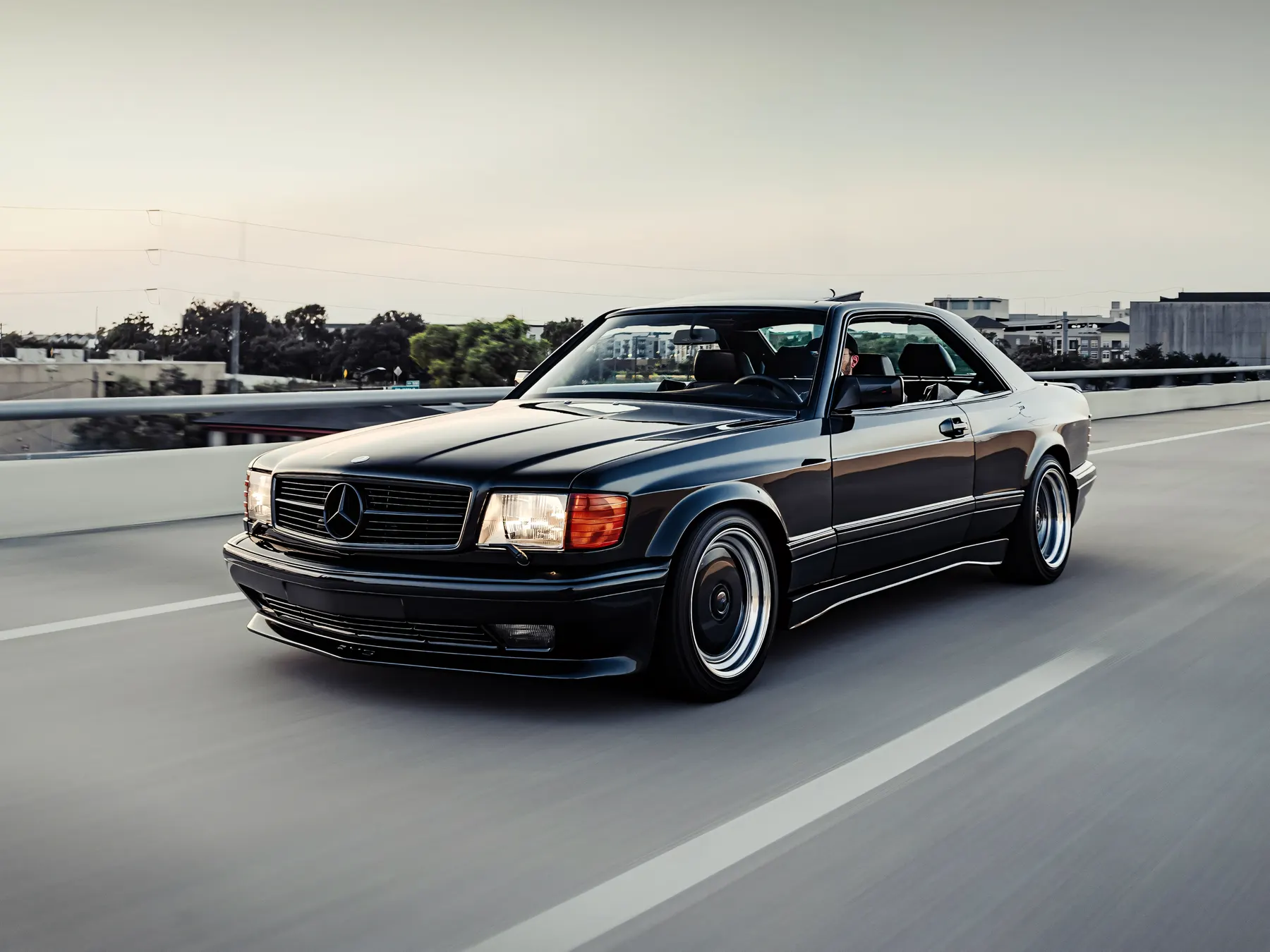
Bruno Sacco’s own verdict on the C126 coupé, as Auto Bild Klassik reported it, was that there was nothing on it to tinker with. Nobody passed that on to AMG. In the second half of the 1980s the Affalterbach firm took the biggest, costliest and most composed Mercedes-Benz coupé of its day, the 560 SEC, and did exactly what its designer thought unnecessary. It bored the V8 out to six litres, fitted its own four-valve cylinder heads, hand-assembled wider wings and door panels to cover wheels the standard car could never have swallowed, and, by one German account, charged about twice what a showroom 560 SEC cost. The result is the 560 SEC AMG 6.0 Wide-Body, or Widebody to many enthusiasts, and the name is really three statements stacked together: a nominal 5.6-litre S-Class coupé, a six-litre engine and a body kit. AMG sold the engine work and the Wide-Body panels as separate packages, which matters more than it first sounds.
AMG’s position at the time was an odd one. Hans Werner Aufrecht and Erhard Melcher, both former Daimler-Benz engineers, founded the company in 1967, and by 1989 it was a roughly 150-person operation in Affalterbach. It was still independent: its first jointly developed car with Mercedes-Benz, the C36 AMG, did not arrive until 1993, and Mercedes took a controlling stake only in 1999 and full ownership in 2005. Yet the two were close enough that, according to RM Sotheby’s, AMG’s cars could be delivered with full manufacturer warranties through Mercedes dealers. The template had been set by the 1986 300 E 5.6 “Hammer”, a W124 saloon that hid a hand-assembled 32-valve M117 V8 behind restrained bodywork. The 560 SEC applied the same thinking to the flagship, and AMG’s appetite for the big coupé extended to the track, where an AMG-prepared 500 SEC ran at the 1989 Spa 24 Hours.
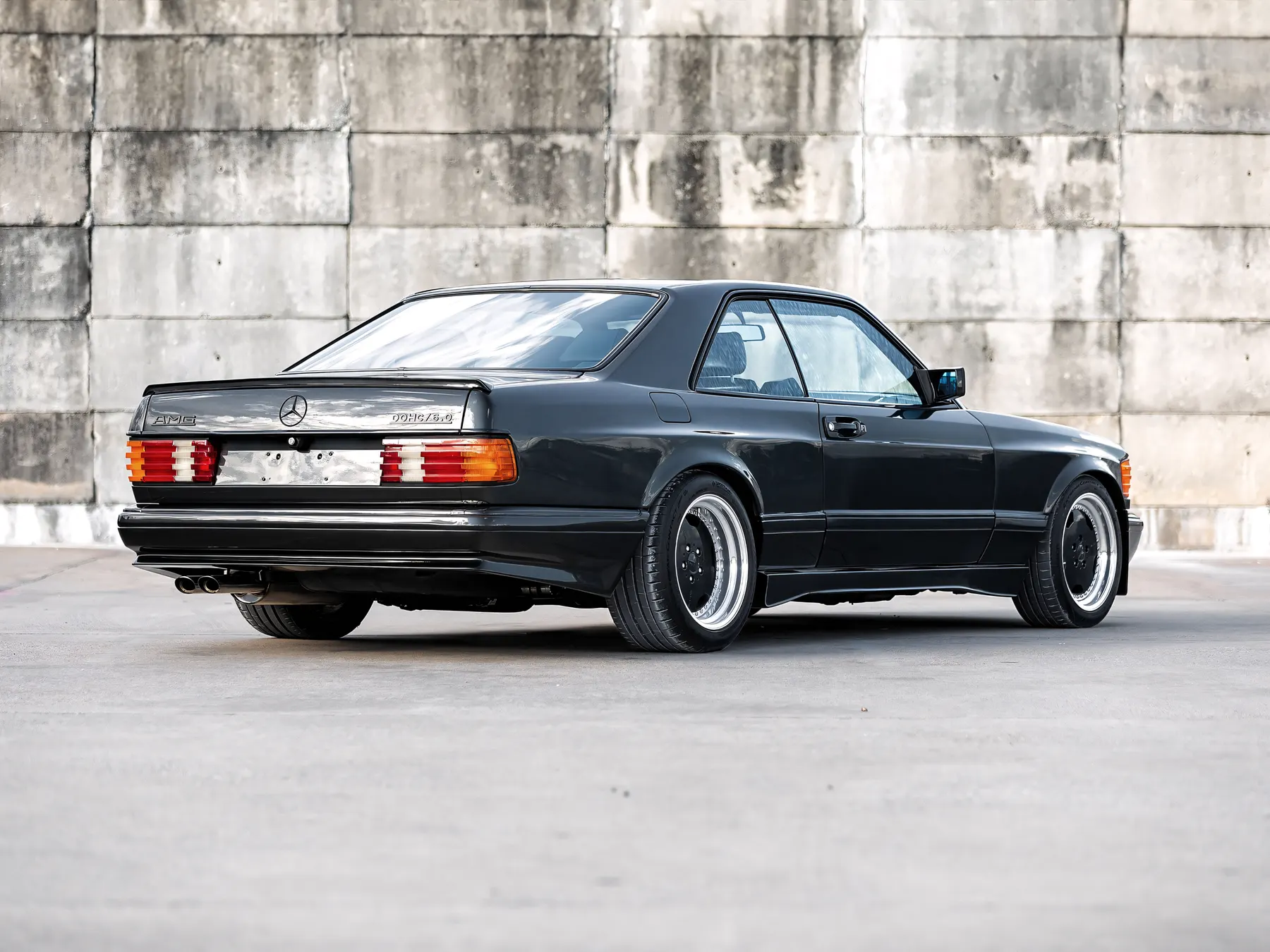
The SEC was already a favourite canvas for the tuning trade, and AMG was far from alone. Auto Bild Klassik lists Lorinser, Zender, Duchatelet and Styling Garage SGS among the houses that widened, gilded, decapitated and even gull-winged the coupé, while firmenauto recalls a six-litre Brabus quoted at roughly 380 bhp that ruled the fast lane. What set AMG’s car apart was that it began as an engine programme and treated the styling as a consequence, with a cylinder head developed from scratch rather than a bolt-on kit. The coupé’s image was never entirely spotless either; Auto Bild Klassik describes later owners dragging the dignified two-door into the red-light milieu. Just over 60 per cent of all SECs went for export, mostly to North America and the Middle East, so the customer base for any conversion was always international.
The donor deserves more credit than tuning mythology usually gives it. Mercedes-Benz introduced the SEC at Frankfurt in September 1981 as the two-door companion to the W126 S-Class, built until 1991 under Sacco’s design leadership. The 560 SEC joined at the September 1985 facelift as the range-topper, and fewer than 29,000 were made out of 74,060 C126 coupés in total. Its 5,547 cc M117 V8, called a 5.6 by courtesy of rounding, made about 295 bhp in unrestricted European form and noticeably less with a catalytic converter, which Auto Bild Klassik pairs with a 155 mph top speed and 0-62 mph in around 7.5 seconds. That was enough to match the V12 BMW 850i when it arrived in 1989, according to firmenauto. The SEC weighed 1,750 kg in basic trim, measured 4,935 mm in length on a 2,845 mm wheelbase, and came only with a four-speed automatic. It was also extremely expensive, listed at 133,600 DM in 1985 and 160,398 DM by June 1991, which Auto Bild Klassik calls the most costly German production car of its time. That is the car AMG’s customers started with, before the conversion bill arrived.
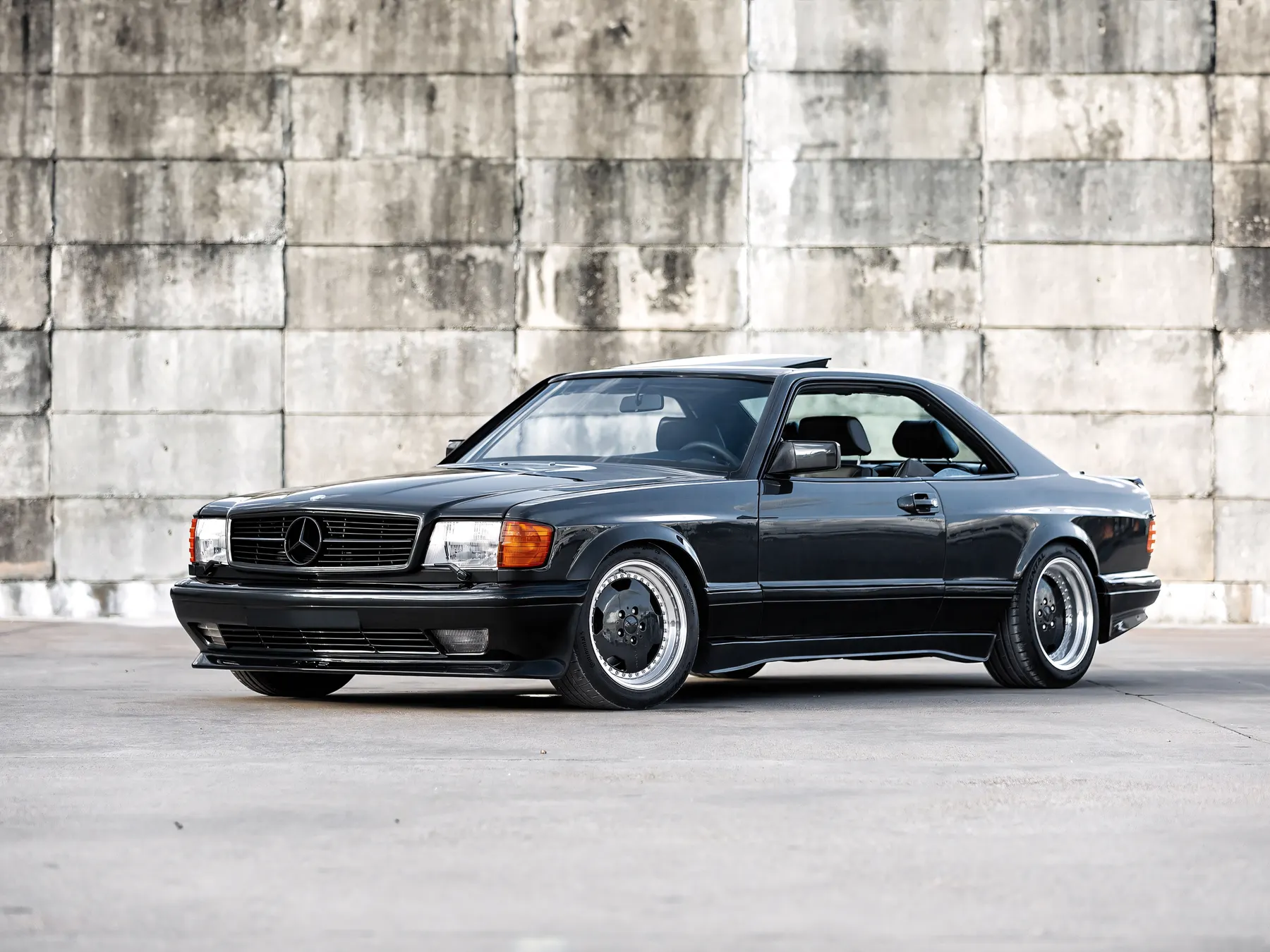
The engine was the substance of the conversion. AMG bored the standard V8 to 6.0 litres and replaced the heads with proprietary twin-cam, four-valve units, 32 valves in all, built up from sand-cast pieces and backed by hotter camshafts, a modified throttle body, a ported intake manifold and a freer-flowing exhaust. Auto Bild Klassik, describing the same engine in AMG’s six-litre saloon, says the heads cost a seven-figure sum to develop and had to be cast in sections to fit the standard block, with a narrow 30-degree valve angle because the head bolts would otherwise have been in the way. That is clever packaging, but it is also a compromise: a clean-sheet four-valve head would not have been shaped by someone else’s bolt pattern.
Output is quoted inconsistently. The commonest figures put the engine at around 380 bhp at 5,500 rpm and 410 lb-ft at 4,000 rpm, though sources range from roughly 375 to 385 bhp and from about 385 to 417 lb-ft. Set against the standard 560 SEC’s roughly 317 lb-ft at 3,750 rpm, a 410 lb-ft peak is a gain of about 30 per cent, which means the line repeated for decades, that the conversion delivers twice the torque at half the engine speed, cannot be a peak-to-peak comparison. It reads as marketing shorthand for stronger low-rpm response that nobody has quantified. Claimed performance is a 0-62 mph time under six seconds and a top speed above 177 mph; those remain claims, and rigorous period test data is hard to find. The late cars changed the engine again. By 1990 and 1991 AMG was building a hybrid it designated M117/9, which RM Sotheby’s describes as a transitional design combining an early M119 block and heads with M117 ancillaries, producing roughly 375 bhp and credited with better robustness, reliability and serviceability than AMG’s earlier DOHC M117 engines. RM Sotheby’s also describes it as the last V8 model AMG released before being absorbed into the Mercedes-Benz corporate structure.
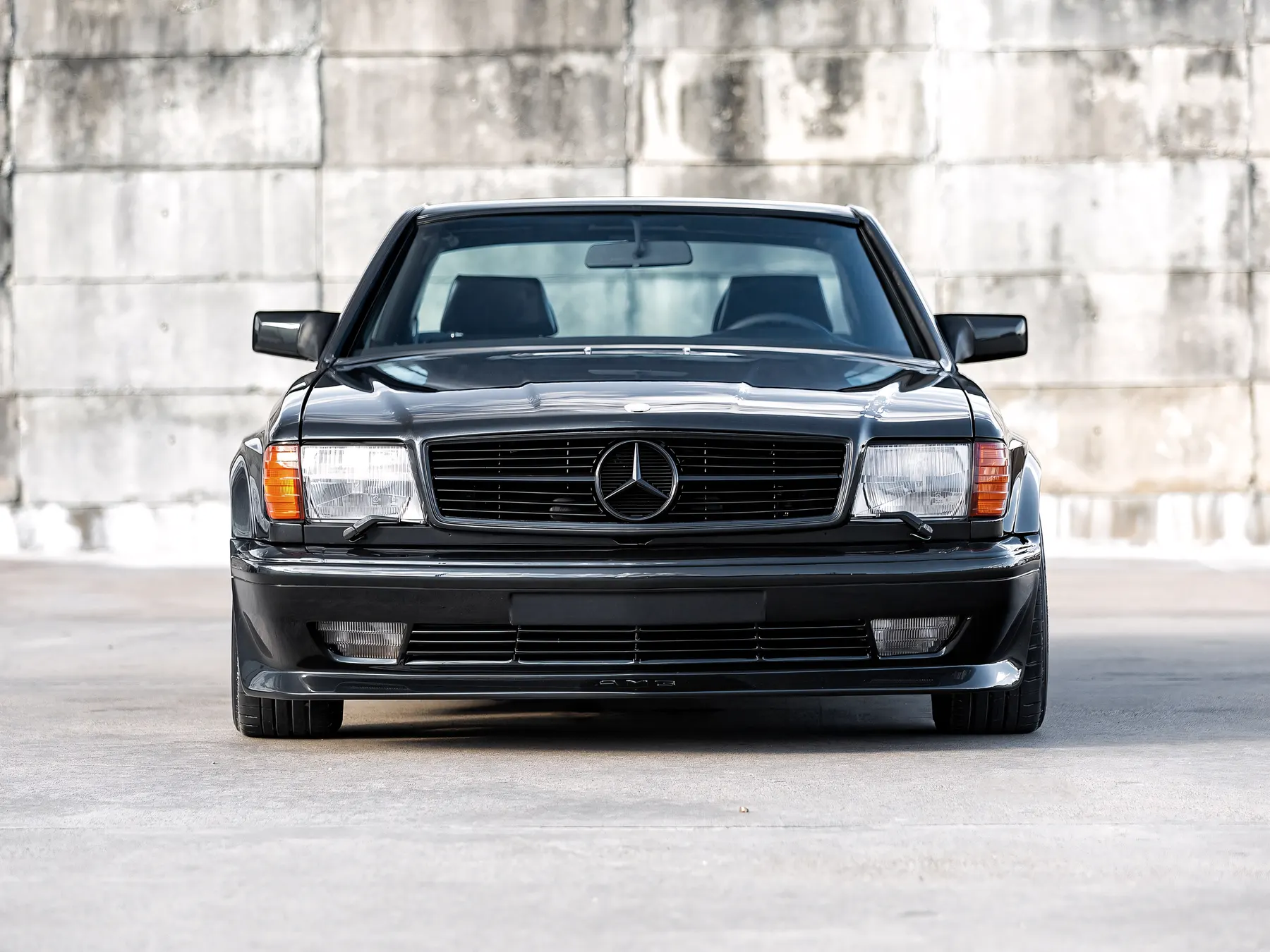
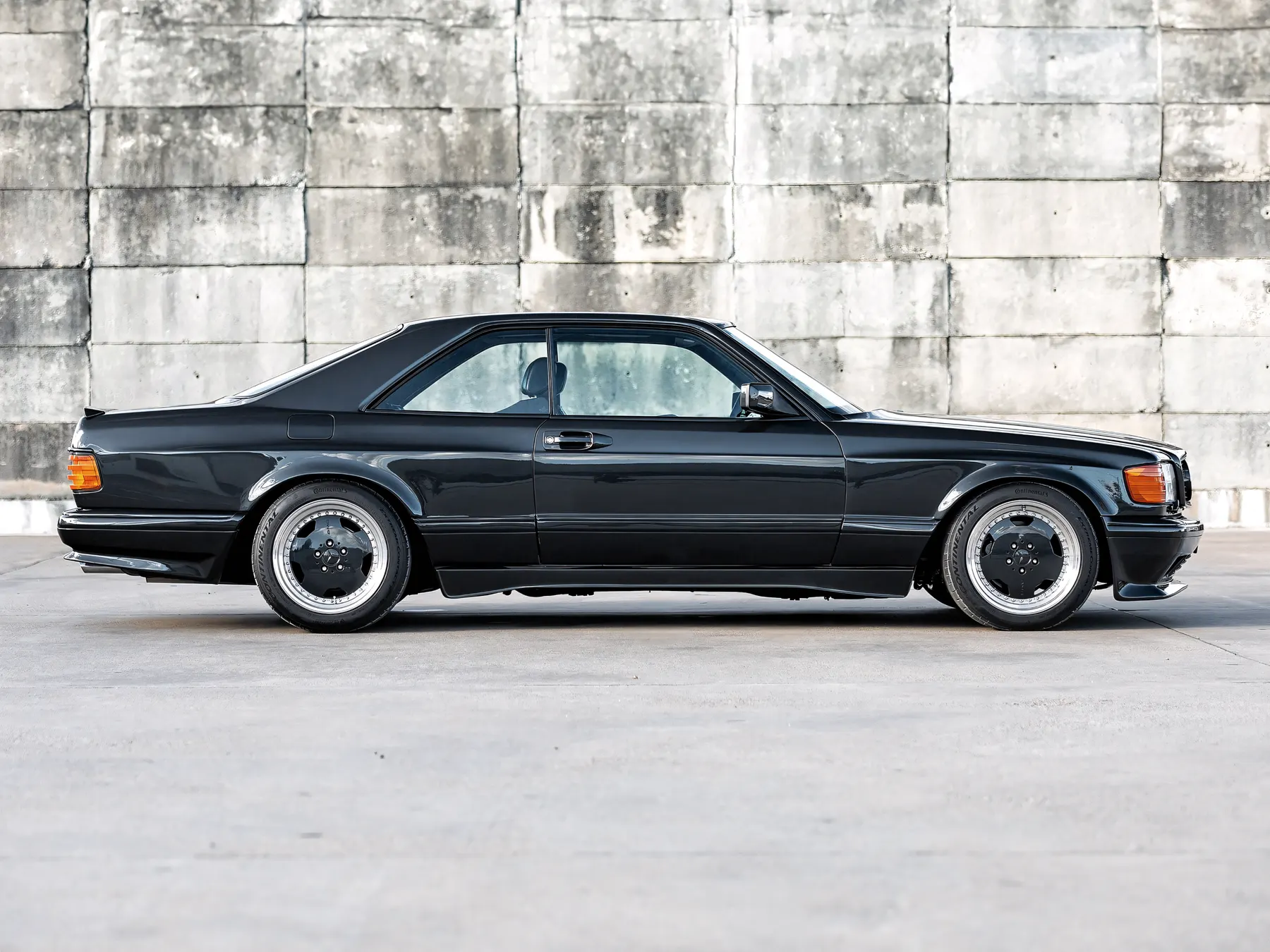
The Wide-Body was more than flared arches. RM Sotheby’s describes AMG-designed front and rear wings and door panels, assembled by hand, plus “Gen II” ground effects, a label that suggests the kit evolved during the car’s life. They covered staggered three-piece 17-inch wheels, a long way from the 15-inch alloys and 215/65 tyres of a showroom 560 SEC. Behind them sat four-piston front calipers, larger discs, firmer springs, AMG-branded Bilstein dampers and a limited-slip differential. Inside, AMG largely left the Mercedes cabin alone, adding adjustable Recaro seats, a small AMG steering wheel made by Momo, white-faced instruments and extended burr walnut. The catalogue’s own phrasing is that the panels turned a graceful shape into a menacing one, and a restrained cabin behind that exterior is part of what made these cars feel like grand tourers rather than show cars.
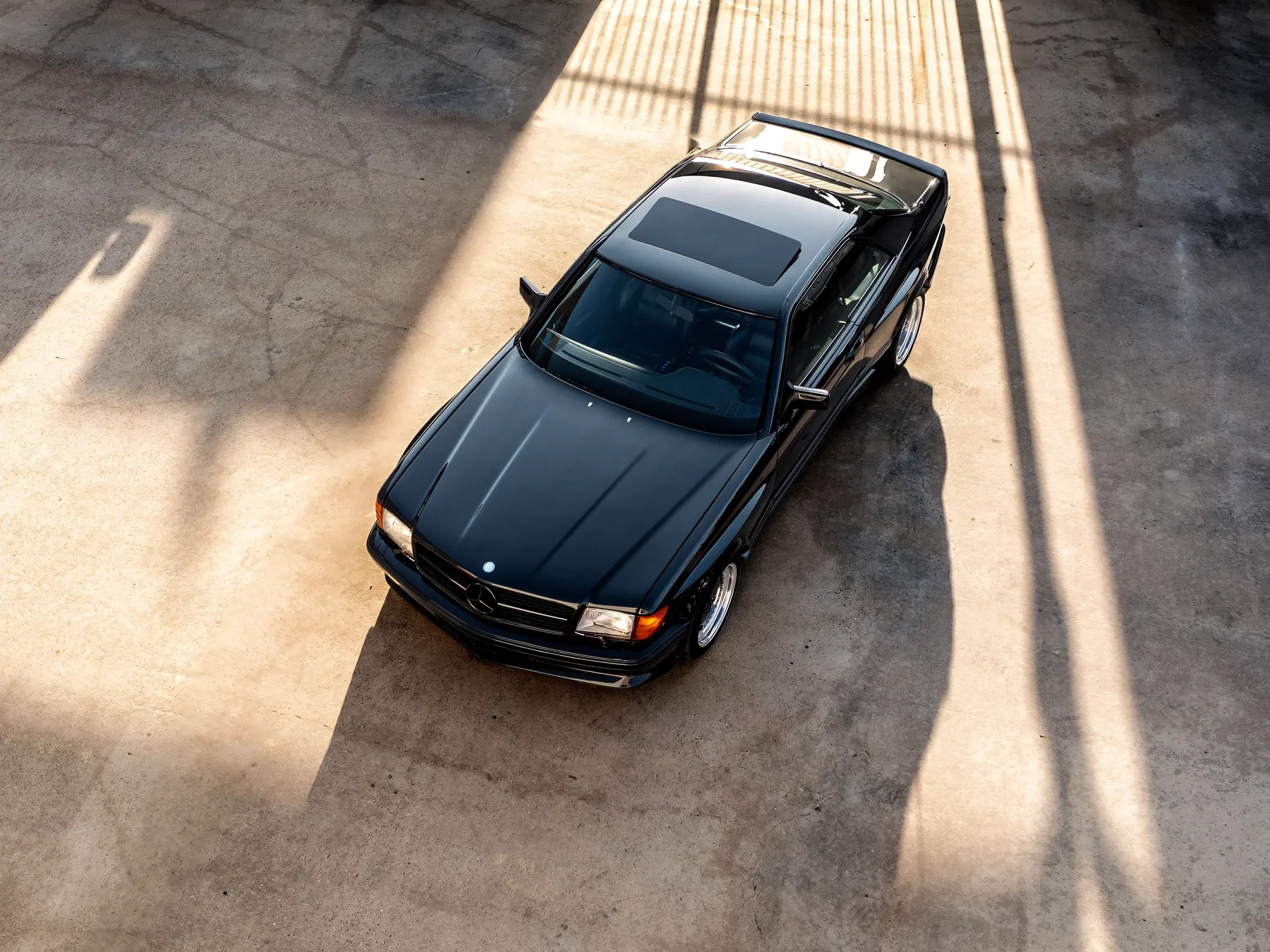
Beneath the new skin the C126 remained a W126, and that defines how it drives. Auto Bild Klassik describes the standard platform as secure and unflappable, with excellent straight-line stability, mild understeer at the limit, long suspension travel and firm damping, but no pretensions to sports-car handling. The layout is double wishbones at the front and a semi-trailing-arm axle at the rear. AMG’s changes sharpened this without re-engineering it. The same magazine’s verdict on AMG’s six-litre saloon, which shares the architecture, is probably the best guide: a deep, bassy exhaust note that stays discreet enough for an S-Class, a hefty torque shove, and an unexpected eagerness to rev beyond 3,500 to 4,000 rpm, set against a somewhat wooden ride and vague steering that the menacing looks help the driver forgive. Gearing is long. The SEC never offered anything but a four-speed automatic, and AMG listed a shorter 2.47 final-drive ratio in place of 2.24 as an option on the saloon, which tells you how tall the standard gearing was. The coupé’s natural territory is a fast autobahn rather than a twisting road.
How many were made is unresolved. Silodrome reports an original plan for 100 cars and about 50 completed, RM Sotheby’s says only about 50 are believed to exist, and Carscoops says fewer than 50. A figure of around 375, roughly 75 a year from 1986 to 1991, circulates in seller descriptions, but it is unsupported and sits uneasily with the others. Dating is just as slippery. RM Sotheby’s catalogue text says the Wide-Body was introduced in 1990, enthusiast write-ups date it to 1986, and since the 560 SEC itself did not exist before autumn 1985, 1986 is the earliest it could have been. The likeliest reading is that, with every car built to order, the specification evolved from the mid-1980s into 1991 rather than debuting at a single moment, which would fit both the second-generation body parts and the late M117/9 engine. Japan was evidently an important market: several well-documented cars were delivered there and converted by AMG Japan. AMG also applied the six-litre recipe to the 560 SEL saloon.
Now the problems. The first is value for money. A conversion costing roughly as much again as the donor bought about 80 bhp more than standard, according to Carscoops, plus wider bodywork, and what it did not buy was a different kind of car. The basic 560 SEC weighed 1,750 kg, Auto Bild Klassik’s own description of the platform is of a machine that never pretended to be agile, and there is no reason to think the six-litre improved on the standard car’s official consumption of about 18 mpg. The second is the engineering itself. A four-valve head forced around the standard block’s bolt pattern was costly and complicated to build, and RM Sotheby’s own praise for the late M117/9 implies that the earlier DOHC engines were less robust and harder to service. Hand-built, low-volume parts also mean specialist-only maintenance. The third is authenticity. Because AMG sold engine, body and suspension work as separate items, and records are patchy, wide panels do not guarantee a six-litre engine underneath, and RM Sotheby’s itself notes that AMG-touched cars of the period may have only some of the correct attributes. The fourth is the donor’s own weakness: Auto Bild Klassik warns that C126 coupés are prone to corrosion around the rear window frame, and that a replacement frame is no longer available new. Finally, taste. Auto Bild Klassik reports that traditionalists regard a spoiler-fitted 126 as unacceptable, the dignity and elegance gone, and Sacco himself has said he is glad that the heavily modified SECs have largely disappeared from the market.
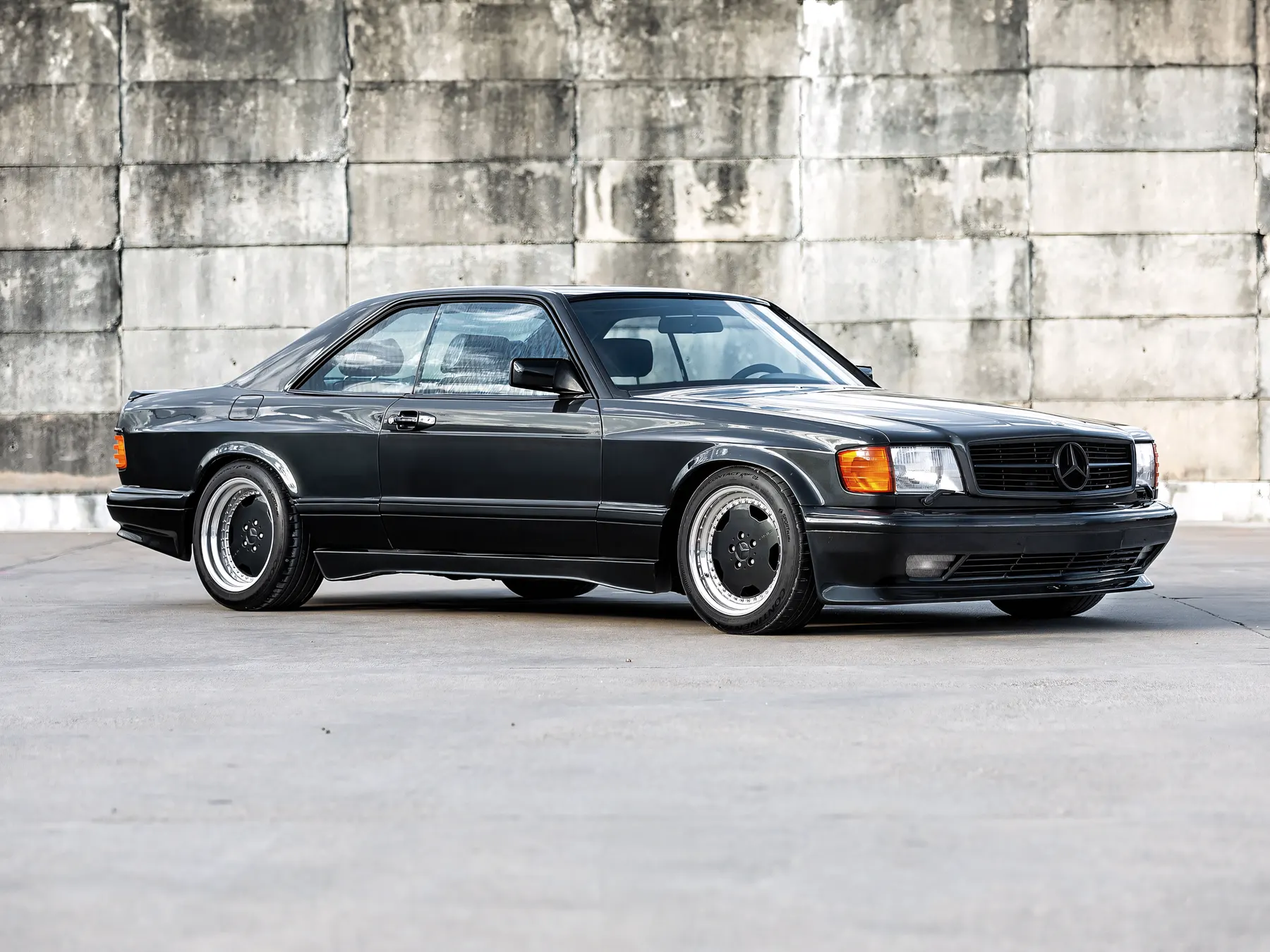
Its reputation has grown as its numbers have shrunk. RM Sotheby’s calls the Wide-Body the most desirable tuner upgrade available for a Mercedes in its period and places it alongside RUF’s CTR Yellowbird as an emblem of Germany’s 1980s tuning culture. Prices reflect that: Silodrome reported recent sales around $150,000 in 2018, and by late 2024 auto motor und sport described a sale at roughly $545,000 as very high but not a record. It is not the best-handling way to use a C126, and it is certainly not the most faithful to Sacco’s drawing. It is the clearest record of what AMG was before Mercedes absorbed it: a firm that, handed the finest coupé in Stuttgart’s catalogue, concluded it needed more of everything, and found customers who agreed.
Technical data
Performance Specifications
| Specification | Standard 560 SEC (C126, European unrestricted specification) | AMG 560 SEC 6.0 Wide-Body |
|---|---|---|
| Production period | September 1985 to 1991 | 1986 to 1991, dating disputed* |
| Units built | 28,929 | Approx. 50, originally planned 100* |
| Engine | V8, 5,547 cc, Bosch KE-III-Jetronic injection | V8, 6.0 litres, AMG twin-cam four-valve heads (32 valves) |
| Power | Approx. 295 bhp at 5,000 rpm | Approx. 380 bhp at 5,500 rpm (sources range 375 to 385 bhp)** |
| Torque | Approx. 317 lb-ft at 3,750 rpm | Approx. 410 lb-ft at 4,000 rpm (sources range approx. 385 to 417 lb-ft)** |
| Late-production engine | Not applicable | M117/9 hybrid, approx. 375 bhp (torque not corroborated)*** |
| Transmission | Four-speed automatic | Four-speed automatic, limited-slip differential |
| Drive | Rear-wheel drive | Rear-wheel drive |
| Kerb weight | 1,750 kg (basic specification) | Not reliably documented**** |
| 0-62 mph | Approx. 7.5 seconds | Under 6 seconds (claimed)***** |
| Top speed | 155 mph | Above 177 mph (claimed)***** |
| Fuel consumption | Approx. 18 mpg Imperial (EU mixed cycle) | Not documented**** |
| Length / width / height | 4,935 / 1,828 / 1,407 mm | Not documented; same bodyshell with wider wings and ground effects**** |
| Wheelbase | 2,845 mm | Not separately documented**** |
| Wheels and tyres | 15-inch alloys, 215/65 VR15 | Staggered three-piece 17-inch wheels (tyre sizes not corroborated) |
| Suspension | Double wishbones front, semi-trailing arms rear | Same layout; firmer springs, AMG-branded Bilstein dampers |
| Brakes | Standard Mercedes-Benz system with ABS | Larger discs, four-piston front calipers |
| List price | 133,600 DM (1985); 160,398 DM (June 1991 list) | Approx. $200,000 in 1989 dollars, about twice the standard car’s price****** |
Sources
- Mercedes-Benz Group: The epic SEC
- AUTO BILD KLASSIK: Mercedes SEC C 126
- firmenauto: 40 Jahre Mercedes S-Klasse Coupés (C 126)
- RM Sotheby’s: 560 SEC 6.0 AMG ‘Wide-Body’ (Arizona 2021 catalogue, model background)
- RM Sotheby’s: 560 SEC AMG 6.0 ‘Wide-Body’ (Amelia Island 2020 catalogue, model background)
- RM Sotheby’s: 560 SEC 6.0 AMG ‘Wide-Body’ (Paris 2019 catalogue, model background)
- RM Sotheby’s: 560 SEC 6.0 AMG ‘Wide-Body’ (Monterey 2025 catalogue, M117/9 engine background)
- RM Sotheby’s: 560 SEC AMG 6.0 ‘Wide-Body’ (Miami 2024 catalogue, model background)
- RM Sotheby’s: 300 CE 6.0 AMG Hammer (catalogue, Hammer background)
- Silodrome: Mercedes-Benz 560 SEC AMG 6.0 Wide-Body
- Carscoops: 1989 Mercedes 560 SEC AMG 6.0 Widebody
- Carscoops: 1989 Mercedes-Benz 560SEC AMG Widebody
- auto motor und sport: Mercedes-Benz 560 SEC AMG 6.0 Widebody
- The Jalopy: AMG Mercedes 560 SEC 6.0 Widebody
- Classic Register: Mercedes C126 560SEC 6.0 AMG Widebody (enthusiast register)
Join the discussion
Comments
Loading comments…
Leave a comment
Share a detail, memory, or perspective. Every comment is reviewed before publication.