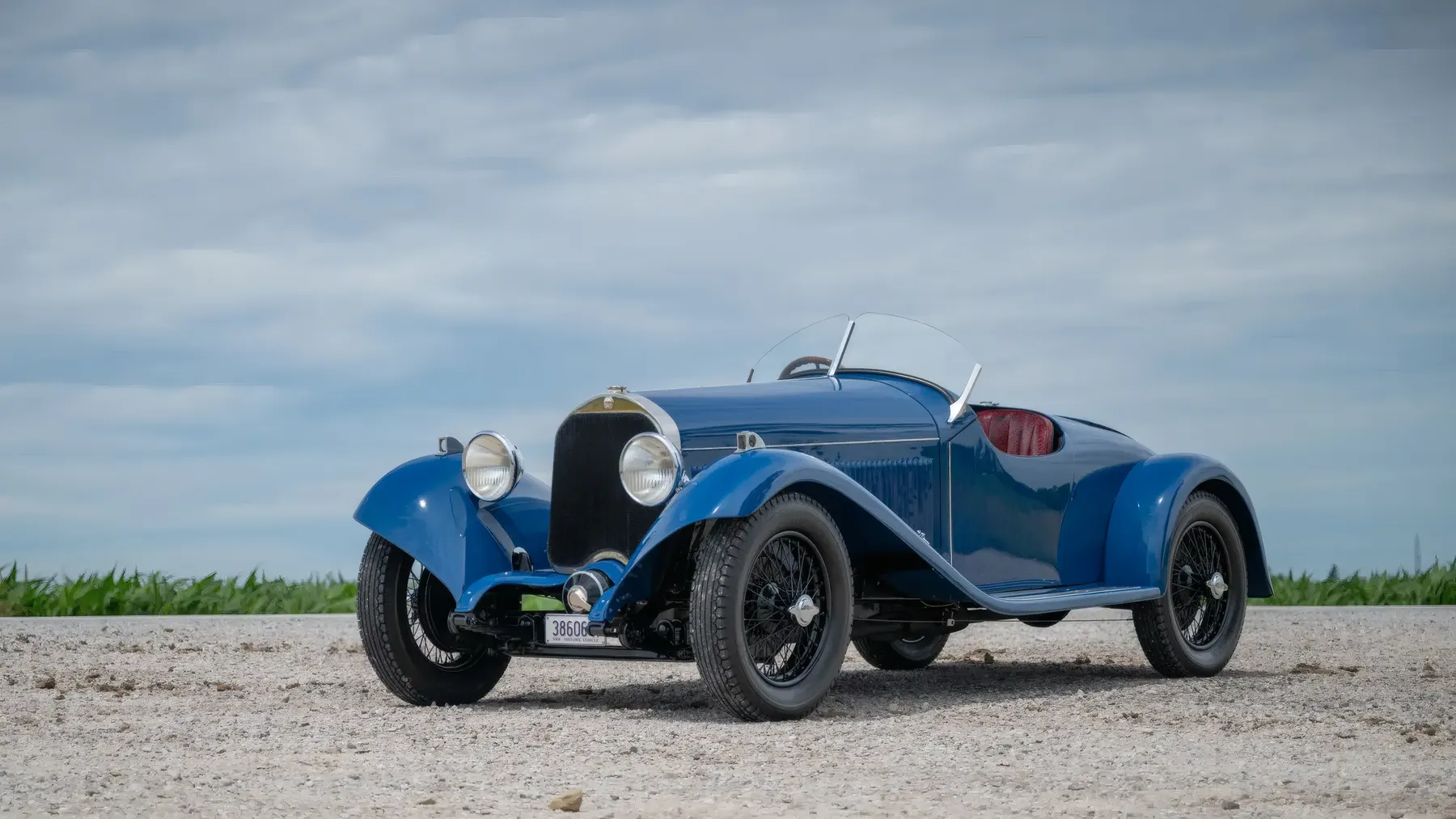
1928 Avions Voisin C11 Custom Roadster
Images: Darin Schnabel / RM Sotheby's
Gabriel Voisin had a habit of treating the automobile as an extension of the aeronautical workshop - a problem of airflow, weight distribution, and material honesty rather than mere transportation. When he introduced the C11 in 1927, it arrived as proof of that conviction: his first six-cylinder car, and the first Voisin sold as a complete, factory-built luxury automobile rather than a rolling chassis dispatched to the nearest coachbuilder. That distinction, quiet as it sounds, was actually radical for the era.
The C11 was positioned precisely at the upper tier of the French luxury market, aimed at the progressive, culturally sophisticated buyer - the sort of person who might also commission a house from Le Corbusier or commission art from a Cubist. Voisin was unapologetically selective about his clientele, and they in turn found in his cars something no Hispano-Suiza or Delage could offer: a machine whose design philosophy emerged from aeronautical engineering rather than carriage-building tradition. Josephine Baker and Rudolph Valentino both drove Voisins, which tells you something useful about the brand’s cultural orbit.
The C11 Custom Roadster, however, occupies a singular place even within that context. While the standard C11 chassis spawned a variety of factory and coachbuilt bodies - including torpedoes and formal saloons - the Custom Roadster represents something altogether more personal: a bespoke body built over the C11’s proven platform, shaped with a seductively curved roadster form that departs from the angularity Voisin’s in-house designer André Noël Telmont typically championed. The radiator treatment on these custom examples was often a flat-fronted interpretation rather than the standard vee’d design, and the windscreen - typically vee’d and steeply raked - gives the car a purposeful, low-slung stance that the factory tourers never quite achieved.
Mechanically, the C11 is defined by its 2,326cc inline six-cylinder sleeve-valve engine, a Knight-patent unit producing 65 bhp and driving through a three-speed manual gearbox. The sleeve-valve configuration was not accidental or eccentric - it was a deliberate engineering philosophy. Sleeve-valve engines eliminate the conventional poppet-valve arrangement, replacing it with sliding cylindrical sleeves that open and close ports in the cylinder walls. The result in operation is famously, almost unsettlingly, smooth: at low speeds a Knight-engined Voisin sounds less like an internal combustion engine and more like a well-oiled watch. Torque delivery is progressive and undramatic, which suits the C11’s character as a fast touring machine rather than a sporting weapon.
Gabriel Voisin’s commitment to light alloys pervades the C11’s construction. Aluminium was used extensively in bodywork and fittings, and the overall philosophy was one of rational weight management rather than brute structural strength. Telmont’s influence is visible in the attention to equal weight distribution and the provision of integrated luggage solutions - the distinctive external cases that lock onto running boards were a Voisin signature that blended practicality with visual coherence. On the Custom Roadster, this rationalist aesthetic meets something more overtly sensual: the coachwork curves in ways the factory bodies typically refused to, making it one of the more visually approachable Voisins while retaining the marque’s mechanical seriousness beneath.
On the road, the sleeve-valve six demands patience. The engine’s power band is narrow by modern expectations, and the three-speed gearbox places the driver in a constant negotiation between pulling torque low in the rev range and the engine’s reluctance to be hurried. What the C11 delivers in exchange is a composure and refinement that most contemporary rivals simply could not match. The underslung chassis geometry that Voisin would perfect on later 1930s models is not yet fully realised here, but the C11’s handling is competent and predictable - qualities that mattered on the unpaved routes nationales of late 1920s France.
Where the C11 genuinely excels is in the coherence of its engineering identity. Unlike most luxury cars of the period, which were assemblies of proprietary components dressed by external coachbuilders with varying degrees of taste, a Voisin was a considered object. Every exposed mechanical component was treated as a design element. Voisin believed that good engineering was inherently beautiful and should never be concealed - and in the C11 Custom Roadster, that philosophy finds perhaps its most elegant physical expression.
The drawbacks, though, are real. The sleeve-valve engine, for all its smoothness, is significantly down on power compared to what Bentley or Hispano-Suiza were producing on similar displacement in the same period. By the mid-1920s, conventional poppet-valve technology had closed the reliability gap that had once made sleeve-valves compelling, and camshaft-driven valves were now enabling far higher specific outputs. Voisin’s insistence on the Knight engine was, by 1927, beginning to look ideological rather than pragmatic. The three-speed gearbox, adequate for town use, also feels pinched on longer runs where a fourth ratio would ease the engine’s workload considerably.
The C11 also marked the moment Voisin stepped back from motorsport entirely. After the C6 Laboratoire’s fifth-place finish at the 1923 French Grand Prix - a result that revealed both the ingenuity and the limitation of the sleeve-valve format - the company had recognised that its race future was closed off by the 1926 formula’s shift to supercharged 1.5-litre engines, a configuration incompatible with sleeve-valve architecture. The C11’s launch the following year was in many ways Voisin’s formal declaration that he was a road-car maker now, and the Custom Roadster is the clearest expression of what that meant aesthetically.
Culturally, the C11 sits at an interesting junction. It was produced at the height of the Art Deco movement, and while Voisin’s own sensibility was more Cubist and functionalist than decorative, the Custom Roadster bodies built on the C11 platform were sometimes more overtly indulgent - custom Scintilla headlights, wire wheels finished in contrasting colours, vee’d and raked glass - objects that participated in the visual language of the late 1920s while maintaining their maker’s insistence on mechanical integrity. André Lefèbvre, who worked as an engineer at Avions Voisin and drove for them at Le Mans, took the lessons of Voisin’s lightweight, aerodynamically-considered construction directly into his later work at Citroën, where they shaped the Traction Avant, the 2CV, and eventually the DS. The C11’s engineering DNA is, in that sense, embedded in some of the most significant cars of the 20th century.
Critical reception in period was positive among the progressive intelligentsia who constituted Voisin’s natural audience, while mainstream motoring press - then as now - tended to favour the more conventional and the more powerful. The cars were never mass-market propositions, and Voisin made no effort to make them so. In the collector market today, C11-based cars occupy a respected but somewhat overlooked niche: known to serious enthusiasts of pre-war French machinery, occasionally surfacing at major auctions - a C11 Custom Roadster sold at RM Sotheby’s Monterey sale in 2024 for $106,400 - but rarely commanding the prices that comparable Bugattis or Delahayes attract.
That relative obscurity may be the most honest measure of Gabriel Voisin’s position in automotive history: too uncompromising for mass popularity, too intelligent to be dismissed, and always, stubbornly, more interested in the right answer than the popular one. The C11 Custom Roadster is a car that rewards the kind of attention Voisin himself paid to engineering - slow, deliberate, and free from the need to impress anyone who isn’t already looking closely.