Cord 812 Custom Beverly: The Coffin-Nose Cord Stretched for Rear Legroom
1937 Cord 812 Custom Beverly




Images: Darin Schnabel / RM Sotheby's
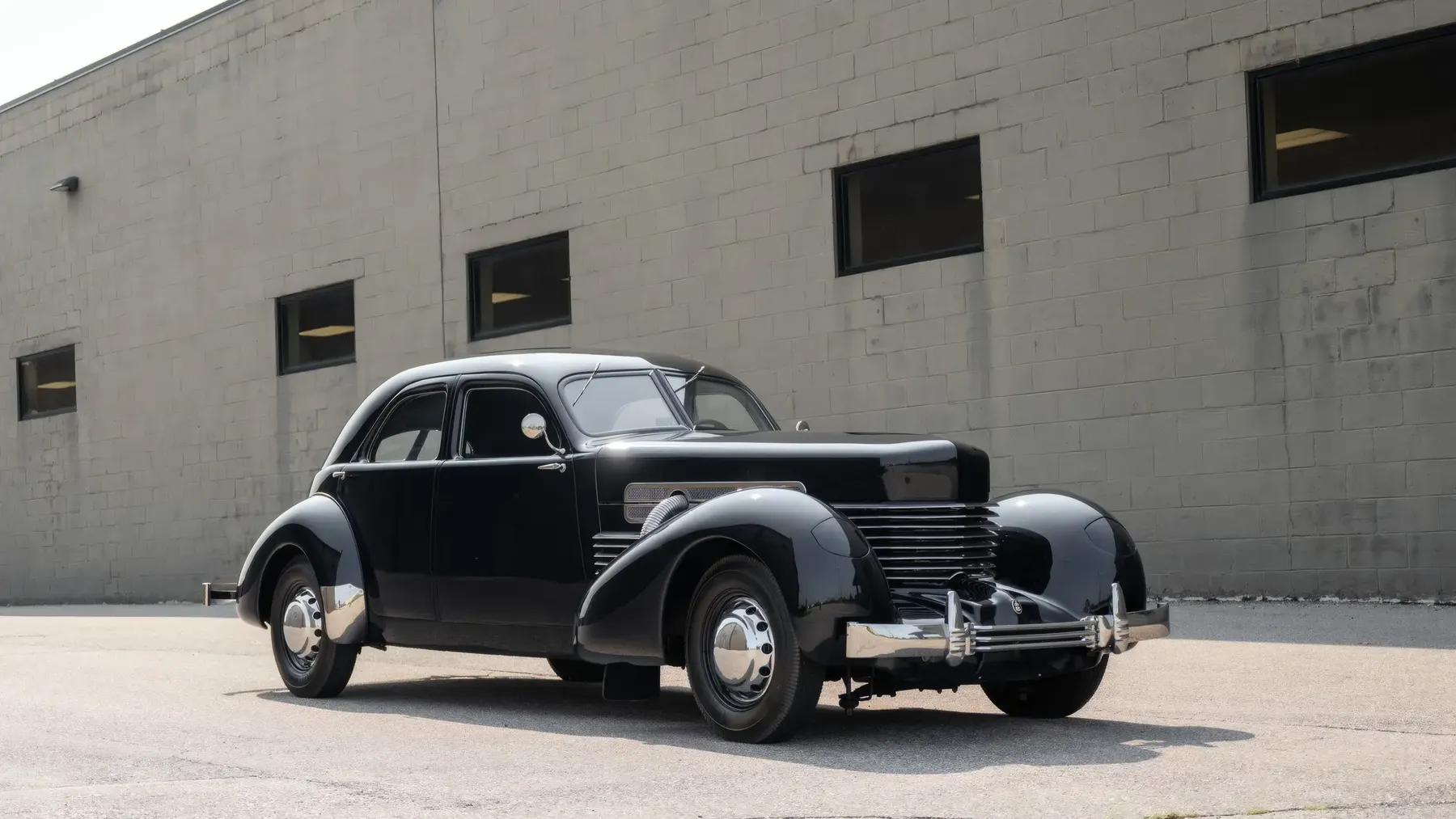
The Custom Beverly exists because a car built to look like the future was criticised for something thoroughly ordinary: the people in the back could not stretch out. Cord’s 810 had reached showrooms in 1936 with hidden headlamps, a wraparound louvred nose and a gearbox selected by a finger-sized lever, yet owners of the early sedans still grumbled about tight rear quarters. For 1937 the company’s answer was blunt and rather elegant. It added roughly 180 mm to the wheelbase, poured all of it into the rear compartment and gave the result a new name. Of the two long-wheelbase sedans that followed, the Custom Beverly carried the Beverly’s more lavish interior, and it is arguably the most resolved version of the 812 story, built in tiny numbers just as the company behind it was running out of money.
To see why the stretch mattered, it helps to remember what the 810 was supposed to be. E. L. Cord’s notion of a “baby Duesenberg”, a smaller and cheaper car that could trade on the Duesenberg name, began with Gordon Buehrig’s sketches, was shelved by a board worried about cheapening the marque, and came back as the foundation for a revived Cord brand. Mechanically it borrowed ideas from Citroën’s Traction Avant and from Cord’s own L-29 of 1929, the first American front-wheel-drive production car. When the 810 broke cover at the New York Auto Show in late 1935 the crowds were so dense that people stood on the bumpers of neighbouring cars for a better look. The trouble was that Cord had needed to build 100 cars to qualify for the show and the transmission was not ready. Orders were taken with promises of Christmas delivery, and the first production cars did not reach New York until April 1936. That gap between sensation and showroom set the tone for the car’s whole career.
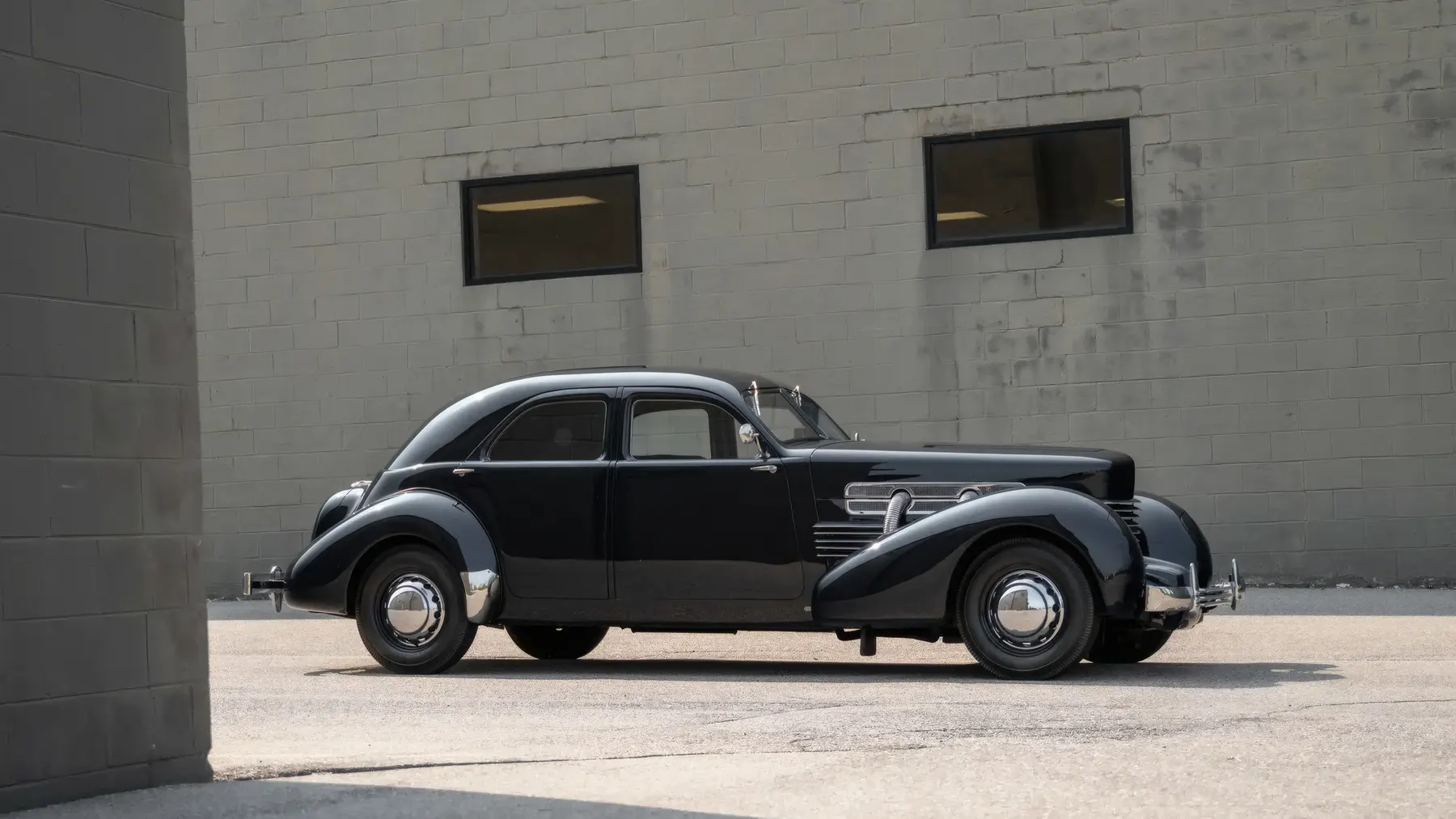
The engineering was the real radicalism. A welded unit body and front drive meant no separate frame, no propeller shaft and no transmission tunnel, so you stepped down into the car rather than up, and by one writer’s estimate the body could sit somewhere between 125 and 300 mm lower than a conventional contemporary. The gearbox and final drive lived ahead of the engine, which meant Lycoming’s 90-degree L-head V8 was turned around from its original rear-drive form; that reversed version became the FB. It was cleverer than a side-valve layout suggests. The camshaft sat high in the block and worked the valves through roller finger followers, the ports were placed high to avoid the heat problems of the Ford flathead, and the aluminium cylinder heads were designed and patented by an engineer at a supplier, Permold, with external bracing to control warping. With an 89 mm bore and 95 mm stroke it displaced 288.6 cubic inches, about 4.7 litres, and was advertised at 125 bhp at 3,500 rpm on a 6.5:1 compression ratio. Independent front suspension used trailing arms and a transverse leaf spring, the rear was a tubular beam axle on semi-elliptic springs, and hydraulic drums braked all four wheels.
Buehrig’s styling hid all of this behind a shape that still looks unlike anything else of its decade. He did not want a conventional upright grille, so horizontal louvres wrapped around the nose in the form that earned the car its “coffin nose” nickname. The headlamps, adapted from aircraft landing lights according to one history, rose out of the front wings on cranks mounted either side of the dashboard. There were no running boards, the door hinges were concealed, the alligator-style bonnet hinged at the rear, and the fuel filler hid behind a flap. Inside, an engine-turned dashboard carried a rev counter and a radio, and one writer likened its look to the cockpit of a vintage airliner.
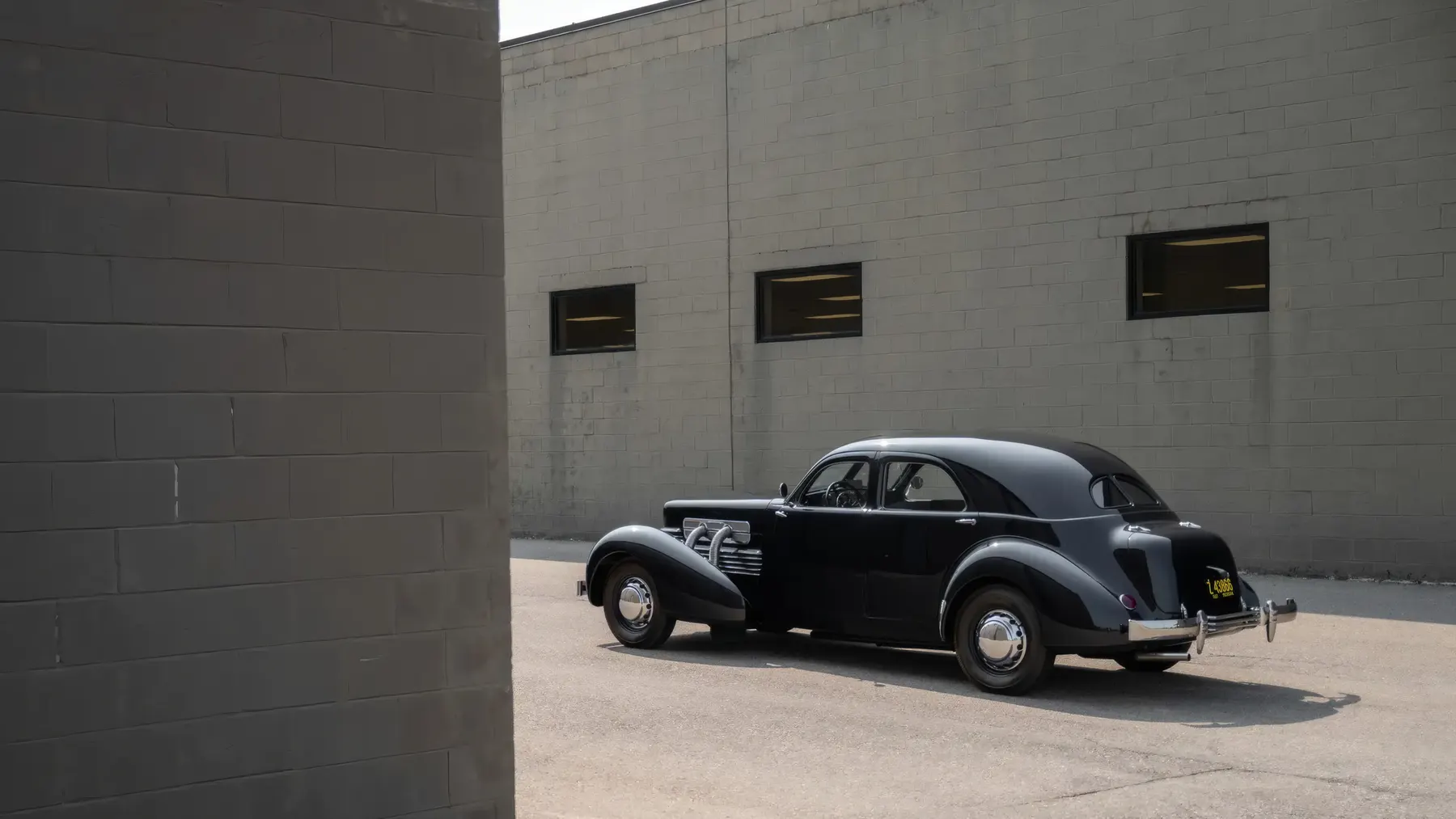
The other big change for 1937 was the option that gave the 812 its reputation. For $415 buyers could specify a Schwitzer-Cummins centrifugal supercharger, driven from the camshaft at 6.5 times crankshaft speed and feeding a larger Stromberg two-barrel carburettor at roughly 6 psi of boost. Compression dropped to 6.2:1 for safety, and the official figures were 170 bhp and 260 lb-ft of torque at 2,200 rpm. Those numbers looked conservative even then. Lycoming dynamometer figures reportedly reached as high as 195 bhp, and Cord specialists commonly estimate 186 to 195 bhp. Only 688 supercharged cars were built across all body styles, recognisable by chrome side pipes, credited to stylist Alex Tremulis and engineered by August Duesenberg according to RM Sotheby’s, which quickly became a fashionable addition to unblown cars too. For anyone assessing a Custom Beverly today, that means exhaust pipes prove nothing, and engine swaps between blown and unblown units are, as one specialist dealer puts it, quite common.
The best proof of the supercharged engine’s stamina came from a sedan rather than a sporting body style. In June 1937 Cord 812 Supercharged Beverly Sedan went to the Indianapolis Motor Speedway, where Ab Jenkins and Billy Winn took the Stevens Trophy by covering more than 3,070 km in 24 hours, an average of roughly 80 mph, though sources quote slightly different speeds. The record reportedly stood until 1954. It is a satisfying detail for the Beverly name: while the roadsters collected the glamour, a four-door was doing the endurance work.
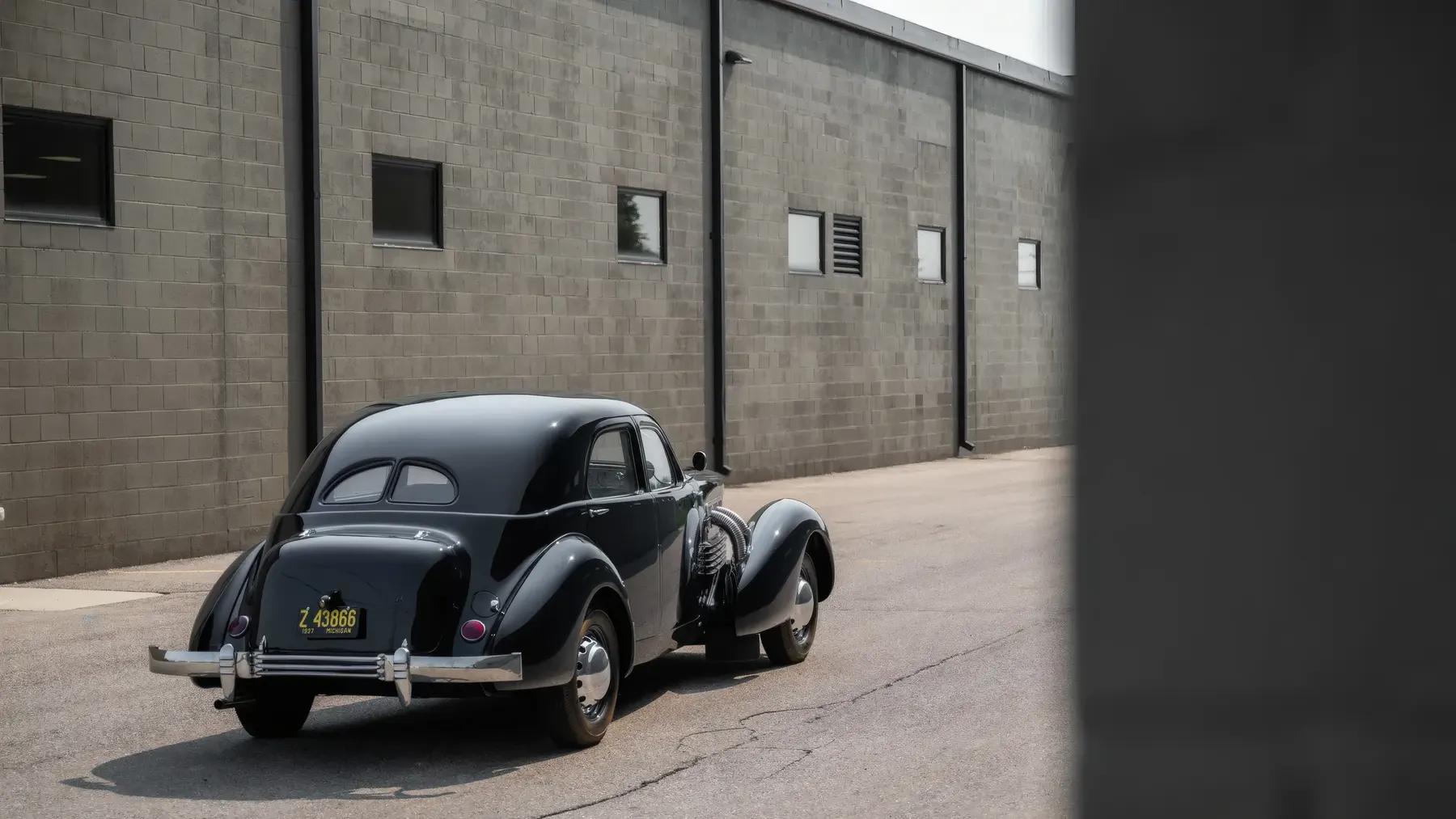
Driving a Cord is stranger than its looks suggest. You start the engine with the key and the clutch pedal depressed, preselect a gear with a small lever on a stalk beside the steering column, and the change happens only when you dip and release the clutch. A magazine writer who drove a Beverly sedan found the shifts smooth and silent, was advised not to rev past about 2,100 rpm in second before changing, and reported that the car would reach 90 mph and more. He also praised unusually flat cornering and a supple ride, crediting the absence of a heavy rear axle and differential. Performance figures need handling carefully. A museum specification sheet for a normally aspirated Phaeton gives about 99 mph and 20 seconds to 60 mph, a museum caption for a supercharged car claims 112 mph and 13.2 seconds, and neither was measured on a Custom Beverly. Kerb weight is quoted at roughly 1,750 to 1,860 kg for standard-wheelbase cars. The Custom, longer and taller, will have weighed more, though I could not find a reliable figure. Because the engine and transaxle stay up front, the stretch should have left the front-end weight bias and steering feel much as they were; what it added was length and mass.
None of this made the Cord an easy car to live with, and the Custom Beverly inherited every weakness of the line. The launch cars were effectively a development programme conducted by customers: the front-drive joints grew noisy and failed too often, early gearboxes had a habit of jumping out of gear, and overheating and vapour lock were common complaints. Most of it was addressed within months, but by then the reputation for unreliability had set, and it hurt a company with a shrinking dealer network and no money for a second attempt. The Bendix preselector remains the part that unsettles owners; one British owner of an 810 still wondered, with the car running well, whether the next shift would work, and its vacuum and solenoid hardware is not something a general garage can fix. On the road, owners describe heavy steering at low speed, understeer when pushed, and unservoed drum brakes that are adequate rather than brilliant. Commercially the car fell between categories: it was not large, yet it was priced at Cadillac levels, and the Custom Beverly, costing more again, sold in small numbers while the Depression kept buyers wary of conspicuous luxury. Even the legroom fix arrived late, because by the time a roomy Cord existed the company’s reputation and finances were beyond repair. Ownership today is not especially kind either. You cannot buy spares for a Cord the way you can for a Chevrolet, brake lines and other parts sometimes have to be made from scratch, and cars are often described as running later-design joints or replacement engines, which makes the original specification hard to prove.
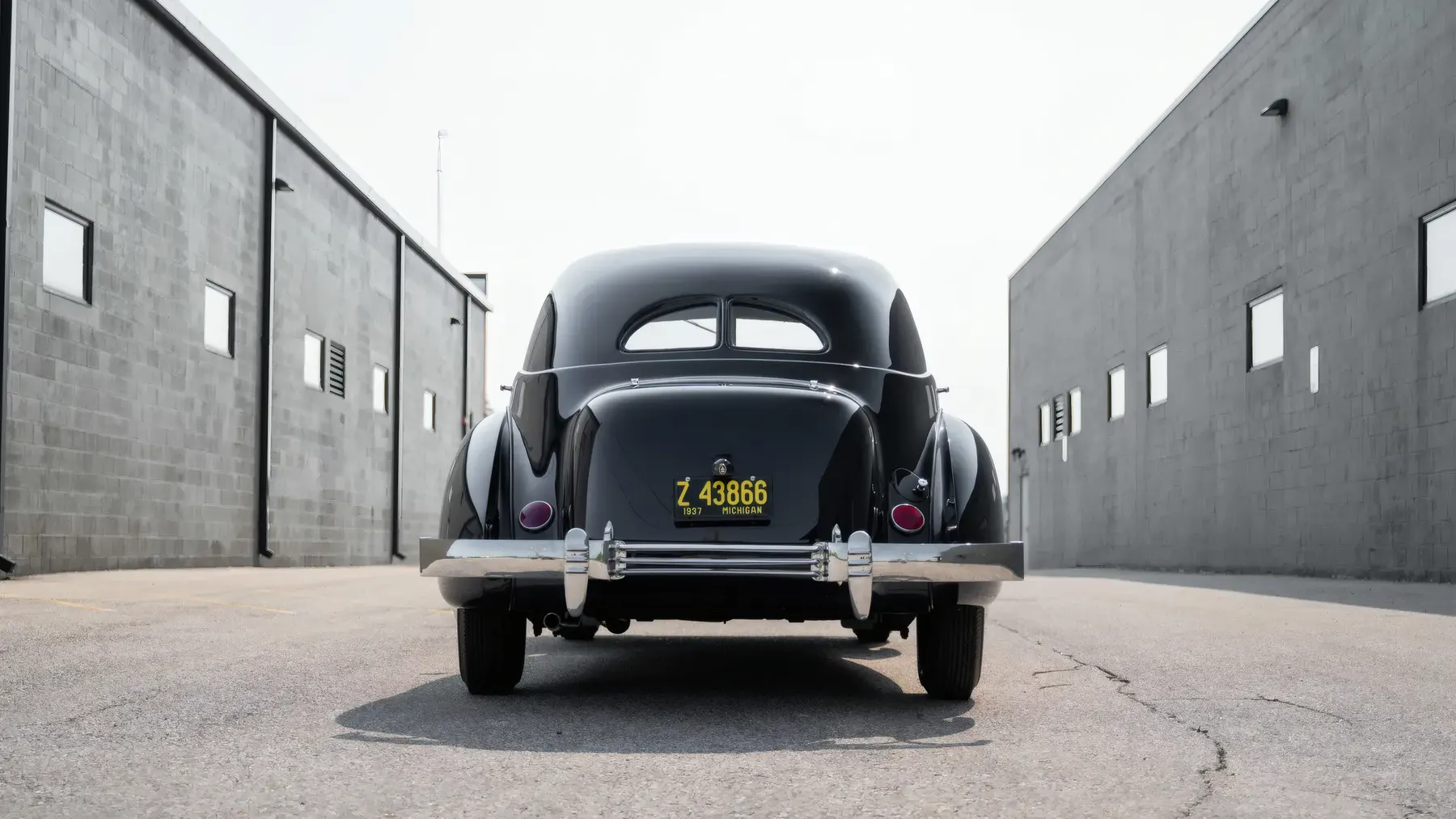
Production figures show how short the run was. Depending on the source, somewhere between about 2,400 and 3,000 Cords were built or sold over the two model years. E. L. Cord had largely divested himself of his holdings in the company well before the 810 appeared, and by December 1937 Auburn, Cord and Duesenberg were all finished; there was no 1938 model. The reputation then travelled in the opposite direction. In 1951 New York’s Museum of Modern Art included a 1937 Cord 812 in its “Eight Automobiles” exhibition, and curator Arthur Drexler singled it out as the outstanding American contribution to car design. Ian Fleming put James Bond into an old Cord, supplied by Felix Leiter, in Live and Let Die, a quiet sign of how quickly the car had become shorthand for modernity that had arrived too early.
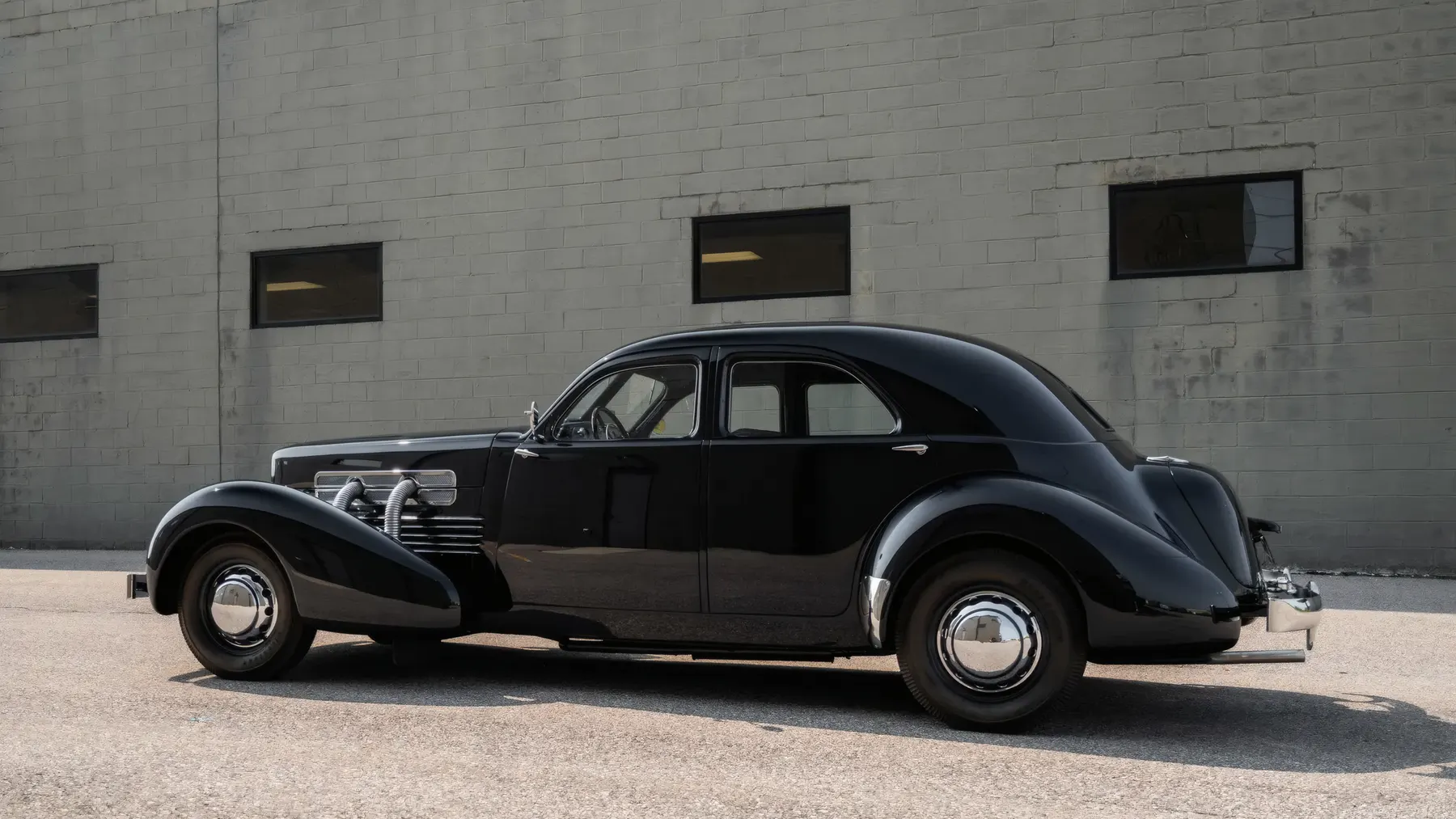
The influence was real but slow. In 1940 Hupmobile and Graham used the body dies for conventional rear-drive cars, the Skylark and the Hollywood, which kept the Cord’s shape and lost its point, and neither sold well; the dies were simply too complex for efficient production. It took until 1966 for an American manufacturer to revive front drive and hidden headlamps in a big luxury coupe, with the Oldsmobile Toronado, followed by the Cadillac Eldorado a year later. Among collectors, the Custom Beverly is a Classic Car Club of America Full Classic and a familiar sight on Auburn Cord Duesenberg Club tours, valued for its rarity and for being the one Cord sedan where the rear seat is not an apology. It never solved the car’s real problems, which were reliability, price and timing. What it does show is a small company listening to its owners in the last months it had left, and hinting at what the 810 might have become with another few years of development: roomier, more practical, and still the strangest-looking car on the road.
Technical data
Performance Specifications
| Specification | Normally aspirated (FB) | Supercharged (FC) |
|---|---|---|
| Model year | 1937 (Custom models new for 1937) | 1937 only |
| Wheelbase | 3,353 mm (Custom); 3,175 mm (standard) | 3,353 mm (Custom); 3,175 mm (standard) |
| Engine | 90° L-head V8, 288.6 cu in (about 4.7 litres) | 90° L-head V8, 288.6 cu in (about 4.7 litres) |
| Bore × stroke | 89 × 95 mm | 89 × 95 mm |
| Compression ratio | 6.5:1 | 6.2:1 |
| Induction | Stromberg two-barrel carburettor | Schwitzer-Cummins centrifugal supercharger, c. 6 psi; Stromberg AA-25 two-barrel |
| Power | 125 bhp @ 3,500 rpm (advertised) | 170 bhp @ 3,500 rpm (rated); up to c. 195 bhp reported* |
| Torque | Not corroborated; omitted | 260 lb-ft @ 2,200 rpm (rated) |
| Transmission | Four-speed, Bendix electro-vacuum pre-selector | Four-speed, Bendix electro-vacuum pre-selector |
| Front suspension | Independent, trailing arms, transverse leaf spring | Independent, trailing arms, transverse leaf spring |
| Rear suspension | Tubular beam axle, semi-elliptic springs | Tubular beam axle, semi-elliptic springs |
| Brakes | 305 mm hydraulic drums, all round | 305 mm hydraulic drums, all round |
| Kerb weight | c. 1,750–1,860 kg (standard wheelbase; varies by body and source). Custom Beverly figure not found* | As left |
| Top speed | c. 99 mph (Phaeton, museum sheet)* | c. 112 mph (claimed; not Custom Beverly)* |
| 0–60 mph | 20.1 s (Phaeton, museum sheet)* | 13.2 s (claimed; not Custom Beverly)* |
| Custom Beverly production | c. 94 or c. 229–230 (sources disagree)* | Not separately documented |
| Production context | Beverly body, both years: 1,146; 810/812 total: c. 2,900–3,000* | 688 supercharged cars, all body styles |
Sources
- RM Sotheby’s – 1937 Cord 812 Custom Beverly (Motor City 2016 lot essay)
- RM Sotheby’s – 1937 Cord 812 Custom Beverly (Hershey 2024 lot essay)
- RM Sotheby’s – 1937 Cord 812 Supercharged Beverly (lot essay)
- RM Sotheby’s – 1937 Cord 812 Supercharged Phaeton (lot essay, supercharger and Indianapolis background)
- Bonhams – 1937 Cord 812 Supercharged Beverly (model background)
- Hyman Ltd – 1937 Cord 812 Custom Beverly Sedan (model background, citing Josh B. Malks)
- Petrolicious – This Cord Custom Beverly Could Be Your Coffin-Nosed Cruiser
- AutoRestorer – Behind the Wheel of a 1937 Cord (Jim Richardson, December 2012)
- Mac’s Motor City Garage – Secrets of the 810/812 Cord V8, 1936-37
- The Henry Ford – 1937 Cord Specifications (archived online exhibit)
- Drives Today – 1936 Cord 810 Westchester feature
- Collings Foundation – 1937 Cord 812 museum description
- ClassicCars.com Journal – 1937 Cord 812 Phaeton background
- Wikipedia – Cord 810/812 (corroboration only)
Join the discussion
Comments
Loading comments…
Leave a comment
Share a detail, memory, or perspective. Every comment is reviewed before publication.