Cord L-29 Brougham: Indy-Bred Front Drive in a Formal Sedan
1931 Cord L-29 Brougham




Images: Darin Schnabel / RM Sotheby's
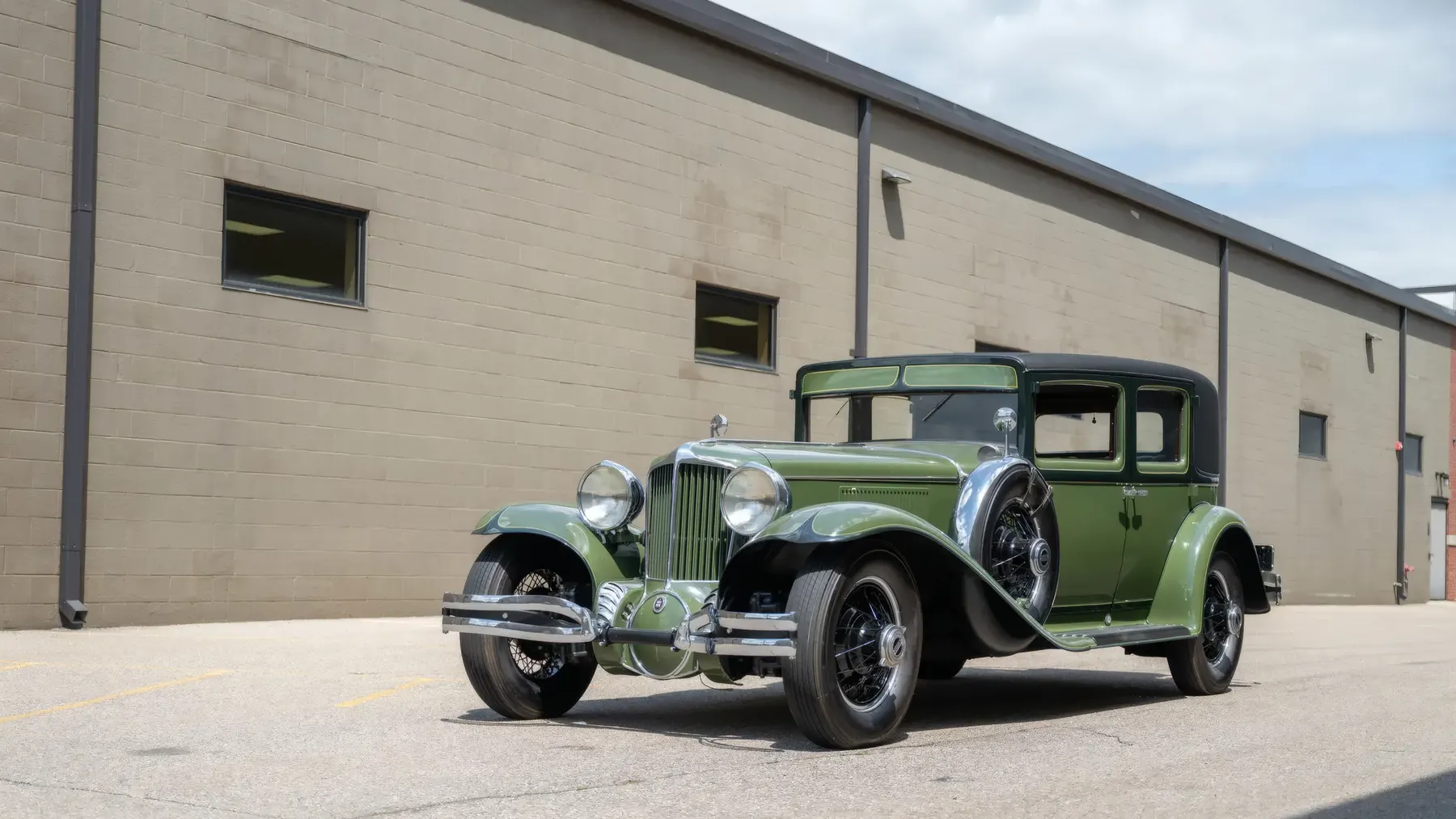
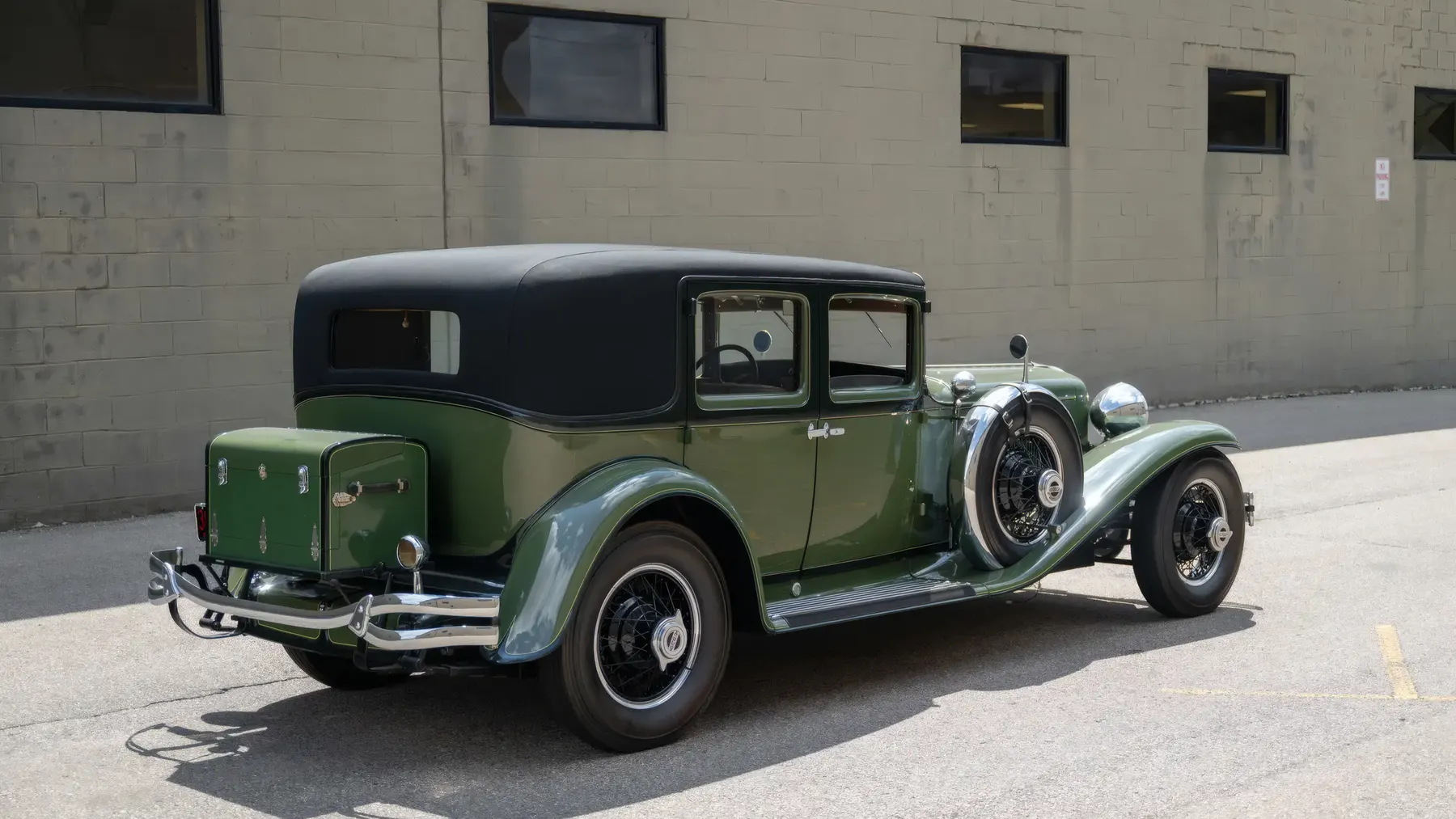
A brougham is meant to be the sensible choice: a closed four-door body with solid rear quarters, built for passengers who care more about privacy and formality than about the view out. Fitting that body to the Cord L-29, a chassis whose layout was lifted from Indianapolis race cars, produced one of the more charming contradictions of the Classic Era. Underneath, the Brougham carried the first front-wheel-drive drivetrain that an American manufacturer managed to put into genuine volume production. On top, it wore the dress code of a Packard or Cadillac sedan, only far lower than either. It was never the glamorous face of the range, a job that fell to the cabriolet and the coachbuilt specials, but it was the shape in which E. L. Cord’s different kind of luxury car could most easily be put in front of conventional buyers, and at launch it sat at the bottom of the price list alongside the plain sedan.
Cord’s motives were as commercial as they were technical. By the late 1920s he controlled Auburn, Duesenberg and Lycoming, and he wanted a car under his own name that would fill the gap between the value-driven Auburn and the exotic Duesenberg Model J, aimed at buyers who might otherwise choose a Cadillac, Packard or Pierce-Arrow in the $3,000 to $4,000 bracket. The route to something different ran through Harry Miller, whose front-drive racers had dominated Indianapolis. According to the history published by Turin’s MAUTO museum, Auburn launched an experimental programme in early 1927 on the strength of Miller’s patents, offering him $60,000 in instalments plus a royalty on every front-drive car sold. The engineering that turned the idea into a road car came largely from Cornelius Van Ranst, who had built the front-drive Detroit Special for the 1927 Indianapolis 500 with Tommy Milton, and who convinced Cord that Miller’s transverse-outboard gearbox was unsuitable for road use. The production layout followed the Detroit Special instead, with Auburn’s chief engineer Herb Snow assisting.
What emerged was not a finished product. MAUTO’s account of the first prototype tests, around the Santa Monica Mountains in November 1927, is unsparing: the engine was noisy, the chassis too flexible, the car shook alarmingly under steering load, and the Rzeppa joints in the drivetrain looked too fragile for paying customers. Van Ranst and Miller wanted a longer shakedown, but Cord wanted to be first, and the car was presented to the public in late summer 1929, beating the rival front-drive Ruxton to market by several months. The fixes that reached production were pragmatic. The Rzeppa joints were judged unproven and too expensive, so each driveshaft received two conventional Hooke’s joints in tandem, which made the L-29 the first American front-drive car to use that arrangement. A central X-member stiffened the frame. The result was the first successful, volume-built American front-drive car, though not, as is sometimes claimed, the first American front-drive car of any kind; Walter Christie and others had tried long before.
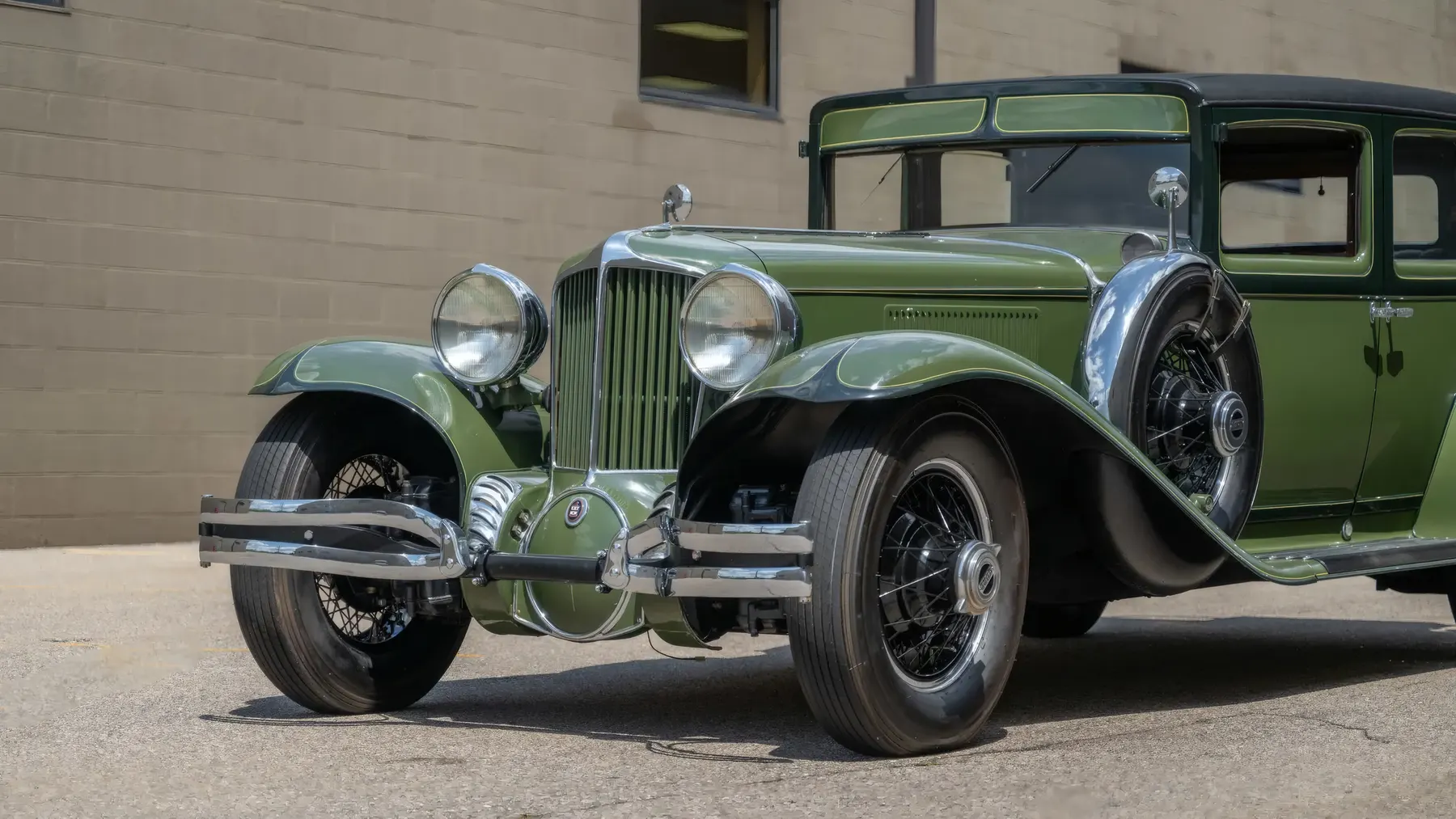
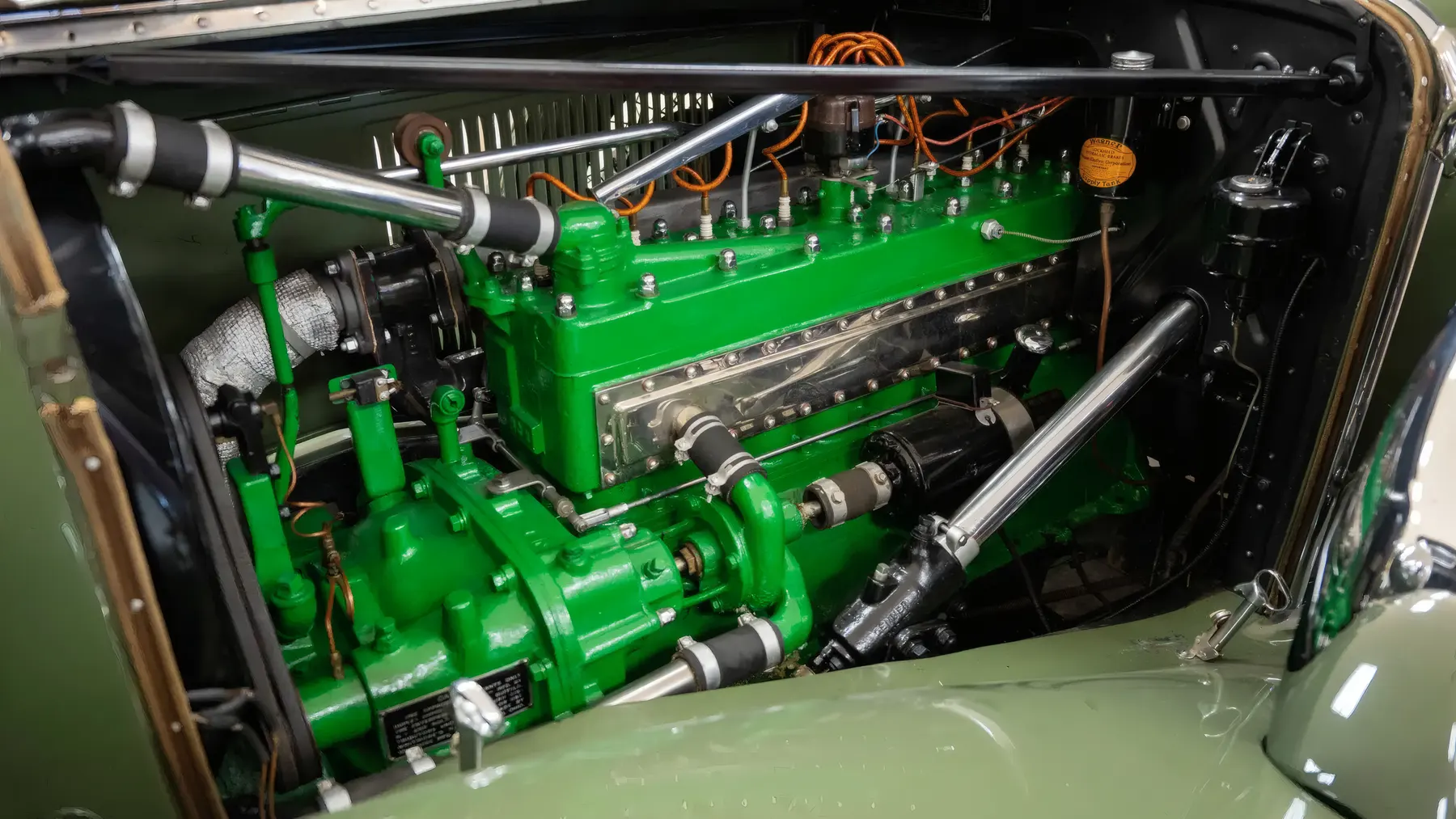
The mechanical package is the heart of the car’s character. Cord took the Lycoming L-head straight-eight used in the larger Auburns, a unit of roughly 4.9 litres (298.6 cubic inches in most sources, 301 in a few) with a bore and stroke of around 83 by 114 mm, and turned it around so that the crankshaft emerged at the front. The clutch, a Detroit Gear three-speed transmission and a hypoid differential were strung out ahead of the engine, and the engine itself needed reverse rotation and, by several writers’ counts, more than seventy new or modified parts. Because the gearbox now sat at the extreme front, the driver reached it through a long linkage running from the dashboard over the engine, and the shift pattern was mirrored, a trap for anyone arriving from a conventional car. Front suspension used a large-diameter De Dion tube locating the wheels, with paired quarter-elliptic leaf springs on each side and Houdaille hydraulic dampers, while the hydraulic front drum brakes, roughly 305 mm across, were mounted inboard, as they were on Miller’s racers. The rear was a tubular beam axle on semi-elliptic springs. None of this was typical Detroit practice in 1929, and it gives the Cord a mechanical sophistication that its power figure completely fails to convey.
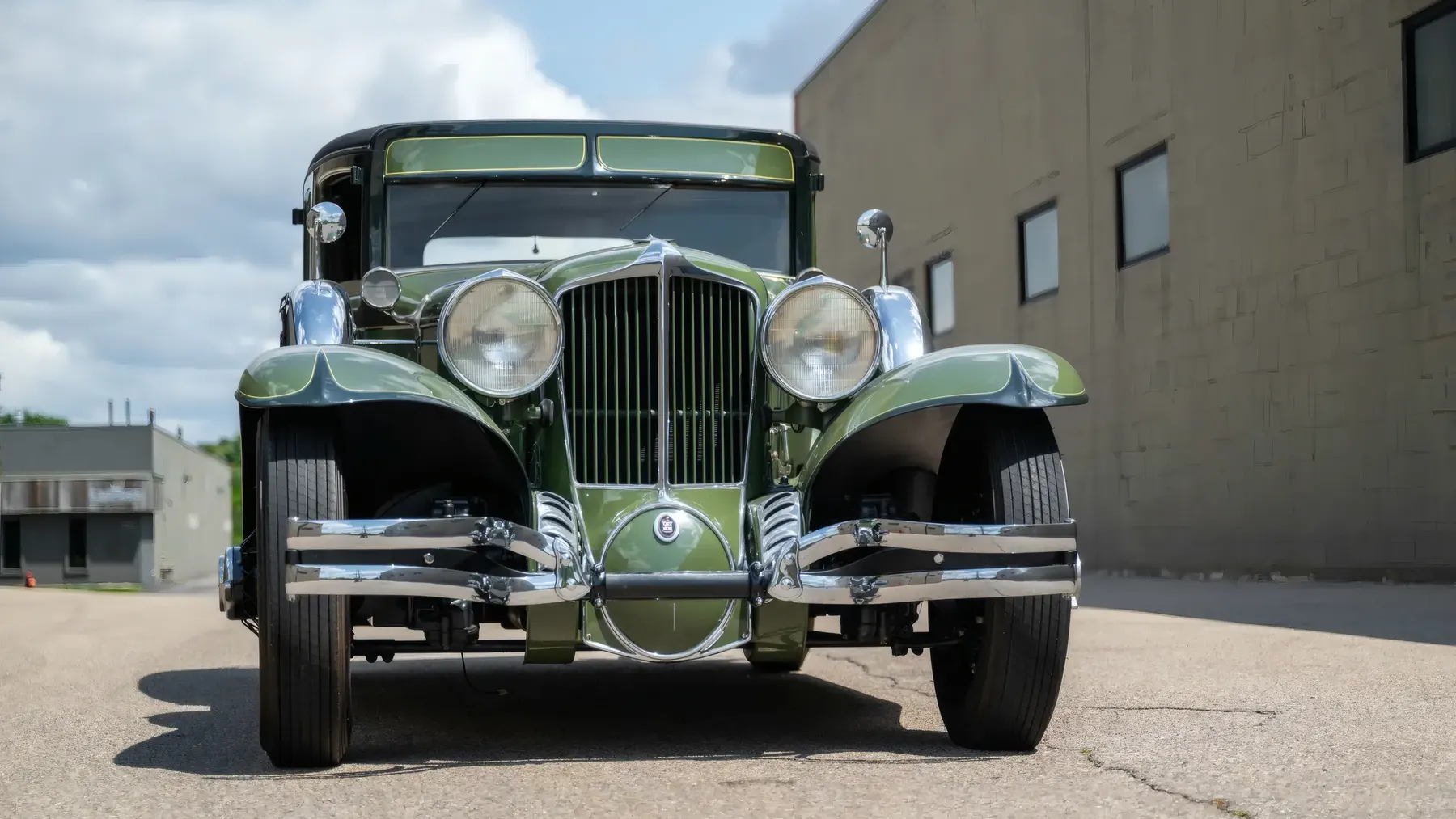
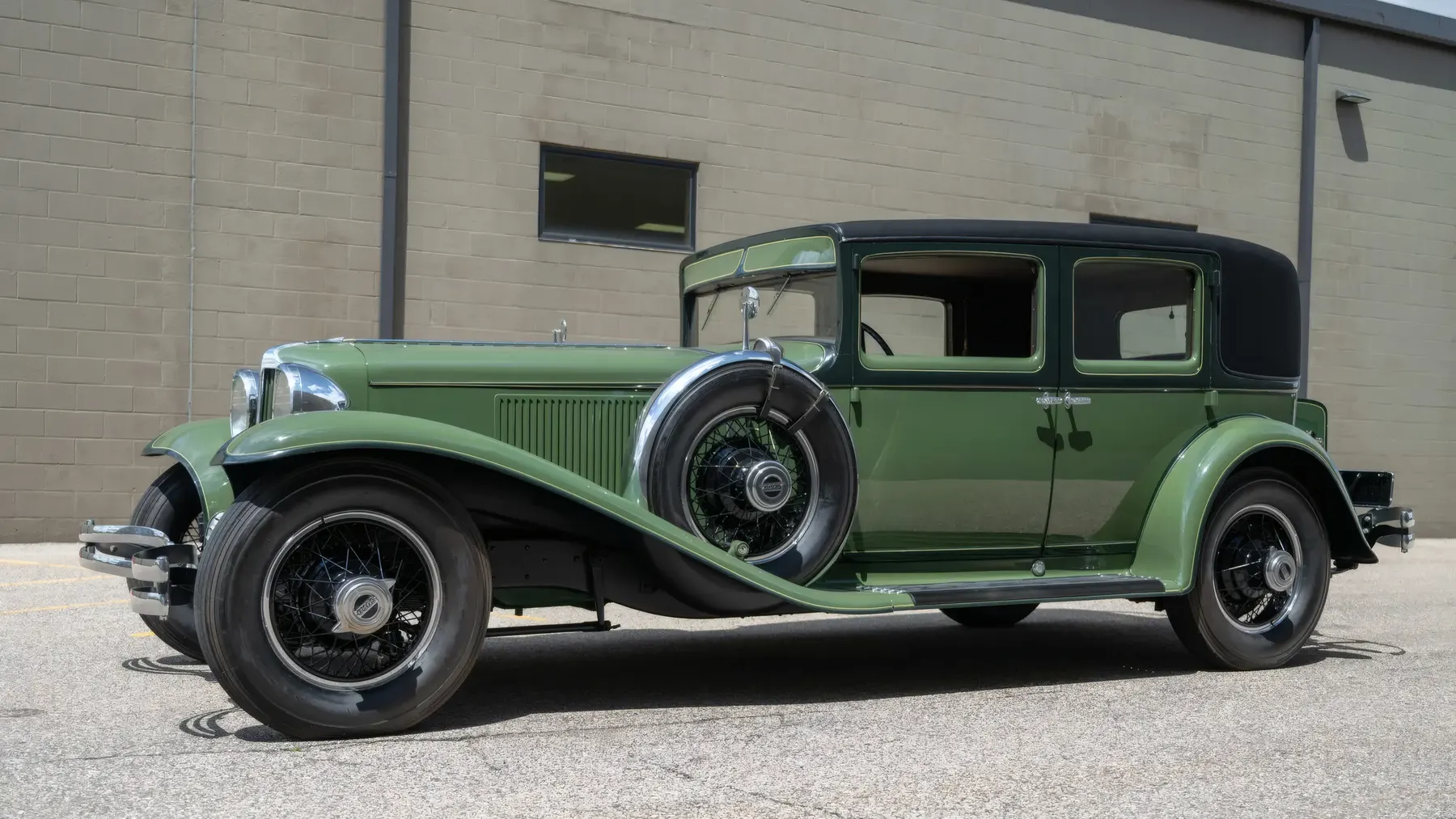
Because there was no propeller shaft and no rear-axle kick-up in the frame, the bodies could be mounted low. A sedan stood about 1,550 mm tall at a time when rivals averaged around 1.8 metres, and stylist Alan Leamy used the long drivetrain to draw one of the longest bonnets of the era, ending in a narrow radiator shell and flowing front wings. Cord’s brief, according to MAUTO, was to emphasise front-wheel drive rather than hide it, which is why the proportions read as engineering made visible. The influence was swift: the 1930 Chrysler Eight and Imperial borrowed several styling cues, including the slightly veed radiator shell. The factory catalogue offered a sedan, the Brougham, a cabriolet or convertible coupé and a phaeton or convertible sedan, priced from $3,095 to $3,295, with the sedan and Brougham at the lower end. The Brougham was the five-passenger four-door with blind rear quarters, and its formal roofline gave it a very different air from the sporting cabriolet. European and American coachbuilders, among them LeBaron, Rollston, Murphy, Castagna, Franay and Saoutchik, were drawn to the low chassis and built special bodies, several of which won concours prizes, but the Brougham was strictly factory fare. The company’s own advertising barely used the L-29 designation at all, preferring to call the car simply the Cord Front Drive.
Inside, the absence of a transmission tunnel gave the Brougham a low-set cabin with a flat floor, and the dashboard was unusually complete for the period, with temperature, oil pressure and speed on the left of the steering wheel and fuel, oil level and charging on the right. Positioning is harder to pin down than the styling. Wikipedia’s summary, drawing on Wise, places the L-29 in the upper tier of American luxury cars alongside Cadillac, Marmon, Lincoln, Packard, Franklin and Stutz and below only Duesenberg, while the Turin museum argues that Cords cost noticeably less than rivals with comparable engine sizes. Both can be true: a Cord was cheaper than a bigger Packard or Cadillac on paper, but it asked buyers to accept an untried layout and a smaller reputation, and at around $3,000 it was still a very expensive car in the first winter of the Depression.
How it drove is where the accounts diverge. The sympathetic reading, found in David Burgess Wise’s survey and echoed by the Turin museum, is that the low centre of gravity and the pull of the front wheels gave the L-29 unusually good handling for its size, even though the steering needed fully four turns from lock to lock on a wheelbase of 3,490 mm. Cord’s advertising leaned hard on the idea that pulling is better than pushing. Against that, HowStuffWorks’s retrospective profile calls the handling twitchy, and Old Cars Weekly reports that some owners found the car front-heavy around town. The honest summary is that the car’s dynamic reputation rests on a handful of period impressions and later owners’ recollections rather than measured data, and the sources do not agree. One writer summed up the performance with a polite phrase about pleasant tepidity, which captures the problem neatly: the Cord looked like a car that ought to be fast, and its publicity leaned on the racing pedigree of the front-drive unit, yet the closed Brougham, at the heavy end of the range, was the body style least able to disguise the shortfall. What none of the sources dispute is that the Cord was not quick.
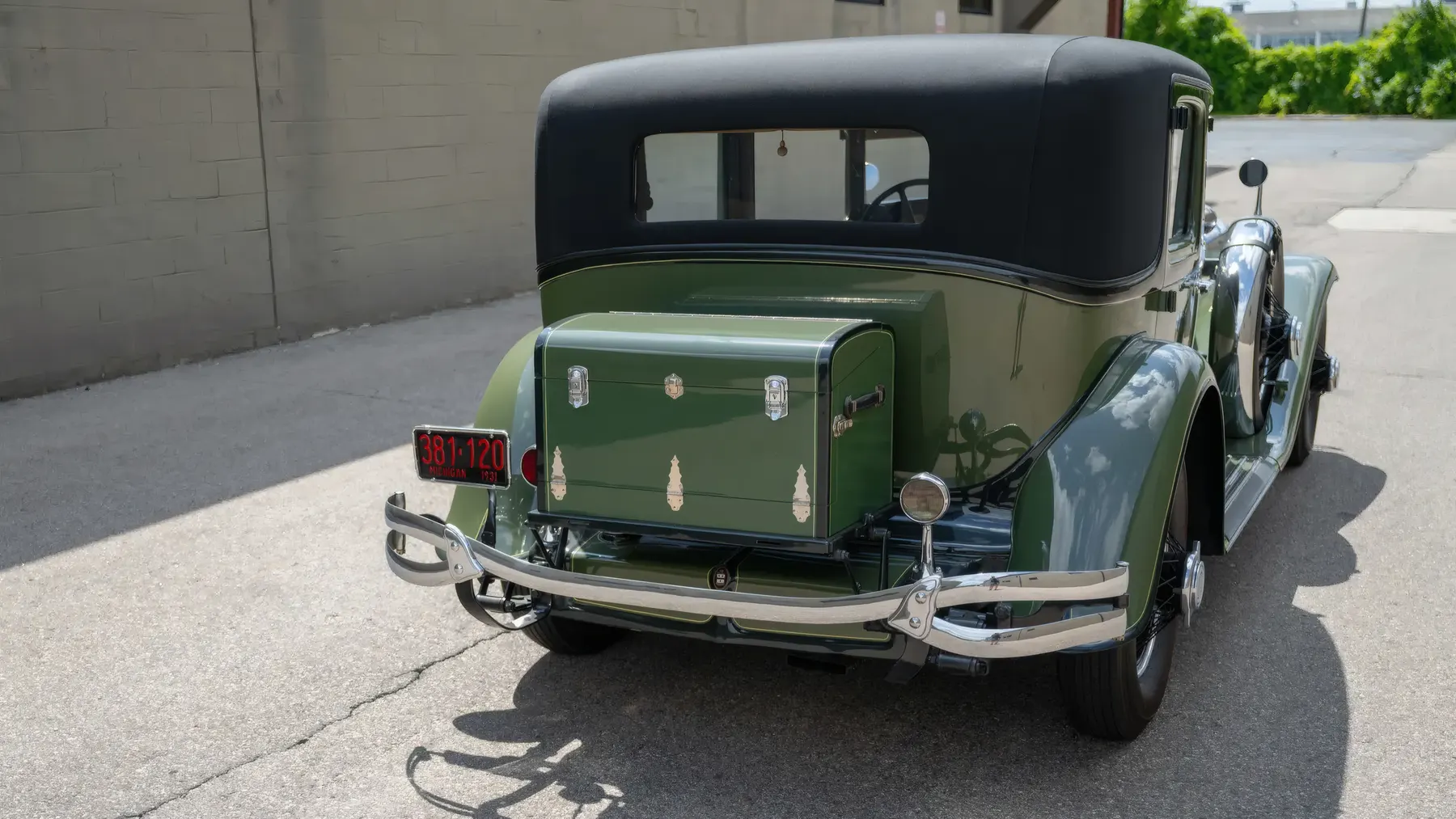
That brings us to what the Brougham, and the L-29 generally, got wrong. Performance was the first disappointment. The straight-eight was advertised at 125 bhp, though retrospective sources suggest real output may have been somewhat lower, with figures from about 115 to 123 bhp appearing, and it had to move a car quoted at roughly 2,100 kg, with closed bodies like the Brougham naturally at the heavy end. Top speed is variously given as barely 75 mph to a little over 80 mph, one retrospective puts 0-60 mph at around 25 seconds, and Wise notes that gearing in both the transmission and the front axle was inadequate and that the cheaper Auburn could outrun it. Durability was the second problem: the front-axle universal joints endured braking, steering and driving all at once, and retrospective accounts describe them wearing out with merciless frequency. Weight distribution was the third. With the engine so far back in the chassis, the driven wheels carried less of the car’s weight than ideal, which compromised traction, and the mirrored gearshift and long linkage made the controls unfamiliar. The Brougham added its own penalty, since solid rear quarters trade some rearward visibility for formality. Finally, the car was expensive to build, which is part of why it sat at the top end of the American market just as that market collapsed.
The market judged the Cord largely on price and performance, and then the Depression made the verdict academic. The L-29 reached Europe with real fanfare: Léon Duray drove one around France while setting records at Montlhéry in his Millers, the car appeared at the Paris and London shows in October 1929, and MAUTO reports eighteen sold in the first three days in Paris, with Malcolm Campbell as London agent. Yet MAUTO’s comparison is stark: over the same period, Packard received around 55,000 orders and Cadillac around 35,000. The original plan was for 5,000 cars in the first year, then a replacement called the L-30, and a V12-powered L-30 was mooted but never appeared. Instead the single production run stretched to the end of 1931, the last cars being titled as 1932 models. Production totals are inconsistent: 5,010 is the figure attributed to Cord historian Josh Malks and repeated by RM Sotheby’s, but MAUTO’s own annual breakdown sums to 4,429 and older sources give about 4,400. The sources consulted do not reconcile the difference.
For the Brougham in particular, the Depression’s effect shows in survival rather than in sales figures. RM Sotheby’s catalogue essays, on two separate occasions, call it the rarest L-29 factory body style and put known survivors at thirteen, though counts like that can shift as cars come to light. The open cars get the attention, but the blind-quartered Brougham is arguably the truest expression of what Cord was attempting: not a sporting special but a real closed luxury car, with front-wheel drive offered as a quiet technical argument rather than a gimmick. Frank Lloyd Wright counted among the L-29’s enthusiastic admirers, and the car’s reputation for style has never faded even though its mechanical reputation has always been mixed.
Its technical influence outlasted its sales. Cord’s follow-up, the 810 of 1936, and its 812 successor, styled by Gordon Buehrig, kept front-wheel drive but moved to a 4.7-litre Lycoming V8 of the same nominal 125 bhp, with a four-speed pre-selector gearbox, hidden headlamps and independent front suspension. It had its own difficulties, early reliability problems among them, and Auburn ended Cord production in 1937. One RM Sotheby’s catalogue essay frames the L-29 as a pioneer that offered buyers the future some three decades before anyone else caught up, a flourish, but not an unreasonable one. The Brougham tells that story best in miniature: a formal sedan with a racing driveline, built by a man who valued being first over being finished, and unable quite to keep pace with its own looks.
Technical data
Performance Specifications
| Specification | Cord L-29 (Brougham body unless stated) |
|---|---|
| Production years | 1929–1931 (final cars titled as 1932 models) |
| Body | Four-door, five-passenger, blind rear quarters |
| Layout | Front engine (reversed), front-wheel drive |
| Engine | Lycoming L-head straight-eight, about 4.9 litres (298.6 cu in; some sources give 301 cu in / 4,934 cc) |
| Bore × stroke | About 83 × 114 mm |
| Power | 125 bhp (advertised); about 115–123 bhp actual* |
| Torque | Not reliably documented; omitted |
| Transmission | Three-speed manual (Detroit Gear), mirrored shift pattern |
| Front suspension | De Dion-type tube, paired quarter-elliptic leaf springs, Houdaille dampers |
| Rear suspension | Tubular beam axle, semi-elliptic leaf springs |
| Brakes | Four-wheel hydraulic drums, front brakes inboard |
| Frame | X-braced |
| Wheelbase | 3,490 mm |
| Height (sedan) | About 1,550 mm |
| Weight | About 2,100 kg* |
| Top speed | About 75 to just over 80 mph* |
| 0–60 mph | About 25 seconds* |
| Launch price | $3,095 (Brougham and sedan); range $3,095–$3,295 |
| Production | 5,010 (Malks/RM Sotheby’s) or 4,429 (sum of MAUTO annual figures) |
Sources
- MAUTO (Museo Nazionale dell’Automobile) – History, technique and style Cord L-29
- Mac’s Motor City Garage – Inside the 1929-32 Cord L-29 Front Drive
- Wikipedia – Cord (automobile)
- Wikipedia – Front-engine, front-wheel-drive layout
- RM Sotheby’s – 1931 Cord L-29 Brougham (catalogue essay, general background)
- RM Sotheby’s – 1931 Cord L-29 Brougham (catalogue essay, general background)
- RM Sotheby’s – 1930 Cord L-29 Brougham (catalogue essay, general background)
- RM Sotheby’s – 1930 Cord L-29 Boattail Speedster (catalogue essay, chassis background)
- RM Sotheby’s – 1931 Cord L-29 Cabriolet (catalogue essay, general background)
- RM Sotheby’s – 1931 Cord L-29 Cabriolet (catalogue essay, general background)
- RM Sotheby’s – Cord L-29 La Grande Speedster recreation (catalogue essay, production background)
- Conceptcarz – 1929 Cord L-29
- Conceptcarz – 1931 Cord L-29
- Conceptcarz – 1930 Cord L-29 profile and body styles
- Conceptcarz – Cord L-29 market positioning
- HowStuffWorks – How Cord Cars Work
- HowStuffWorks – 1929-1931 Cord L-29
- Old Cars Weekly – Cord put the power forward
- Driven to Write – Book of the dead: Auburn, Cord and Duesenberg (Part Two)
- Unique Cars and Parts – Lost Marques: Cord
Join the discussion
Comments
Loading comments…
Leave a comment
Share a detail, memory, or perspective. Every comment is reviewed before publication.