Cord 812 Supercharged Phaeton: The Beauty That Outran Its Gearbox
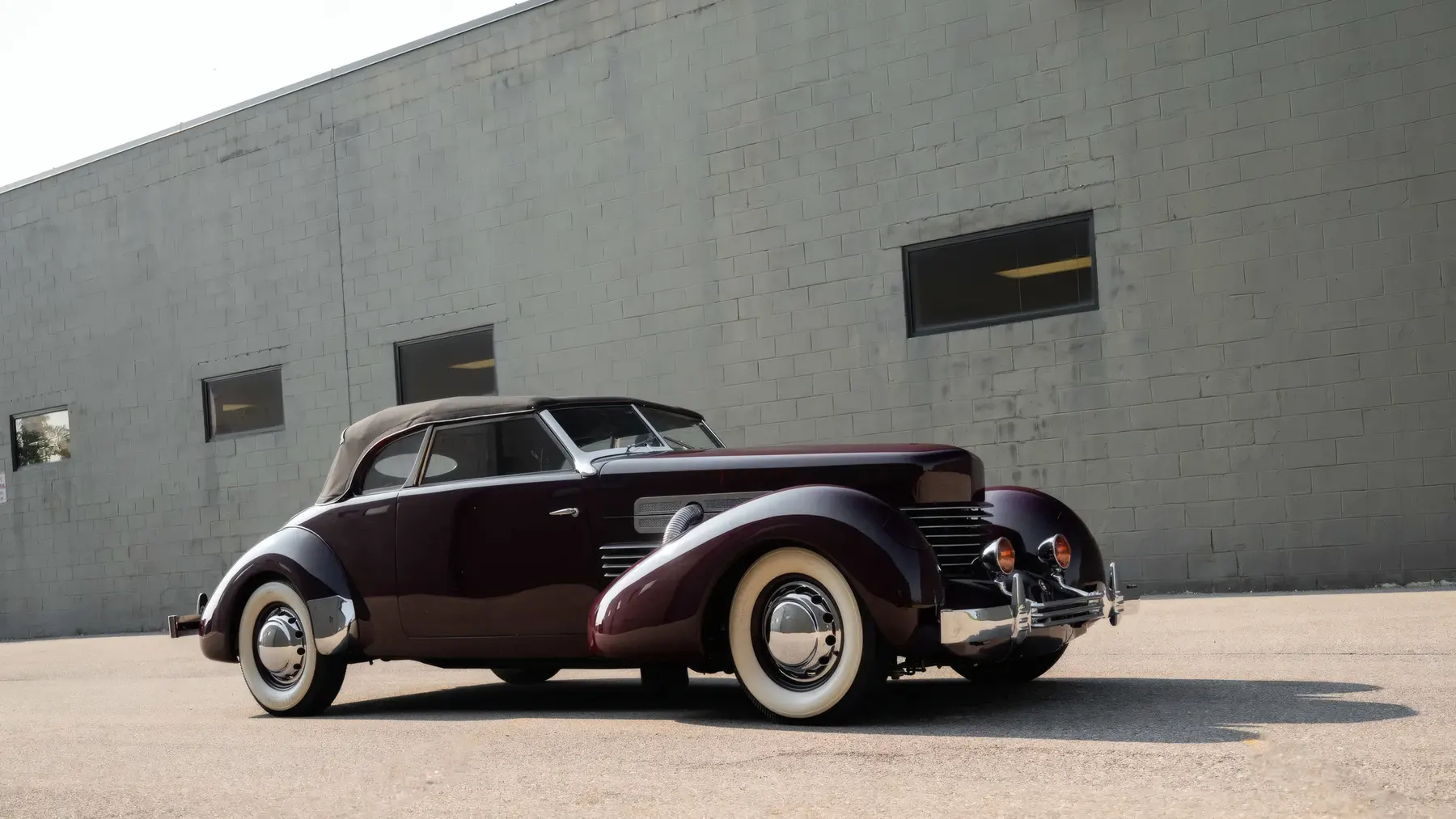
1937 Cord 812 Supercharged Phaeton




Images: Darin Schnabel / RM Sotheby's
The Cord 812 Supercharged Phaeton asks its driver to make up their mind early. You choose the next gear on the steering column, and only when you dip the clutch does the car act on that choice, with a clunk that owners learn to wait for rather than force. It is fitting behaviour for a car that was itself a decision taken slightly too soon: a front-wheel-drive, independently sprung, hidden-headlamp American luxury car, put on sale in the depths of the Depression before its development was finished. The blown four-seat Phaeton is the most theatrical expression of that decision, and it packs both the brilliance and the unfinished business of the Cord 810/812 family into a single open body.
The roots lie in E. L. Cord’s Indiana empire, where Auburn, Duesenberg and the engine maker Lycoming all answered to one owner. Gordon Buehrig’s “Baby Duesenberg” concept of 1933 became a medium-priced Cord, a belated successor to the front-drive L-29 of 1929 to 1932. The route to approval was irregular. Sports Car Market’s account has five prototype sedans built even though the board had rejected the project at the end of 1934, with sign-off in mid-1935 granted on photographs of the clay model, and with profits from steel kitchen cabinets, made in idle factories for Montgomery Ward, covering enough of the bill for the Cord to go ahead.
The launch was worse organised than the approval. With the industry persuaded to preview its 1936 models early, in November 1935, Cord needed the 100 cars that the manufacturers’ association demanded for a show appearance, and Hagerty’s history says nearly all of them were built without transmissions, with canvas covering the hole where the gearbox should have been. Accounts differ on how many show cars truly existed, but not on the state of the gearbox. The public knew none of this. Crowds stood five deep at the New York stand, Sports Car Market counts more than 7,500 requests for information, and customers who had been promised delivery by the end of the year received a bronze scale model to keep them patient. Deliveries began early in 1936, and just 1,174 cars were sold that year. The 812 of 1937 was a lightly revised car with a supercharger option and longer-wheelbase Custom sedans, and the whole 810/812 story lasted only 19 months.
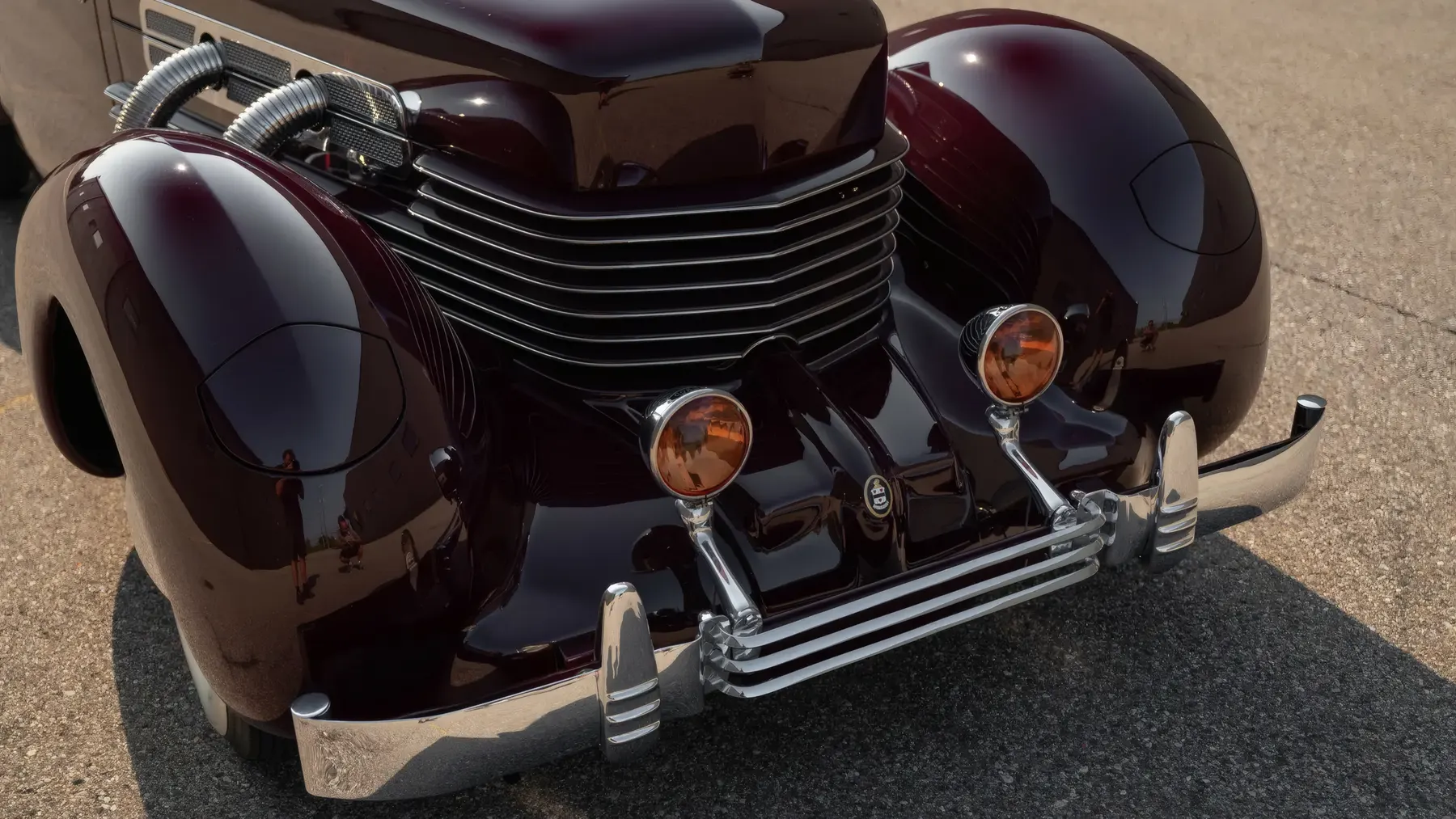
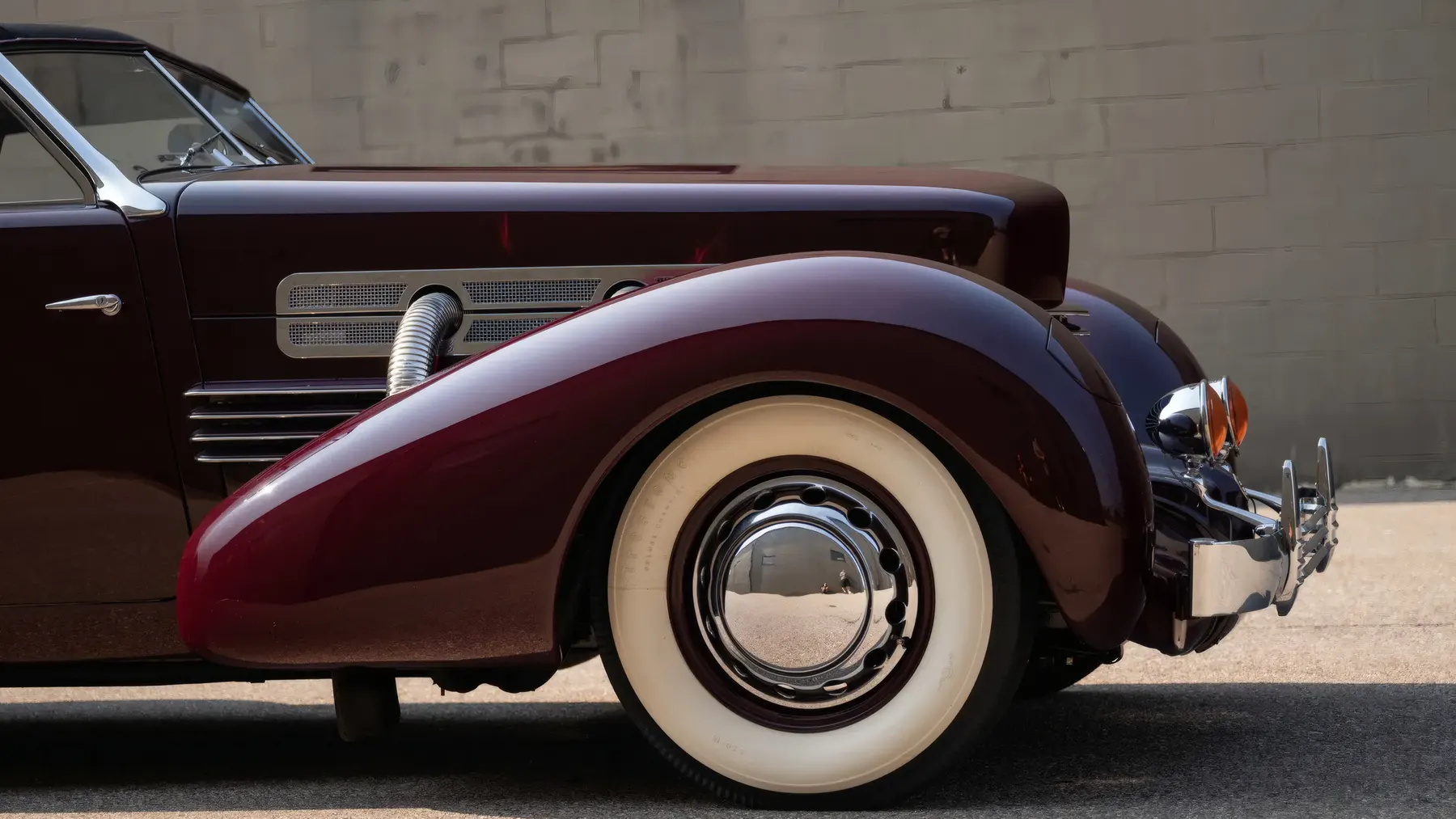
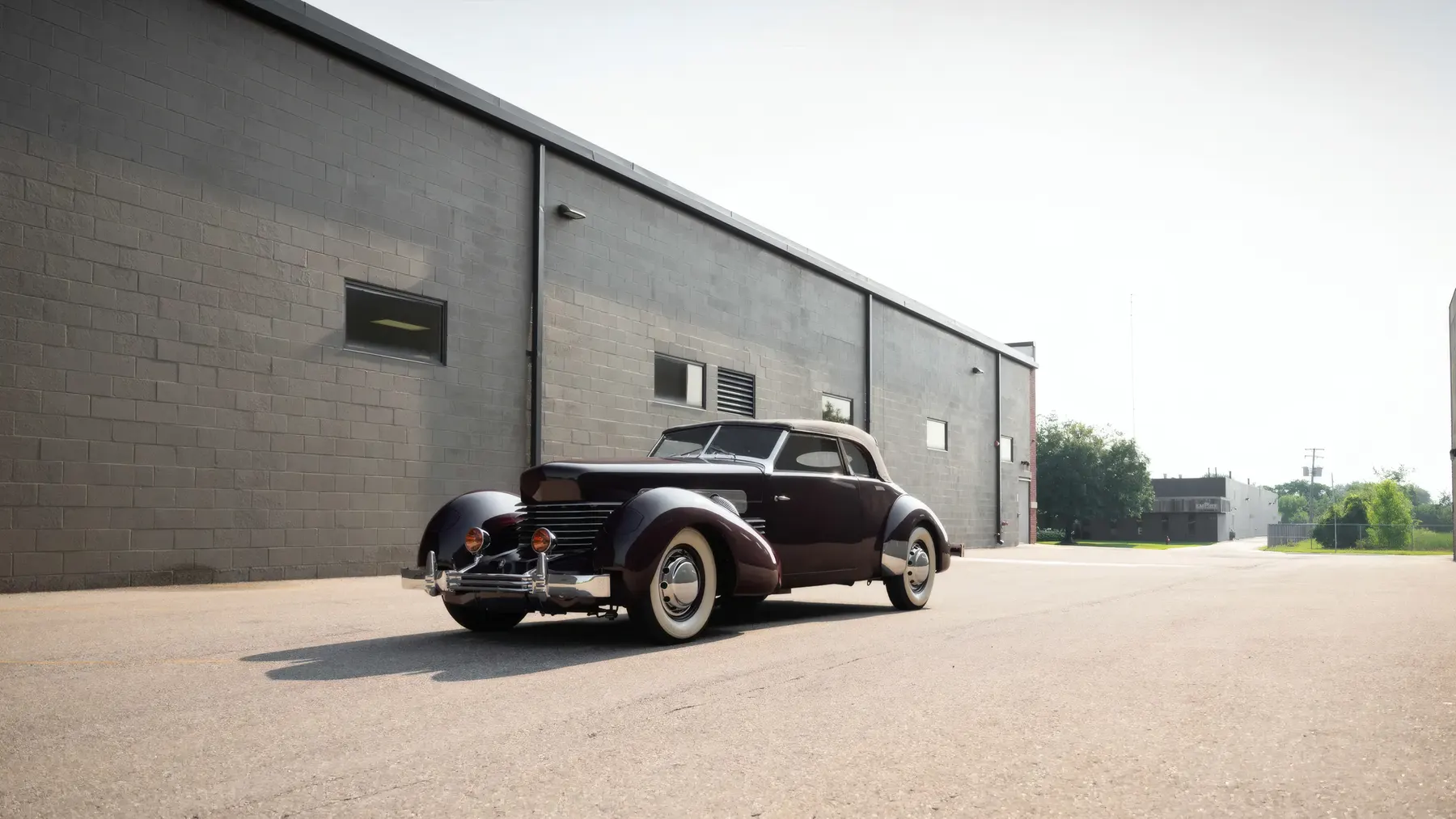
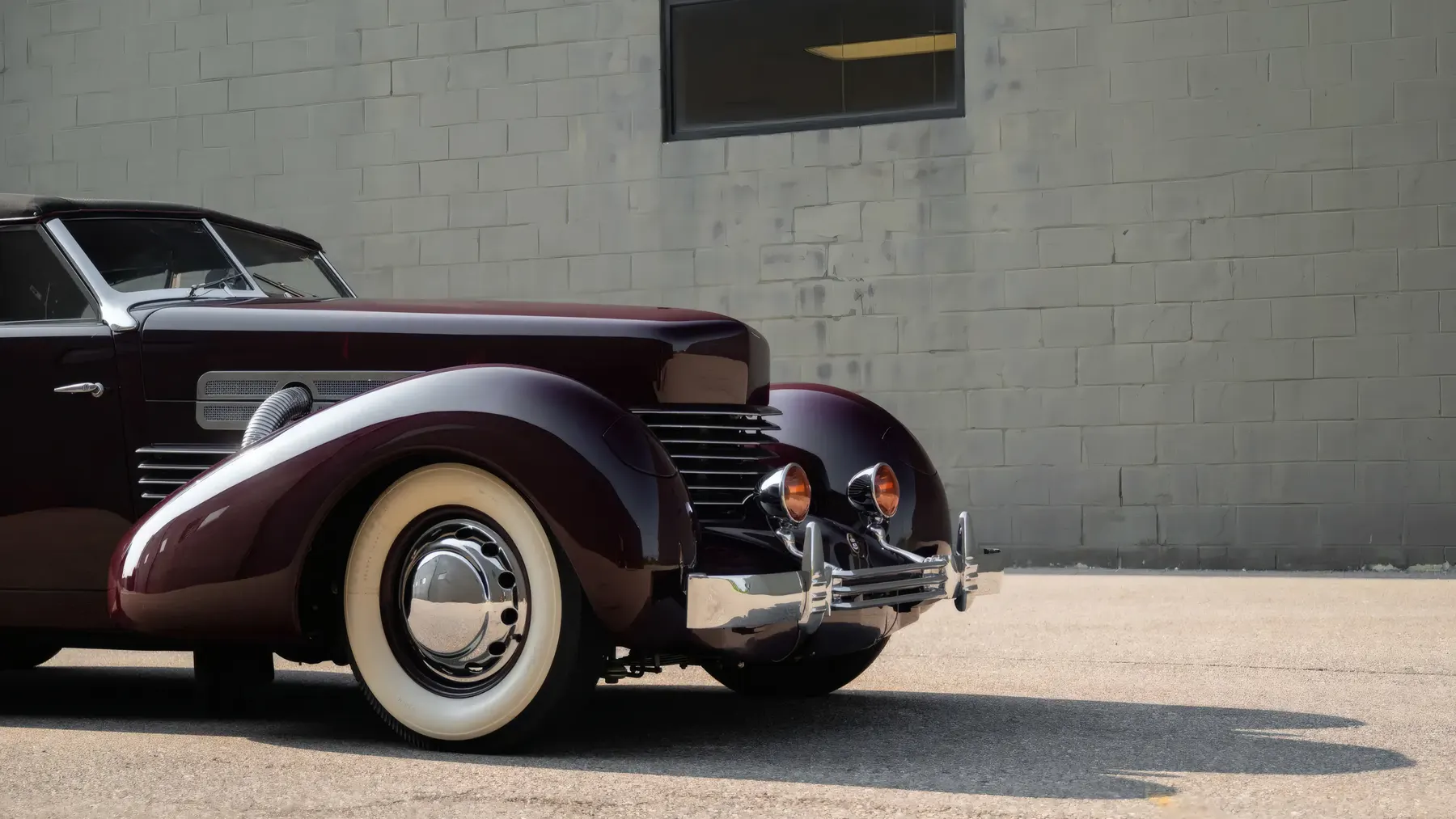
Buehrig’s styling is the reason anyone still writes about the car. A follower of Le Corbusier’s form-follows-function thinking, he refused the car a conventional grille, and the horizontal louvres wrapping around the “coffin nose” are a hangover from an abandoned scheme for side-mounted radiators. The layout did the rest. With the transmission ahead of the engine and driving the front wheels, there was no propshaft and no transmission tunnel, and the floor could sit low enough that running boards became pointless. The details were as radical as the silhouette: headlamps adapted from Stinson aircraft landing lights and raised in about five seconds by hand cranks under the dash, hidden door hinges, a one-piece bonnet hinged at the rear, a flap over the fuel filler, an engine-turned dashboard with eight gauges, a standard radio and variable-speed wipers. When the Museum of Modern Art assembled its Eight Automobiles exhibition in 1951, a Cord was among them, and the catalogue said it suggested “the driving power of a fast fighter plane.”
The Phaeton is the four-passenger open car in the range, catalogued in 1937 as the Convertible Phaeton Sedan, with its soft top folding away beneath a flush-fitting cover so that the profile stayed as clean as the closed cars’. It shares the standard 3,175 mm wheelbase with the two-seat Sportsman and the Beverly and Westchester sedans. Classic & Sports Car argues that the closed four-door cars remain truest to the original concept, and without the sedan’s hunched roofline the Phaeton does lose a little of the front end’s slightly sinister look, but the open cars and the blown cars are what collectors chase, and the blown Phaeton is both. In 1937 a Phaeton listed at $2,645; the supercharger added $415, bringing the total to $3,060. Only 688 Cords of all body styles left the factory with the supercharged engine, and the two sources that give a figure for supercharged Phaetons both say about 196.
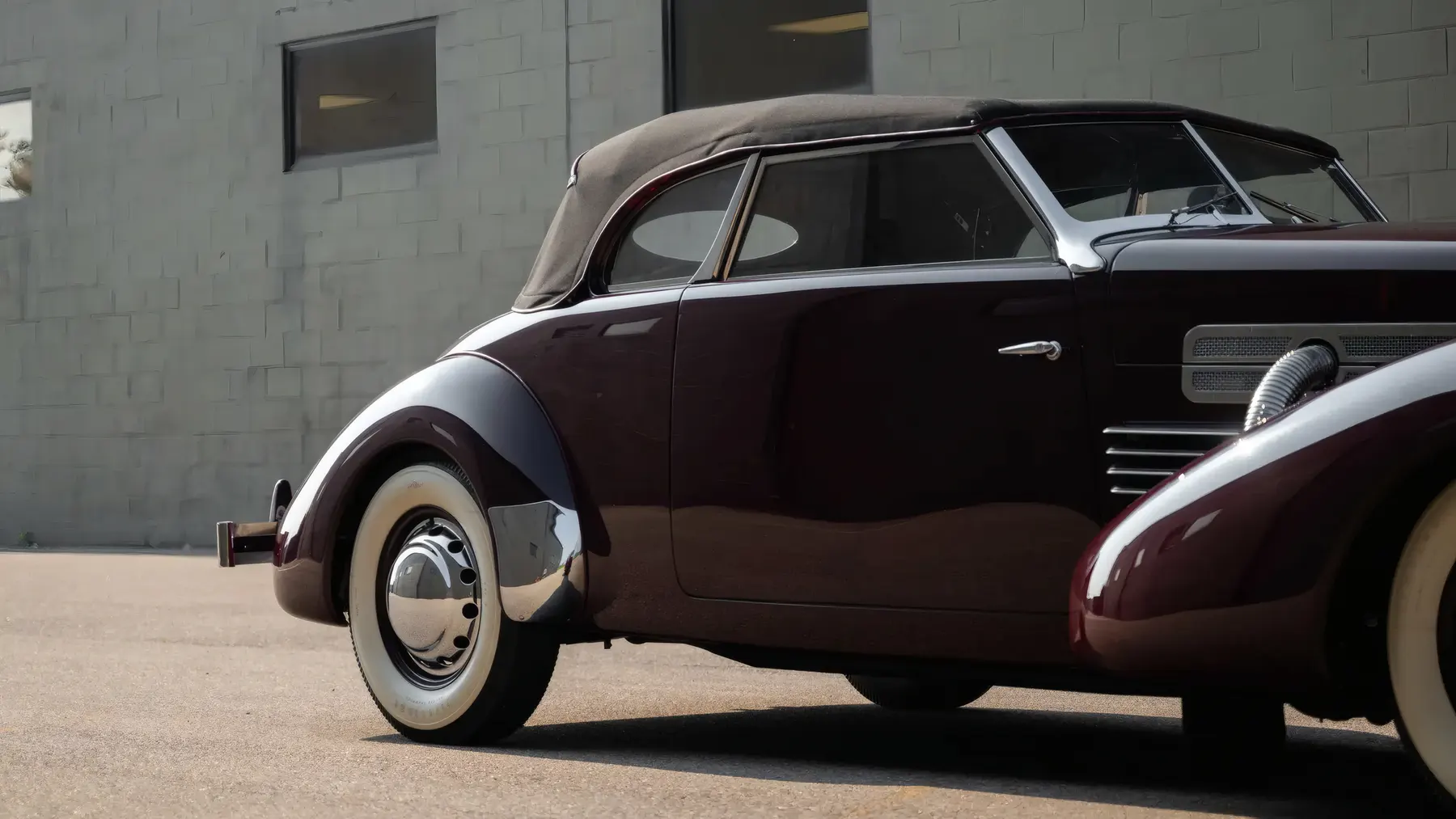
Underneath, the Cord was an all-steel unitary body on a front subframe, with roughly 55 per cent of its weight over the driven wheels, a deliberate attempt to learn from the L-29 with better traction and a shorter wheelbase. Classic & Sports Car also credits the new Citroën Traction Avant as an inspiration. Rzeppa constant-velocity joints served the driveshafts, the trailing-arm front suspension with a transverse leaf spring was new for a front-drive car, and deeply dished wheels pushed the hydraulic drum brakes outboard. The rear remained a beam axle on semi-elliptic leaf springs, which looks conservative beside the front end. Weight figures for the range vary with source and body, from about 1,700 kg to about 1,860 kg. The engine was a 4.7-litre (289 cu in) Lycoming V8 with alloy heads and side valves, rated at 125 bhp in standard form, the only V8 Lycoming ever built and designed from the start to accept a centrifugal supercharger. The gearbox was a four-speed with synchromesh on second, third and top and Bendix electric control, a system also used on the Hudson Terraplane, in which a switch in a miniature gate on the steering column pre-selected the ratio through electromagnets and vacuum diaphragms, leaving the clutch pedal to execute it.
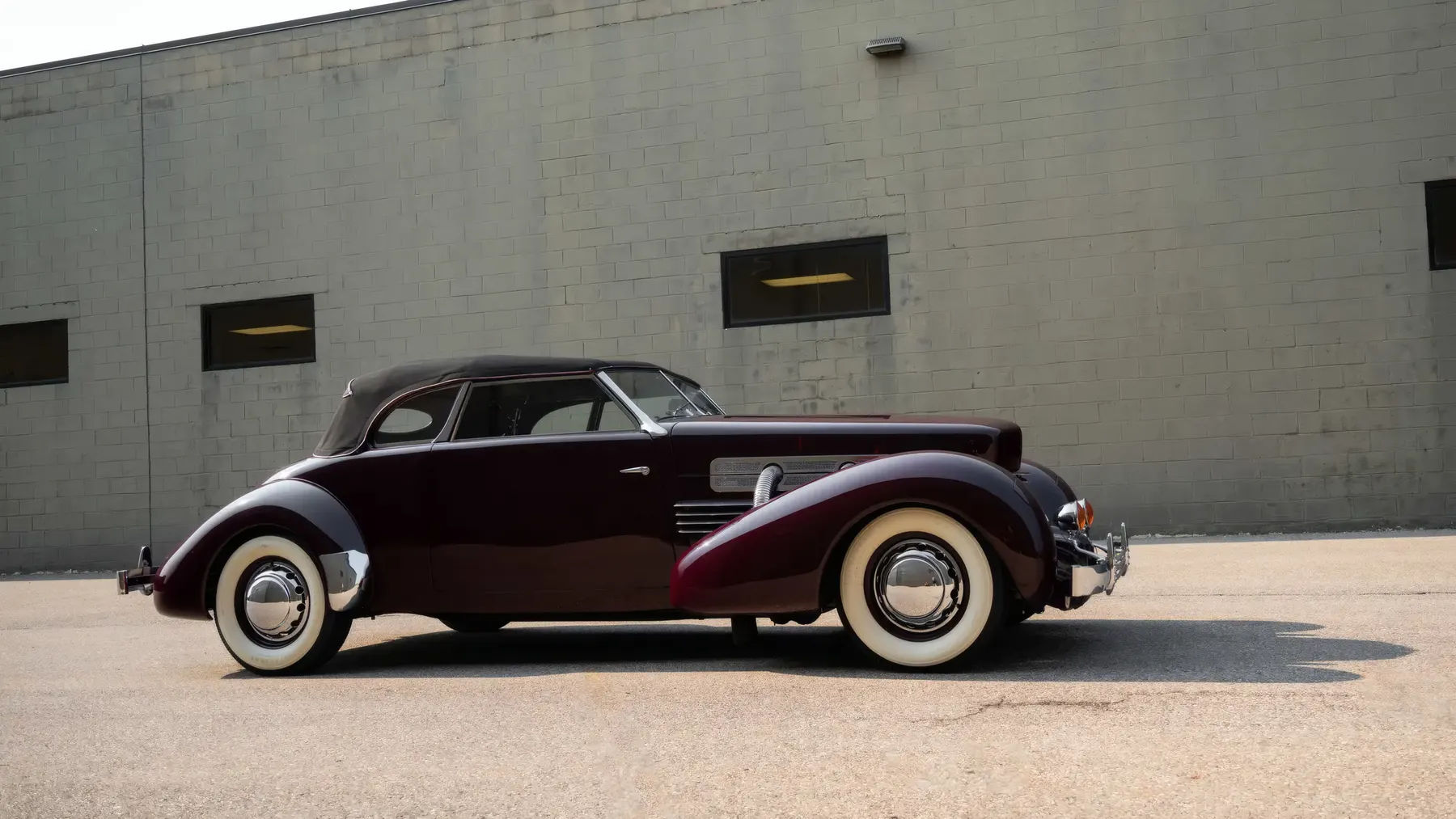
The supercharger is what makes this particular Cord. A Schwitzer-Cummins centrifugal blower, driven by bevel gears from the middle of the camshaft, lifted output from 125 to a factory-quoted 170 bhp on around 4.5 psi of boost. RM Sotheby’s describes a revised firing order, a lowered compression ratio, a more aggressive camshaft and a larger Stromberg AA-25 carburettor to suit. Lycoming employees later recalled figures as high as 195 bhp, and one enthusiast account describes a revision to the blower drive ratio during the model year, so the true output of any given car may have depended on when it was built. The trademark was the pair of chromed exhaust pipes sweeping out of the bonnet sides, which RM Sotheby’s says were believed to have been Alex Tremulis’s idea and engineered into being by August Duesenberg, and the blown car retained the standard pre-selector gearbox. Top gear was an overdrive giving about 27 mph per 1,000 rpm, and claims of 100 mph-plus were credible, where the unblown Beverly in Classic & Sports Car’s figures managed 98 mph and took 20.1 seconds to reach 60 mph.
The factory backed the claim with an endurance run. Supercharged Beverly sedans, driven by Ab Jenkins and Billy Winn, took the Stevens Trophy with a 24-hour average of close to 80 mph, which Bonhams puts at 79.58 mph over about 3,070 km at the Indianapolis Motor Speedway in June 1937. Classic & Sports Car cites trials at both Indianapolis and Bonneville and a 24-hour stock-car record of 101 mph that stood for 17 years. Sources differ on which run produced which figure, but they agree the benchmark survived until 1954. The record cars were closed sedans rather than Phaetons, so the open car borrows the reputation, though it shared the same supercharged engine family.
On the road, the first job is to learn the gearbox. Hagerty’s drive in a blown 812 describes the drill: select first, release the clutch and go, pre-select second, then press and slowly release the clutch when ready, and wait for the clunk. Avoid neutral when stopping, because treating it like an ordinary manual can leave the car stuck in a false neutral. Classic & Sports Car adds that first gear sits below reverse in the gate, that the engine starts with the clutch pedal on the floor, and that the car cannot be rushed. Once moving, the V8 is smooth and flexible rather than musical, with a subdued rumble, and it pulls hard in the lower gears and will happily potter in third, leaving the overdrive for open roads. The steering is heavy at low speed and settles into balance on the highway, with firm, positive castor action; the ride is firm but softened by deeply padded seats, and body roll is low. Hagerty found the blown car cruising at 70 mph on around 2,000 rpm with the supercharger’s soft whirr in the background, and Classic & Sports Car reports that Road & Track’s early features marvelled at the stability and cornering of a near-20-year-old car that handled better than most of its American peers. For a 1937 driver used to tall, rear-drive contemporaries, that low-slung, front-drive stability must have felt startling.
None of it was dependable in period, and that is the central criticism. The gearbox was the main culprit: Classic & Sports Car says early boxes had an unnerving habit of seizing at high speed once the oil began to foam, bottom gear was weak, and wheel bearings and engine cooling also drew complaints, while other sources add that early cars slipped out of gear and suffered vapour lock. Hagerty’s list of early faults includes body shake and electrical glitches, the Frist Art Museum mentions braking problems, and Hagerty calls cracking wheels a chronic Cord problem. Body tooling was never fully resolved, which is why the sedan’s roof is assembled from several smaller pressings, and for 1937 only modest fixes arrived, including revised CV joints and better brakes, according to Curbside Classic. The supercharger landed on top of that unfinished foundation: it kept the standard pre-selector gearbox while lifting power by about a third, and the chassis still relied on hydraulic drums and a leaf-sprung beam rear axle. The market compounded the engineering. American buyers expected expensive cars to be much larger than the 810/812, Classic & Sports Car points out, and no amount of beauty or technical finesse could repair a poor reputation for reliability. The dealer network dwindled quickly as a result. Ownership today is no simpler: Hagerty notes that a general parts store holds little for a Cord, and a specialist industry exists to cure the inherited faults. Visibility is another cost of the style, and Hagerty found it a little limited by the snug top in a blown convertible.
The company ran out of road before the car could be fixed. E. L. Cord announced on 16 August 1937 that he was selling his holdings, and the next day production of the 812 stopped, according to Sports Car Market. Total 810/812 output is usually given as 2,320, though some sources say just under 3,000, and unsold 1936 cars were renumbered as 1937 models, with sources putting the count anywhere from about 150 to about 450. The body dies later went to Hupmobile and Graham, whose Skylark and Hollywood had rear-wheel-drive engineering, conventional grilles and exposed headlamps, and neither lasted much beyond a year.
The reputation has outlived the factory. Two-thirds of production is thought still to exist, the Classic Car Club of America classes the cars as Full Classics, and the Cord found its way into fiction: Ian Fleming gave Felix Leiter one in Live and Let Die, and James Leasor owned a supercharged convertible and gave the same car to his hero Jason Love. At least two replica programmes followed in the 1960s. General Motors paid homage to the hidden headlamps on the 1966 Oldsmobile Toronado and the 1967 Cadillac Eldorado, and the layout of a transmission ahead of the axle and an engine behind it has not been used on an American front-drive car since.
Seen that way, the supercharged Phaeton is less a failed car than an accurate record of the price of being early. It is the version where Buehrig’s clean, hard-edged body, the Lycoming’s lazy muscle and the whining blower come together in one low, open four-seater, and the version where every unfinished corner of the programme, the gearbox most of all, was asked to carry more than the standard car’s power. Collectors forgive it now because the cars have been put right, one specialist at a time. The buyers of 1936 and 1937, who had to live with the faults while the factory caught up, never got that chance.
Technical data
Performance Specifications
| Specification | 810/812 (naturally aspirated) | 812 Supercharged (incl. Convertible Phaeton Sedan) |
|---|---|---|
| Model years | 1936–1937 | 1937* |
| Engine | Lycoming 90-degree V8, side-valve, alloy heads, about 4.7 litres (289 cu in) | Same engine with Schwitzer-Cummins centrifugal supercharger, revised camshaft, lower compression, larger Stromberg AA-25 carburettor |
| Power | 125 bhp at 3,500 rpm | 170 bhp factory-quoted; up to about 190–195 bhp recalled by Lycoming staff* |
| Boost | n/a | Around 4.5 psi (reported)* |
| Transmission | Four-speed, Bendix electric pre-selector, synchromesh on 2nd/3rd/top, overdrive top | Same |
| Top-gear road speed | Around 27 mph per 1,000 rpm | Around 27 mph per 1,000 rpm |
| Front suspension | Independent, trailing arms, transverse leaf spring | Same |
| Rear suspension | Beam axle, semi-elliptic leaf springs | Same |
| Brakes | Hydraulic drums, all round | Same |
| Wheelbase | 3,175 mm (standard cars) | 3,175 mm (Phaeton) |
| Length | Around 4,950–4,970 mm* | Same* |
| Width / height | 1,803 mm / 1,524 mm | Same |
| Weight | About 1,685 kg (Beverly) to 1,860 kg (range figure)* | Not separately documented in sources used |
| 0–60 mph | 20.1 seconds (Beverly) | Not corroborated |
| Top speed | 98 mph (Beverly) | 100 mph-plus (period claims) |
| Production | 2,320 (or just under 3,000)* for all 810/812 | 688 supercharged cars, about 196 of them Convertible Phaeton Sedans* |
| 1937 list price (Phaeton) | $2,645 | $3,060 (includes $415 option) |
Sources
- RM Sotheby’s – 1937 Cord 812 Supercharged Phaeton (Amelia Island 2019), model background
- RM Sotheby’s – 1937 Cord 812 Supercharged (Auburn Fall 2014), model background
- RM Sotheby’s – 1936 Cord 810 Cabriolet, model background
- Bonhams – 1937 Cord 812 Supercharged Beverly, model background
- Classic & Sports Car – Cord 810: ahead of its time
- Hagerty Media – The Cord Capital
- Sports Car Market – 1937 Cord 812 Supercharged Phaeton
- Curbside Classic – 1937 Cord 812 Phaeton For Sale
- Wikipedia – Cord 810/812
- Frist Art Museum – 1936 Cord 810 Beverly Sedan
Join the discussion
Comments
Loading comments…
Leave a comment
Share a detail, memory, or perspective. Every comment is reviewed before publication.