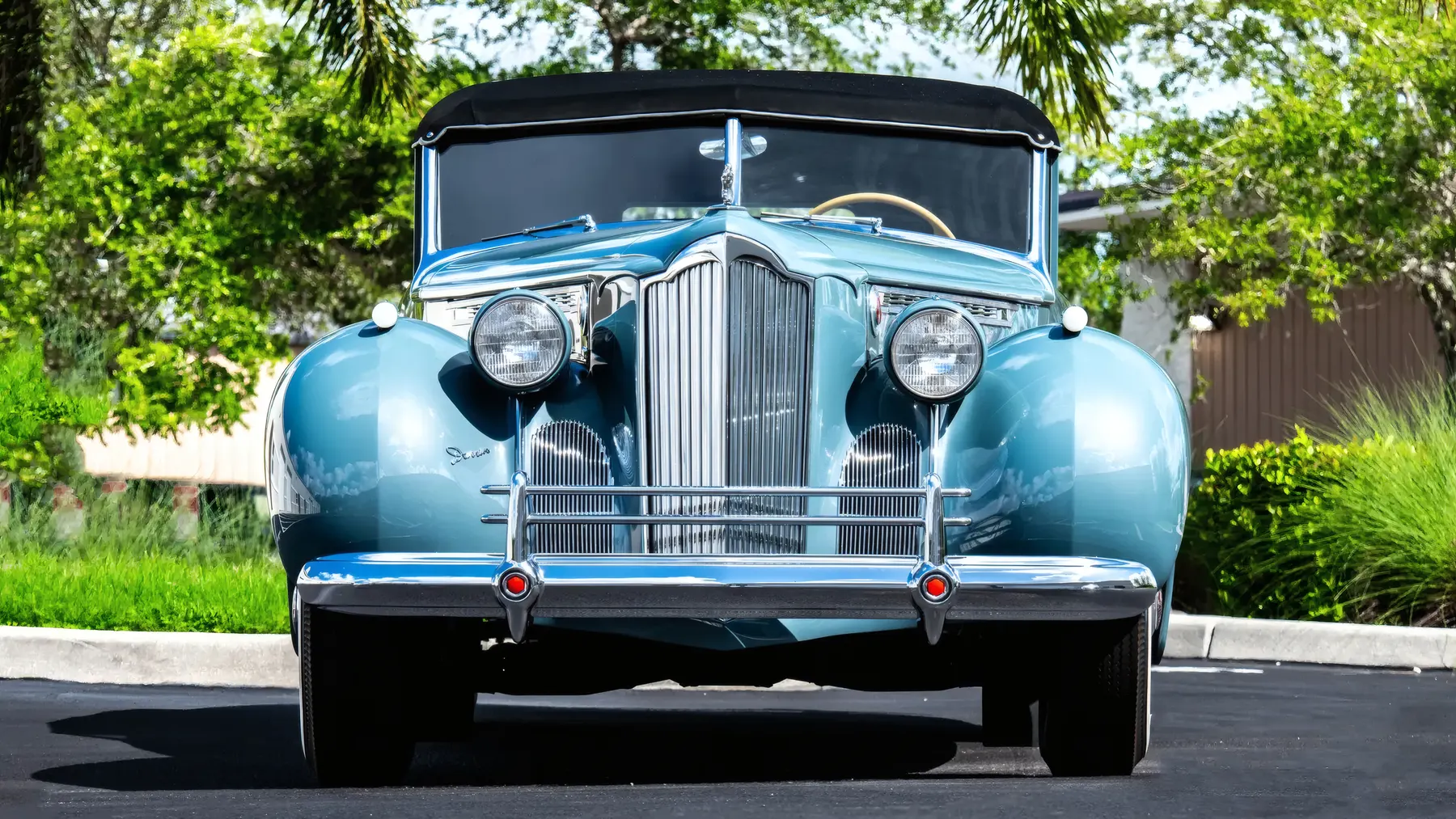
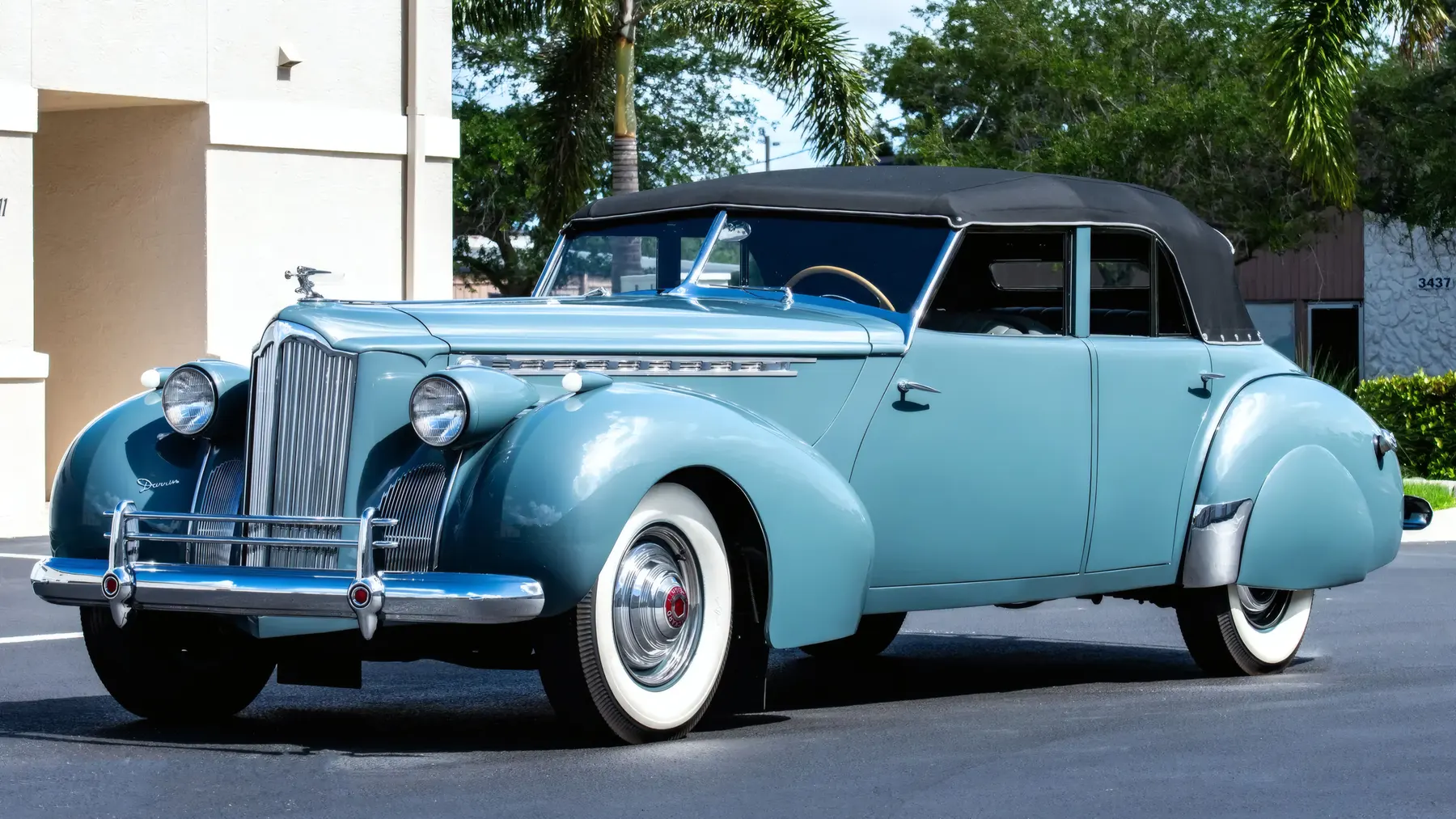
1940 Packard Custom Super Eight One-Eighty Convertible Sedan by Darrin
Images: Jorge Guaso / RM Sotheby's
Howard Darrin understood Hollywood better than almost any other automotive designer of his era, which is precisely why his most important work was never really about the movies at all. The convertible sedan he produced on Packard’s Custom Super Eight One-Eighty chassis in the early 1940s represents something rarer and more culturally loaded than a glamorous accessory for film stars: it is one of the last serious expressions of American coachbuilding at the precise moment that tradition was about to vanish forever, executed by a man who grasped both what the car needed to look like and what it needed to mean.
Howard “Dutch” Darrin had come to the craft through an unusual route. Having spent years in Paris during the 1920s and 1930s operating a coachbuilding atelier with partner Tom Hibbard, he absorbed the French school’s preoccupation with proportion, surface tension, and the relationship between bodywork and the mechanical structure beneath. When he returned to the United States and established himself in Hollywood, he brought those sensibilities into a market that was simultaneously more ostentatious and more commercially ruthless than anything the Parisian carrossiers had faced. His clients wanted to be seen. They also wanted something that read as European sophistication translated through an American lens - lower, wider, more theatrical than anything Detroit was producing from its standard lines.
Packard was the natural partner for this ambition. By the late 1930s, Packard occupied a peculiar position in the American luxury market: it was genuinely prestigious, genuinely engineered to a high standard, and yet struggling to reconcile its coachbuilt heritage with the economics of volume production. The company had introduced the One-Ten and One-Twenty series through the mid-1930s as more affordable Packards, which diluted the marque’s exclusivity even as it saved the company financially. The Custom Super Eight One-Eighty was Packard’s answer to its own identity crisis - a deliberate reassertion that the company could still produce motorcars of the very highest order. Positioned above the standard One-Sixty, the One-Eighty offered coachbuilt and semi-custom bodywork through a handful of approved coachbuilders, with Darrin among the most prominent.
The One-Eighty designation itself covered the 1940, 1941, and 1942 model years before wartime production requirements ended civilian automobile manufacturing entirely. The Super Eight engine at the heart of these cars was a 356-cubic-inch straight-eight - a configuration Packard had refined over many years into something genuinely distinguished. Producing around 160 bhp, it was not the most powerful unit in Packard’s arsenal (that honour fell to the company’s twin-six and, latterly, its V12), but the straight-eight was beloved for reasons that raw output cannot fully explain. It was exceptionally smooth, with a sense of unhurried mechanical inevitability that matched the weight and presence of the cars it propelled. Torque delivery was broad and tractable rather than peaky, which suited long-distance travel and the unhurried urban progress expected of a car this expensive. The chassis, a substantial ladder-frame affair with independent front suspension, provided a stable platform for coachwork that was heavier than standard bodies and demanded structural integrity over rough surfaces.
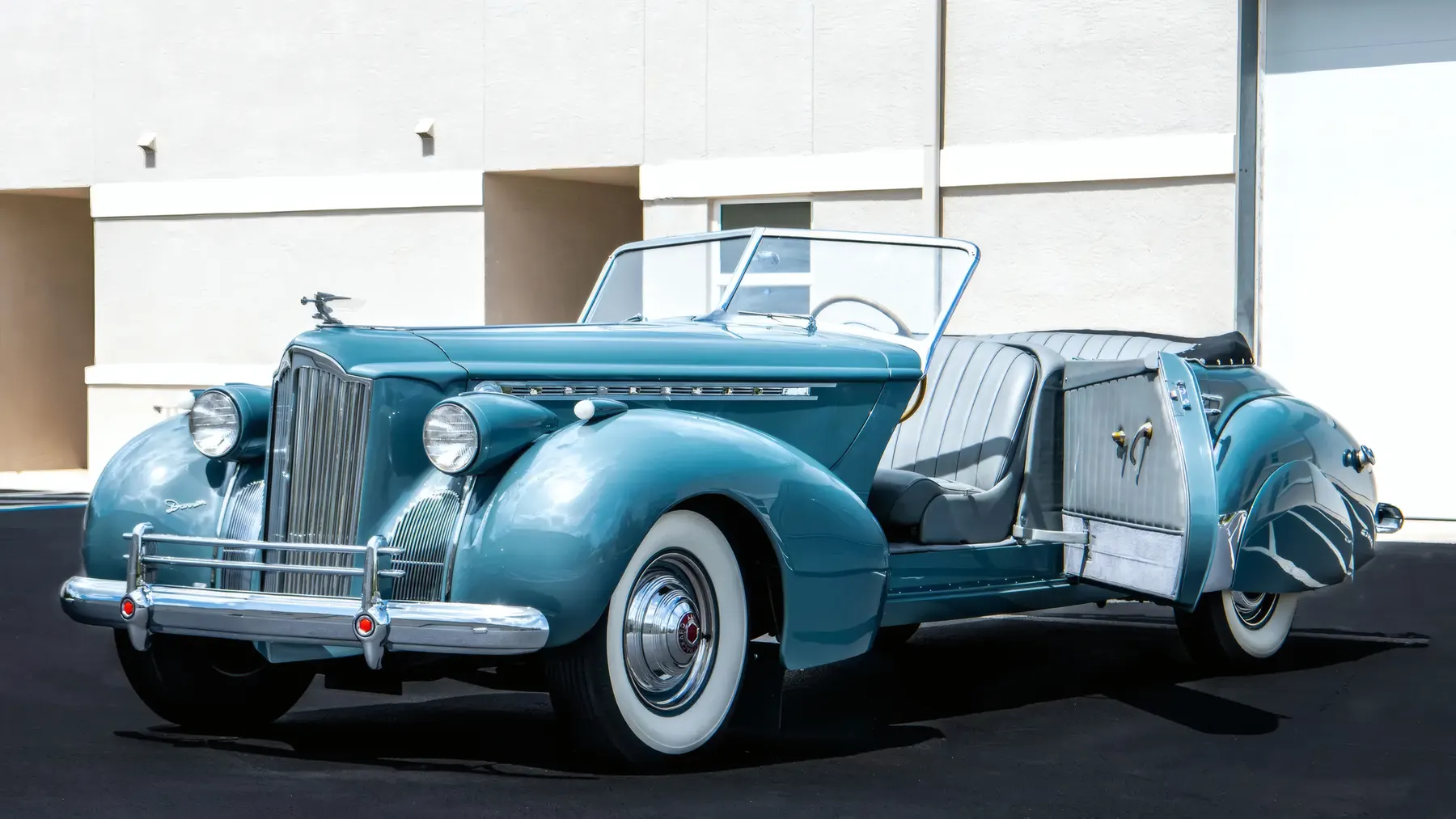
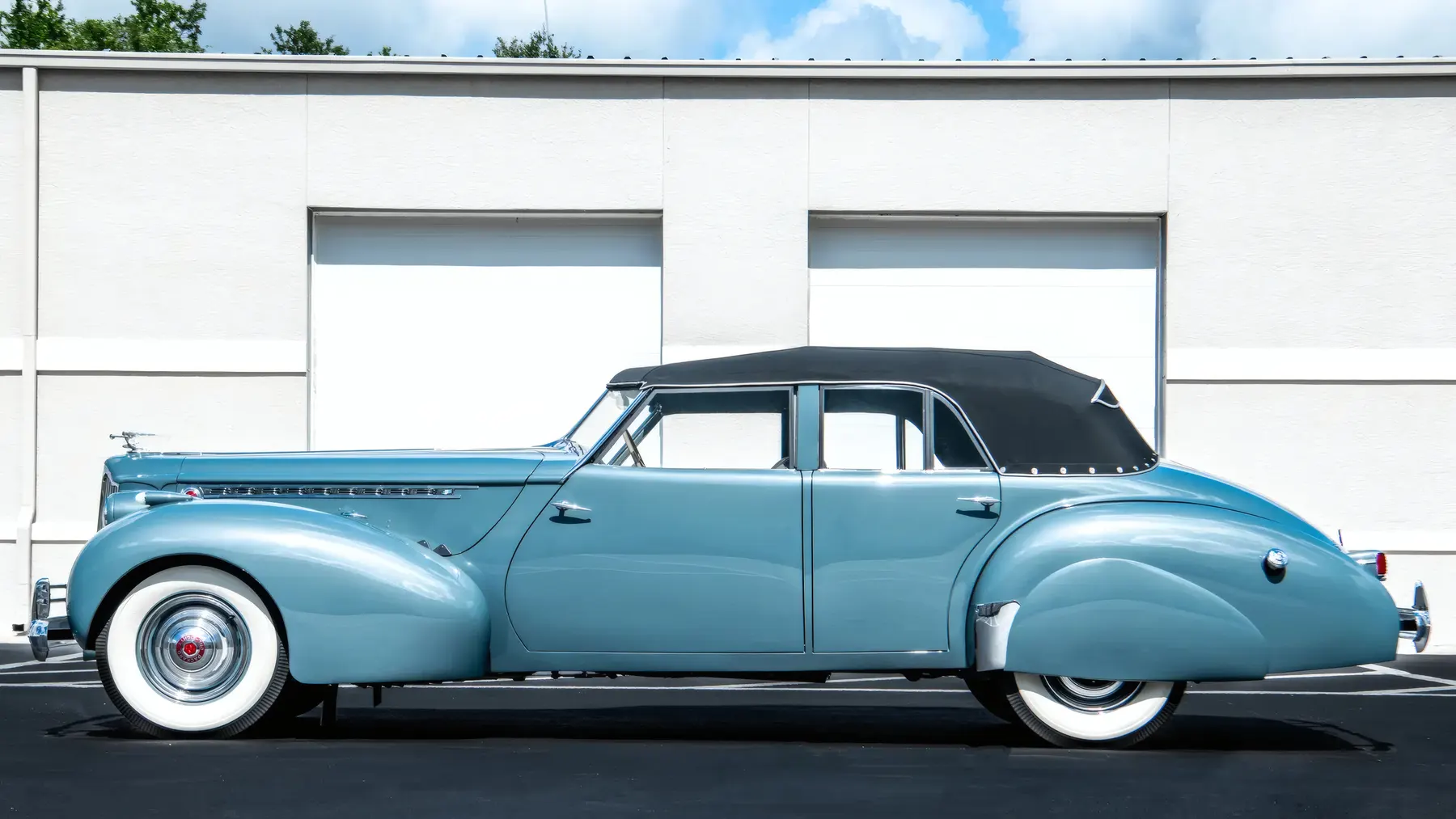
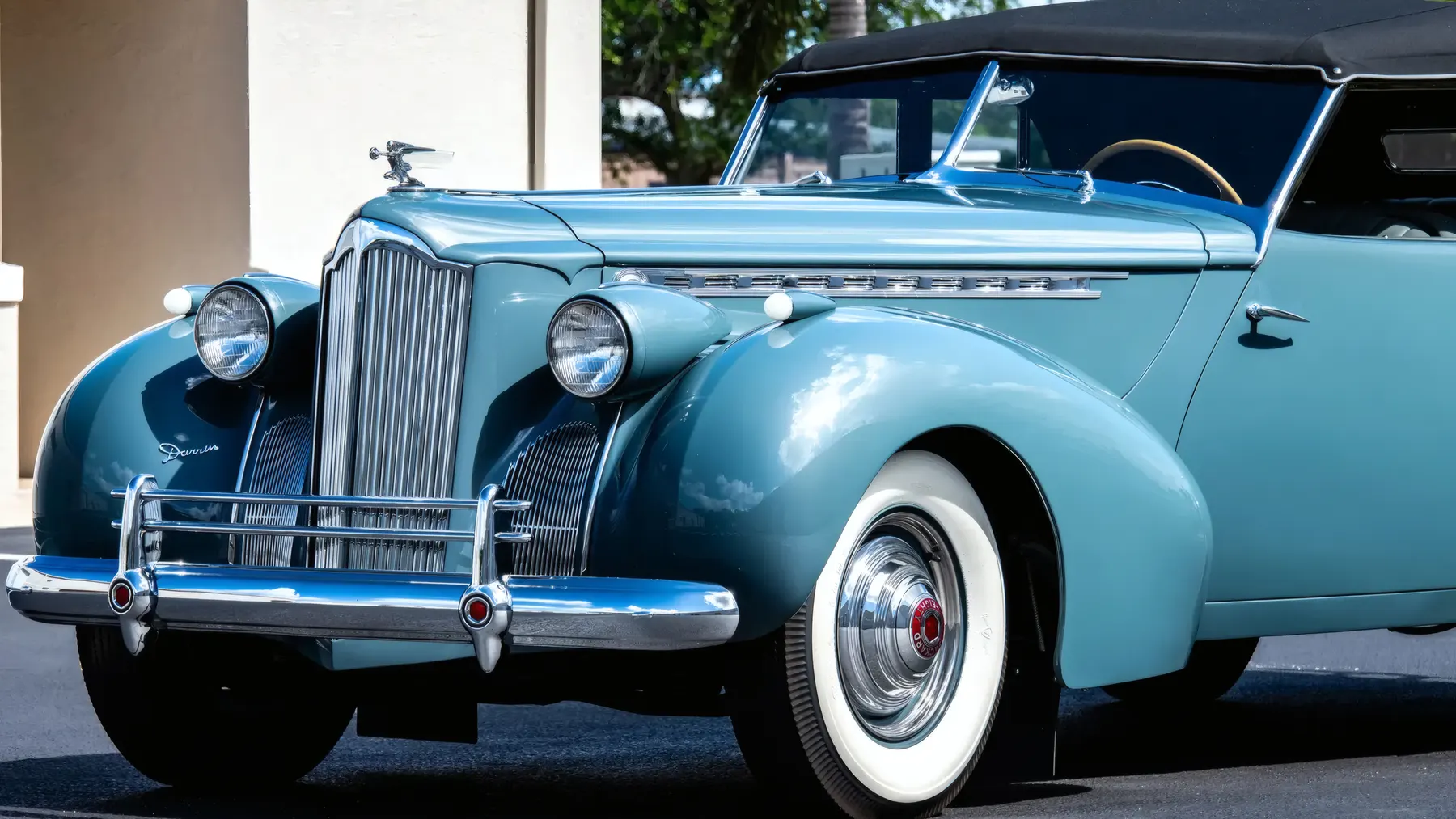
The Darrin convertible sedan - sometimes catalogued as a convertible victoria - was among the most ambitious body styles available on the One-Eighty platform. Unlike a convertible coupe or roadster, a four-door convertible sedan presented genuine engineering and aesthetic challenges. Eliminating the fixed roof over a long four-door body requires a very different approach to structural rigidity; the beltline and sill sections carry loads that would otherwise pass through the roof structure, and the result is always a heavier, more complex solution than its open two-door equivalent. Darrin addressed this partly through sheer mass and partly through design intelligence: his coachwork was not trying to be a lightweight sports car, and the visual language never pretended otherwise. The car sat low on its chassis by the standards of the period, with a flowing, uninterrupted beltline that swept gracefully downward through the door area - the feature that would become known as the “Darrin dip.” This characteristic concave sweep at the leading edge of the door cutout was not simply a stylistic signature; it lowered the visual centre of gravity, made ingress and egress more natural, and gave the profile a sense of forward motion even at rest.
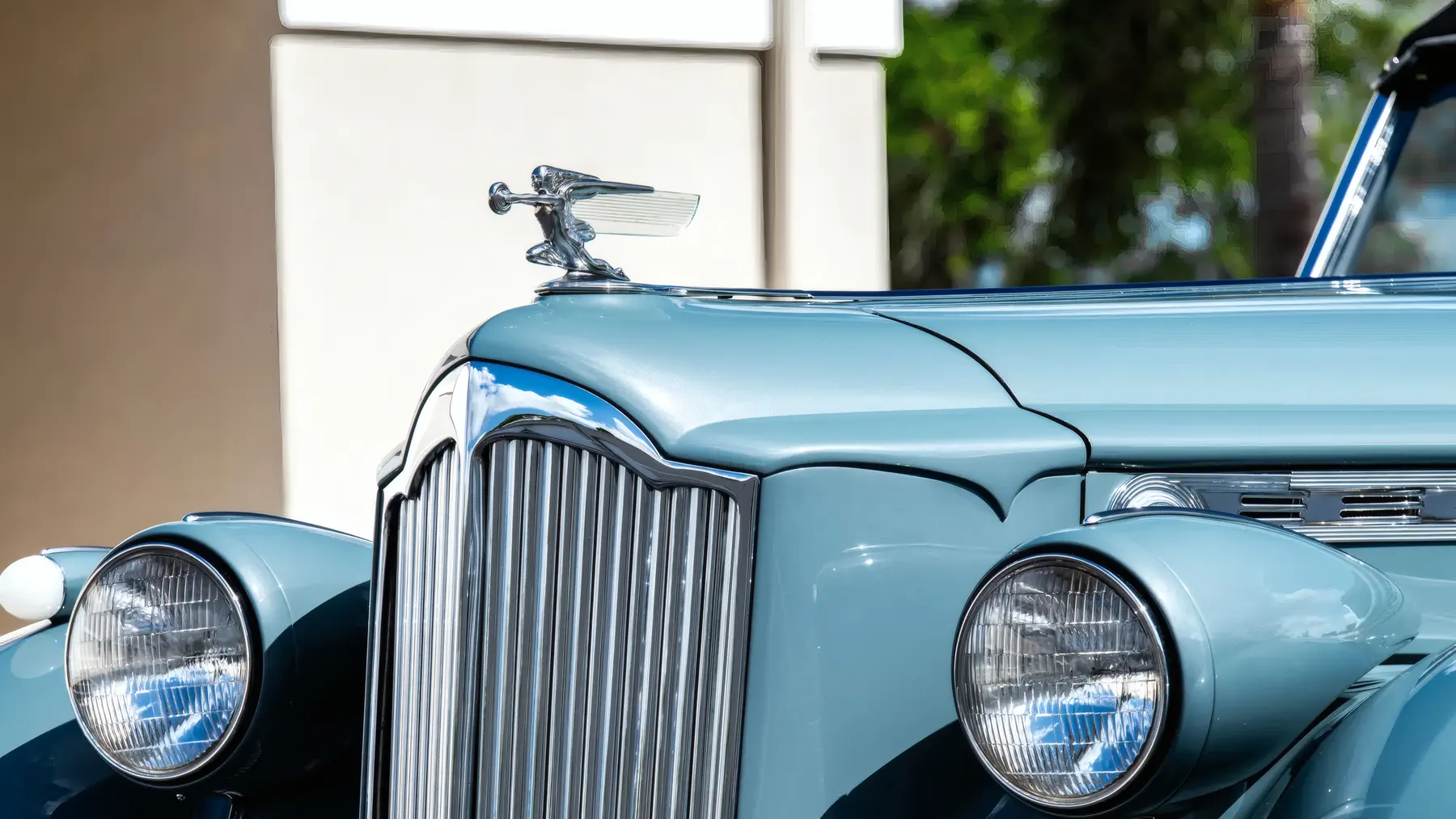
The long hood, demanded by the straight-eight’s considerable length, worked in Darrin’s favour here. He treated it as a compositional element, allowing the eye to travel from the prominent vee’d grille through the hood’s length and then down into the flowing rear bodywork without interruption. The front fenders were separate, fully skirted, and integrated into the overall silhouette with more visual cohesion than many American coachbuilt designs of the era, which could feel like components assembled from a catalogue rather than resolved wholes. Darrin’s Paris training showed in precisely this - the sense that every surface had been considered in relation to every other surface, rather than designed in isolation.
The interior of a Darrin One-Eighty convertible sedan reflected the expectations of its clientele without excess vulgarity. Fine leathers, polished wood veneers, deep pile carpeting, and proper attention to the details of switchgear and fittings characterised the cabin. The convertible roof mechanism, when lowered, folded in a way that was tidier than many contemporary American open cars, though it never quite disappeared as neatly as the best European coachwork of the period. When raised, the fabric top fitted well enough, but as with all convertible sedans of this generation, it was understood that the car’s best life was lived in fine weather.
Driving a car of this type in period required acceptance of its physical presence. These were large, heavy motorcars - the kind of machine for which the roads of Beverly Hills and Bel Air had been implicitly designed. The steering was precise enough by the standards of the day, the gearbox manageable, and the ride, on long-travel suspension with generous tyre section, absorbed the imperfections of American roads with the appropriate sense of isolation and refinement. These were not cars for hustling along mountain roads; they were for being seen arriving, for covering ground in comfort, and for communicating something about their owners that words alone could not.
Production figures for Darrin-bodied One-Eighty convertible sedans were extremely limited - as with most semi-custom coachwork of this era, only a small number of examples left the Packard-approved coachbuilders in any given model year, and the convertible sedan body was a low-volume variant even within that constrained universe. The outbreak of the Second World War and the subsequent halt to civilian car production in early 1942 ended the story abruptly, as it ended so many others. There would be no postwar continuation. Packard emerged from the war a changed company, and the appetite and infrastructure for semi-custom coachwork at this level never really recovered in the American market.
What Darrin had achieved in this narrow window was a genuinely considered piece of design that placed American coachbuilding in productive conversation with European practice without simply imitating it. The One-Eighty convertible sedan was not trying to be a Figoni et Falaschi creation or a Saoutchik exercise in baroque excess. It was, in its own terms, a serious and coherent automobile - one that happened to serve as the most glamorous possible expression of a particular American moment, when the country’s wealth and self-confidence were about to be redirected into something far more urgent than beautiful motorcars. That the last examples were completed just months before that redirection began gives the whole lineage a poignancy that purely technical analysis cannot capture, and that no amount of subsequent restoration can entirely dissolve.