2005 Ferrari 612 Scaglietti
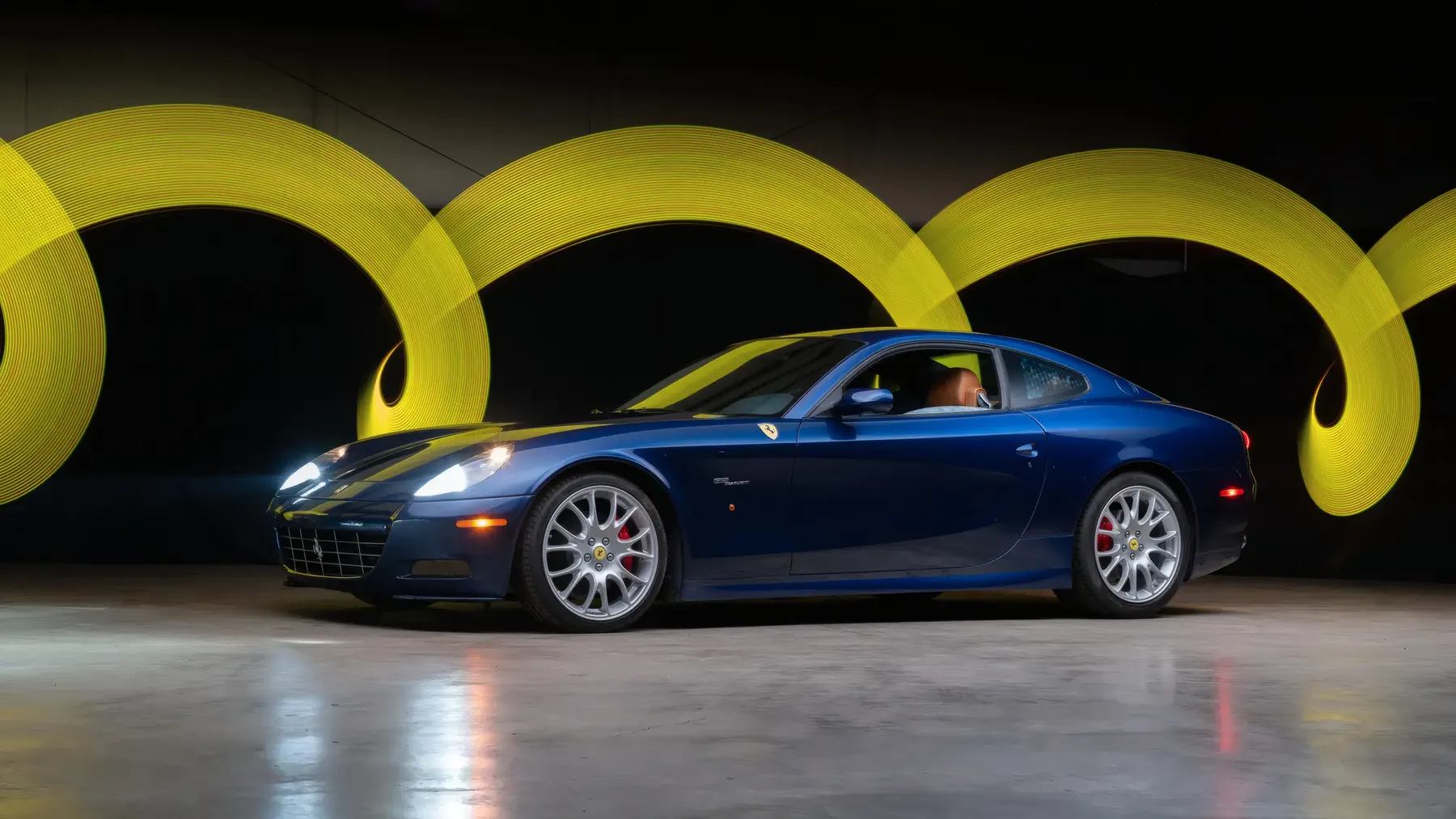
When Ferrari unveiled the 612 Scaglietti at the 2004 Geneva Motor Show, it did so with a peculiar kind of confidence - naming a car after the man who had shaped aluminium by hand into the most beautiful Ferraris ever made, Sergio Scaglietti of Modena, was either an act of extraordinary reverence or a very high bar to clear. The 612 managed, more or less, to live up to it.
The car arrived as the direct successor to the 456M GT, Ferrari’s previous attempt at the four-seat grand tourer - a formula the company had pursued with varying conviction since the 365 GT 2+2 of the late 1960s. Where the 456M was elegant but narrow in ambition, the 612 was a more deliberate statement: a proper four-seater that could genuinely transport four adults on a trans-continental run without requiring them to apologise to the rear passengers at journey’s end. The design brief, as Ferrari’s product strategy director Giuseppe Bonollo put it at launch, was to build a car capable of Ferrari-grade performance in a package that could comfortably carry four actual adult humans - something no four-seatbelt Ferrari in history had really managed.
The 612 sat above the 575M Maranello in the range and was priced accordingly, entering the US market at over $313,000. It occupied an unusual position - too large and luxurious for those who wanted a pure sports car, yet too overtly Ferrari for those who might otherwise consider a Bentley Continental GT or a Mercedes CL63 AMG. That ambiguity was partly the point. Ferrari was not trying to compete in the traditional grand tourer segment so much as define its own corner of it.
The engine is where the 612’s story begins in earnest. The 5,748cc naturally aspirated V12 - 89mm bore, 77mm stroke, 65-degree V-angle - sat longitudinally at the front and drove the rear wheels through a transaxle gearbox mounted at the back, which was a deliberate engineering choice to achieve a 46/54 front-to-rear weight distribution. At 1,840kg, the 612 was 150kg heavier than the 456M it replaced, and Ferrari’s engineers put considerable thought into where that weight sat. The result of moving the gearbox to the rear axle - and locating 85% of the car’s mass within the 2,950mm wheelbase - was a car that felt more wieldy than its kerb weight suggested. Power output was 532 bhp at 7,250rpm, with 434 lb-ft of torque arriving at 5,250rpm, enough to push the car to a genuine 199 mph top speed.
Gearbox options spanned the production run in interesting ways. Early cars offered a choice between a six-speed manual - fitted to roughly one in ten examples - and Ferrari’s F1-type electro-hydraulic automated manual, the F1A. The manual was the purist’s choice but the F1A matured considerably over the car’s life: by 2008 it had been recalibrated to execute shifts in 100 milliseconds, making it genuinely rapid rather than merely clever. The 2006 introduction of the Handling Gran Turismo Sport (HGT-S) and Handling Gran Turismo Competizione (HGT-C) packages added further dimension to the range - the former bringing stiffer dampers, revised anti-roll bars, a quicker-shifting gearbox calibration and a sportier exhaust, while the HGT-C layer added carbon-ceramic brakes and more permissive traction control thresholds. Later these two packages were consolidated into a single HGT-2 option. None of the variants altered the engine output; Ferrari correctly judged that the chassis, rather than the powertrain, was what needed refinement.
The one genuinely special-edition 612 was the Sessanta, produced in 2007 to mark Ferrari’s 60th anniversary. Sixty examples were built - one for each year - finished in period-appropriate liveries referencing significant Ferraris from each decade. It was celebratory rather than technically distinct, but it crystallised the 612’s status as a car with genuine history behind it rather than simply a product cycle to fill.
Pininfarina’s exterior design, executed under the direction of Ken Okuyama, drew explicitly on the long-bonnet, short-tail proportions of the classic Ferrari 375 MM that Scaglietti himself had bodied in the early 1950s. The 612’s silhouette was unambiguously a nod to those cars: a long, arching roofline, a prominent bonnet that stretched well ahead of the front axle, and flanks that swept cleanly from the front wheel arch to the tail. One detail that generated discussion was what became known internally as the “Ingrid scallop” - a subtle concave section pressed into the side of the body to optically foreshorten the 2,950mm wheelbase, which Ferrari’s own engineers admitted looked “a bit awkward from some angles” without it. It was an honest admission that the car’s size was a compromise made for the sake of the weight distribution and the rear seat space.
The aluminium construction was genuinely novel for Ferrari at the time. The 612 was the first twelve-cylinder Ferrari road car to feature an all-aluminium chassis and body, developed in partnership with Alcoa. The structure was exceptionally stiff, and its rigidity translated directly into the car’s dynamic character: no vibration, no rattles, a solidity underfoot that made the 612 feel more like a focused sports car than its dimensions implied. Ferrari claimed the 612 was six seconds faster than the 456M GT around Fiorano, a meaningful delta on a short circuit.
On the road, the car’s personality shifted depending on which variant and which mode you selected. The standard suspension setup was compliant and long-legged - well-suited to the autostrada or the motorway, where the V12’s torque made light work of sustained high-speed cruising. In sport mode, the traction control’s intervention threshold was raised enough to permit a degree of oversteer, and the steering - three turns lock to lock, but calibrated at exactly 64mm of rack travel per revolution - became noticeably more alert. The integrated stability and traction control system was, at its introduction, a first for Ferrari - an acknowledgement that a 1,840kg GT was not the appropriate vehicle for relying entirely on driver skill in adverse conditions.
The genuinely impressive achievement was how the 612 balanced these demands. This was a car with usable rear seats - not the token gesture of its predecessors - combined with a V12 engine that revved freely to over 7,000rpm and a chassis that rewarded committed driving. The fuel consumption was predictably considerable; Ferrari quoted around 20 litres per 100km in real-world use, and the car’s thirst for premium fuel was an ongoing operational reality for owners.
Where the 612 was less successful was in the area of aesthetic coherence. The interior, while luxuriously appointed and wider and more practical than the 456M’s, never quite achieved the visual harmony of the exterior. The driving position was commanding but the dashboard design reflected the early 2000s Ferrari house style - functional and well-made, but not memorable in the way the exterior was. The car was also, simply, large - and Ferrari’s chassis engineers had done what they could to disguise that, but at low speeds in urban environments the 612’s 4,902mm length and wide body made it less than effortless.
Reception at launch was warm but measured. Road testers acknowledged the genuine achievement of the four-seat packaging while noting that buyers looking for the sharpest possible driving experience might find more satisfaction in the 575M Maranello or the forthcoming 599 GTB Fiorano, which arrived in 2006 and used a related but more driver-focused architecture. The 612, by contrast, was praised specifically for what it was - an honest, capable grand tourer that happened to carry a prancing horse on its nose.
Production ended in 2011, with 2,398 examples built across the model’s seven-year run. Its replacement, the Ferrari FF, took the four-seat Ferrari concept in an entirely different direction - four-wheel drive, shooting brake body, even more interior space - and in doing so underlined just how conservative the 612’s brief had been by comparison. The 612 Scaglietti was not trying to reinvent anything. It was trying to do one thing properly: give four people a genuinely excellent car to travel in quickly. By the time the last one left Maranello, it had succeeded on its own quietly confident terms, carrying the name of a man who would, one hopes, have approved.