Ferrari 599 GTB Fiorano: The Last Manual V12 Ferrari Ever Built
2009 Ferrari 599 GTB Fiorano





Images: Remi Dargegen / RM Sotheby's
Ferrari built the 599 GTB Fiorano as its most electronically sophisticated front-engined V12 to date, stuffed with a paddle-shift gearbox that could swap cogs in a tenth of a second, magnetically adjustable dampers, and a steering-wheel dial lifted straight from Formula 1. And yet the version enthusiasts now chase hardest is the one that rejects nearly all of it: a plain six-speed manual gearbox, offered to just thirty buyers, that turns Ferrari’s flagship touring supercar back into something a driver operates rather than negotiates with. That tension, between a car engineered to showcase everything Maranello’s electronics division could do and a car most prized for the one thing it let you do yourself, sits at the heart of the 599’s story.
The 599 GTB Fiorano did not appear in a vacuum. Its immediate predecessor, the 575M Maranello, had been quietly judged within Ferrari and by the wider press as a dynamic step backwards from the 550 Maranello it replaced, a car that traded some of its predecessor’s clarity for a heavier, more isolated feel. Ferrari’s response was not a facelift but a ground-up replacement. Unveiled at the Geneva Motor Show in February 2006 as a 2007 model, the 599 GTB Fiorano discarded the 550/575 family’s tubular-steel chassis in favour of an all-aluminium spaceframe structure, chosen for its combination of greater stiffness and reduced mass, and it lengthened the wheelbase to reposition the fuel tank and lower the car’s polar moment of inertia. Under the bonnet sat a reworked version of the naturally aspirated 5,999cc V12 developed for the mid-engined Enzo hypercar, a genuine halo-car engine repackaged to fit a front-engined GT. The name folded all of that into a single badge: 5999cc of displacement, Gran Turismo Berlinetta body style, and Fiorano, Ferrari’s private test track, where the car’s suspension and aerodynamics were developed and validated.
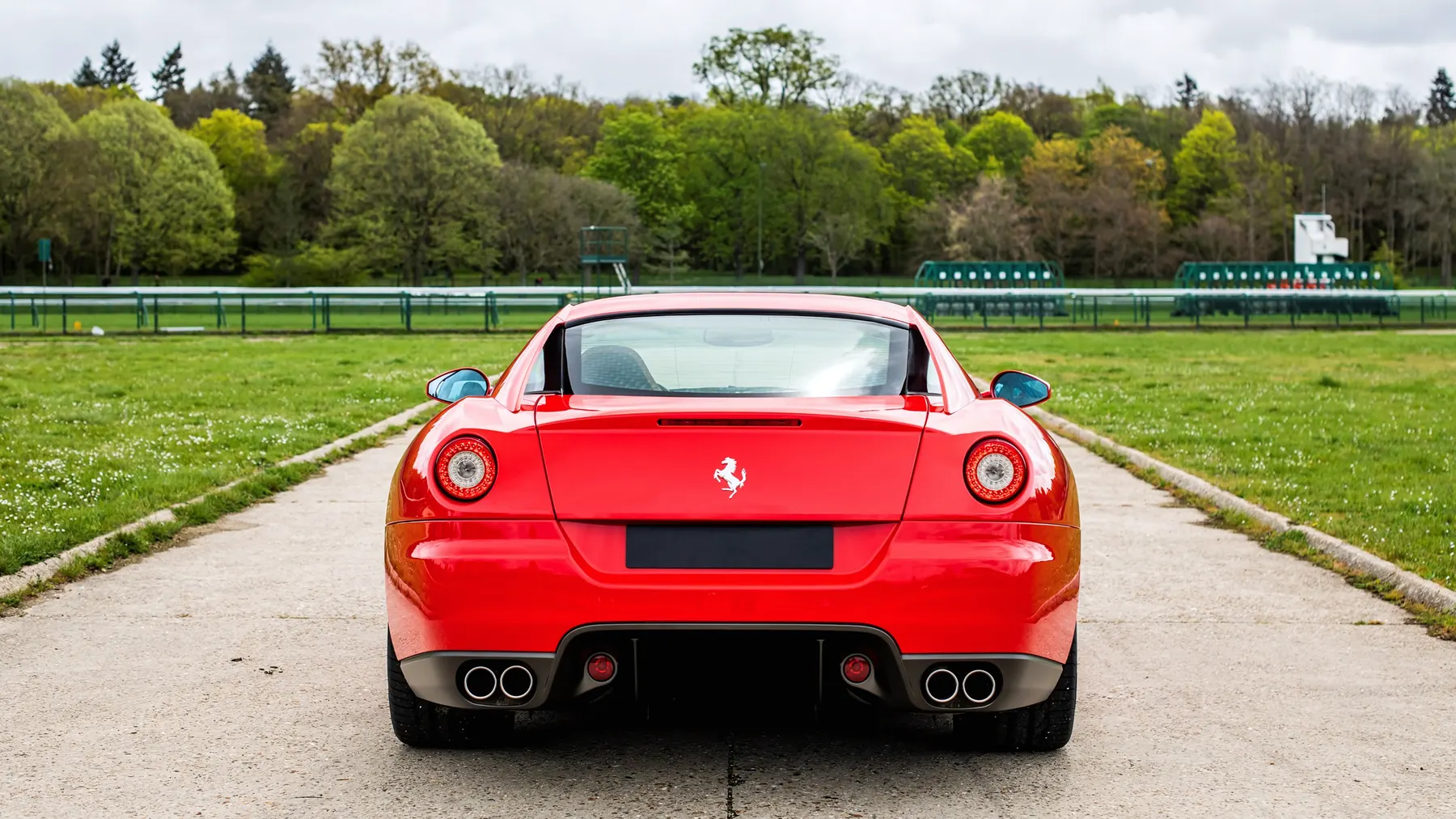
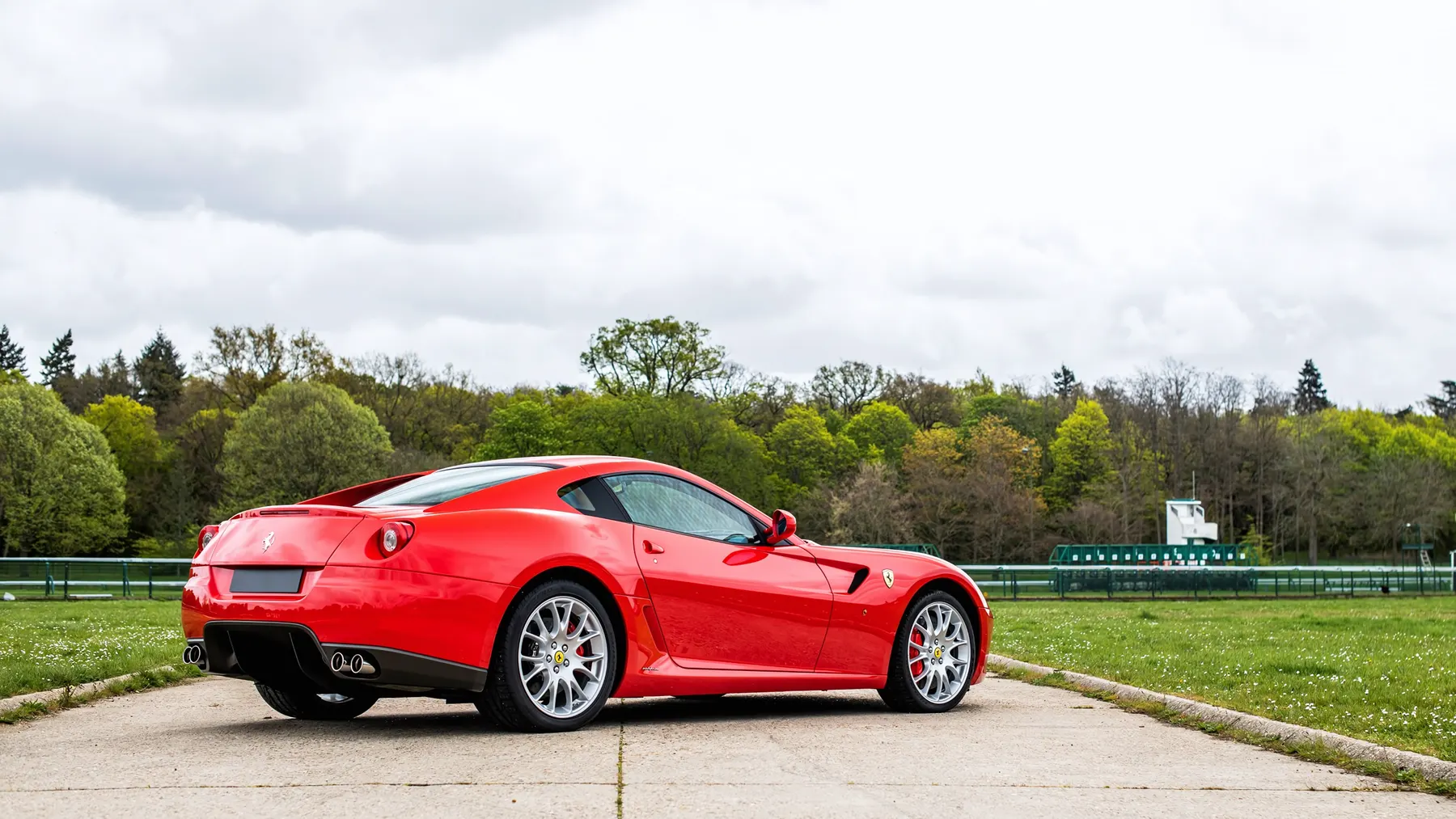
Pininfarina handled the bodywork, styled under the direction of Ferrari’s design chief at the time, Frank Stephenson, though period accounts differ on exactly how credit for individual details should be split with Pininfarina’s own studio staff. Whoever deserves the pen strokes, the result was unmistakably a departure from the softer 575M: a long, slanted bonnet, twin bi-xenon headlamps, and muscular rear haunches that culminated in flying buttress-style “sail panels” flanking the rear glass. Those buttresses started life as a styling flourish and were only later found, during wind-tunnel testing, to meaningfully cut rear-end lift, a happy accident that Ferrari leaned into for the production car. The single circular tail light on each side, breaking with Ferrari’s long-running quad-round-light signature, drew some criticism as fussy or unresolved next to the rest of the design, but the broader shape was well received as a confident, modern take on the front-engined V12 berlinetta format that stretched back through the 550 to the 275 GTB and Daytona.
Mechanically, the 599 GTB’s V12 produced 612bhp at 7,600rpm, spinning to an 8,400rpm redline, with 448lb-ft of torque arriving at 5,600rpm, output that pushed it past 100bhp per litre without any form of forced induction, a rare feat for a naturally aspirated road-car engine at the time. Buyers could specify a conventional six-speed manual gearbox, but the vast majority chose Ferrari’s “F1 SuperFast” automated paddle-shift transmission, which in its fastest setting could complete a gearchange in around 100 milliseconds, twice as quick as the equivalent system fitted to the Enzo. A five-position manettino dial on the steering wheel, borrowed conceptually from Ferrari’s F1 cars, bundled together the throttle mapping, traction and stability intervention, and the calibration of the car’s magnetorheological dampers, whose fluid could change viscosity almost instantly under a magnetic field to stiffen or soften the ride. Carbon-ceramic brakes, measuring 398mm at the front and 360mm at the rear, were available as an option, and Ferrari claimed around 160kg of aerodynamic downforce at 186mph from the underbody and rear diffuser work. Against a claimed kerb weight in the region of 1,690kg, though quoted figures vary depending on whether a source is citing a dry DIN weight or a fuller EU kerb weight with fluids and driver, the GTB’s power-to-weight sat at roughly 362bhp per tonne. Ferrari quoted 0-62mph in 3.7 seconds and a top speed of around 205mph; independent testers at evo magazine recorded the sprint slightly quicker, in the mid-3.5-second range, and awarded the 599 their 2006 Car of the Year honour, praising the calm, unhurried way it delivered genuinely supercar-grade pace.

That manual gearbox deserves its own line, because of how rare it turned out to be. Ferrari built just thirty 599 GTB Fioranos with the traditional gated six-speed, of which only twenty were imported into North America, making it the last front-engined, twelve-cylinder Ferrari ever offered with a proper stick shift. Every subsequent V12 berlinetta from Maranello has been paddle-only. That scarcity, combined with the visceral appeal of rowing your own gears through an engine this vocal, has made manual 599s among the most sought-after and expensive examples of the model on the collector market today, commanding a substantial premium over otherwise identical paddle-shift cars.
Ferrari kept developing the 599 well beyond its 2006 launch. In 2010 it introduced the HGTE package, short for Handling Gran Turismo Evoluzione, an option pack rather than a distinct model that added stiffer springs, a firmer rear anti-roll bar, recalibrated magnetorheological dampers, lighter wheels to cut unsprung mass, and a louder, more bass-heavy exhaust, all for around £14,000 on top of the standard car’s price. Contemporary road testers found it sharpened the 599’s body control noticeably without materially hurting its everyday ride, and some considered it the best-judged version of the standard car. Also in 2010, Ferrari unveiled the road-going 599 GTO, named to evoke the 250 GTO and 288 GTO before it, though unlike either of those homologation specials, the 599 GTO was never built to satisfy any racing series’ entry requirements; the badge here was closer to marketing shorthand for “our most track-focused 599” than a literal claim to competition pedigree. Developed from the non-road-legal, client-programme 599XX track car, the GTO’s V12 was tuned to 661bhp at 8,250rpm and 460lb-ft at 6,500rpm, with a widened front track, a stickier and wider front tyre, a quicker-shifting F1 gearbox, and a second-generation active damper system feeding off real-time accelerometer data. Ferrari claimed a Fiorano lap time of one minute twenty-four seconds, a full second quicker than the mid-engined Enzo, alongside a 3.3-second 0-60mph time and a 208mph top speed. Production was capped at 599 examples, with roughly 125 earmarked for the US market. Later that same year, at the Paris Motor Show, Ferrari added the SA Aperta, an open-top roadster built to mark Pininfarina’s eightieth anniversary and named for Sergio and Andrea Pininfarina, the coachbuilder’s late father-and-son leaders. Limited to 80 units, all pre-sold before the car was formally shown, the SA Aperta carried the GTO’s uprated engine and gearbox in a reinforced, lower-windscreened body wearing a simple soft top, with a carbon-fibre hard panel offered as a costly option. Sitting apart from the mainstream range entirely was the 599XX, a roughly £1.2 million, non-road-legal track machine built in a run of just 29 for a closed client programme, reworked with F1-derived technology to lap Fiorano some ten seconds faster than an Enzo.
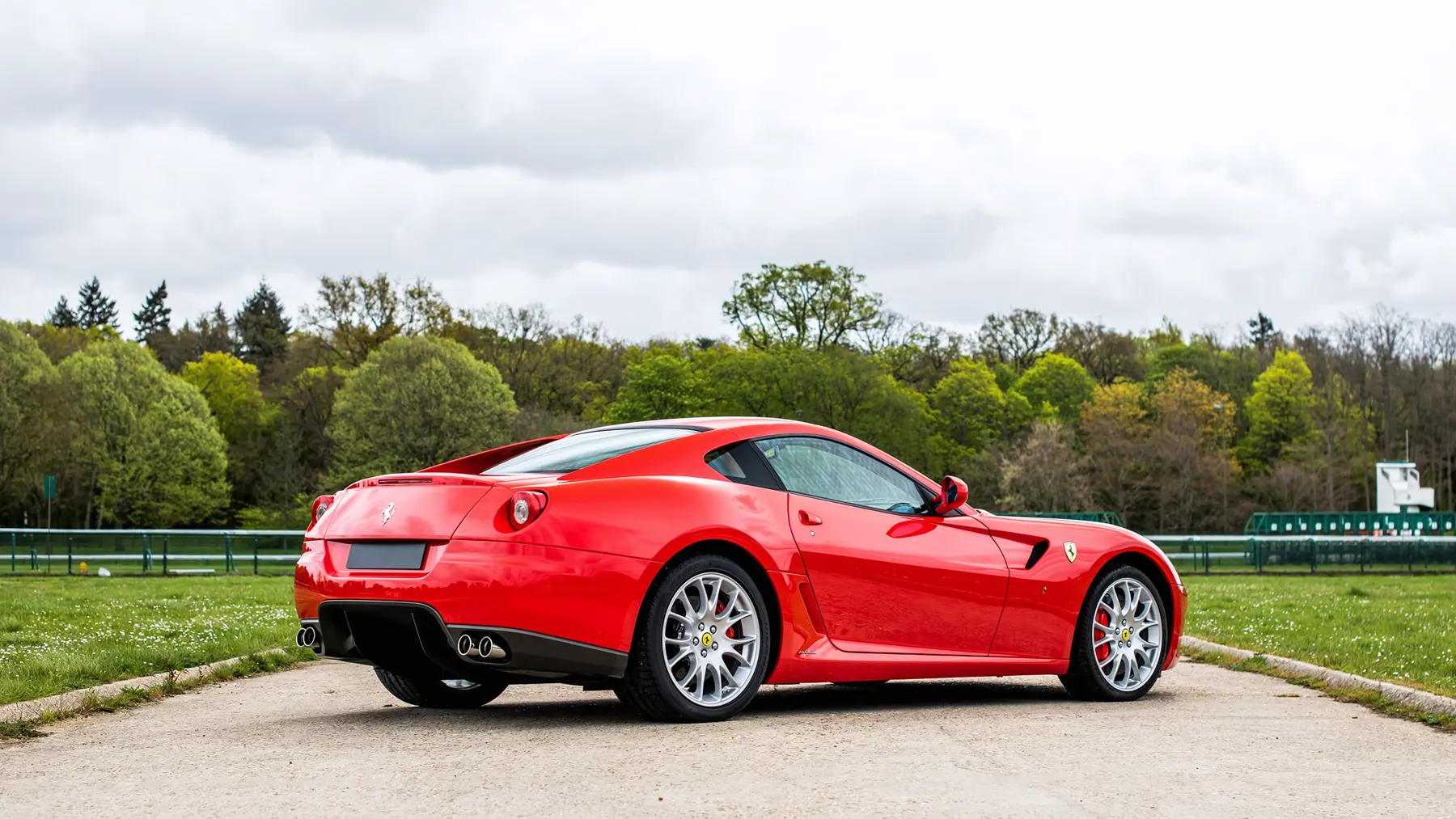
On the road, what stood out about the standard 599 GTB was how little drama it needed to move quickly. The V12 pulled cleanly from idle all the way to its redline with none of the flat spots or artificial-feeling delivery that turbocharged rivals would later normalise, and it did so with a mechanical smoothness Autocar compared favourably with dedicated luxury V12 installations. The driving position was low, deeply sculpted, and well aligned with the pedals and the thick-rimmed wheel; visibility was good enough, unusually for a car this fast, to include reversing sensors as a genuinely useful rather than token fitment. It was, by most contemporary accounts, the most complete grand tourer Ferrari had built to that point: capable of covering long distances in comfort, then embarrassing considerably more expensive and exotic machinery the moment the road opened up.

That completeness came with real compromises, though, and they are worth naming rather than waving away as charming Ferrari eccentricity. The manettino system, for all its clever engineering, forced owners into an awkward trade-off on UK-style roads: Sport mode gave the fastest gearshifts but damping that Autocar judged too firm for typical B-roads, while dropping to Winter mode softened the ride but left the transmission noticeably more sluggish, and there was no setting in between that combined the best of both. The steering, though accurate, was widely described as light to the point of feeling remote, offering little of the textured feedback that made earlier, unassisted Ferraris so communicative, and road testers noted that the automated gearbox did not always match engine speed cleanly on downshifts, occasionally producing a slightly clumsy changedown rather than the seamless blip drivers expected from a car this expensive. Wind and tyre noise intruded more than buyers might have hoped at a cruise, undermining some of the car’s grand-touring credentials on a motorway. The GTO pushed the compromises further in the name of outright pace: evo’s road testers found its carbon brakes prone to grumbling and genuinely difficult to judge smoothly at low speed, and reported that away from a billiard-smooth circuit surface the car would tip into abrupt oversteer or have its electronics clamp down hard on the throttle, a deliberately edgy character Ferrari itself described as tuned to be nervous rather than forgiving. None of this made the 599 a bad car; it made it a car with a clearly defined set of priorities that not every buyer, or every road, suited equally well. Running costs, inevitably, sat well above those of anything with fewer than twelve cylinders: tyres, servicing, and brake wear on a car this powerful were never going to be trivial expenses, and few owners entered 599 ownership expecting otherwise. Inside, the cabin’s blend of analogue dials and a small central LCD display was praised for usability but criticised by some testers as visually cluttered next to the clean instrumentation of Ferrari’s later cars, and the steering-wheel starter button, while a novel touch borrowed from racing cars, was gently mocked as more theatre than function since the car still needed its ignition key inserted regardless.
Contemporary road testers routinely measured the 599 against a similar cast of front-engined V12 grand tourers and near-supercars: one period test of the sharpened HGTE-specification car judged it to hold a clear advantage in body control and driver confidence over V12-engined Aston Martins, Mercedes-Benz’s SLR McLaren and AMG Black Series machinery, and even Chevrolet’s Corvette ZR1, a broad field that says as much about how few true rivals occupied the 599’s specific niche as it does about the Ferrari’s own ability. In the United States, Ferrari’s own figures show the 599 GTB Fiorano launching at a manufacturer’s suggested retail price of $260,034 in 2007 and climbing to $357,225 by 2011 as the model aged and specification crept upward, pricing that positioned it firmly above mainstream GT rivals and just below Ferrari’s own mid-engined halo cars.

Replaced in 2012 by the F12berlinetta, the 599 GTB Fiorano closed out an era in more ways than one. It was the last Ferrari V12 berlinetta offered with a manual gearbox, the last of the marque’s front-engined flagships developed before turbocharging became the default route to Ferrari performance, and arguably the last of the breed built while the balance still tipped, however narrowly, in favour of driver feel over outright digital precision. Its aluminium spaceframe architecture and its manettino-controlled electronic chassis systems became the template Ferrari refined across the F12 and its successors, so in engineering terms the 599 was less an end point than a foundation. But for the people who actually search out the manual cars, the GTOs, and the SA Apertas today, its appeal lies precisely in that in-between status: modern enough to use confidently, analogue enough, at least in its rarest form, to remind you what a V12 Ferrari felt like before every input was mediated by a computer first.
Technical data
Performance Specifications
| Variant | Engine | Power | Torque | Transmission | 0-62mph (claimed) | Top speed (claimed) | Production |
|---|---|---|---|---|---|---|---|
| 599 GTB Fiorano (2006–2012) | 5,999cc naturally aspirated V12 (Tipo F140) | 612bhp @ 7,600rpm | 448lb-ft @ 5,600rpm | 6-speed manual or 6-speed “F1 SuperFast” paddle-shift | 3.7 sec | ~205mph | Manual: 30 units (20 to North America); overall GTB production totals vary by source, see editorial notes |
| 599 GTB HGTE (option pack, from 2010) | As GTB Fiorano | As GTB Fiorano | As GTB Fiorano | As GTB Fiorano | As GTB Fiorano | As GTB Fiorano | Option pack, approx. £14,000 |
| 599 GTO (2010–2012) | 5,999cc naturally aspirated V12 (Tipo F140) | 661bhp @ 8,250rpm | 460lb-ft @ 6,500rpm | 6-speed “F1 SuperFast” paddle-shift (faster-shifting calibration) | 3.3 sec (0-60mph) | ~208mph | Limited to 599 units (approx. 125 to US market) |
| 599 SA Aperta (2010–2011) | 5,999cc naturally aspirated V12 (Tipo F140), GTO-specification | 661bhp | 460lb-ft (GTO-specification) | 6-speed “F1 SuperFast” paddle-shift | Not separately corroborated | Not separately corroborated | Limited to 80 units |
Sources
- RM Sotheby’s: 2008 Ferrari 599 GTB Fiorano (London 2023)
- RM Sotheby’s: 2009 Ferrari 599 GTB Fiorano (Monterey 2021)
- RM Sotheby’s: 2007 Ferrari 599 GTB Fiorano (Monterey 2024)
- RM Sotheby’s: 2009 Ferrari 599 GTB Fiorano (Villa Erba 2023)
- RM Sotheby’s: 2012 Ferrari 599 GTB Fiorano, “Sealed – The Final Pair”
- RM Sotheby’s: “Gated Glory: A Very Special Ferrari 599 GTB Fiorano Showcases a Six-Speed Manual”
- Bonhams: 2007 Ferrari 599 GTB Fiorano F1 Coupé
- Autocar: Used Ferrari 599 2006-2012 Review
- Hagerty Valuation Tools: 2009 Ferrari 599 GTB Fiorano
- evo: Ferrari 599 GTO Supercar Review
- evo: Ferrari 599 GTB (2006-2012) Review
- evo: Ferrari 599 GTO Road Test
- Top Gear: Retro Review – The Ferrari 599 GTB HGTE
- Ferrari.com: SA Aperta (2010)
- autoevolution: 5 Outstanding High-Performance Production Cars That Share the GTO Acronym
- Kidston: 2011 Ferrari 599 GTO
- Forza: “New Breed” (Issue 188)
Join the discussion
Comments
Loading comments…
Leave a comment
Share a detail, memory, or perspective. Every comment is reviewed before publication.