Lagonda LG45 Coupé de Ville Sedanca by Mayfair: W.O. Bentley Goes Formal
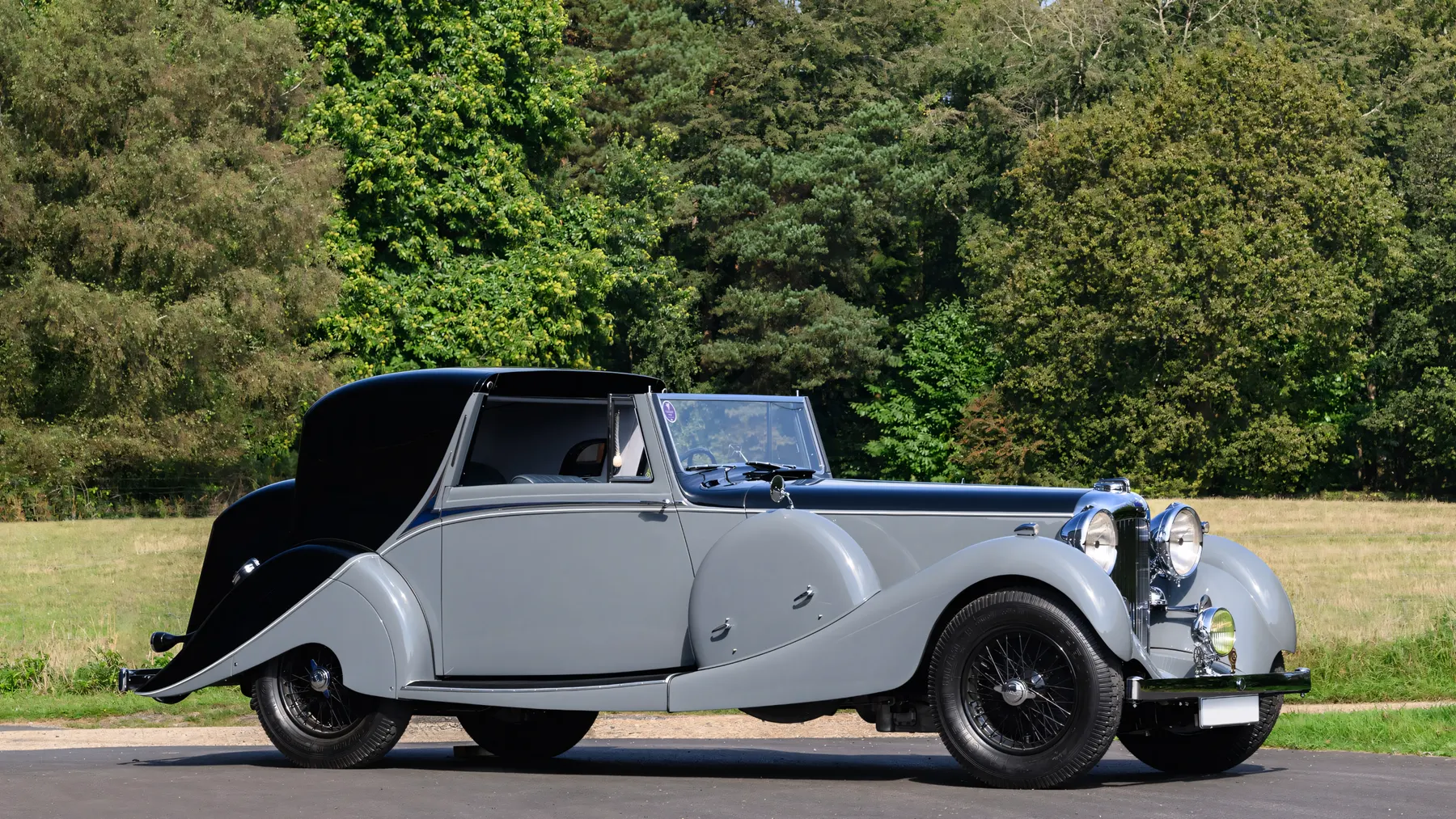
1936 Lagonda LG45 Coupé de Ville Sedanca by Mayfair




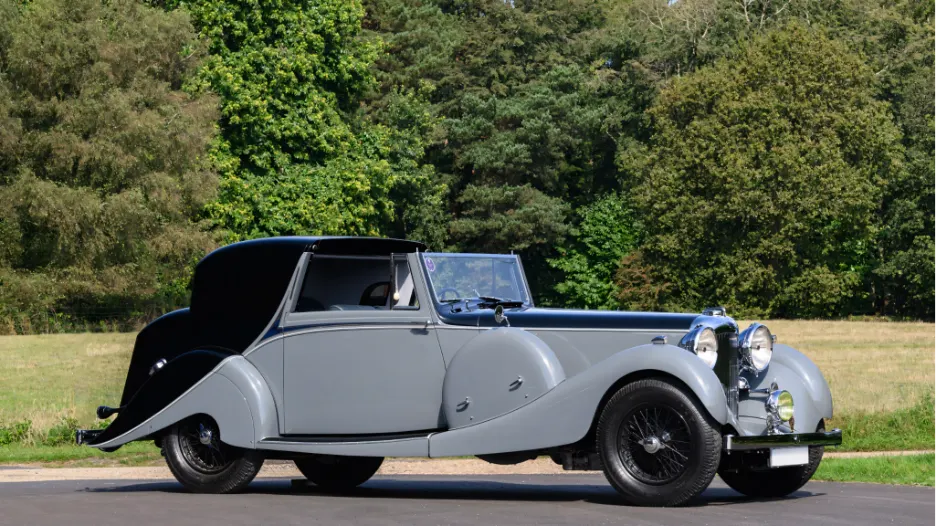
Images: Tim Scott / RM Sotheby's
Lagonda’s LG45 spent its short life being asked to be two things at once: the heir to a Le Mans winner, and a hushed, well-mannered carriage for people who would rather not wrestle a big six through a corner. The Coupé de Ville Sedanca that Mayfair built on the chassis for the 1936 Olympia Motor Show makes that tension unusually easy to see. Under a formal town-car shape sits a 4½-litre Meadows six with twin magnetos and a competition lineage, and neither half of the car ever quite lets the other forget about it.
The LG45 exists because Lagonda very nearly didn’t. A 4½-litre Lagonda won Le Mans in June 1935, driven by Johnny Hindmarsh and Luis Fontés, yet the company was in trouble, and it looked set to be absorbed by Rolls-Royce until the entrepreneur Alan Good bought it out of receivership and persuaded W.O. Bentley to leave Rolls-Royce and join as technical director. LG Motors (Staines) Ltd was registered that August, and the new model was unveiled in late September 1935 for the 1936 season. Its name combines the initials of the new company with the size of the engine. It was the first production Lagonda to carry Bentley’s influence, and it was aimed at the luxury market rather than at the wealthy sporting motorists who had favoured the M45. That was a repositioning, and the rest of the story is about how comfortably it sat.
Underneath, this was evolution rather than revolution. The chassis was a channel-section ladder frame on the 3,277 mm wheelbase inherited from the M45 family, now with longer, softer springs and Luvax linked hydraulic dampers. Girling drum brakes, a centralised chassis lubrication system and flexible engine mounts completed the civilising package. The engine was Henry Meadows’ pushrod overhead-valve six, 4,453 cc from an 88.5 mm bore and 120.65 mm stroke, breathing through twin SU carburettors and fired by two plugs per cylinder. Meadows engines had a reputation for being robust, even over-engineered, which left Bentley plenty of scope to develop the unit rather than replace it. Alongside it came a four-speed gearbox with Lagonda-designed synchromesh on third and top, the company’s first, and later a centre-change version that added synchromesh on second.
Lagonda built the car in batches it called Sanctions, with changes introduced whenever a new batch began. Sanction One was close to the M45R engine but with lower compression. Sanction Two moved to twin Scintilla Vertex magnetos, both on the exhaust side. Sanction Three brought a redesigned cylinder head with the cross-flow inlet manifold cast into it and the carburettors bolted straight on, plus a lightened flywheel that allowed the engine to rev to 4,000 rpm. Sanction Four, shared with the later LG6, was broadly similar. Power depends on whom you ask. The earlier M45 is usually quoted at around 108 bhp, the Lagonda Club lists 140 bhp at 3,000 rpm in its LG45 specification, one auction house gives 150 bhp for the Sanction Three, and the Sanction Four is commonly described as about 130 bhp. Treat any single figure as belonging to a particular Sanction and a particular claimant.
Lagonda’s own range was broad. There were pillarless saloons, first the early Sanction One design and then the more streamlined SB3, plus tourers, drophead coupés and a long-wheelbase De Ville saloon with a central pillar and an optional division for a chauffeur. At the sharp end sat the Rapide, or LG45R, a stark four-seater with cycle wings and external exhausts, of which only about 25 were made. Weight tells the story of the range. The Lagonda Club gives 1,473 kg for the Rapide, 1,778 kg for a standard tourer and 1,880 kg for a saloon. Production is usually put at 278 chassis, though Wikipedia gives a range of 278 to 303 including Rapides, and the Lagonda Club believes 93 survive. The factory also sold bare chassis to outside coachbuilders, and that is where Mayfair comes in.
Mayfair Carriage Co. began in 1925 as Progressive Coach and Motor Co., took its better-known name in 1929, and by 1934 was working from The Hyde on the Edgware Road. Alvis was the marque most closely tied to its fortunes, though a dealer’s history also lists Rolls-Royce, Bentley, Humber and Wolseley among its chassis. By 1939 it had stopped building car bodies. A Lagonda therefore sits outside the names most associated with Mayfair, and the Coupé de Ville was an unusually formal choice for a chassis that Lagonda’s own stylist, Frank Feeley, was dressing in low, sweeping tourers. Feeley, whom one auction house calls arguably the most talented British stylist of his generation, gave the factory cars a distinctly sporting profile. Mayfair’s answer was a two-door body, catalogued as a Coupé de Ville and built for exhibition at Olympia in 1936.
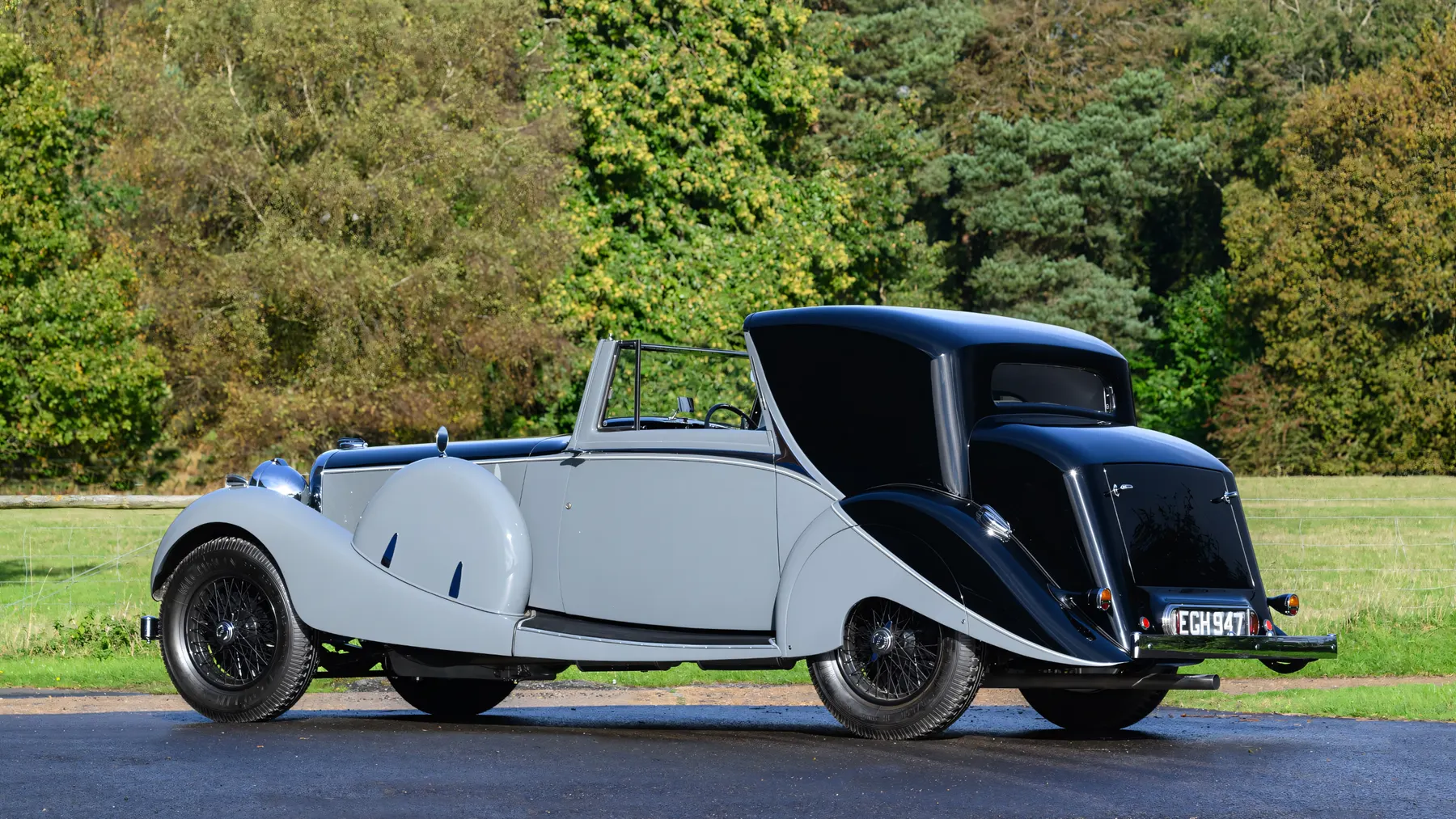
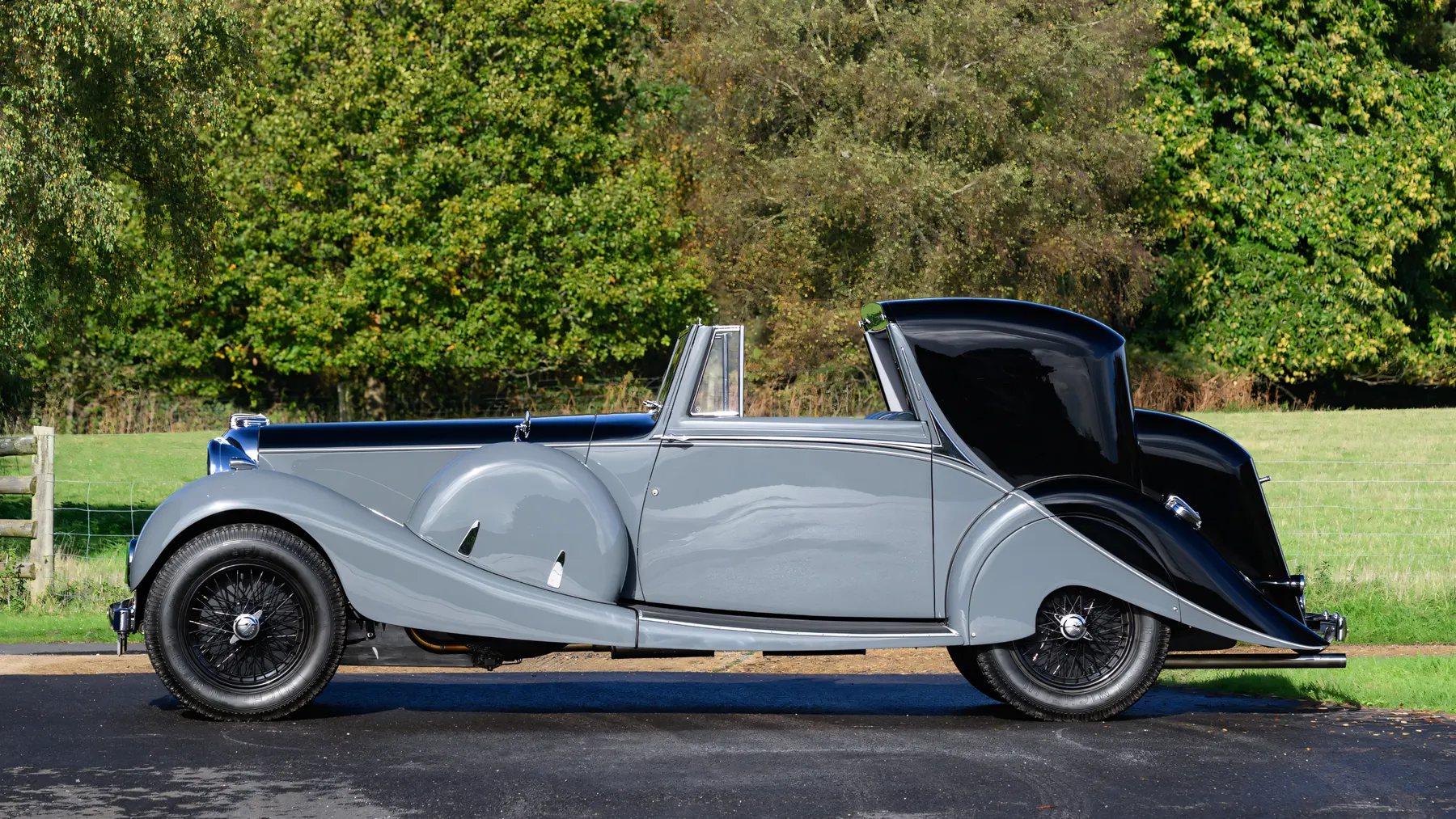
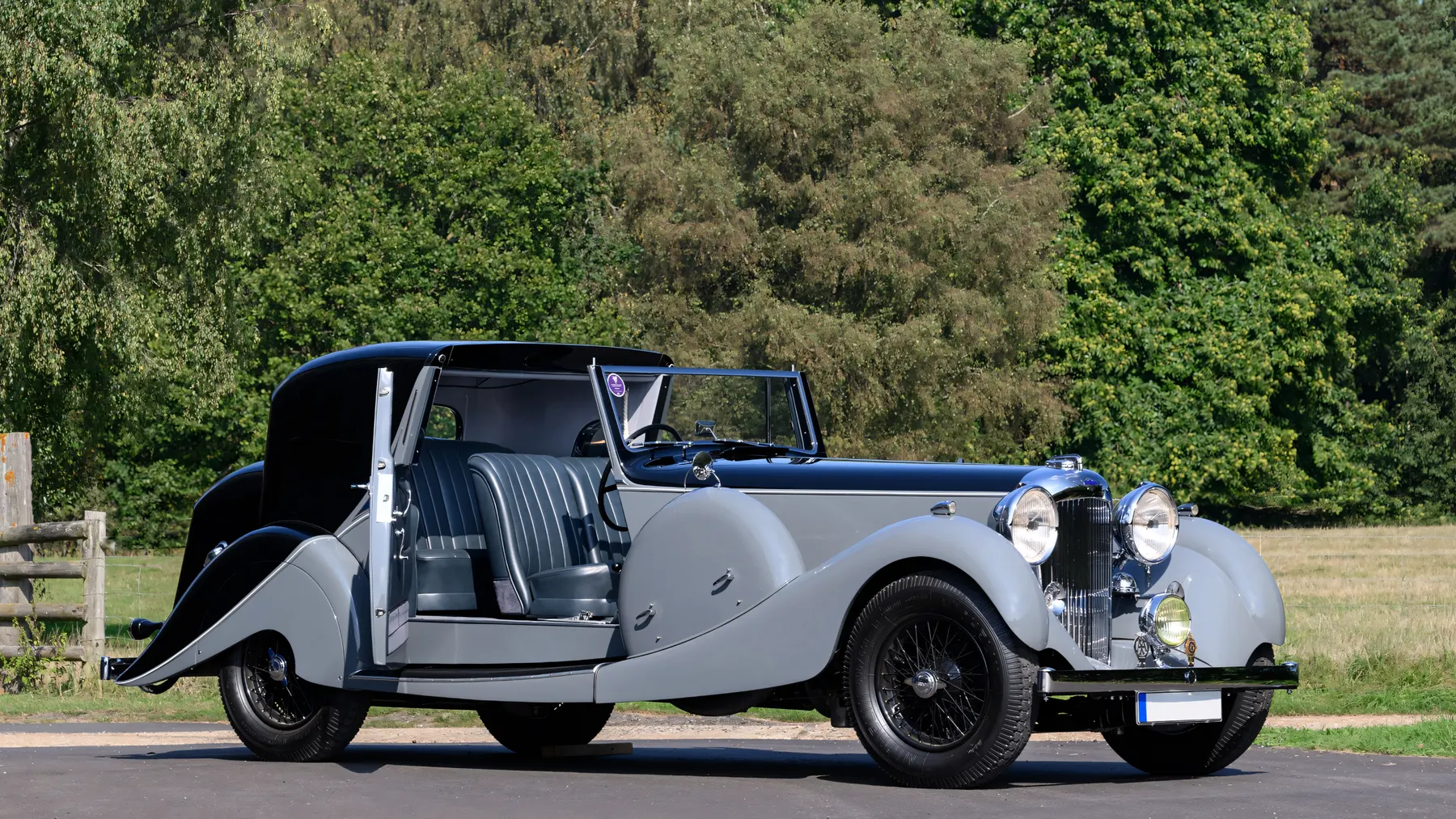
The name needs a little unpicking. A coupé de ville, also called a sedanca de ville or town car, was a style that ran roughly from 1908 to 1939, with an enclosed passenger compartment and a driver’s position that was open or had a roof that could be folded away or removed. Count Carlos de Salamanca coined “sedanca” in 1923, and sources disagree about exactly which term meant what, so catalogues use them interchangeably. I have not found a period description of how this particular body’s roof worked, so it is safest to take the labels as a statement of intent rather than a mechanical specification. What the sources do record are the details that made it more than a stock town car. Such bodies usually had no luggage space, so Mayfair gave this one an expandable luggage compartment, which an auction catalogue describes as one of two such configurations the coachbuilder made. The rear compartment reportedly carried curtains for the back window, mirrors and cigarette lighters. The twin side-mounted spare wheel covers followed Lagonda practice, with one cover typically doubling as storage for tools and spares, while Lagonda’s built-in Jackall jacking system also lived in a dummy spare cover on at least some cars.
On the road, the LG45’s reputation was built on refinement. The Autocar’s April 1936 test, as reported in auction literature, concluded that the 4½-litre had always been quick, that it now offered all the performance anyone could reasonably want, and that it had been silenced and smoothed to the point where it was barely recognisable against earlier versions. Closed cars were typically good for more than 90 mph and some open ones reputedly topped 100 mph. For the Rapide, modern sources repeat that The Motor recorded 108 mph in 1937 and 60 mph in 13.2 seconds, which I would treat as reported rather than verified. The Lagonda Club says the later LG6, with the same basic engine, appealed to lovers of a low-revving, torquey six, which is a fair description of what a big, long-stroke Meadows does best. I have found no contemporary test of this specific Mayfair body, so its manners are inferred from the model rather than measured.
Now the uncomfortable part. The LG45 was heavy, and its closed bodies were heavier still. A factory saloon at around 1,880 kg leaves little room for a coachbuilt formal body to add mass without costing performance. One auction house puts it plainly: as a luxury tourer it was among the best of its class, but the refinement came at some cost to the visceral sports-car feel of earlier Lagondas. A well-known motorsport broadcaster who drove an LG45 tourer reported trouble getting used to its heavy steering and uncooperative transmission. The softer springing seems to have brought its own problems: Sanction Three added a bar linking the rear shock absorber spindles specifically to stop oscillation at the back. Mechanically the chassis was already a late example of an older layout, with a front axle and Girling drum brakes, and within two years Lagonda would replace it with a cross-braced frame, independent front suspension and hydraulic brakes. Competition results were mixed. An LG45 driven by Richard Seaman and Freddie Clifford took fourth at the 1936 Spa 24 Hours, but one Fox & Nicholl team car ran second in that year’s Tourist Trophy at Ards before sliding off, then recovered to finish 14th while losing oil, with a Derby Bentley ahead of it. There is a stylistic tension as well. A chauffeur-oriented town-car body on a chassis whose engineering owed so much to a Le Mans winner is, to my eye, a slightly confused proposition. Buyers who wanted to be driven had the long-wheelbase De Ville saloon, and buyers who wanted to drive had the Rapide. The Coupé de Ville served neither perfectly, and coachwork of this type was notoriously expensive to produce, a point made in a dealer’s account of a Rolls-Royce sedanca de ville by H.J. Mulliner. The Sanction system adds a practical wrinkle for owners today, since ignition layout and cylinder-head design differ between batches, although the Lagonda Club does maintain a source of spares.
The LG45’s replacement arrived with something close to a bang. The Lagonda Club describes the LG6 and the V12, announced on the eve of the 1937 Motor Show, as having a new cross-braced chassis with independent front suspension, which reduced flexing and allowed the engines to sit lower in the space the front axle had occupied. Only 85 LG6 cars were sold, and the LG45 became the last Lagonda built on the older chassis layout. Today the Rapide is the car enthusiasts chase, and one auction listing says most enthusiasts regard it as the high-water mark for the marque. Yet the coachbuilt cars tell a more interesting story about what the chassis could be. A modern dealer’s description frames the LG45 as a less common but no less desirable alternative to a Derby Bentley, which is a fair summary of its market position, and the Mayfair car shows how far that alternative could be stretched toward formality.
What the Mayfair Coupé de Ville preserves is the other half of the LG45’s personality. The Rapide is the racer in the family photograph, but this is the car that shows a W.O. Bentley-refined Meadows six could be asked to carry a body built for dignity rather than speed, and mostly manage it. It is a heavy, slightly contradictory machine, and the contradiction is the interesting part.
Technical data
Performance Specifications
| Specification | LG45 (standard factory cars) | LG45R Rapide |
|---|---|---|
| Production | Unveiled late September 1935; built to 1937 | About 25 built* |
| Chassis built | 278 (Lagonda Club); Wikipedia gives 278–303 including Rapides* | Included in total |
| Engine | Meadows 4,453 cc OHV straight-six, modified by Lagonda | Same engine family; higher compression than standard cars |
| Bore × stroke | 88.5 × 120.65 mm | Same |
| Induction / ignition | Twin SU carburettors; two plugs per cylinder; magnetos (twin Scintilla Vertex from Sanction Two) | Same family; Sanction Three engine reported for Rapide-style cars (auction excerpt) |
| Power | Roughly 130–150 bhp depending on Sanction and source* | Separate figure not corroborated |
| Rev limit | 4,000 rpm with Sanction Three lightened flywheel | Not corroborated |
| Gearbox | Four-speed; synchromesh on third and top (G9, right-hand change); synchromesh on second added with later G10 centre-change | Higher gearing than standard cars |
| Brakes | Girling drums all round | Same |
| Front end | Front axle (independent front suspension arrived with the LG6) | Same |
| Wheelbase | 3,277 mm standard; long-wheelbase De Ville saloon 3,430 mm or 3,505 mm* | 3,277 mm |
| Kerb weight | Tourer 1,778 kg; saloon 1,880 kg | 1,473 kg |
| Top speed | Most closed cars over 90 mph; some open cars reputedly over 100 mph* | 108 mph reported (The Motor, 1937)* |
| 0–60 mph | Not corroborated | 13.2 seconds reported* |
Sources
- Lagonda Club – LG 45
- Lagonda Club – LG6
- Classic Cars For Sale – Lagonda LG45 Drophead Review
- RM Sotheby’s – 1936 Lagonda LG45 Coupé de Ville Sedanca by Mayfair (London 2023), general model and coachwork background only
- RM Sotheby’s – 1936 Lagonda LG45 Tourer (Hershey 2023), general model background only
- Hyman Ltd – 1936 Lagonda LG45 Sedanca DeVille, Mayfair company background only
- Hyman Ltd – 1936 Lagonda LG45 Tourer, market positioning only
- H&H Classics – 1936 Lagonda LG45 4½-Litre ‘Rapide-Style’ Sports Tourer (search excerpt only)
- Brightwells – Lagonda LG45 Tourer, model background only
- Car & Classic – 1936 Lagonda LG45 Rapide, LG Motors registration date only
- Car & Classic – 1934 Rolls-Royce 20/25 Sedanca de Ville by H.J. Mulliner, cost of sedanca coachwork only
- Sports Car Market – 1936 Lagonda LG45R Rapide profile
- Sports Car Market – 1934 Lagonda 4½-Liter M45 Tourer profile
- Supercars.net – 1936→1938 Lagonda LG45 Rapide
- Motorious – The Story Behind This Globe Trotting 1937 Lagonda LG45 Rapide
- Driving.co.uk – How to drive a pre-war Lagonda, with Jennie Gow
- Wikipedia – Lagonda LG45
- Wikipedia – Mayfair Carriage Co
- Wikipedia – Coupé de ville
Join the discussion
Comments
Loading comments…
Leave a comment
Share a detail, memory, or perspective. Every comment is reviewed before publication.