Mercedes-Benz 170 S Cabriolet A (W136): Luxury Built on Pre-War Bones
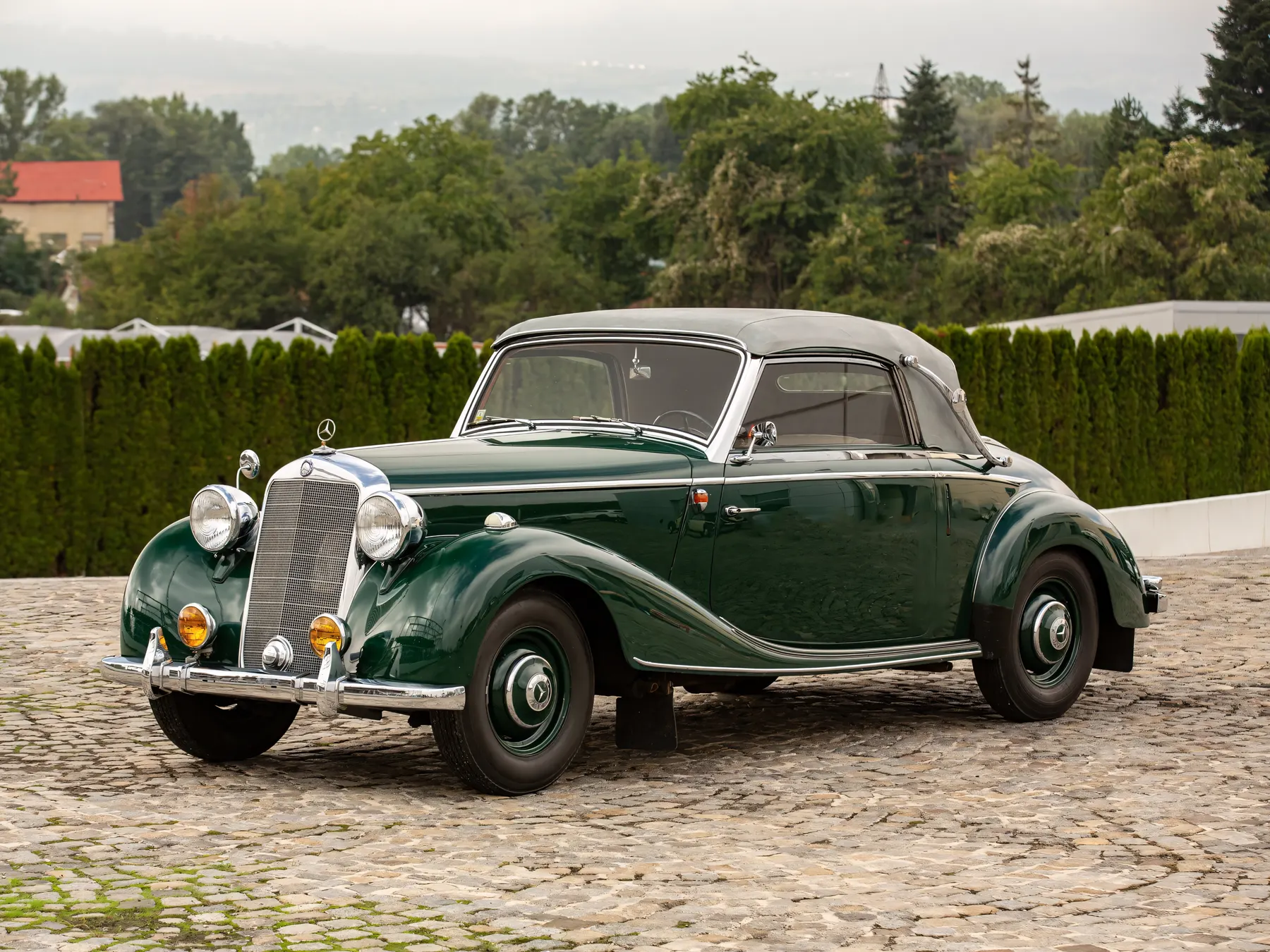
1951 Mercedes-Benz 170 S Cabriolet A



Images: RM Sotheby's
In 1949 the top of the Mercedes-Benz catalogue was a two-door convertible with a side-valve four-cylinder engine whose lineage ran back to 1936. That reads like a contradiction, and in engineering terms it partly was, but the 170 S Cabriolet A was never intended as a technical showpiece. Introduced alongside the 170 D at the Hanover Technical Export Fair in May 1949, it was Daimler-Benz’s way of announcing a return to the luxury market while owning very little of the machinery that market usually demands. What the company did have was a sound chassis, a body-building tradition at its Sindelfingen plant, and a name that still carried weight.
The logic is easiest to follow through the wider W136 family. The 170 V had debuted in 1936 as a mid-range saloon that was more advanced beneath the skin than its looks suggested, and after the war its tooling survived well enough for the Untertürkheim works to restart production under American supervision, with a production permit granted in January 1946. Six-cylinder tooling was another matter. According to the Mercedes historian behind benz-books, it had not survived and money for replacements was scarce, which left the 170 S to carry the flagship role on four cylinders while generating the sales needed to fund more modern engines and machinery. Its natural rival in that account was the six-cylinder Opel Kapitän, which undercut it on price.
Mercedes-Benz’s own archive is candid about the 170 S’s ancestry. Conceptually and stylistically it was based on the pre-war 230 (W153), with a more powerful engine, an improved front axle and a roomier body than the 170 V. The Cabriolet A and Cabriolet B labels were pre-war inheritances too: the 170 V had been offered in both forms, and RM Sotheby’s puts the earlier Cabriolet A at roughly 800 cars between 1936 and 1942. For the 170 S, the B was the four-seater and the A the two-seater, which the factory presented as the sportier expression of the range. Some auction and specialist copy calls the A a 2+2, so the seating description varies by source. It began as a pre-production series in May 1949, moved to standard production that November, and ended in November 1951 after 830 had been built. In its day the factory regarded it as a luxury car that satisfied the highest demands, and it capped the range accordingly.
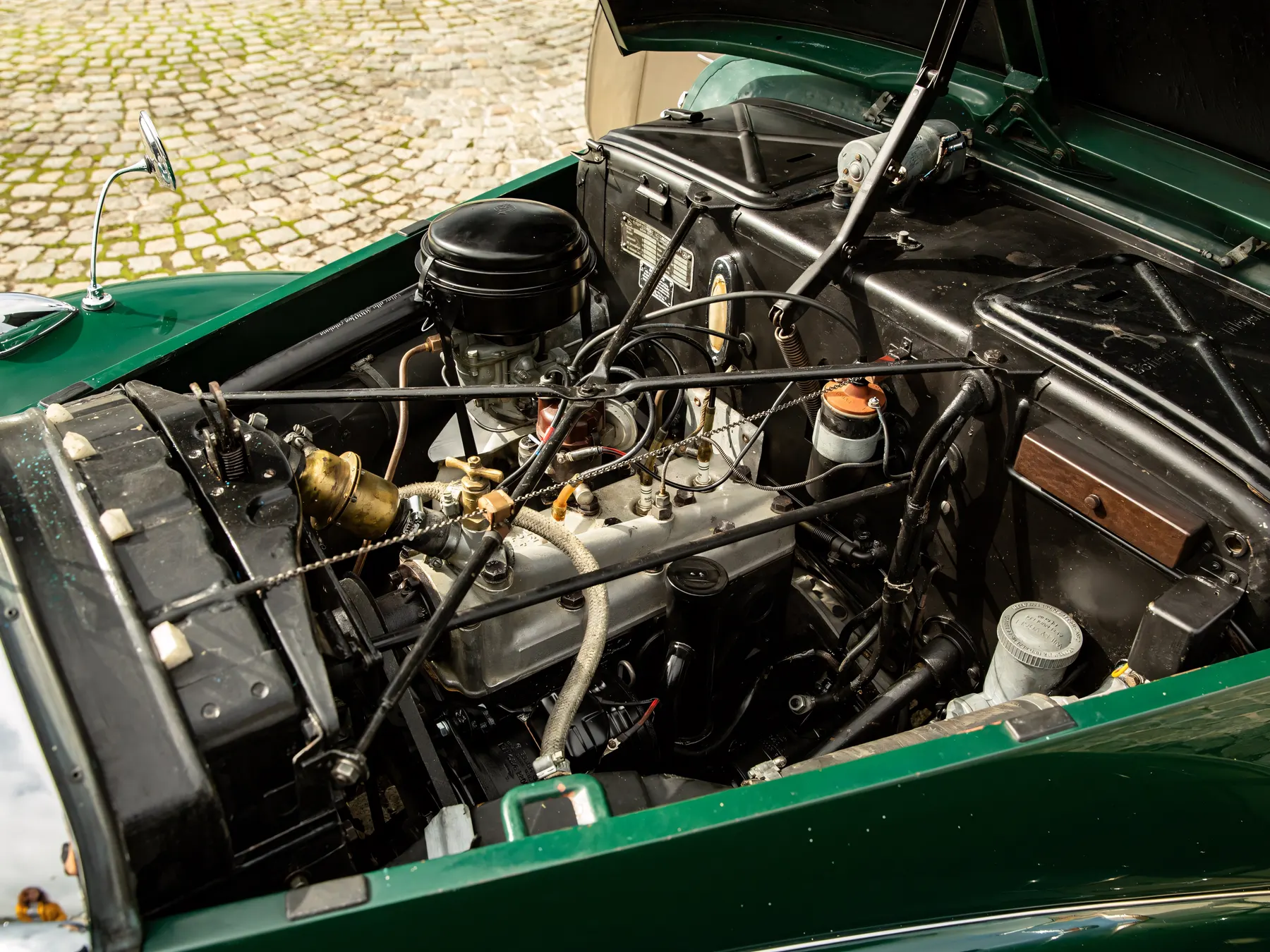
The engine was the M136 in its III form: 1,767 cc from a 75 mm bore and 100 mm stroke, side valves, a camshaft driven by spur gears and a single Solex 32 PICB downdraught carburettor. Compression was a conservative 6.5:1. Mercedes-Benz rated it at about 51 bhp at 4,000 rpm, with roughly 82 lb-ft arriving at 1,800 rpm, against roughly 37 bhp for the 1,697 cc unit in the 170 V. That is a gain of well over a third in output for an increase of only about four per cent in capacity. Classic & Sports Car describes an iron block under an alloy head and a gearbox with synchromesh on every ratio, worked by a long, angled lever. The ratios were 4.025, 2.28, 1.42 and direct fourth, with a 4.375 final drive, and a 47-litre tank sat at the rear.
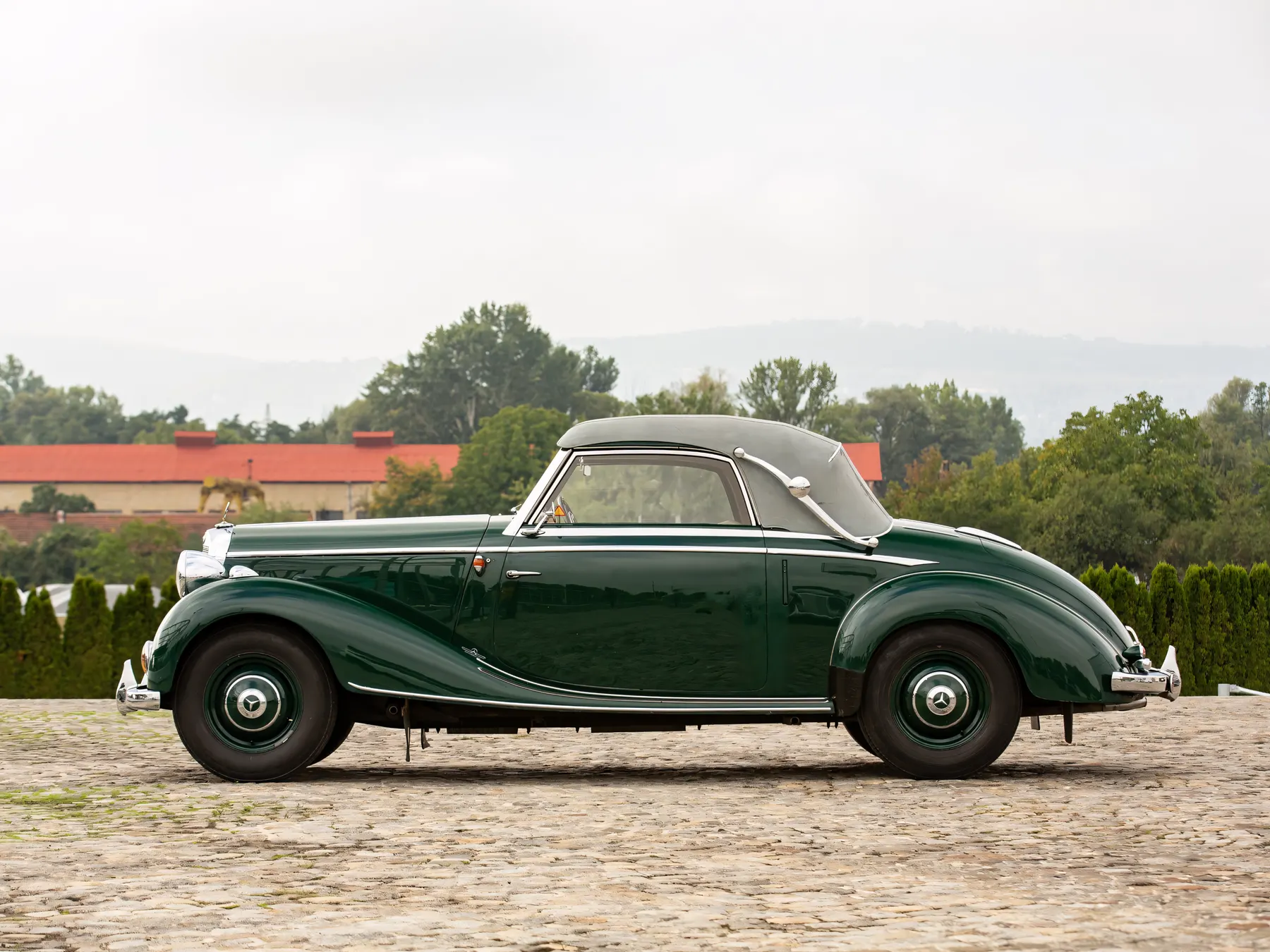
The chassis deserves more attention than the engine. A cruciform oval-tube frame carried the body, with independent suspension all round: double wishbones, coil springs and a torsion-bar stabiliser at the front, swing axles on coil springs at the rear, telescopic dampers at both ends, and hydraulic drum brakes on all four wheels. Classic & Sports Car points out that the 170 S replaced the 170 V’s twin transverse leaf springs at the front with this coil-and-wishbone arrangement, the wishbones pivoting through the frame on rubber bushes. The rear track, at 1,420 mm, was wider than the 1,315 mm front track, and the car rode on 15-inch wheels with 6.40-15 tyres. The magazine reads both choices as efforts to contain the swing axle’s reputation for sudden breakaway.
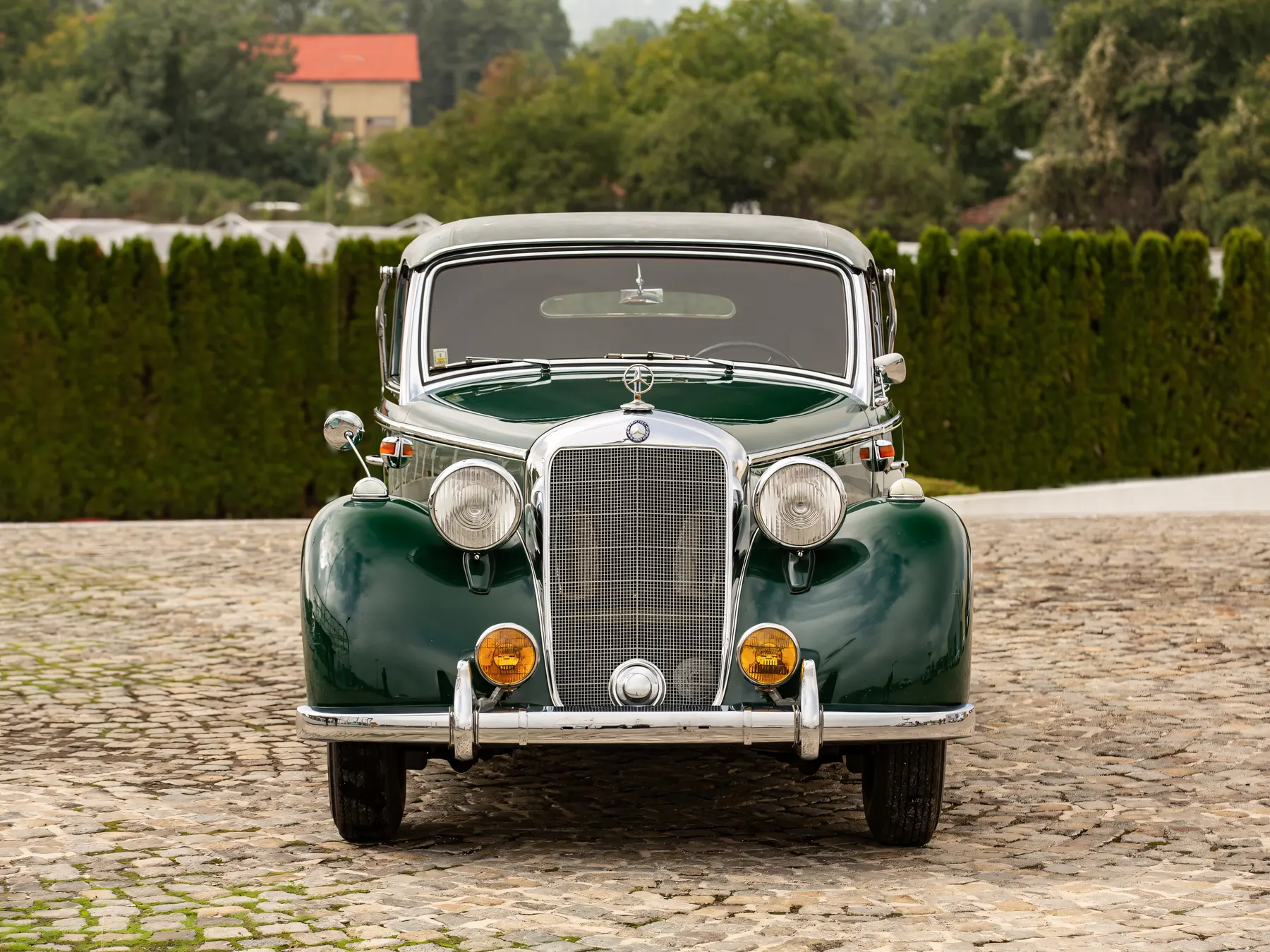
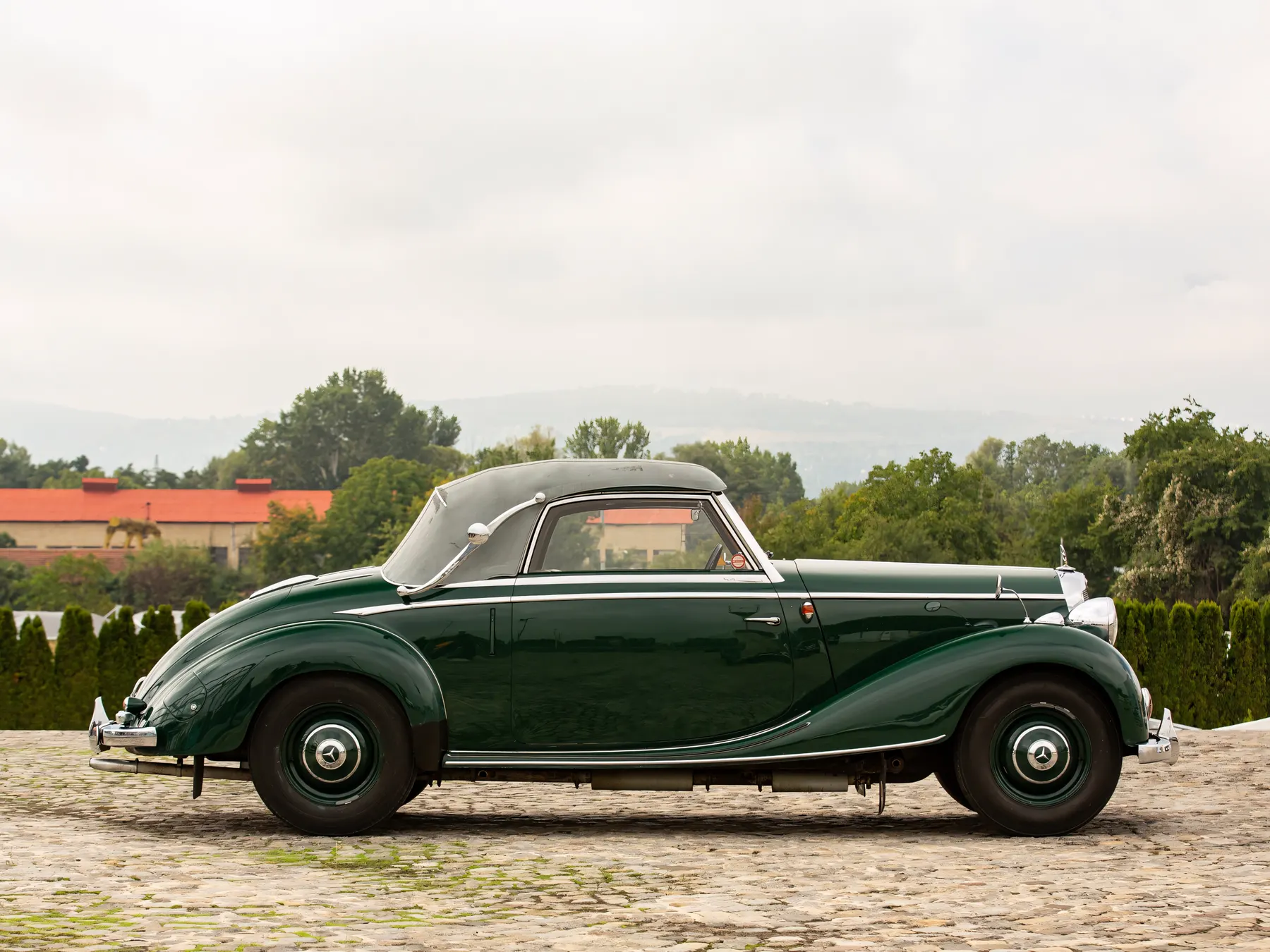
Visually, the Cabriolet A was the most carefully finished body in the range. According to benz-books it was built largely by hand, in pre-war fashion with a wooden body structure, its brightwork hand-fitted in brass before chroming, and a choice of walnut or burr walnut veneer that looked richer than the wood in the saloon. Details common to the 170 S line included chromed horizontal bonnet louvres, heavier bumpers and neatly integrated semaphore trafficators, with a heater available as an option. Some specialist writing sees the shape as a scaled-down cousin of the later 300 S Cabriolet, with the same curving wings and chrome beltline. The car measured 4,510 mm long, 1,684 mm wide and 1,560 mm tall on a 2,845 mm wheelbase, the same wheelbase quoted for the 170 V Cabriolet A, and its factory kerb weight was 1,270 kg. That is a large car for 1.8 litres of side-valve engine.
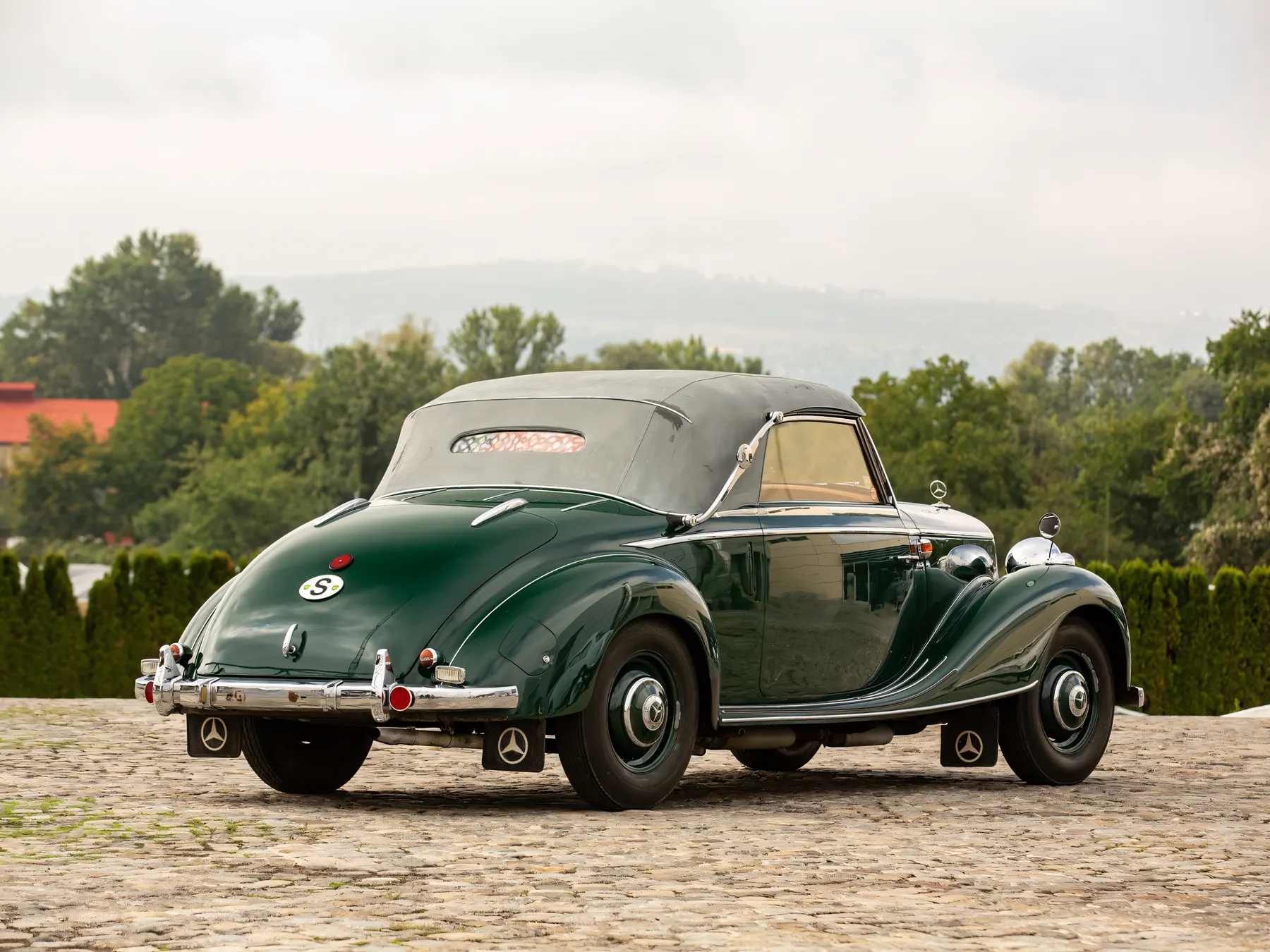
The factory figures set expectations accurately: a top speed of 75 mph, roughly 32 seconds to reach 62 mph, and consumption of around 29 mpg by the DIN method, measured at three-quarters of top speed plus ten per cent. About 40 bhp per tonne is not a sports-car number, and the Cabriolet A was not sold as one, whatever the factory meant by “sportier”. Classic & Sports Car’s drive of the four-seat Cabriolet B, which shares the A’s engine, running gear and chassis layout, is the best modern description available of what the A should feel like. It found a softly thrumming engine that reveals little of its effort, a rubber-mounted gearbox that changes gear smoothly, light steering and a gentle ride on rubber-bushed suspension. The car felt almost brisk without ever threatening its chassis. This is a machine designed to be driven at the pace of a procession, and for the customer it was aimed at, that was arguably the point.
None of this makes the Cabriolet A easy to defend on the numbers. The first problem is performance: 51 bhp hauling 1,270 kg, around 25 kg for every bhp, produces a 32-second run to 62 mph and a ceiling of 75 mph. The second is price. The factory listed the Cabriolet A at DM 15,800 in May 1949, while benz-books quotes DM 10,100 for the saloon and DM 9,950 for the six-cylinder Opel Kapitän, so the open car cost more than half as much again as a saloon sharing its engine and chassis. The same writer doubts Daimler-Benz made much money on the cabriolets given the hand-work involved. Third, the swing-axle rear end was mitigated but not cured by the wider rear track and 15-inch wheels: Classic & Sports Car judged the Cabriolet B comfortably within a careful driver’s control, with a telling rider that this applied in the dry. Fourth, the engine and brakes were conservative even in period, a side-valve four with drums on all four wheels. Finally, the economy figure looks optimistic. The factory’s DIN number of about 29 mpg sits well above the 23.7 mpg that Classic & Sports Car quotes for the 170 S saloon, and the two measure different things, so real-world consumption in an open car is likely to have been closer to the lower figure.
Period press verdicts on this specific body style are hard to find, so the car’s standing is better read from commercial evidence than from road-test quotes. The cabriolets gave the 170 S line an image boost, in benz-books’s account, and the factory itself treated the Cabriolet A as the top of the programme. They were also rare. Against 28,764 examples of the 170 S built in total between 1949 and 1952, per benz-books, the 830 Cabriolet As amount to under three per cent. Auction material commonly cites 2,433 cabriolets across the two body styles, which would imply roughly 1,600 four-seaters, though Classic & Sports Car’s factfile attaches the same figure to the B alone, so the split is not settled. The clearest sign of the car’s place is what replaced it. The six-cylinder 220 arrived with its own Cabriolet A and Cabriolet B, and the factory archive names the corresponding 220 types as the 170 S cabriolets’ successors. The cabriolets were phased out in November 1951, before the 170 Sb of January 1952 brought a finger-tip gearshift, a dashboard starter button, a double roller-chain camshaft drive and hypoid rear-axle gearing, and the revised car was offered only as a saloon. Cabriolet A buyers never saw those refinements.
What the Cabriolet A shows is Mercedes-Benz at the last moment when it could build a luxury convertible largely from pre-war thinking and sell it on finish and reputation. The 1953 180 dropped the separate chassis and traditional wings that the 170 family still carried, and the archive notes that many traditional customers struggled with the change, which is why the 170 S-V and 170 S-D stayed in production alongside it. The 300 S and 300 were the last cars built in the old manner, with production running to 1958 and 1962 respectively. Benz-books titles its profile of the car “the first Mercedes S-Class from the late 1940s”, an after-the-fact label since no such class existed in 1949, and it flatters the Cabriolet A: nothing about its engine or performance anticipated what the S-Class became. What it did anticipate was the commercial idea that a hand-finished, expensive Mercedes-Benz could earn its place at the top of the range through materials, finish and badge rather than speed. It was never the fastest or most advanced car Stuttgart would build in the 1950s. It was a bridge: pre-war engineering carried through the lean years, dressed well enough to remind buyers what the badge had once meant, and retired as soon as the six-cylinder cars were ready to take over.
Technical data
Performance Specifications
| Specification | 170 S Cabriolet A (W 136 IV, type 136.042) | 170 V Cabriolet A (W136, 1936–42; reference) |
|---|---|---|
| Production | 830 (pre-production from May 1949; standard production Nov 1949 – Nov 1951) | Approx. 800 (1936–42) |
| Engine | 1,767 cc side-valve inline-four (M136 III), 75 × 100 mm | 1,697 cc inline-four |
| Compression ratio | 6.5:1 | — |
| Fuel system | Single Solex 32 PICB downdraught carburettor | — |
| Power | Approx. 51 bhp at 4,000 rpm | Approx. 37 bhp |
| Torque | Approx. 82 lb-ft at 1,800 rpm | — |
| Power-to-weight | Approx. 40 bhp per tonne* | — |
| Transmission | 4-speed manual, synchromesh on all ratios; 4.025 / 2.28 / 1.42 / 1.00; final drive 4.375 | 4-speed manual, synchromesh |
| Front suspension | Double wishbones, coil springs, torsion-bar stabiliser, telescopic dampers | Independent |
| Rear suspension | Swing axle, coil springs, telescopic dampers | Swing axle |
| Brakes | Hydraulic drums, all four wheels | Drums, all four wheels |
| Steering | Worm type (archive: worm-and-lever; C&SC: worm and roller) | — |
| Wheels / tyres | 4.50K × 15 / 6.40-15 | — |
| Wheelbase | 2,845 mm | 2,845 mm |
| Track (front / rear) | 1,315 / 1,420 mm | — |
| Length / width / height | 4,510 / 1,684 / 1,560 mm | — |
| Kerb weight | 1,270 kg (ready to drive incl. fuel, spare wheel, tools) | — |
| Fuel tank | 47 litres, rear-mounted | — |
| Top speed | Approx. 75 mph (factory) | — |
| 0–62 mph | Approx. 32 seconds (factory) | — |
| Fuel consumption | Approx. 29 mpg (DIN 70030 method, at three-quarters of top speed plus 10%)† | — |
| Launch price | DM 15,800 (May 1949) | — |
Sources
- Mercedes-Benz Public Archive – 170 S Cabriolet A (W 136 IV), 1949–1951
- Mercedes-Benz Public Archive – Types 170 S / 170 DS / 170 S-V / 170 S-D (W 136, W 191), 1949–1955
- Classic & Sports Car – Mercedes-Benz 170S Cabriolet B: hidden in plain sight
- benz-books.com – Mercedes 170 S, the first Mercedes S-Class from the late 1940s
- RM Sotheby’s – 1936 Mercedes-Benz 170 V Cabriolet A (general model background)
- Gooding Christie’s – 1951 Mercedes-Benz 170 S Cabriolet A (general model background)
- Conceptcarz – Mercedes-Benz 170S
Join the discussion
Comments
Loading comments…
Leave a comment
Share a detail, memory, or perspective. Every comment is reviewed before publication.