First-Generation Packard Caribbean: A Straight-Eight Swan Song
1953 Packard Caribbean




Images: Darin Schnabel / RM Sotheby's
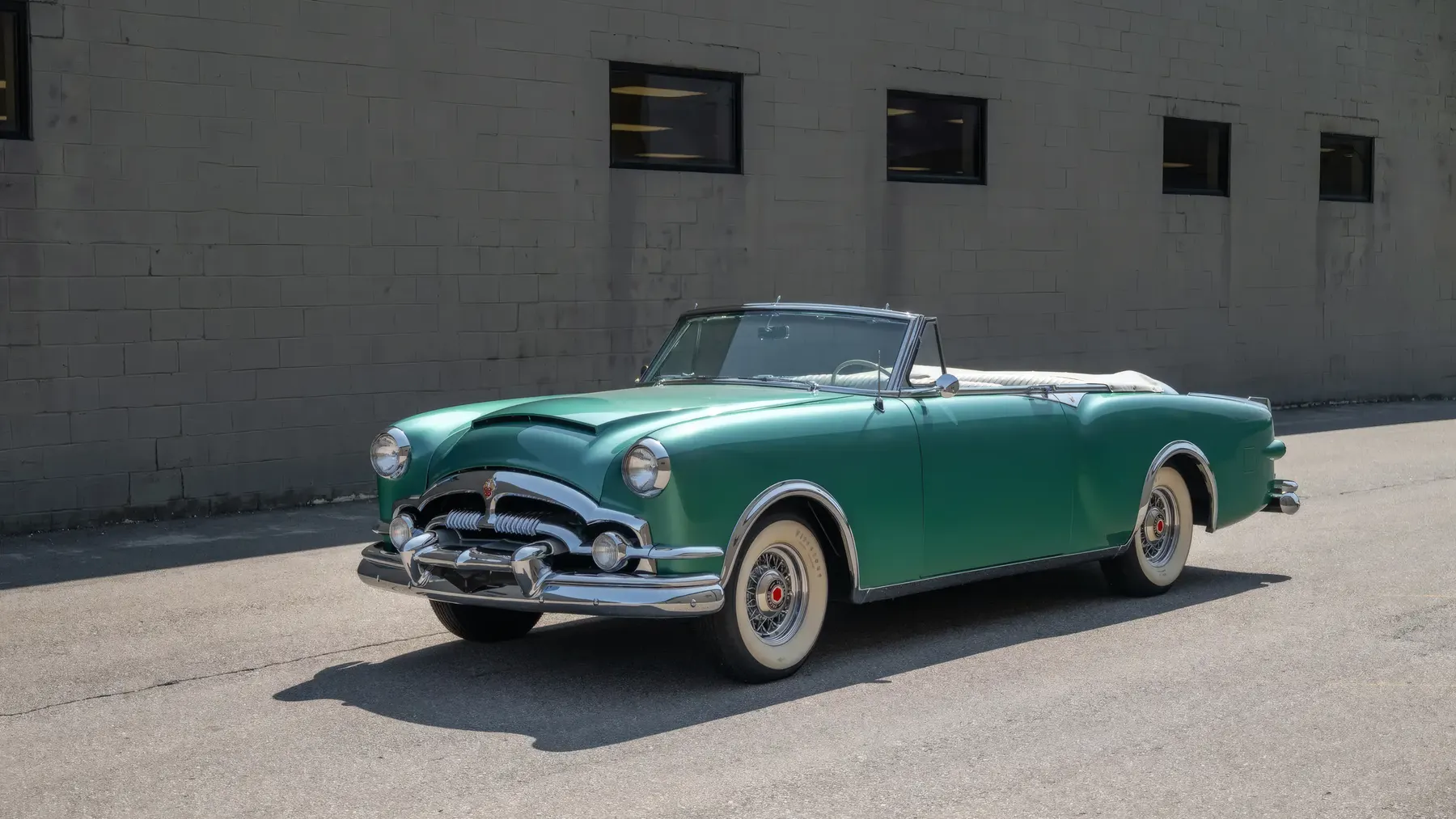
The car that was meant to make Packard look modern was not built by Packard. Standard convertibles were shipped to Mitchell-Bentley, a sheet-metal specialist in Ionia, Michigan, where the chassis were lowered and the bodies reworked into something far sleeker than the showroom model they started as. Under the long, low bonnet sat a straight-eight whose design reached back to 1924, in an industry that was busily abandoning such engines for overhead-valve V8s. That tension, a fresh and fashionable skin over an engine architecture most rivals had already left behind, defines the first-generation Packard Caribbean of 1953 and 1954. It explains why the car is so admired and why it could not rescue the company that sold it.
Here, “first generation” means the 1953 and 1954 cars, which shared Packard’s shorter 3,099 mm wheelbase and ran the company’s final straight-eights. The 1955 and 1956 Caribbeans, with their overhead-valve V8, torsion-bar suspension and longer 3,226 mm wheelbase, are a different proposition. RM Sotheby’s catalogue copy draws the same line, describing the 1954 as the hardest to find of the first-generation cars.
Packard’s trouble in the early 1950s was one of perception as much as engineering. The marque was widely seen as stodgy and old-fashioned, and Hagerty’s post-mortem on the company blames part of that on the high-waisted 1951 body, which looked heavy and dated beside a sleeker, finned Cadillac. The company’s first answer was a show car. The Pan American, unveiled at the 1952 New York show, was designed by Richard Arbib and built by Henney, a firm better known for hearses and ambulances on Packard chassis. It began as a 1951 Series 250 convertible that was chopped, sectioned and channelled into a low two-seater, and it collected awards in New York and again in Los Angeles. Six were eventually built, but management struggled to see a market for a car projected to cost at least $18,000 when its most expensive production model, the Patrician 400, listed at $3,767. Packard needed the Pan American’s look at something close to a convertible’s price. The company was also hiring outside help elsewhere, bringing in the design consultant Dorothy Draper to brighten interiors across its range with two-tone schemes, which says something about how urgently it felt the need to freshen up.
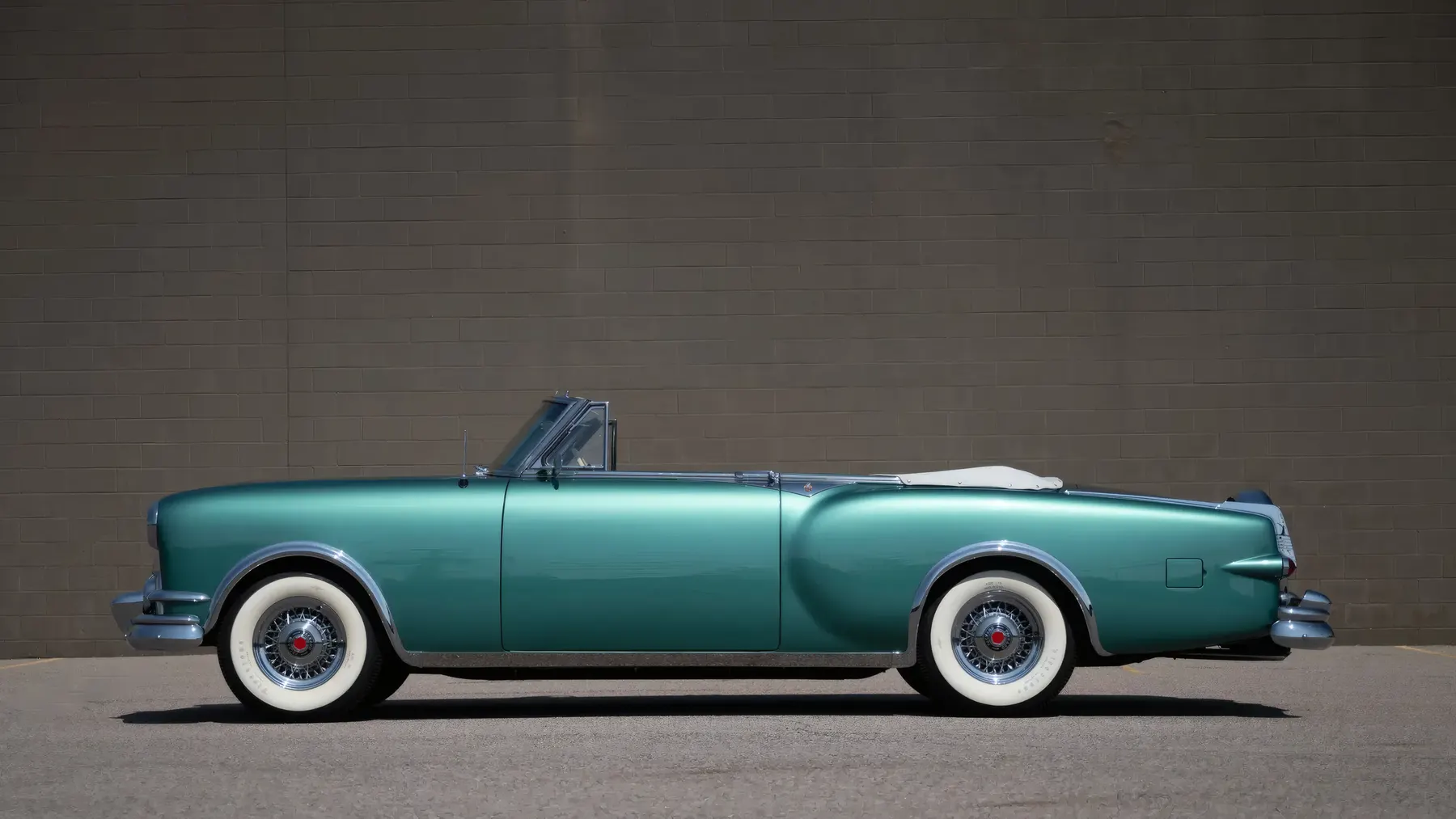
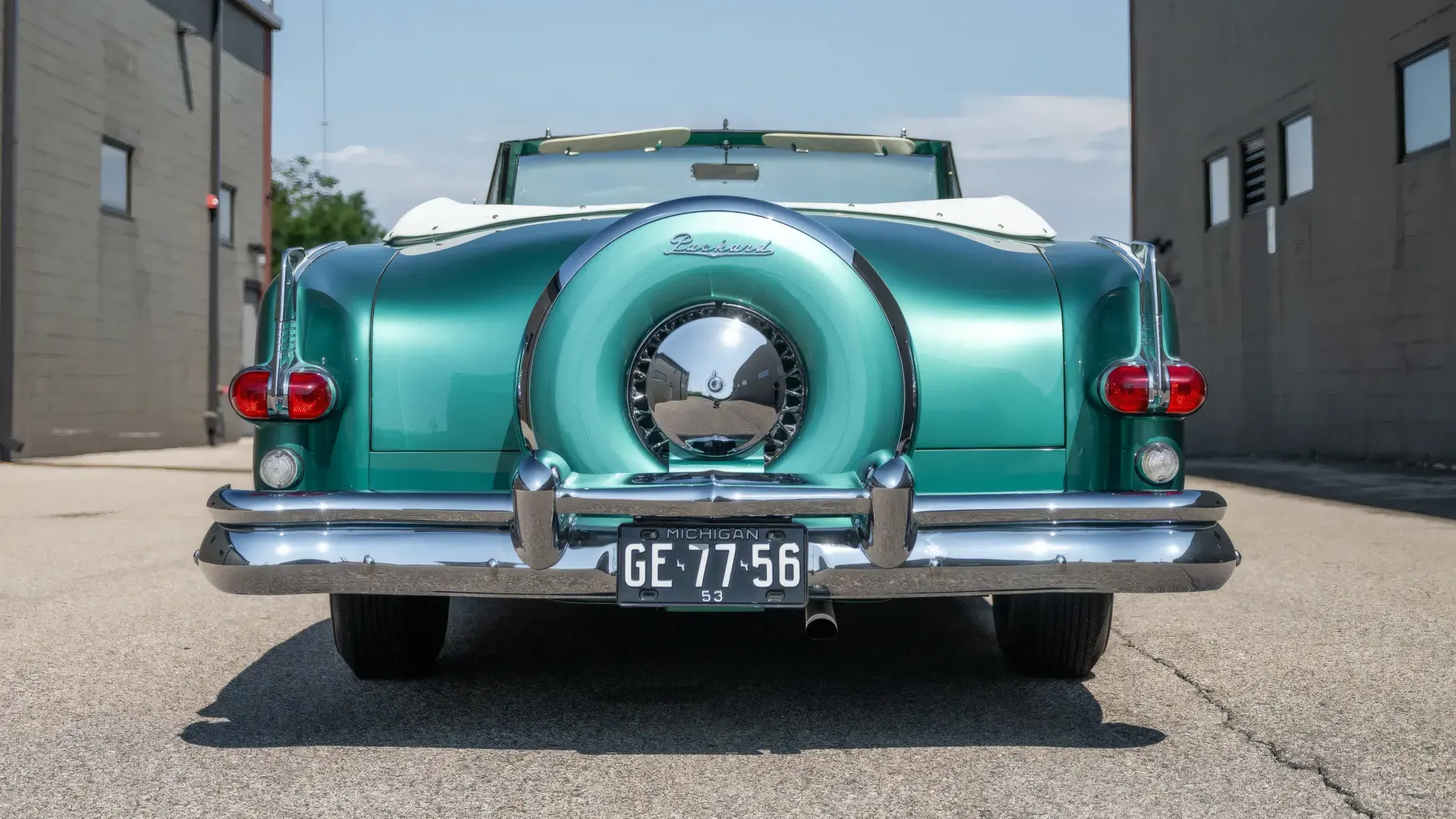
The Caribbean was that compromise. Mitchell-Bentley, rather than Packard or Henney, did the work, and RM Sotheby’s catalogue notes credit Dick Teague with the styling. The 1953 cars wore their identity in the details: radiused, skirt-less rear wheel arches edged in brightwork, a chrome band tracing the lower edge of the body in place of conventional side trim, concealed door handles, a steel Continental spare tucked between lengthened rear fenders, and a broad, low bonnet scoop that RM Sotheby’s describes as a faux intake. Horizontal “senior” taillamps and Kelsey-Hayes chrome wire wheels finished a look that remains cleaner in profile than most of its chrome-laden contemporaries. Inside, it was a leather-trimmed, six-passenger convertible. Only four colours were officially listed, Polaris Blue, Gulf Green Metallic, a maroon or Matador red metallic (period descriptions differ) and Sahara Sand, although a handful of special-order cars were built in ivory or black.
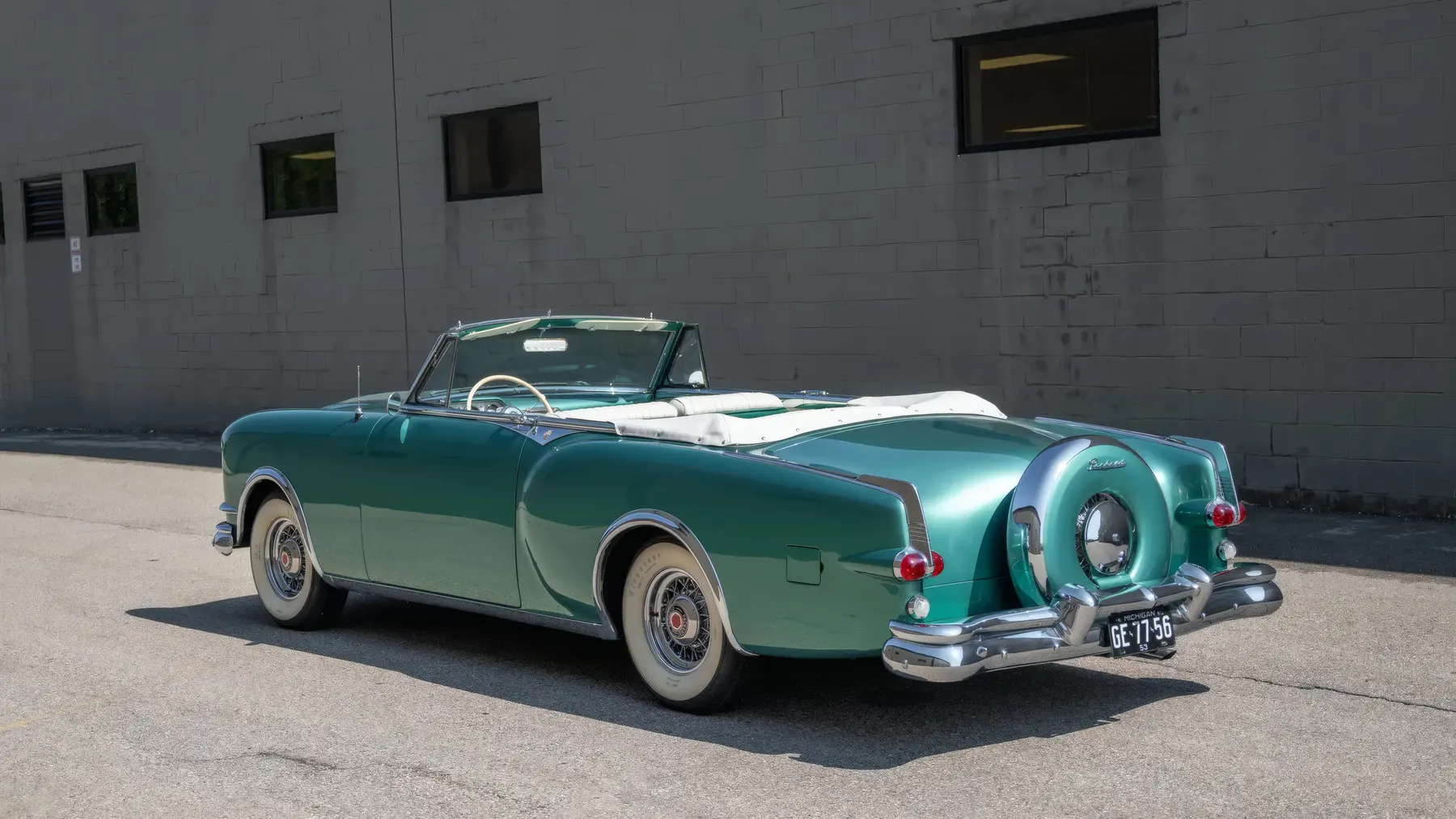
Packard asked $5,210, around $2,000 more than the Cavalier convertible it was based on. For that came leather upholstery, power steering, Easamatic power brakes, a heater and defroster, and a power-adjustable front seat. Its natural rival was the new Cadillac Eldorado, introduced the same year at $7,750 with a 331 cu in overhead-valve V8 and Hydra-Matic transmission. The Packard was the cheaper way into this exclusive new genre, and in 1953 it won the volume contest too, with 750 Caribbeans built against 532 Eldorados.
The 1953 powertrain was the least modern thing about the car. Packard’s 327 cu in (5.4-litre) L-head straight-eight, with a bore of roughly 89 mm and a stroke of 108 mm, had five main bearings and, in Caribbean form, a four-barrel carburettor that lifted output to 180 bhp at 4,000 rpm on a modest 8.0:1 compression ratio. Behind it could sit Packard’s Ultramatic, a cleverly engineered transmission with a two-speed epicyclic gearset and a torque converter that locked up to give direct drive at cruising speeds, a feature most rivals did not adopt for the better part of three decades. On the 1953 Caribbean it was an extra-cost option at $199. The engine family was no embarrassment in competition either: Hagerty notes that Packard eights placed fifth in the 1953 Pan American Road Race, with stock Packards 12th and 14th, and that a Packard also won an AAA 150-mile stock car race at Milwaukee. None of that involved the Caribbean itself, but it fits the durability the company’s eights were known for.
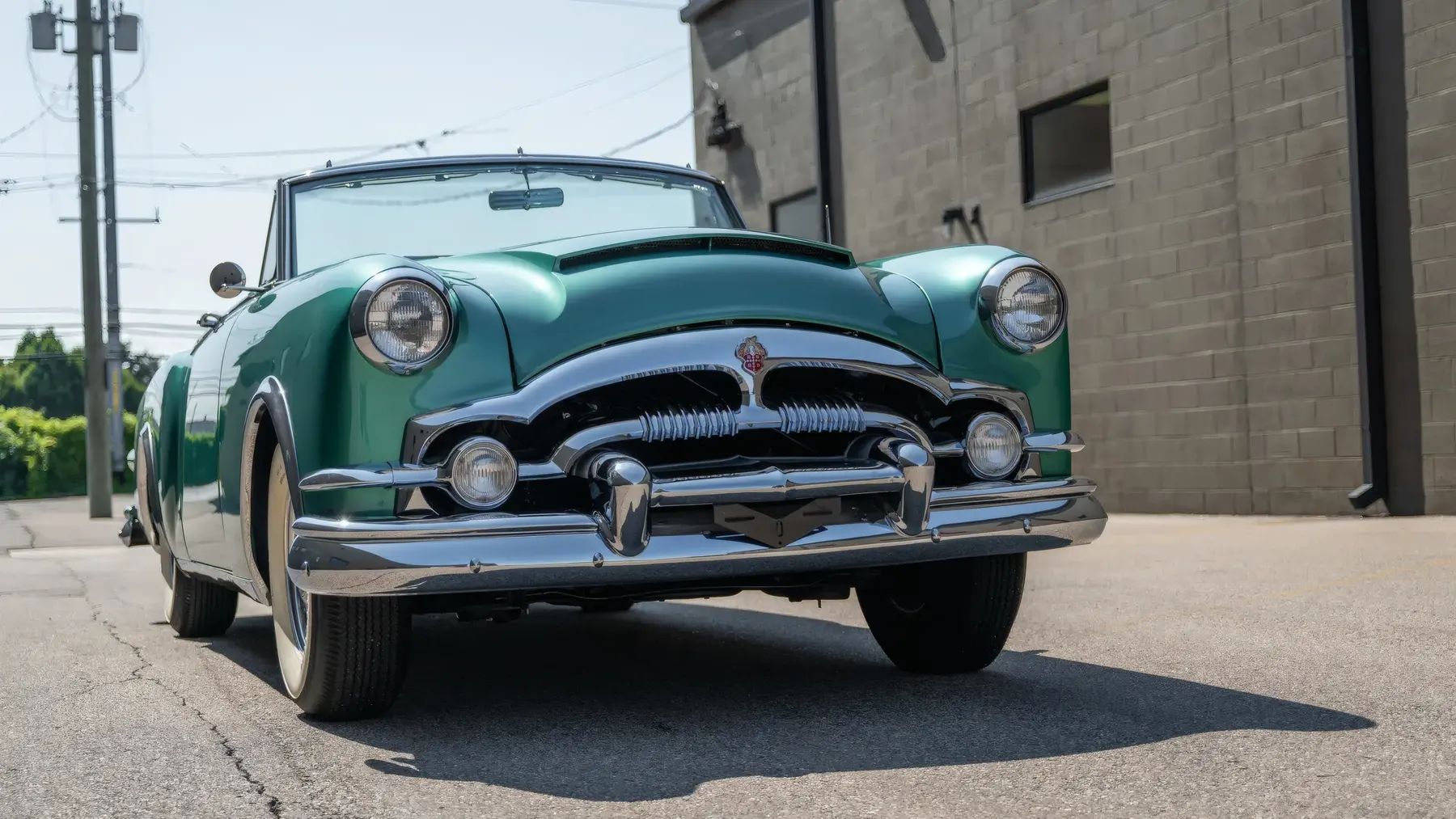
For 1954 Packard gave the straight-eight everything it had left. Senior Packards received a one-year-only 359 cu in (5.9-litre) engine, with a bore of about 90.5 mm and a stroke of 114 mm, nine main bearings, hydraulic lifters, valves canted toward the cylinders for better breathing, 8.7:1 compression, a four-barrel carburettor and an aluminium cylinder head. It was rated at 212 bhp and 330 lb-ft at 2,200 rpm, which Consumer Guide’s retrospective calls the most powerful postwar straight-eight. The Caribbean moved up to senior status, gaining heavier finned headlamp housings, two-tone paint, chrome on the bonnet scoop, “Caribbean” script on the rear fenders and a new dashboard shared with the rest of the line. The full rear wheel cutouts of 1953 shrank to half-size openings, the Ultramatic became standard, and the price climbed to $6,100. Only 400 were built, against 1,189 of the related Pacific hardtop, which shared the senior engine and the shorter wheelbase for the same single year. Part-way through the model year the transmission itself was revised: the Gear-Start Ultramatic finally selected low ratio automatically when the driver pulled away in Drive.
Nobody bought a Caribbean to chase lap times, and the figures are honest about that. Packard’s eights had long been prized for a silky idle and effortless low-speed pull, and RM Sotheby’s describes the 1953 combination as respectable performance delivered smoothly, while crediting the nine-main-bearing 359 with working very smoothly indeed. The chassis was conventional, with independent coil springs at the front, a live rear axle on semi-elliptic leaf springs and power-assisted hydraulic drum brakes all round, so this was a substantial car meant for unhurried cruising rather than cornering. Consumer Guide’s retrospective reckons a 1954 car took around 15 seconds to reach 60 mph, and that like most cars of the period it could lose its composure on corrugated surfaces. The earlier Ultramatic added its own quirk. The column quadrant read Park, Neutral, High, Low, Reverse, and the driver chose the range: the converter handled the getaway and direct drive locked in somewhere between 15 and 56 mph, depending on axle ratio and throttle position. The sensation, in other words, was of smooth, quiet machinery moving a great deal of car: pleasant, but never urgent.
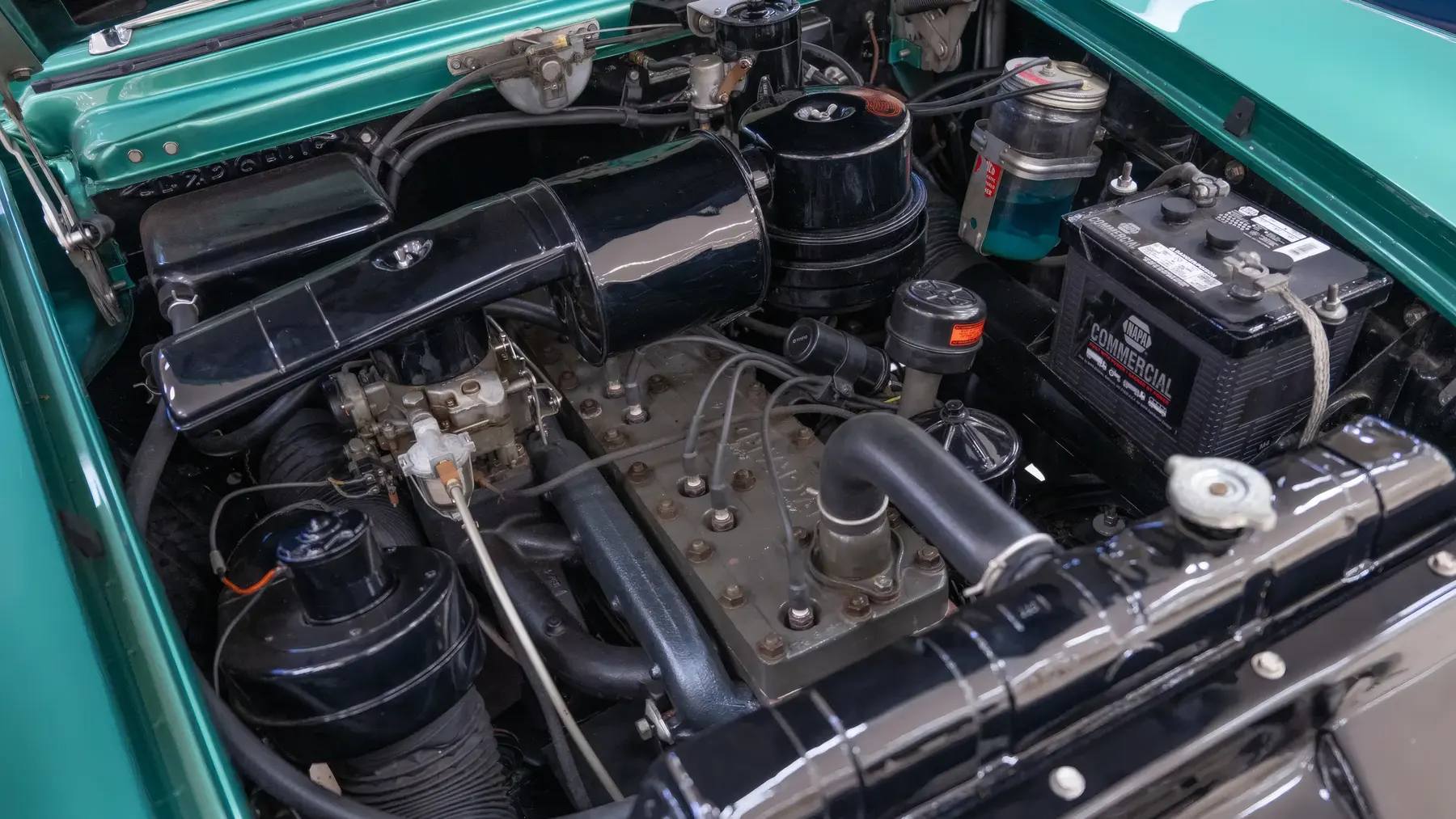
The weaknesses were real, and the engine sits at the centre of most of them. Oldsmobile and Cadillac had launched overhead-valve V8s in 1949, Studebaker and Chrysler followed in 1951, and Buick’s arrived in 1953; Packard and Pontiac were the last American builders still using L-head straight-eights, and Hagerty calls such engines anachronisms by the early 1950s. Even at 212 bhp the 359 only placed in the middle of the luxury field. Cadillac’s 331 cu in V8 had already been rated at 210 bhp in 1953, so Packard needed an extra 28 cu in, a four-barrel carburettor and an aluminium head to match what its rival offered a year earlier. That aluminium head was itself a problem: Hagerty says the one-year-only part was prone to warping and cracking and generated warranty repairs at dealers, and RM Sotheby’s notes that it was often replaced in period with a more readily available cast-iron head. Owners of earlier Ultramatics also learned that brisk acceleration meant starting in Low and shifting to High by hand, a chore that rival automatics had already removed before Gear-Start arrived in mid-1954.
The car beneath the cutting and brightwork was a second concern. The Caribbean was nominally a senior Packard in 1954, yet it rode the shorter 122 in Clipper-based chassis, and its body was still the 1951 shell whose thick, high-waisted proportions Hagerty names as one reason Packard looked dated. Mitchell-Bentley’s handwork gave the car its profile, but an outside-shop conversion of standard shells is hard to do cheaply, which helps explain the price. And the pricing logic looked backwards in 1954, just as the market turned: Packard raised the Caribbean to $6,100 and built 400, while Cadillac stripped the Eldorado of its bespoke sheet metal, cut its base price to $5,738 and sold 2,150.
Contemporary reaction was warm. RM Sotheby’s notes that the new convertible drew raves from the automotive press, and the 1953 sales victory over the Eldorado was flattering. But a halo car could not fix Packard. The company depended on an outside body supplier that Chrysler bought, was late with a V8 and bought Studebaker in 1954, a purchase Audrain Automobile Museum identifies as the source of the fragile finances that ended Detroit production. The 1955 Caribbean arrived with an all-new 352 cu in V8 rated at 275 bhp, Torsion-Level suspension and Teague’s restyling; the 1956 car added a hardtop and a 374 cu in V8 rated at 310 bhp, and then Packard’s Detroit production ended. Those later cars are quicker, with Consumer Guide putting the 1955 at 60 mph in 11.5 seconds, and more advanced, but they are not the same car.
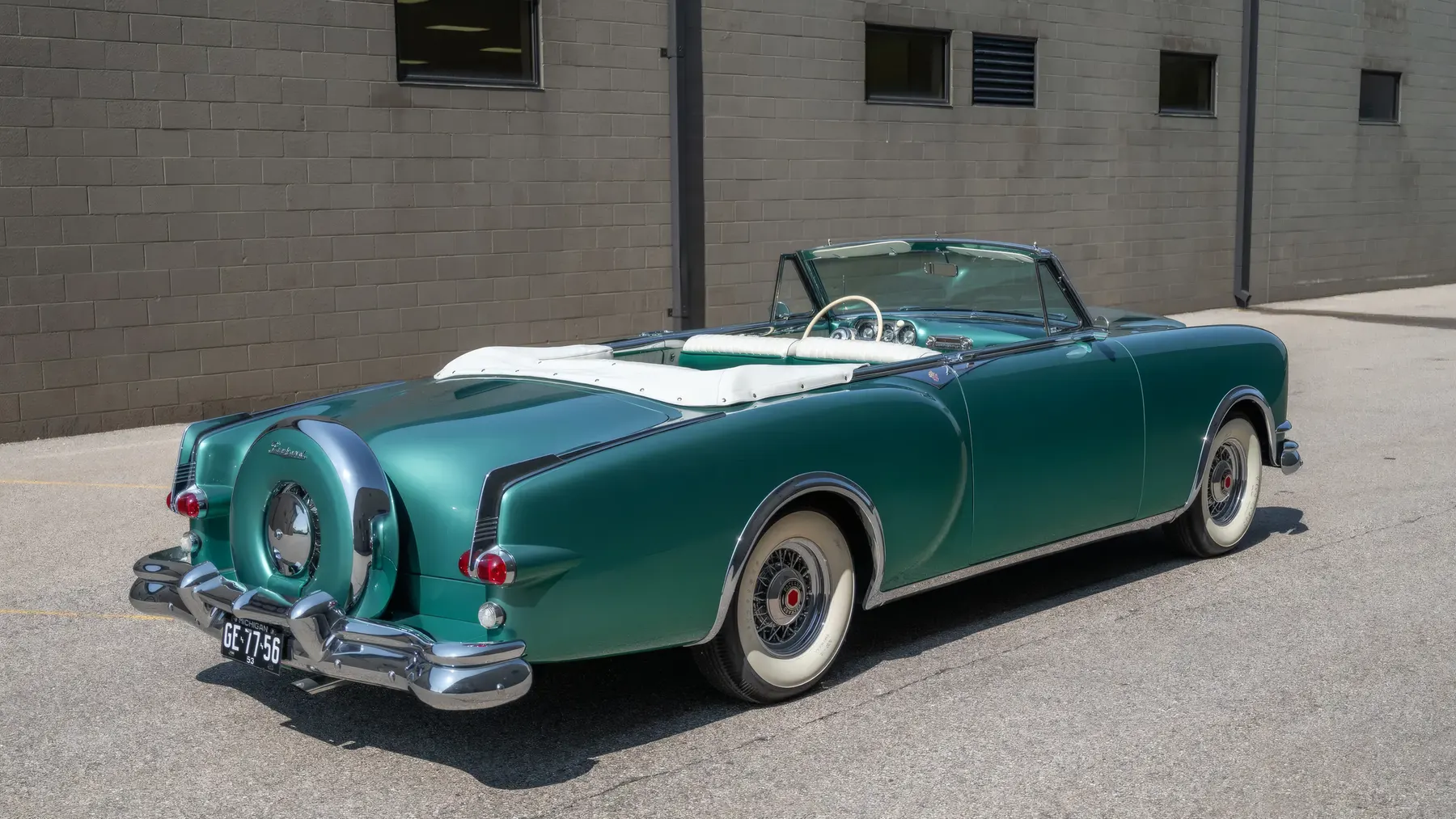
Choosing between the two first-generation years is a genuine trade-off. The 1953 has the purer design, with the one-year-only open rear arches and cleaner sides, and RM Sotheby’s catalogue copy observes that the 1954 lost many of its predecessor’s individual touches. The 1954 has the bigger nine-main-bearing engine, the standard Ultramatic and the rarer production run. In neither case did the packaging change enough to disguise what lay beneath it.
What the first generation left behind is mostly a matter of proportion and timing. It was the moment Packard worked out, with an outside contractor’s help, what a postwar halo car for the company should look like: long, low and free of the chrome clutter that was beginning to engulf Detroit. It was also the last time the old straight-eight carried that ambition, in its most developed and most troublesome 359 cu in form. Hagerty’s valuation guide now calls the Caribbean the most collectible postwar Packard, and with 1,150 first-generation cars built across two years it is a rare sight by any measure. The idea was right and the shape was handsome, but the powertrain belonged to an earlier decade, and the market had already moved on by the time the bodywork caught up.
Technical data
Performance Specifications
| 1953 Caribbean | 1954 Caribbean | |
|---|---|---|
| Production | 750 | 400 |
| List price (US$) | 5,210 | 6,100 |
| Engine | 327 cu in (5.4-litre) L-head straight-eight, five mains, four-barrel carburettor | 359 cu in (5.9-litre) L-head straight-eight, nine mains, hydraulic lifters, aluminium head, four-barrel carburettor |
| Bore x stroke | approx. 89 x 108 mm | approx. 90.5 x 114 mm |
| Compression ratio | 8.0:1 | 8.7:1 |
| Power | 180 bhp at 4,000 rpm | 212 bhp |
| Torque | Not corroborated (omitted) | 330 lb-ft at 2,200 rpm |
| Transmission | Ultramatic two-speed with lock-up converter (US$199 option) | Ultramatic (standard); Gear-Start version from mid-year |
| Wheelbase | 3,099 mm | 3,099 mm |
| Front suspension | Independent, coil springs | Independent, coil springs |
| Rear suspension | Live axle, semi-elliptic leaf springs | Live axle, semi-elliptic leaf springs |
| Brakes | Four-wheel power-assisted hydraulic drums | Four-wheel power-assisted hydraulic drums |
| 0-60 mph | Not corroborated (omitted) | approx. 15 s* |
| Top speed | Not corroborated (omitted) | Not corroborated (omitted) |
| Kerb weight | Not corroborated (omitted) | Not corroborated (omitted) |
Sources
- Wikipedia: Packard Caribbean
- Wikipedia: Ultramatic
- Wikipedia: Cadillac Eldorado
- Wikipedia: Packard Pacific
- RM Sotheby’s: 1953 Packard Caribbean (Hershey 2022)
- RM Sotheby’s: 1954 Packard Caribbean (Hershey 2025)
- RM Sotheby’s: 1953 Packard Caribbean (Fort Lauderdale 2015)
- RM Sotheby’s: 1953 Packard Caribbean (sale gc19)
- RM Sotheby’s: 1954 Packard Caribbean (sale am13)
- RM Sotheby’s: 1953 Packard Caribbean (Hershey 2013)
- RM Sotheby’s: 1953 Cadillac Eldorado (sale ca16)
- Society of Automotive Historians in Britain: Snapshot 428, 1952 Packard Pan American
- Hagerty Media: The top 10 reasons why Packard died
- Hagerty Media: The last American straight-eight engine had a life fully lived
- Hagerty Valuation Tools: 1953 Packard Caribbean
- Hagerty Canada Valuation Tools: 1953 Cadillac Eldorado
- HowStuffWorks (Consumer Guide): 1953-1956 Packard Caribbean
- Hyman Ltd: 1953 Packard Caribbean
- Audrain Automobile Museum: 1955 Packard Caribbean Ultramatic Convertible
Join the discussion
Comments
Loading comments…
Leave a comment
Share a detail, memory, or perspective. Every comment is reviewed before publication.