Shelby GT500 Fastback (1967–68): The Big-Block Compromise That Became an American Icon
1967 Shelby GT500 Fastback
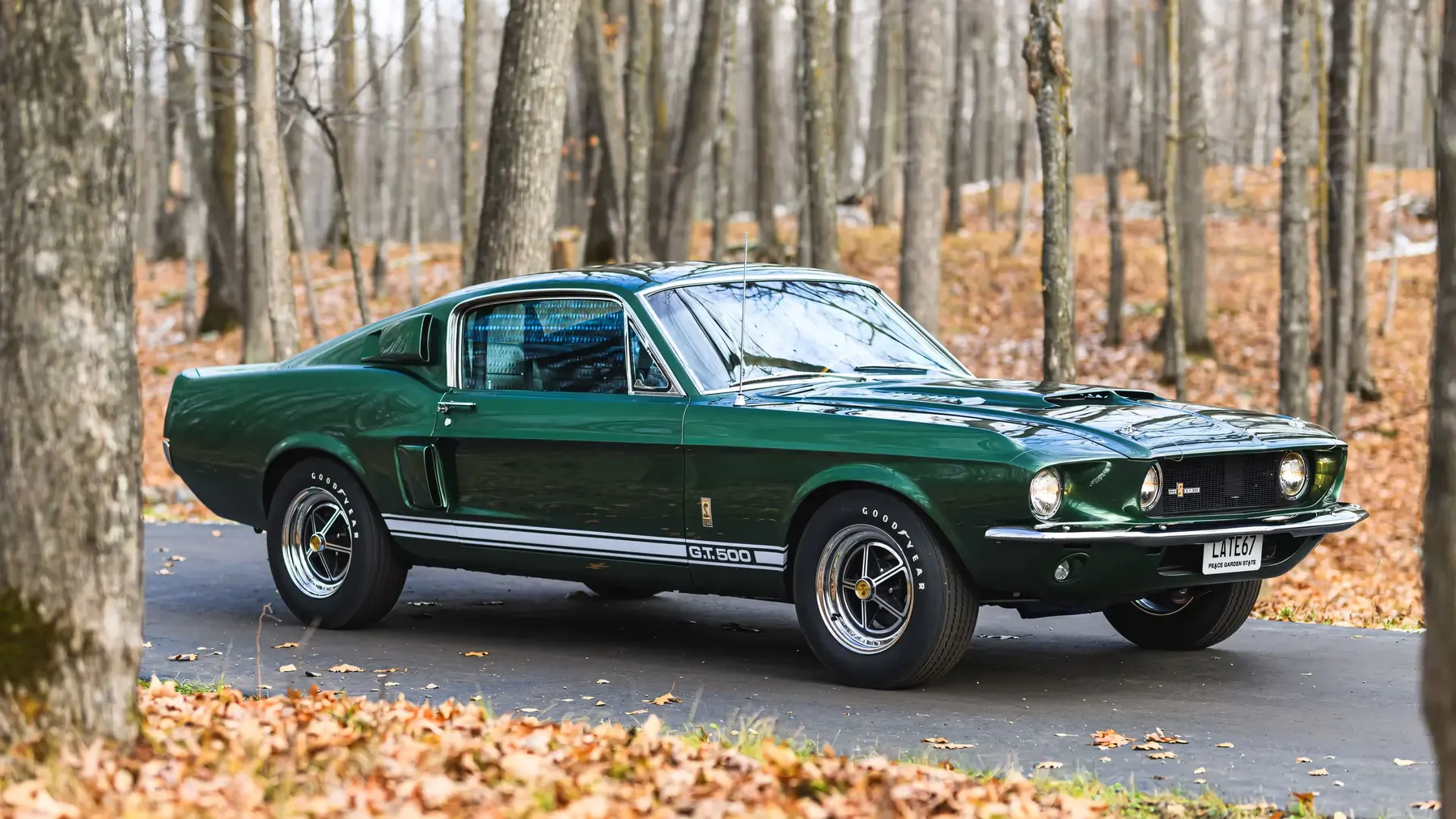
Images: Alex Bellus / RM Sotheby's
The Shelby GT500’s name was, depending on who you asked, either a straightforward numerical escalation from the GT350 or an implied horsepower promise that no period production engine could quite keep. Carroll Shelby, by his own admission, chose numbers without strict engineering rationale: the GT350 supposedly referenced the distance - in feet - between two buildings at his Gardena workshop; the GT500 was a number that sounded more potent and sold better at a Ford dealership. That kind of commercial pragmatism, dressed in the language of performance, ran through everything about the GT500. It was not dishonest, exactly. But it was always more about aspiration than specification.
The GT500 arrived alongside the restyled 1967 Ford Mustang as a companion to the GT350, and its existence came more from Ford’s commercial calculus than from Shelby’s sporting instincts. Shelby’s original Mustang concept was the GT350 - a small-block, high-revving performance car with genuine motorsport credentials and a philosophy rooted in the Anglo-American sports car tradition. The GT350 had begun as an SCCA B-Production racing machine, and the road cars retained that lineage’s directness and purpose. Ford, watching the sales figures and the shifting appetite of the American performance market, wanted more: more cubic inches, more presence, more showroom spectacle for buyers who associated performance with displacement rather than precision. The GT500 was Ford’s request, and Shelby built it accordingly, fitting the new car’s engine bay with the 428 cubic inch Police Interceptor V8 - a large-capacity, torque-oriented unit from the FE-series family that Ford rated conservatively at 355 bhp.
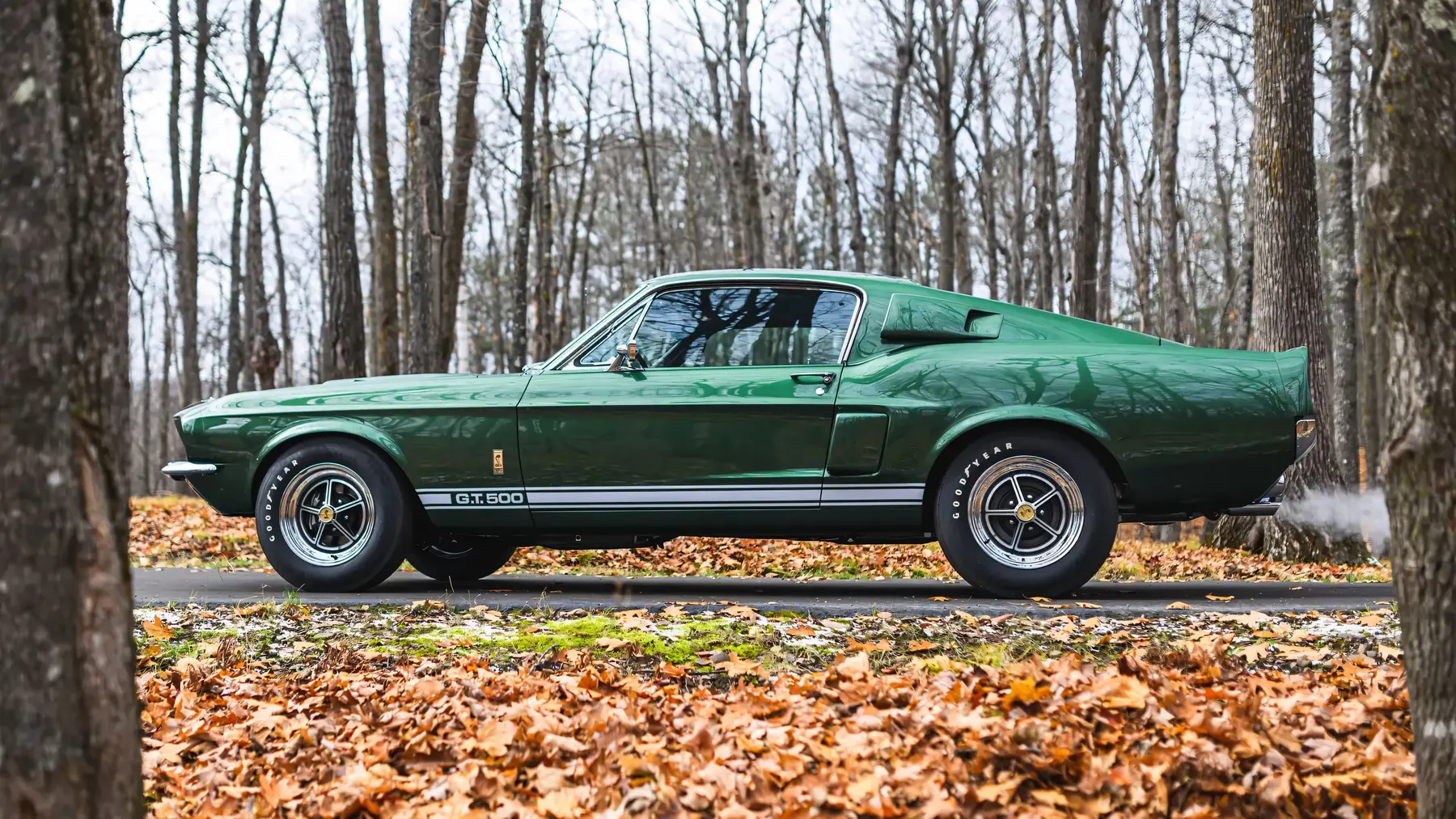
The conservative rating was partly commercial: automakers of the period had reasons both practical and insurance-related to understate power outputs, and the 428 PI’s actual output was broadly accepted among enthusiasts to exceed the factory figure meaningfully. What the factory number did not understate was the torque, which the 428 PI produced in abundance - around 462 lb-ft at comparatively modest revs. This is the engine’s real character: not a revvy, high-output unit with a screaming exhaust note, but a long-stroke iron motor that pulled with effortless authority from low in the rev range, rendering much of the gear ratio spread largely academic on public roads. In a straight line, on the long American roads the car was designed for, the 428 was deeply convincing.
This divergence in purpose between the GT350 and GT500 was not a secret in period, and it created a slight ambiguity in the Shelby brand’s identity that was never fully resolved. Buying a Shelby Mustang in 1967 implied a connection to Cobras, Le Mans, and the whole Anglo-American sports car philosophy that Shelby himself had built his reputation on. The GT350 sustained that connection, however tenuously, through its suspension tuning and its surviving motorsport pedigree. The GT500 was more honestly a luxury muscle car: fast, visually imposing in a direct American way, and built around a powertrain that could outperform almost everything on a highway but carried no real circuit ambitions. This was not a disappointment for the buyers who chose it. But it was a different promise made under the same name.
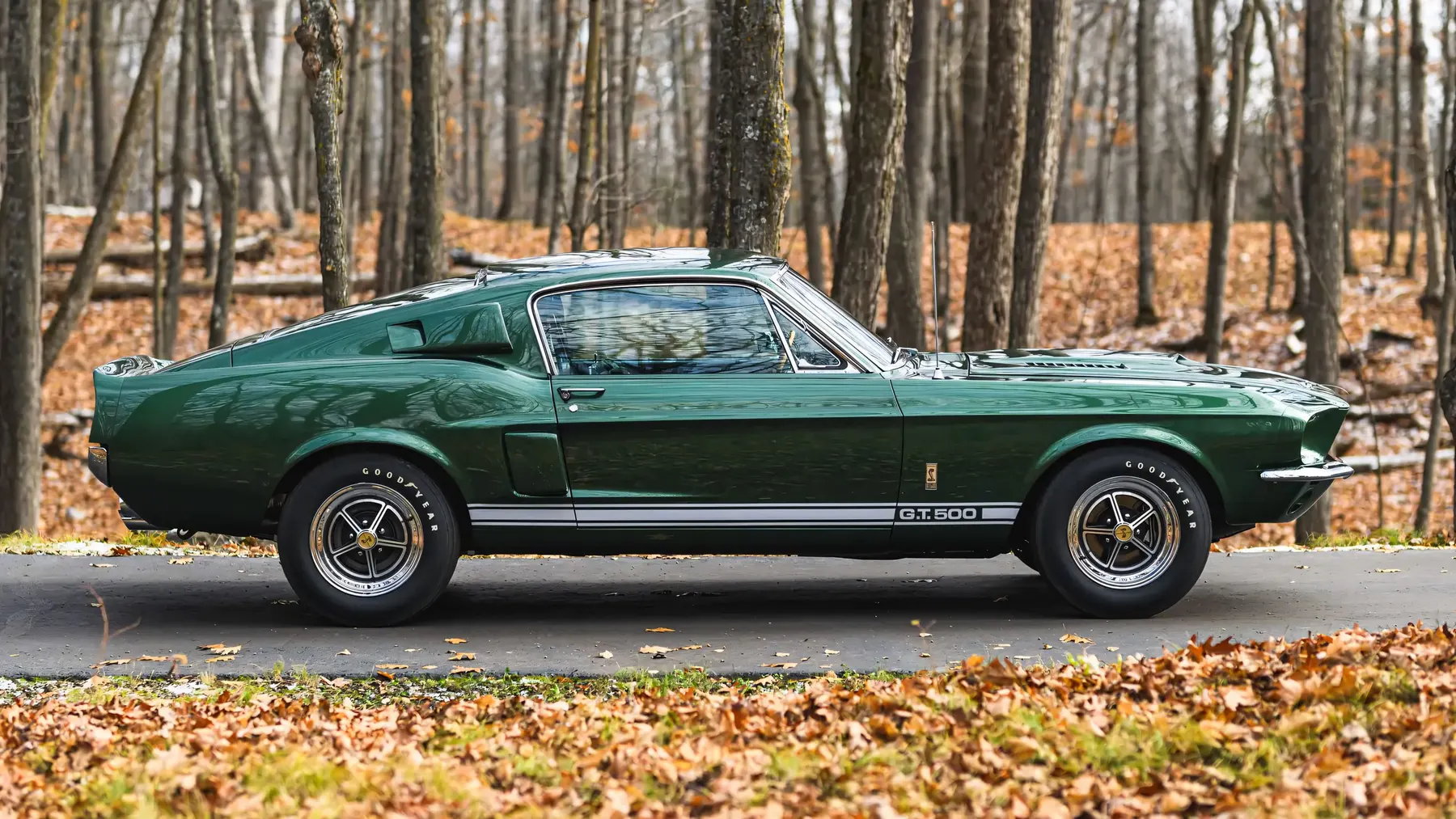
Against the Pontiac GTO and the early Chevrolet Camaro SS of the same period, the GT500 offered a more refined and more exclusive proposition - the combination of Shelby’s modifications and the 428’s output making it a serious contender in straight-line terms with the best the segment could produce, while the Shelby name carried a prestige premium that pure muscle cars could not match. In this context it was a coherent product. Its market was real, and it found its buyers.
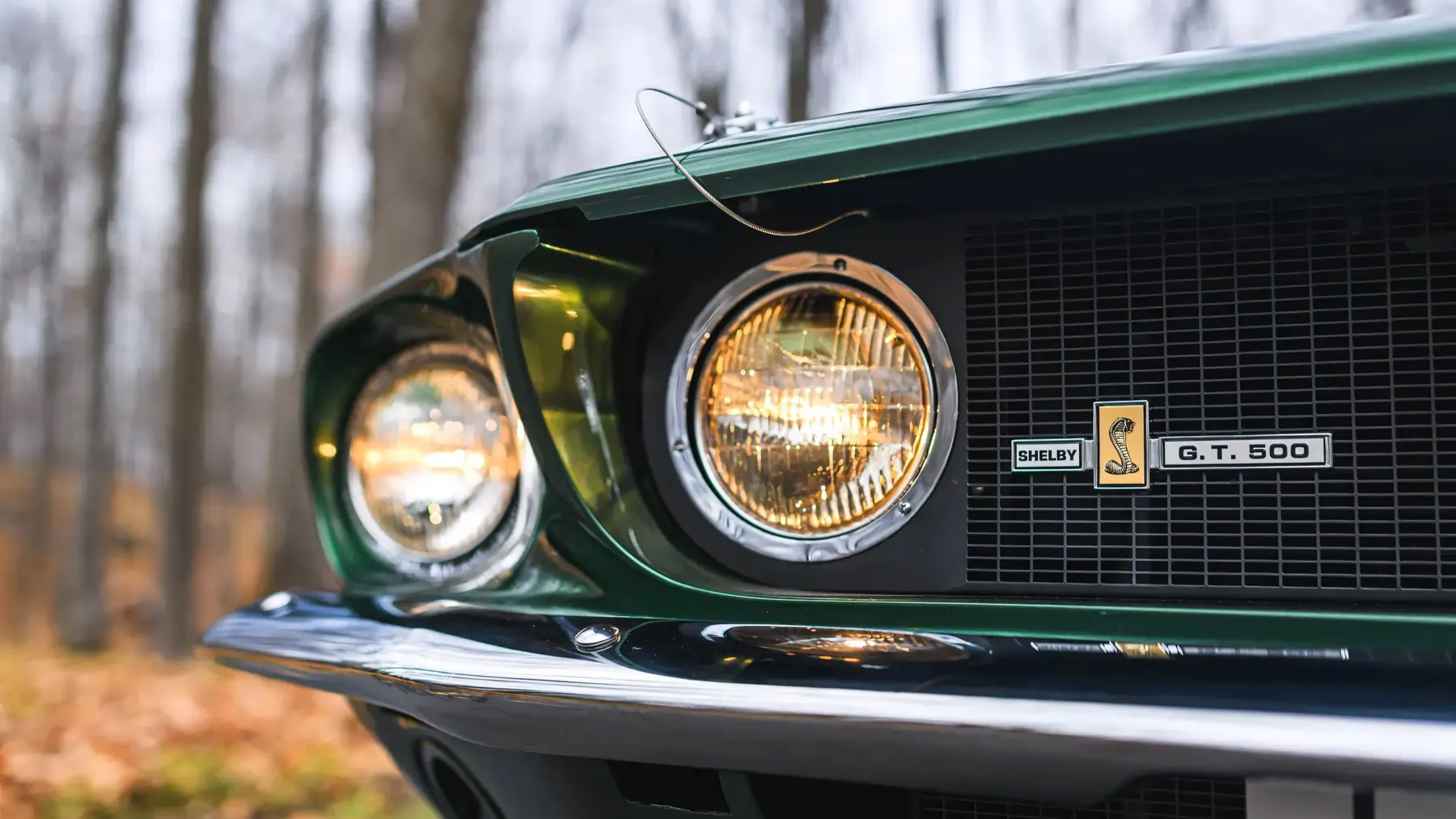
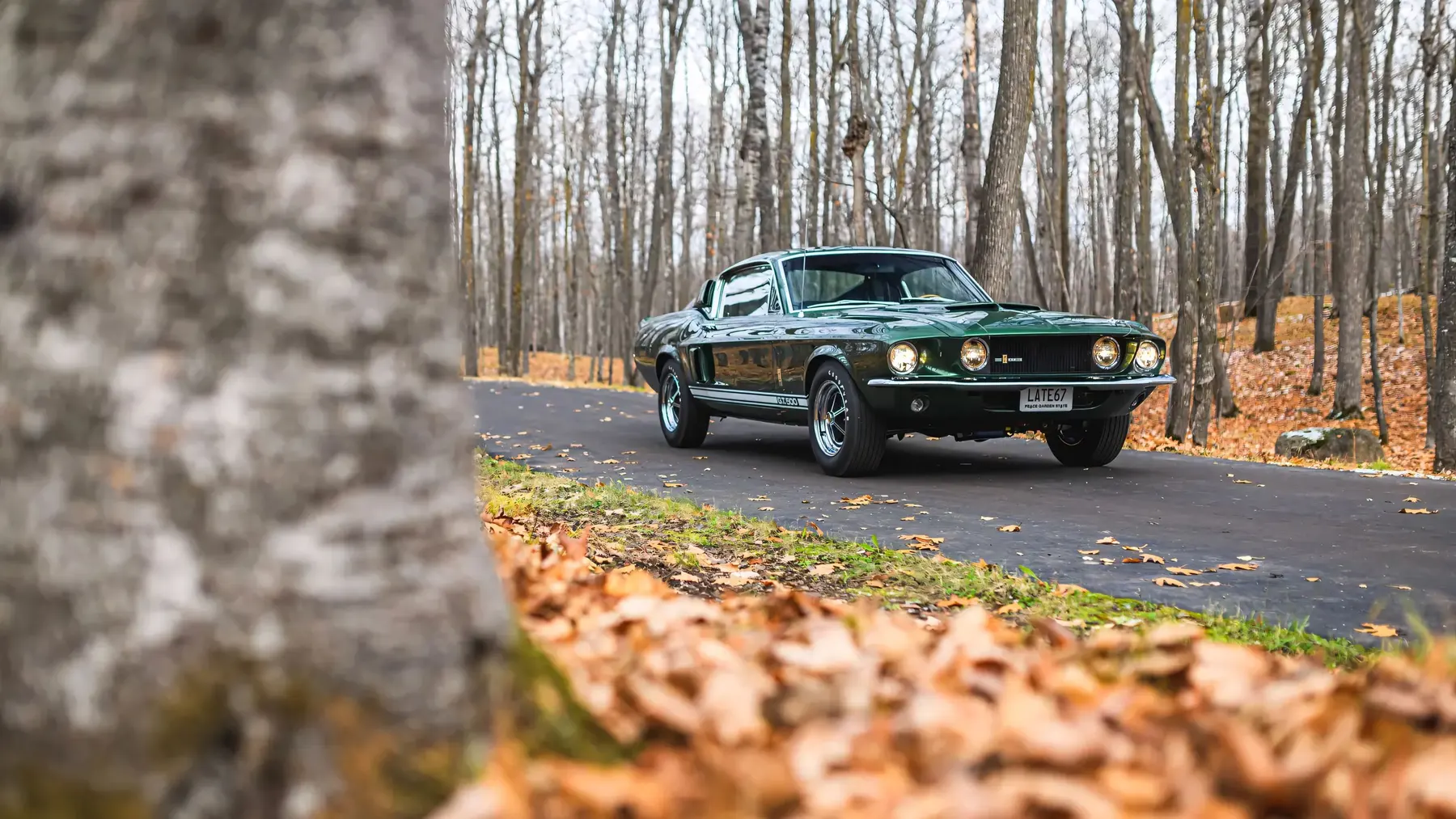
Shelby American’s visual treatment of the 1967 fastback was coherent and distinctive without being gratuitous. The production Mustang’s steel bonnet was replaced by a fibreglass unit with twin functional scoops, providing visual drama and genuinely routing air toward the engine bay. A revised front grille with integral driving lights, unique side body striping, and a full-width rear valance gave the car an identity clearly distinct from the standard Mustang. At the rear, sequential turn signals - borrowed from the Ford Thunderbird - replaced conventional indicators, giving the tail end a small theatrical flourish that became one of the car’s identifying details. The cabin received additional instrumentation and a sport steering wheel, though the core of the cockpit remained fundamentally standard-issue Ford. Approximately 2,050 GT500 fastbacks were built for the 1967 model year - exact figures vary slightly between registries - making it a relatively rare car even at the time of sale.
For 1968, the range broadened. A convertible joined the fastback, extending appeal toward buyers who prioritised open-air motoring over the fastback’s more purposeful proportions and superior structural rigidity. More significant mechanically was the mid-year introduction of the GT500KR - King of the Road - which replaced the Police Interceptor engine with the new 428 Cobra Jet. The CJ benefited from revised cylinder heads, a larger carburettor, and improved breathing throughout the induction system, and was universally understood to exceed its nominal factory rating of 335 bhp - paradoxically lower, on paper, than the Police Interceptor it replaced. Ford’s official reasoning related to drag racing classification rules, where advertised horsepower influenced class placement, and the deliberately conservative figure kept the Cobra Jet in a more favourable bracket. Whatever the paperwork suggested, the KR was a more developed machine than the standard GT500, and represented the first-generation car at its most mechanically sorted.
From 1968 onward, and decisively into the 1969 and 1970 cars that concluded the original run, Ford’s direct involvement in the conversion process deepened as Shelby American’s creative latitude narrowed. Production moved from the LAX facility in California to A.O. Smith’s operation in Ionia, Michigan, and the cars grew progressively heavier, more visually extravagant, and more clearly oriented toward luxury marketing than performance integrity. Shelby himself was disengaging; the later cars were, in meaningful ways, Ford products carrying Shelby identification rather than Shelby products using Ford running gear. The first-generation GT500 story, properly told, belongs to 1967 and 1968, when Shelby American’s fingerprints were still directly on the conversion process.
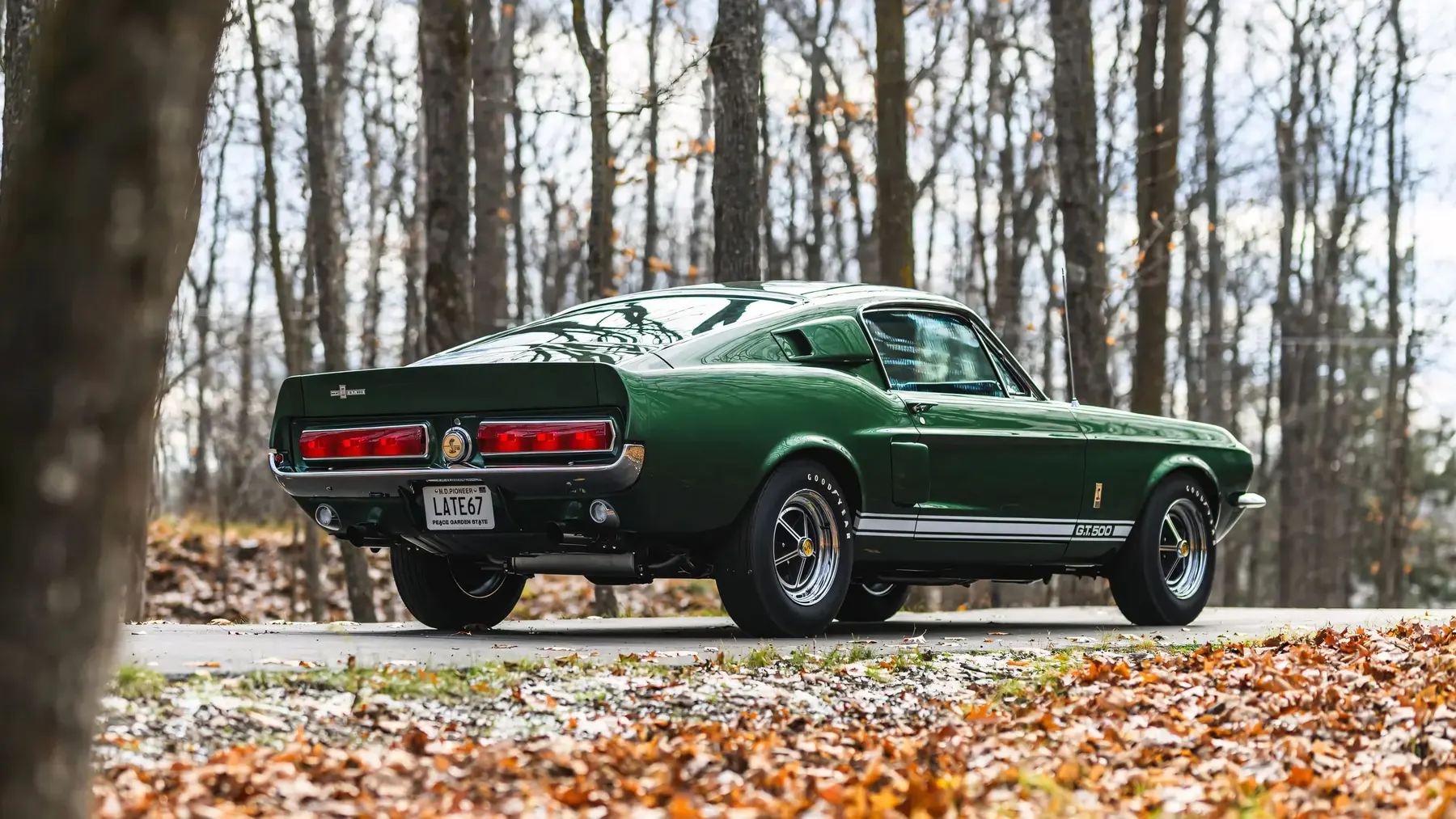
The driving experience of the GT500 was formidable in a straight line and genuinely limited everywhere else. The 428 FE was a heavy engine, and its mass sitting well forward in the engine bay produced a front-heavy weight distribution that the suspension geometry - derived from the Mustang’s existing architecture with Shelby’s revised springs and dampers - could not neutralise. The result was a car that understeered consistently when pressed into corners, a characteristic that road testers of the period identified clearly and without ceremony. The GT350 handled with more communication and more willingness to rotate under power; the GT500 was a different kind of machine entirely. Shelby’s suspension calibration for the GT500 reflected this honestly - the car was tuned for stable, predictable behaviour under acceleration rather than for the adjustability that would reward a committed driver through a succession of corners. The standard four-speed manual gearbox was a properly sporting instrument, and the standing-start acceleration was genuinely quick by the period’s standards. But the dynamic experience beyond a straight line was always conditioned by the weight carried forward of the front axle, and no amount of spring tuning could change the fundamental arithmetic of the mass distribution.
Front disc brakes were standard on all Shelby Mustangs in a period when even performance-oriented American cars commonly used drums all round, and this was one of the GT500’s genuine engineering contributions. The braking performance it provided was proportionate to the car’s straight-line capability in a way that the base Mustang’s setup was not.
Where the premium over a standard Mustang was more difficult to justify was in the consistency of the build process itself. Shelby American’s LAX operation was capable and enthusiastic, but it was not a precision manufacturing facility, and the fibreglass bodywork panels that gave the GT500 its visual distinction were sometimes poorly fitted, with panel gaps and surface inconsistencies that a buyer paying a meaningful premium should not have encountered. Interior trim finish could be uneven. The improvised, hands-on energy that made these cars charismatic was the same energy that made build quality a variable rather than a guarantee. Ford’s subsequent move toward Michigan production was partly motivated by the desire for greater manufacturing consistency, though the character of the car migrated with it toward something more corporate and less personal.
The GT500’s second life as a cultural object arrived in 2000, when the remake of Gone in 60 Seconds cast a 1967 GT500 as Eleanor, the most coveted of the film’s target vehicles. The cars built for the production - modified, widened, lowered, and comprehensively upgraded beyond factory specification - bore a structural but not a detailed resemblance to an unmodified original. It did not matter to audiences. The Eleanor cars became one of cinema’s most recognisable automotive images, demand for first-generation GT500s surged accordingly, and the legal disputes over the Eleanor name and likeness - pursued by the estate of Denice Halicki - became a protracted subplot that touched everyone from unlicensed replica builders to the film’s own production company. The factory 1967 GT500 and the Eleanor derivative are now distinct collector categories with their own valuation logic and their own communities of interest, but the film’s effect on the market for the original car was permanent and substantial.
The original Shelby GT500 fastback is a benchmark of the American muscle car era - not for technical sophistication, but for coherent expression of a specific performance philosophy. It was a large-displacement, torque-heavy, visually imposing fastback built by a small operation under a celebrated name and a complicated corporate partnership, aimed at buyers who wanted genuine authority on American roads and a nameplate that carried real cultural weight. Its handling compromises and occasional build inconsistencies were the price of a car made in that way at that time by those people, and understanding both the achievement and the limits is what allows you to appreciate the GT500 honestly - not as mythology, but as a very specific and very American kind of machine that earned its reputation on its own terms.