Cadillac V-16 Sport Phaeton by Fleetwood: America's Most Ambitious Pre-War Luxury Car
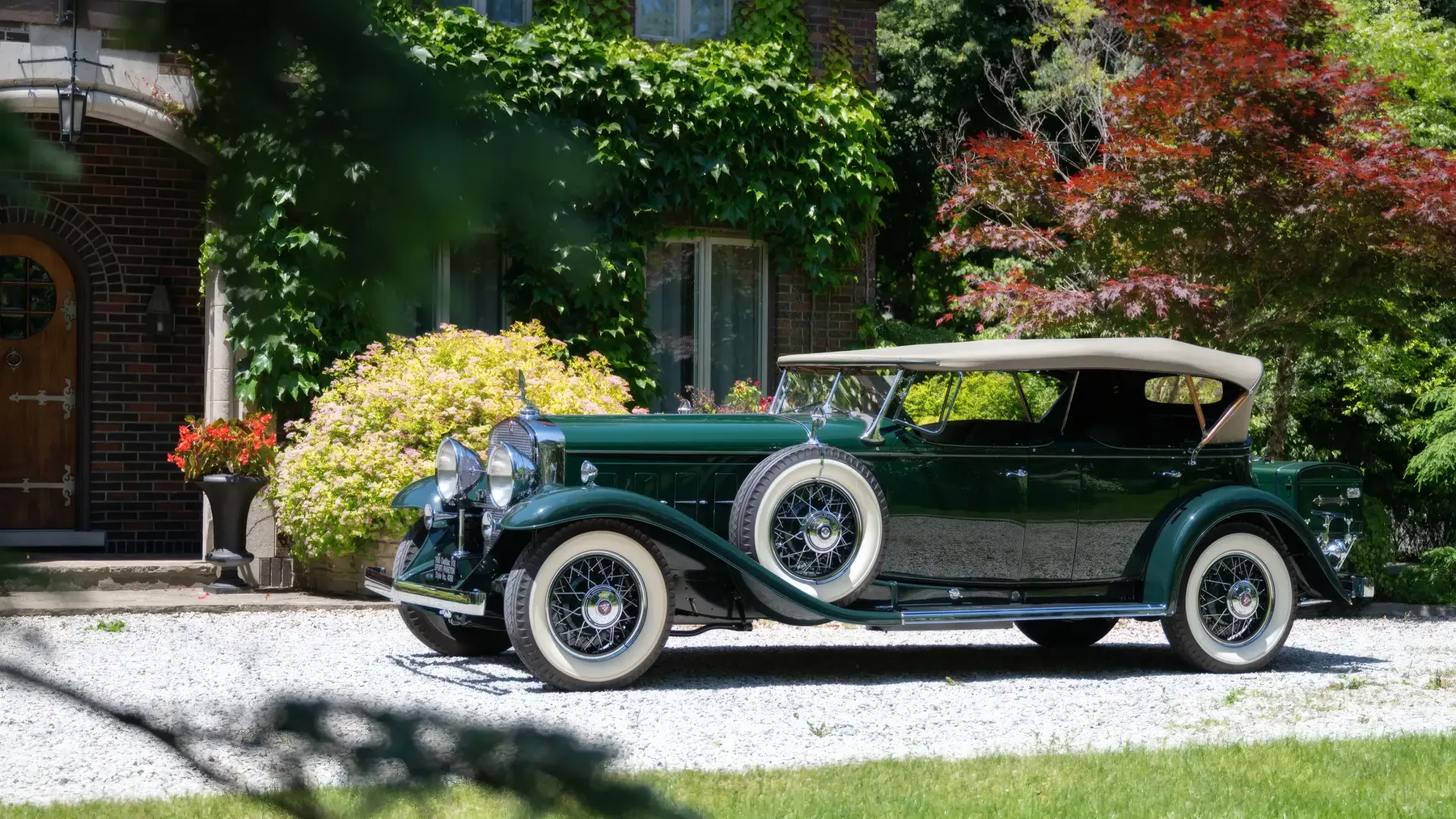
1930 Cadillac V-16 Sport Phaeton by Fleetwood
Images: Darin Schnabel / RM Sotheby's
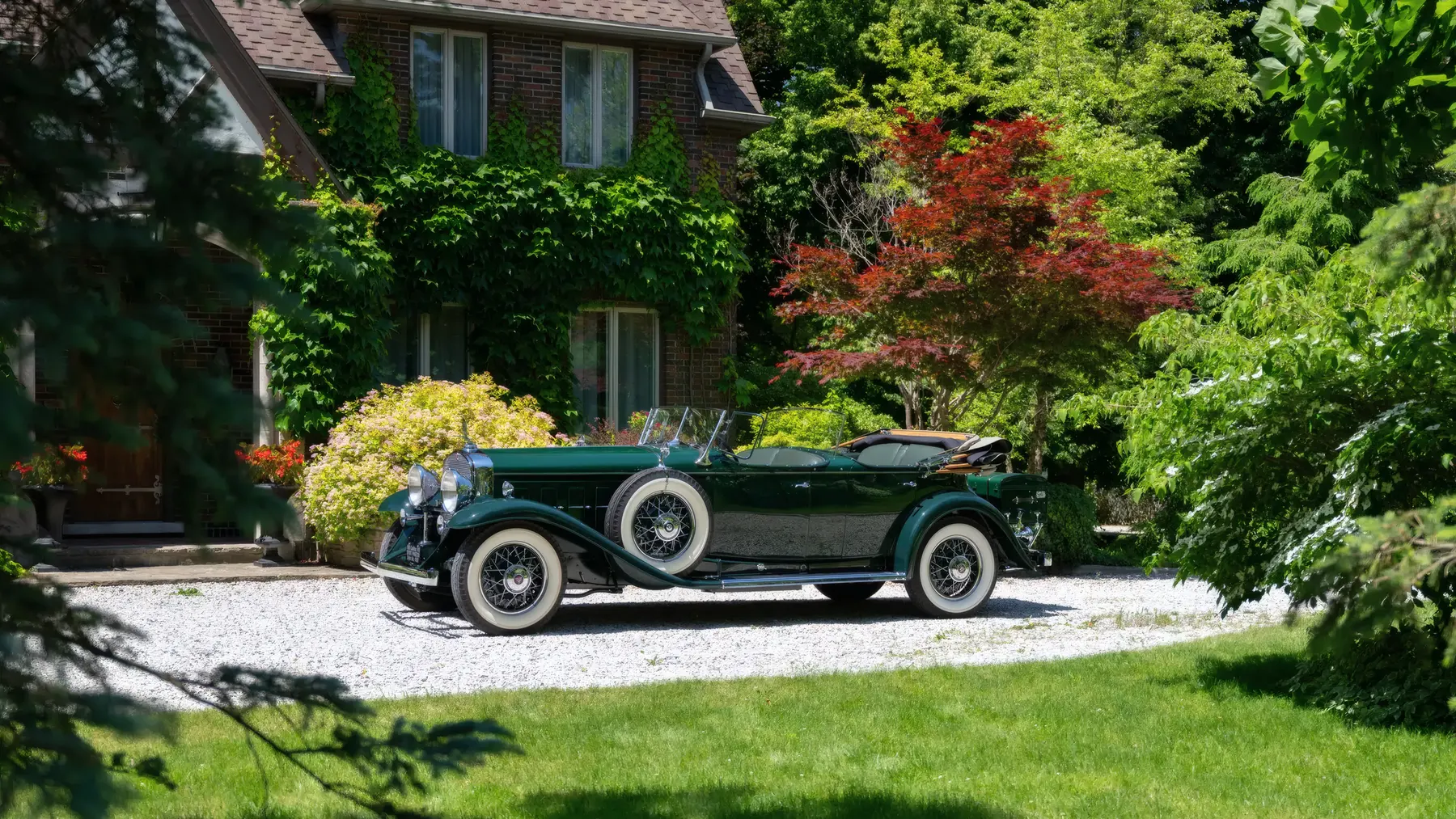
When Cadillac dispatched a convoy of five consecutively built V-16s from Detroit to Copenhagen in June 1930 for a promotional tour through nine European countries, the choice of body styles was deliberate and pointed. Among them was a Sport Phaeton - the most theatrically open, sculpturally ambitious, and visually assertive interpretation of the new flagship. The message was unambiguous: America had built something that could confront Rolls-Royce and Hispano-Suiza on their own continent and not flinch. That the car arrived in Europe just months after the Wall Street crash had begun dismantling the wealth of its target buyers was the defining tragedy of the whole V-16 enterprise, and it haunts the model’s history from beginning to end.
The Cadillac Series 452 V-16 was unveiled at the New York Auto Show on 4 January 1930, and the timing was almost grotesquely ill-starred. Development had begun in earnest around 1926, orchestrated by Cadillac president Lawrence Fisher and executed primarily by Owen Nacker, a brilliant engineer recruited from the Marmon Motor Company where a similar V-16 concept had stalled for lack of resources. Working in a secluded section of the Detroit factory alongside GM engineering chief Charles Kettering and Cadillac’s chief engineer Ernest Seaholm, Nacker’s team designed what remains one of the most technically considered American passenger car engines of the pre-war era. The goal was not simply to produce an engine with sixteen cylinders, but to produce one whose refinement would be self-evidently superior to anything Packard, Pierce-Arrow, or the European prestige builders could offer.
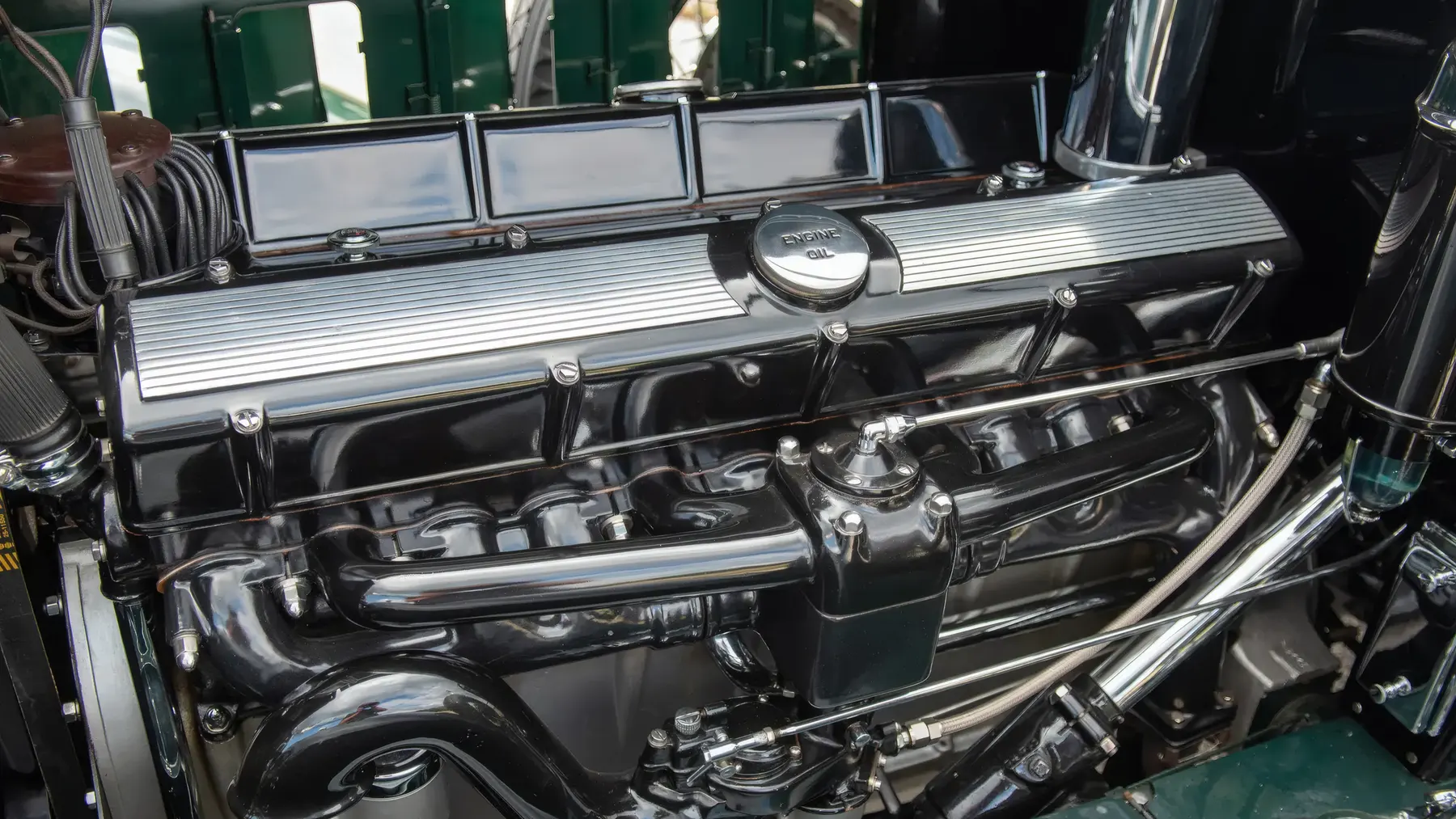
The solution was a 45-degree overhead-valve V-16 displacing 452 cubic inches - 7.4 litres - built around two separate cast-iron eight-cylinder blocks sharing an aluminium alloy crankcase and a single forged crankshaft supported on five main bearings. The 45-degree angle between the banks was chosen with exceptional care: it was narrow enough to package cleanly between the chassis frame rails, but it also produced perfectly even 45-degree firing intervals with an eight-throw crankshaft, delivering the pulse-free, essentially vibration-free power delivery that defined the car’s character. Each bank was largely self-contained, with its own carburetor, intake manifold, ignition system, and exhaust, so the engine ran as two coordinated straight-eights rather than a monolithic lump. Hydraulic valve lifters - a rarity at the price - ensured near-silent running and eliminated the periodic adjustment that plagued most contemporaries. Power output has been reported variously across sources, reflecting the inconsistent measurement conventions of the era, but conservative contemporary ratings placed it at around 165 bhp, with torque of approximately 320 lb-ft arriving at a remarkably low 1,200 to 1,500 rpm. Some period promotional materials claimed figures closer to 185 bhp, though the torque characteristic matters more than any headline figure: this engine pulled with the effortless constancy of something far larger than it needed to be for the task.
Harley Earl’s styling department became involved in a way almost unprecedented for an engine. The V-16 is frequently cited as the first production powerplant to receive dedicated aesthetic attention from a stylist rather than being treated as a purely mechanical artifact. Earl had the wiring concealed beneath polished metal covers, the valve covers finished in black porcelain enamel with brushed aluminium ridges carrying the Cadillac crest, and the general underhood architecture arranged so that opening the bonnet was itself an act of ceremony. It was an engine designed to be looked at, which was appropriate given that the cars it powered were expressly built for people who would also be looked at.
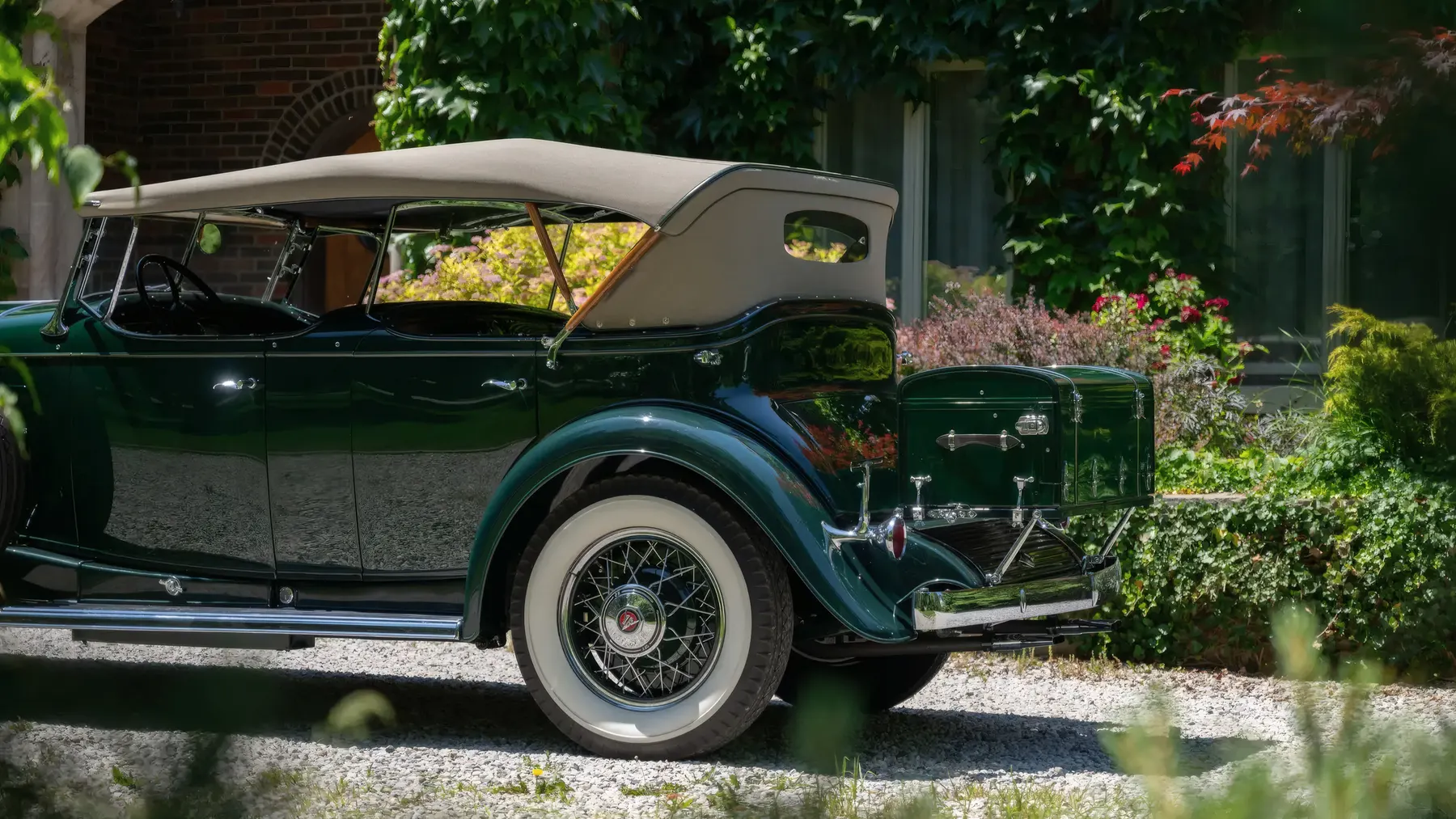
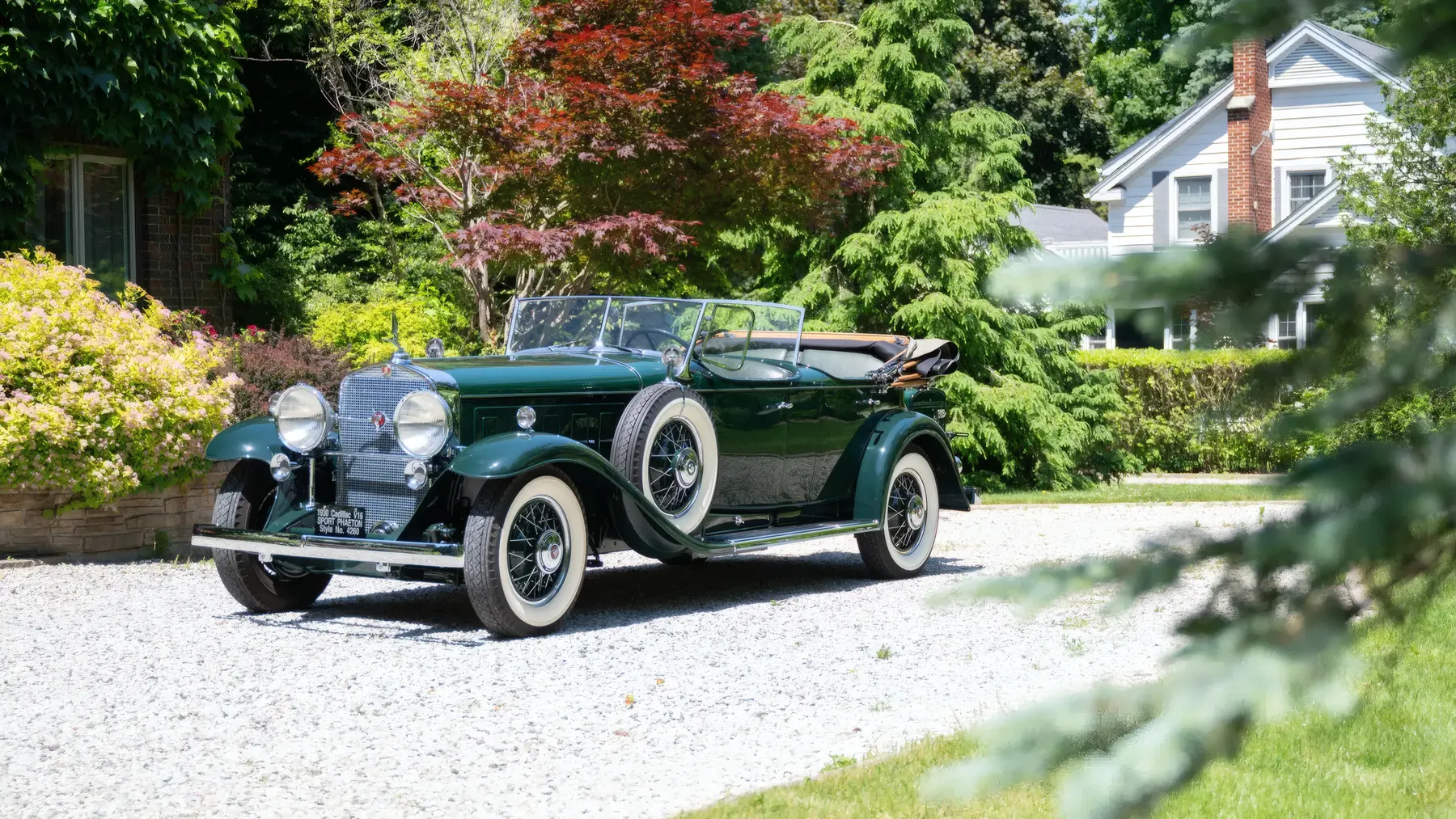
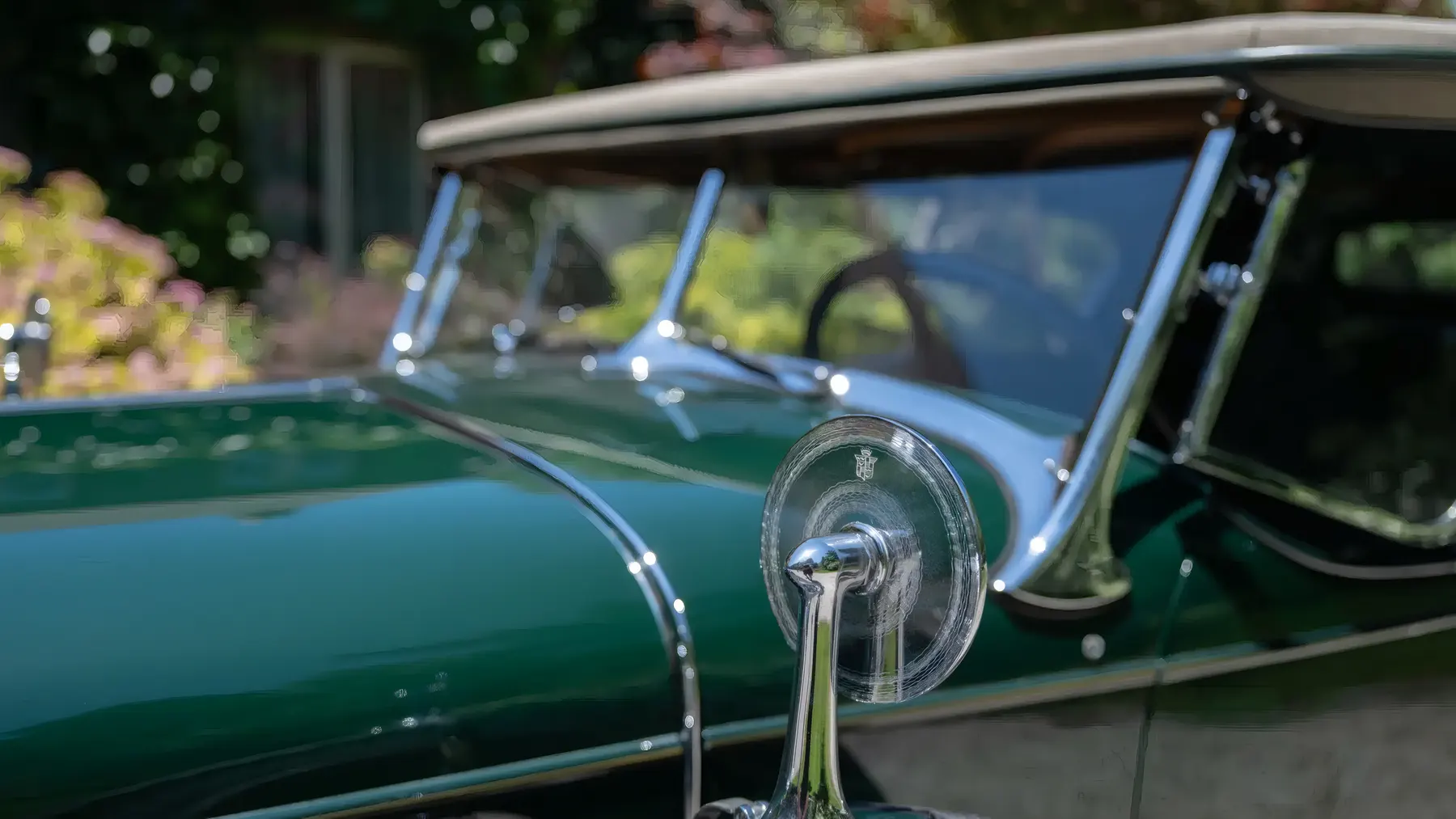
The Sport Phaeton, catalogued by Fleetwood as body style 4260, was among the most visually spectacular of the more than fifty configurations offered on the Series 452 chassis, and it was a relatively rare choice: just 52 were built in 1930 and 33 in 1931, for a combined total of 85 across the model’s first two years. It drew direct inspiration from Gordon Buehrig’s tourster designs for Duesenberg - an acknowledgement that Cadillac, even with a V-16, was watching what Indiana was producing with considerable attention. The Sport Phaeton was a formal four-door, five-passenger open touring body, but its defining innovation separated it from the conventional dual-cowl phaetons of the era. Rather than a separate rear cowl that lifted on hinges to admit passengers, Fleetwood’s engineers mounted a second windshield directly into the back of the front seat itself. This screen could be raised or lowered by the rear occupants using a small hand crank, offering some protection against buffeting at speed without interrupting the car’s unbroken visual line when fully lowered. A second set of instruments was provided for the rear compartment - a detail that acknowledged the Social Reality of these cars, which were often driven by professionals while their owners occupied the back seat.
The 148-inch (3,759mm) wheelbase chassis that underpinned the Sport Phaeton was not designed to flatter the driver. It was a conventional heavy-ladder steel frame, sprung front and rear on semi-elliptic leaf springs with hydraulic dampers, riding on a solid front axle and a three-quarter floating rear axle. The transmission was a three-speed synchromesh manual unit, advanced for its time in offering Cadillac’s “Clashless” synchronisation technology. Braking was by four-wheel mechanical drums assisted by vacuum - an arrangement that was already being supplanted by fully hydraulic systems elsewhere, and which demanded early and confident application given the mass involved. These cars weighed in the region of 2,300 kg depending on body style and specification, and the mechanical brakes had to arrest that considerable inertia with the limited assistance available.
What the chassis lacked in driver engagement it compensated for in a quality of motion that contemporaries found genuinely remarkable. The V-16 engine’s torque plateau meant the driver almost never needed to change gear for normal road use. It simply gathered speed with an implacable, unhurried authority - the silence of the drivetrain amplified by the hydraulic tappets, the dual exhausts, and the engine’s natural freedom from the mechanical clatter that plagued smaller-displacement contemporaries. Period press reception was unambiguously admiring, and Cadillac received over two thousand orders in the first seven months of 1930 alone, a genuinely startling response to a car that cost approximately $6,500 in a year when the national economic edifice was visibly fracturing.
Fleetwood’s role in producing the Sport Phaeton body deserves specific attention. In 1930, Fleetwood was still operating from its original factory in Fleetwood, Pennsylvania - it would not relocate to Detroit until December of that year and would not be formally absorbed into GM until 1931. This means the earliest Sport Phaetons were genuinely coachbuilt in the traditional artisanal sense, hand-fitted bodies from a craftsmen’s atelier rather than an industrial pressing line. Cadillac was famously reluctant to deliver the V-16 as a bare rolling chassis to independent coachbuilders - a policy that frustrated European clientele accustomed to commissioning their own coachwork - and the consequence was that Fleetwood’s catalog styles, however numerous they appeared, effectively defined the full range of what a new V-16 buyer could acquire. The handful of known custom bodies from European houses such as Saoutchik and Vanden Plas were almost invariably built over existing Fleetwood-bodied cars that had been stripped and rebodied after first delivery, a logistical workaround that underscores how tightly Cadillac controlled its flagship’s presentation.
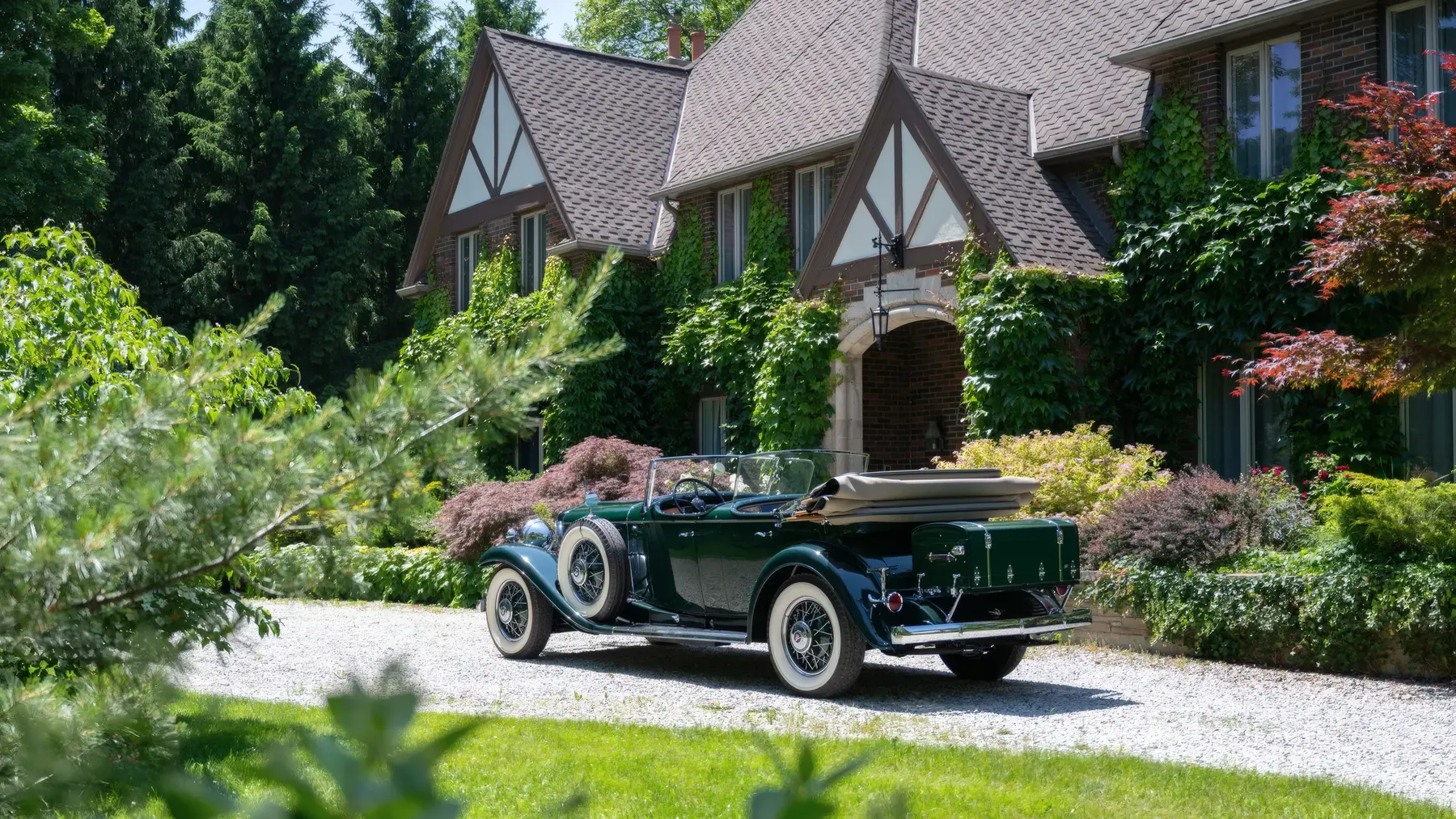
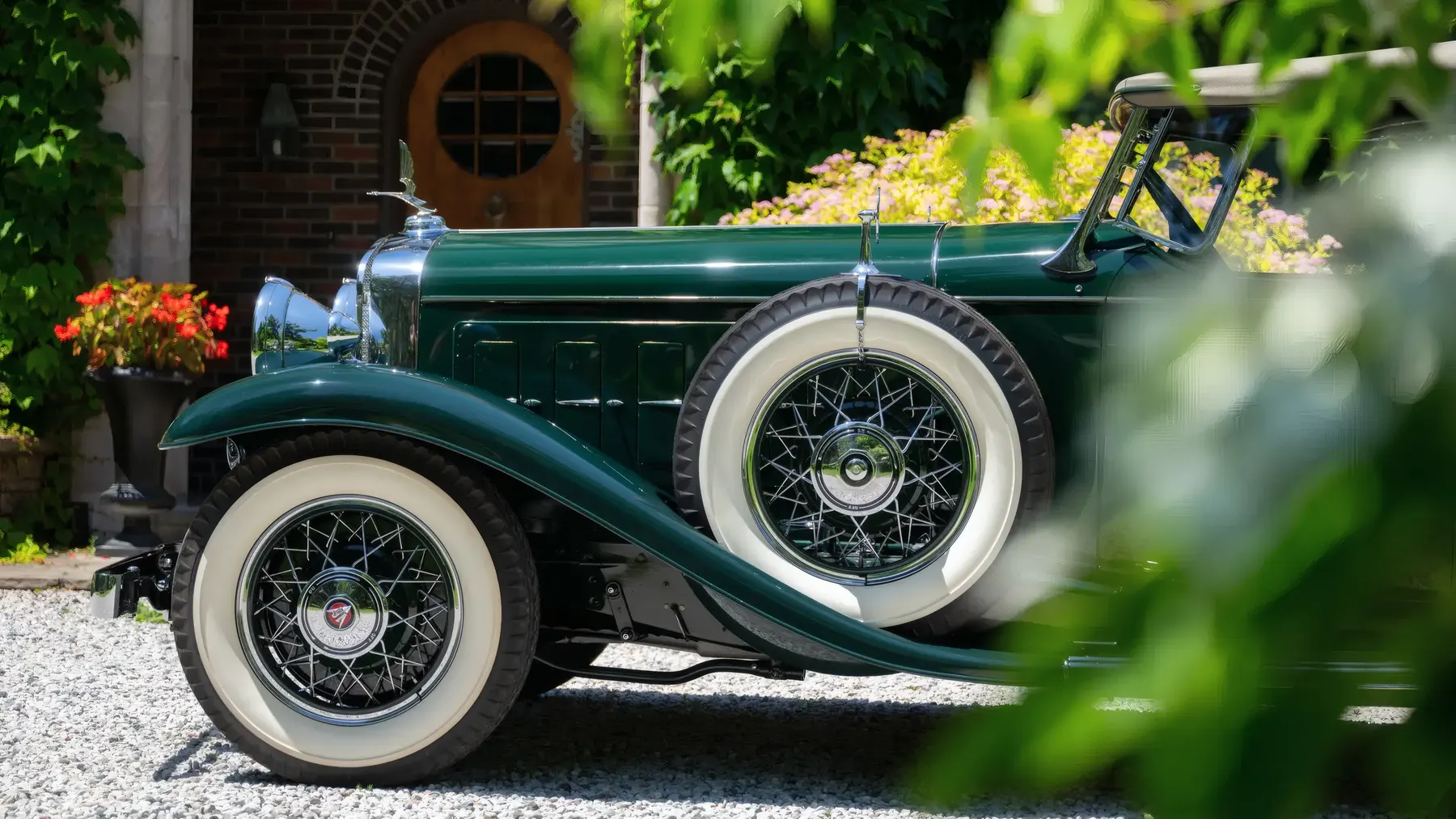
The Sport Phaeton’s proportions on the 148-inch wheelbase were as good as any American car of the era achieved. The long bonnet - necessary to contain Nacker’s engine - gave way to a front-hinged cowl and a swept passenger compartment that read as sleek rather than overwrought. The chrome wire wheels, sweeping fenders, dual sidemount spare tyres, and fanned dual exhaust tips were all standard Visual Grammar of the American Classic Era, but Fleetwood applied them with unusual discipline. The car wore its accessories as elegantly as it wore its proportions: optional Pilot-Ray steerable headlamps that tracked the steering, dual Klaxon horns, radiator stone guards, and a rear trunk rack all added to the sense of a motorcar dressed for occasion rather than convenience.
The V-16 and its Sport Phaeton body are genuinely important objects, but honest appraisal requires understanding what they sacrificed and where they fell short. The open phaeton configuration, for all its visual glory, was essentially dysfunctional as everyday transportation. American weather - from the Great Plains winters that many early customers would have encountered to the rain that fell perfectly democratically on the wealthy - made open touring cars a seasonal proposition at best. There was no provision for meaningful heating in the passenger compartment, and the soft top, when raised, transformed the interior into a dark, drafty approximation of a tent rather than a refined cabin. The Sport Phaeton was a car for the specific conditions of a warm, dry afternoon on uncrowded roads, and it was never designed to be anything else. That made it arguably the most impractical interpretation of an already extravagant concept.
The chassis itself was technically conservative by European standards. At a time when Bugatti was exploring independent front suspension and the engineering avant-garde was beginning to question the solid-axle orthodoxy, the Series 452’s underpinnings were solidly traditional. The vacuum-assisted mechanical brakes demanded considerable pedal effort and careful anticipation - subsequent V-16 generations would receive hydraulic assistance, but the earliest cars left buyers with a braking system that was somewhat marginal for the performance and mass involved. The enormous wheelbase delivered imposing presence and good low-speed ride quality but made the car genuinely unwieldy in urban environments, a fact that was rather beside the point given how few cities had streets proportioned for a car of these dimensions. Parking a 5.5-metre-long open touring car in a pre-war American downtown was an exercise in logistics rather than motoring pleasure.
The financial reality of the V-16 program was equally uncomfortable. General Motors later acknowledged losing money on every car it built - a remarkable admission for a product sold at prices that would have purchased a comfortable house in most American cities. The combination of complex engineering, labour-intensive coachwork, and a market that collapsed almost immediately after the launch year made the V-16 commercially unsustainable. Production, which had reached approximately 2,500 units in 1930, fell to around 750 in 1931 and continued declining precipitously thereafter, dropping to roughly 300 in 1932 and settling at approximately 49 units per year by the mid-1930s. The car that had attracted rave press notices and enormous public attention at the 1930 New York show was, within two years, being produced at a rate of fewer than six units a month. The Depression did not kill the V-16 immediately - GM persisted with it on grounds of prestige rather than profit - but it mortally wounded the commercial case for its existence almost at birth.
When the Series 90 replaced the first-generation V-16 for 1938, Cadillac made an engineering choice that has divided opinion ever since. The new engine was a 431-cubic-inch (7.1-litre) unit with a 135-degree V angle and side valves - essentially a flathead - designed primarily to achieve a lower bonnet line for aerodynamic styling purposes. It produced comparable power to the outgoing OHV unit and was by some measures more durable and mechanically straightforward, but the elegant 45-degree architecture, the twin-carburettor per-bank independence, and the jewelled underhood aesthetic of Nacker’s original were all abandoned. Many V-16 enthusiasts regard the Series 90 as a technically regressive compromise - a brilliant engine traded for a lower cowl height, the priorities of Harley Earl’s studio ultimately outweighing those of the engineering department. The new car sold in similarly tiny numbers and the entire V-16 programme was discontinued in 1940 after a total of just over 4,000 first-generation cars across eleven model years.
Of the 85 Sport Phaetons built in 1930 and 1931, roughly seventeen are believed to survive in original or restored configuration - a survival rate that reflects both the rarity of the body style and the determined efforts of American classic car preservationists. The fact that several known examples have passed through major European coachbuilders’ hands, been exhibited in museums, appeared in Hollywood films, or toured multiple continents during their working lives says something about the ambitions Cadillac held for the model when it was new: these were built to be seen, to be experienced, to make a claim about what American industry could produce when it chose to reach for the highest standard rather than the widest market.
The Sport Phaeton catches the Cadillac V-16 programme at its most idealistic and most vulnerable simultaneously - a car of genuine engineering sophistication and coachbuilt artistry, launched into an economic catastrophe with pricing that required either great fortune or an institutional disregard for profit. That contradiction runs through every dimension of its story, from Nacker’s obsessively refined engine to the impractical open bodywork, from the rave press reception to the plummeting production figures. It is, by any reasonable measure, one of the most significant American automobiles of the twentieth century - and one of the most melancholy demonstrations of how comprehensively timing can undermine even the most accomplished engineering ambition.