Alfa Romeo Giulia 1600 Spider: The Giulietta's Last Pininfarina Act
1963 Alfa Romeo Giulia 1600 Spider




Images: Simon Clay / RM Sotheby's
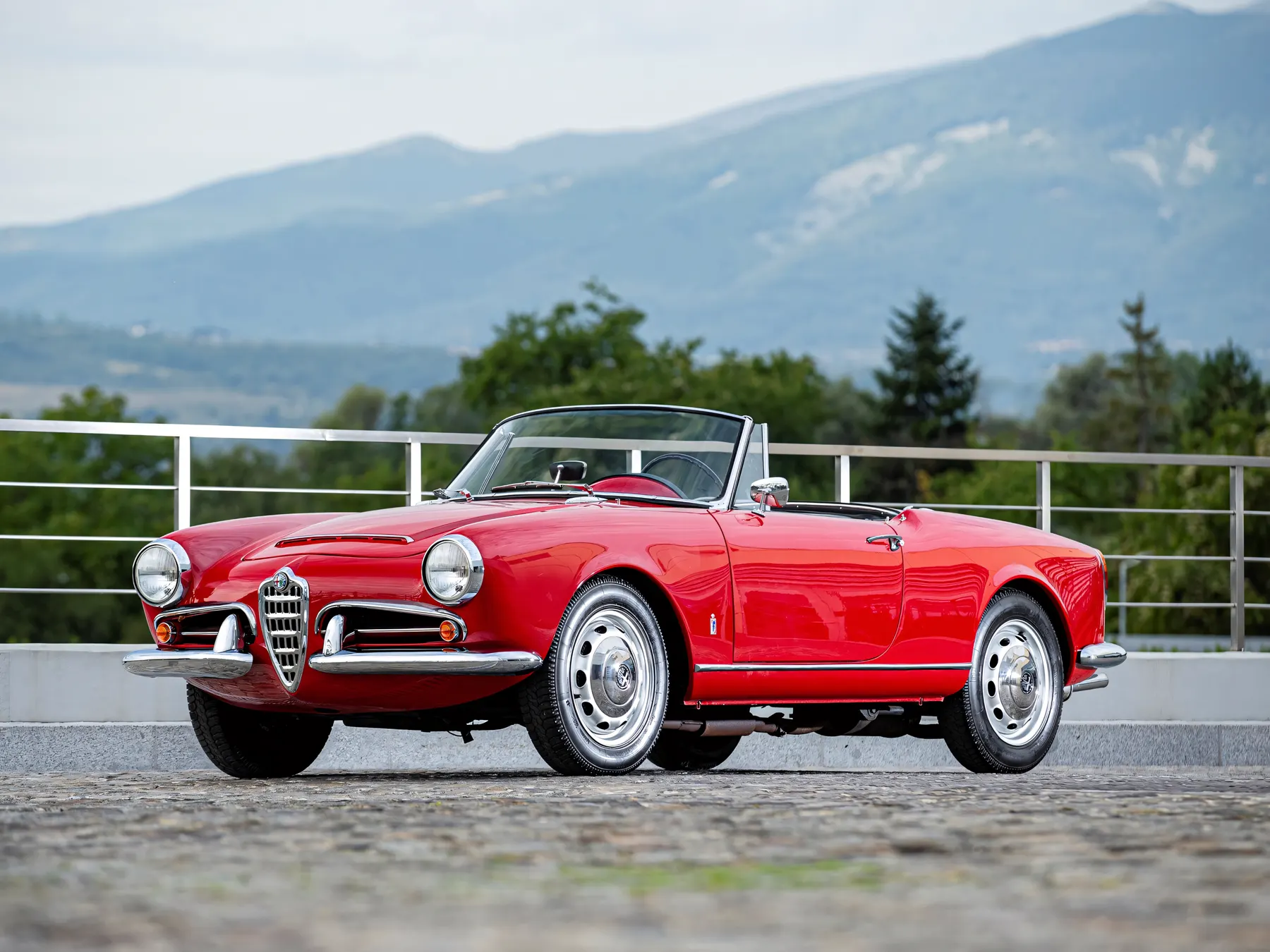
In 1962 Alfa Romeo gave its Pininfarina roadster a bigger engine, a five-speed gearbox and a new name, and left the shape alone. That decision defines the Giulia 1600 Spider, the Tipo 101 car that lasted only a few seasons and has spent the decades since being confused with its predecessor, its successor, or both. Outwardly it is a design from 1955. Mechanically it is a different car from the one Alfa built for the American market at the start of the Giulietta era, and the gap between those two facts is where most of its interest lies.
The Giulietta Spider exists because of Max Hoffman. In a well-worn story retold by Hagerty, the New York importer was in Milan to buy Bertone-built Giulietta Sprint convertibles when he told Alfa’s executives he would order 600 Giuliettas, with an option on 2,000 more, if they gave him a two-seat roadster. Bertone and Pinin Farina both built prototypes. Hoffman favoured the Pinin Farina car but bought the Bertone one for himself, and the Pinin Farina design was the more formal of the pair, closer in its lines to the saloon and coupé than to anything overtly dramatic. Pininfarina designed and built the bodies. In 1959 the Spider moved to the Tipo 101 chassis, gaining a longer wheelbase, now 2,250 mm, and reshaped doors for easier entry.
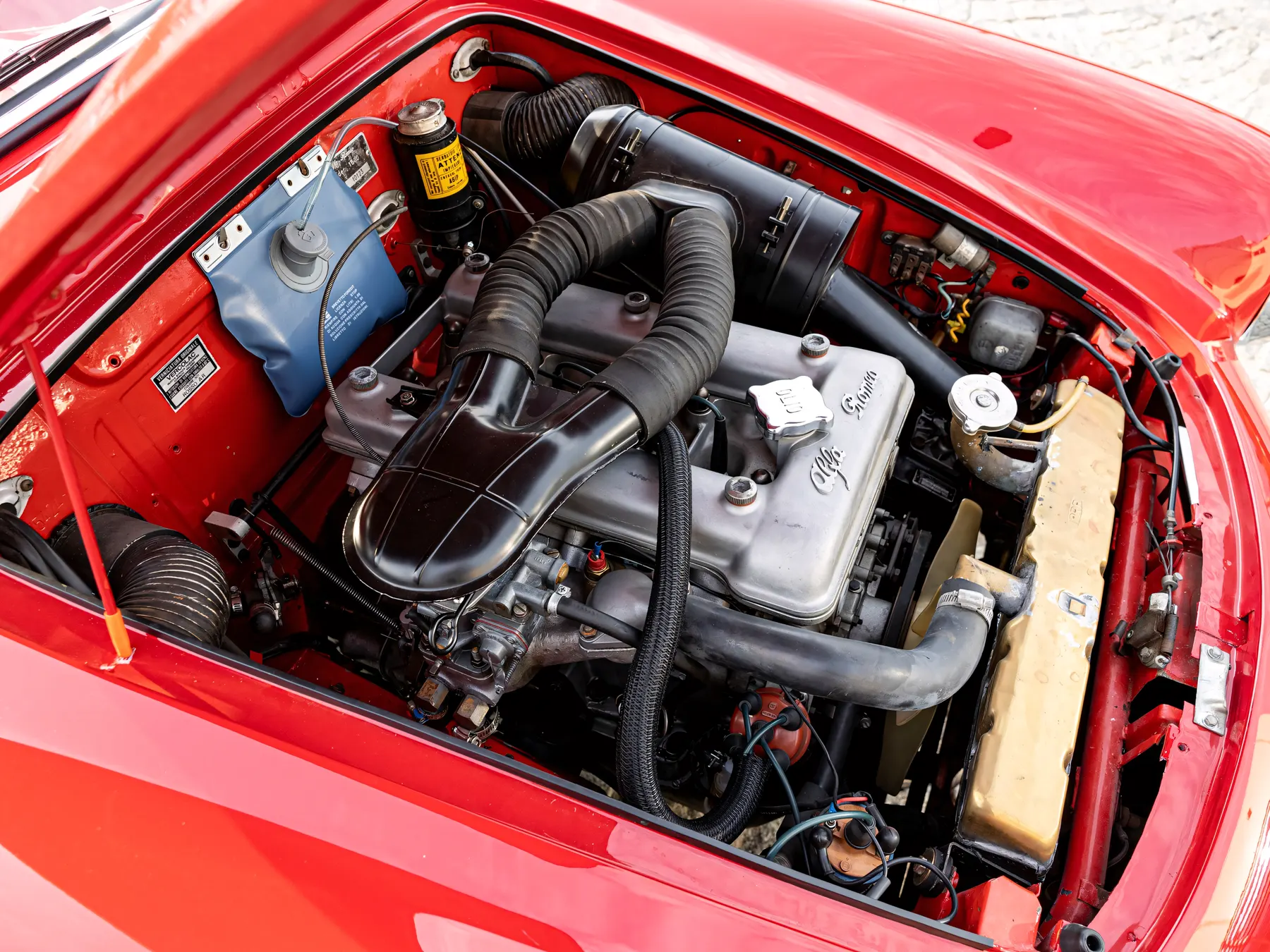
The Giulia range was launched at Monza on 27 June 1962, the work of a team led by Orazio Satta Puliga, and the Spider’s share of the news was the enlarged twin-cam. Giuseppe Busso’s all-alloy four had debuted in the 1954 Giulietta at 1.3 litres. The 1,570 cc Giulia version was more than a rebore: it used a different casting method, a revised crankshaft, altered bore spacing and a longer timing chain. In the Spider it lifted claimed output from 80 to 92 bhp and top speed to about 109 mph, with a single Solex carburettor doing the feeding and a five-speed gearbox fitted as standard. The name settled as Giulia 1600 Spider by 1963. Hagerty’s summary of the arrangement is blunt: the Giulia saloon was all new, but there was no all-new Giulia Spider, only the Giulietta with a new name and the 1600 engine.
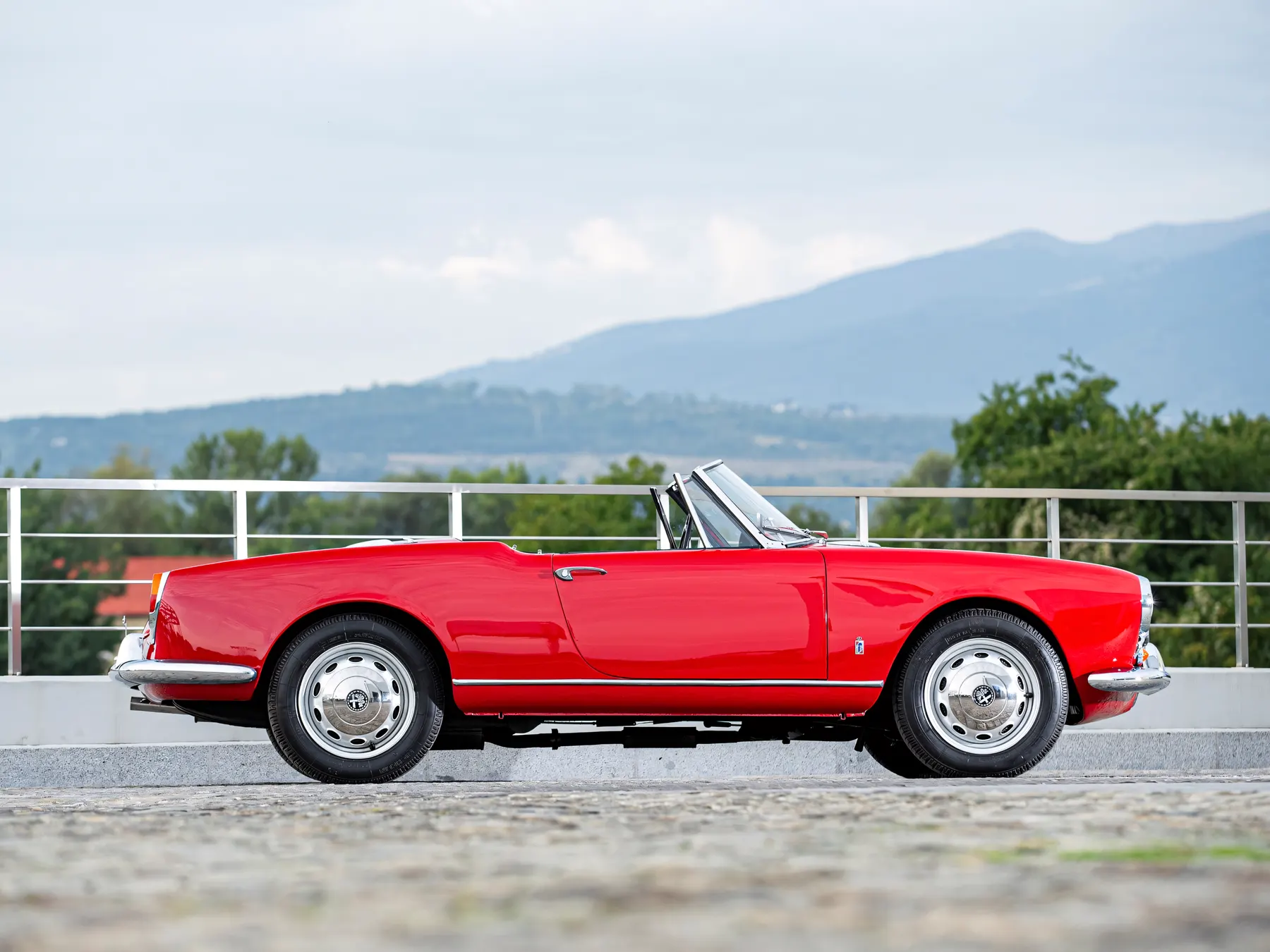
You can tell a Giulia from a Giulietta by the bonnet, which gained a gentle bulge with a horizontal chromed vent at its leading edge, said to be necessary to clear the taller engine. Sports Car Market noted in a 1993 appraisal that the larger engine is routinely fitted to earlier cars without clearance problems, which suggests a fair share of the scoop was styling. Inside, the changes were light: a new steering wheel, a revised radio blanking plate, gauges with white numerals on black, and the loss of the contrasting piping on the seats. From 1964 the hood frame also gained spring assistance. The significant upgrade was the gearbox. The same magazine says the five-speed unit had previously been reserved for the Sprint Speciale and Sprint Zagato, and that its fifth gear was a 0.79 overdrive that let the engine relax at a cruise, a rarity in a production car of the period. Auction-house copy makes the same point in plainer terms: the bigger bore made the twin-cam more flexible, and the fifth gear made the Giulia more comfortable at motorway speeds.
The Veloce followed in 1964, though a few sources date it a year earlier, and it was no simple tuning kit. SCM argues that its drivetrain differed almost entirely from the Normale’s: different camshafts, higher-compression pistons, a pair of dual-throat side-draught Webers, tubular headers feeding an expansion chamber, and a two-piece aluminium sump with an internal cooling maze. A taller final drive, front disc brakes and an air intake split between the driver’s fresh-air vent and the carburettors completed the package. Quoted power is the usual Alfa tangle. Most catalogue copy gives 112 bhp for the Veloce and 92 bhp for the Normale, while SCM prints 129 and 104 bhp respectively. Alfa quoted both CUNA and SAE gross ratings in this era, so the spread probably reflects the rating basis rather than different engines, though few sources say which standard they are using. Artcurial’s catalogue puts the Veloce’s top speed at about 112 mph.
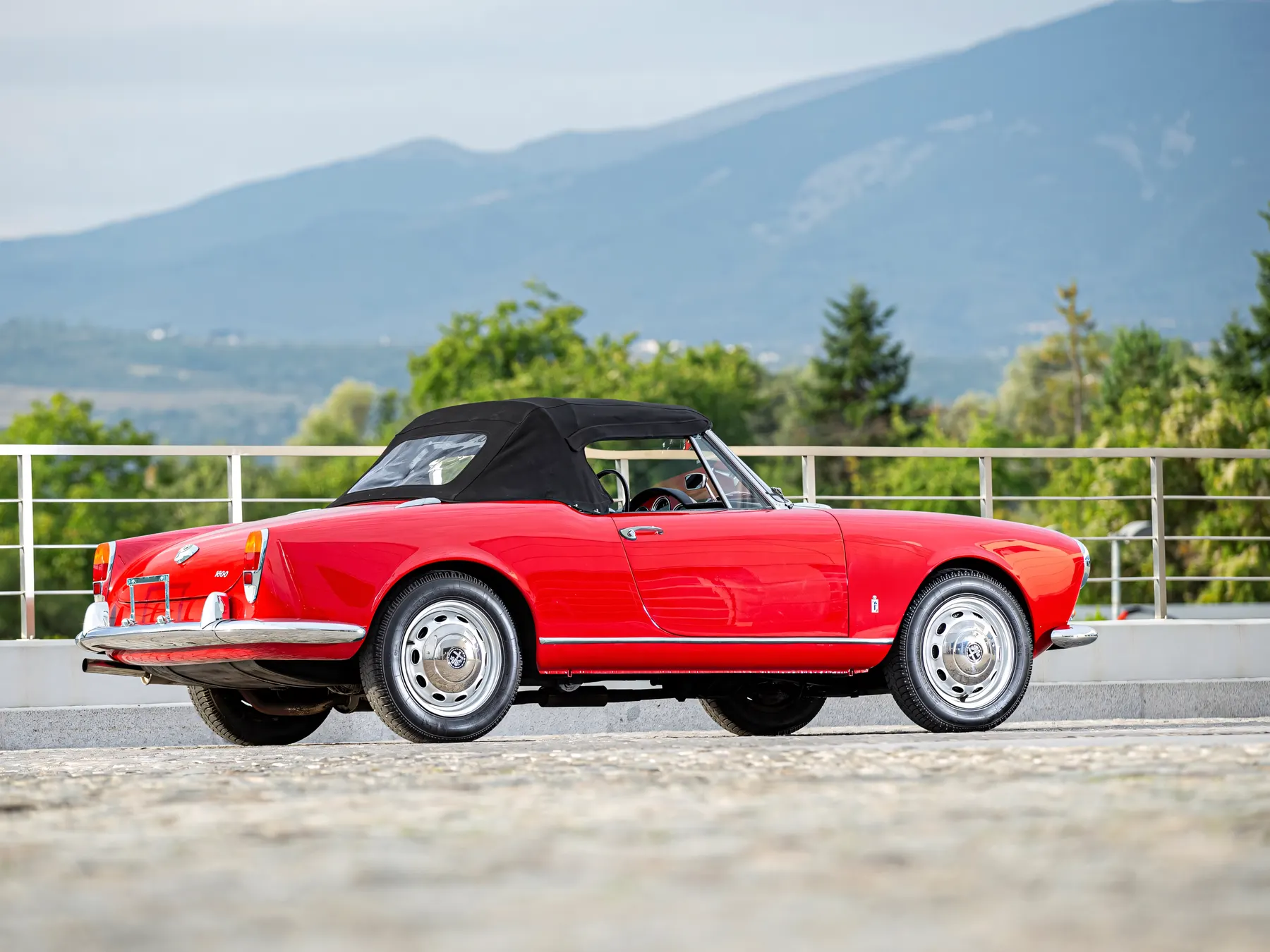
Rarity is part of the Veloce’s appeal. SCM counts 1,091 Veloces built across 1964 and 1965 against 8,950 Normales, while auction houses commonly quote about 9,250 Giulia Spiders in total, so published totals vary by source. Hagerty, working from the Alfa registry data compiled by Luigi Fusi, puts Veloce output at 289 cars in 1964 and 800 in 1965, against 286 Normales in the final year, which means the Veloce was effectively the Giulia Spider in its last season. Type codes help sort the survivors: 101.23 for the left-hand-drive Normale and 101.18 for the Veloce, with Hagerty noting a separate 101.19 code for right-hand-drive cars.
Most of what is written about driving these cars is inherited from the Giulietta, and for good reason: the structure is the same. A pressed-steel unibody carries double-wishbone front suspension with coil springs and an anti-roll bar, and a rigid rear axle on coil springs, located by trailing arms and a triangular link to the top of the aluminium differential housing. SCM called the Giulietta one of the best-handling cars of the 1950s and more refined than the MGA and Triumph TR3 of its day, with roll-up windows, a hood that kept out most of the weather and a workable heater. Hagerty calls the Giulietta Spider remarkably conservative engineering, with suspension and brakes simple enough that decent tyres and a proper alignment bring out what the car has. The twin-cam does the rest. Catalogue writers reach instinctively for its rev-happy nature, and a period Cars Illustrated verdict, relayed by Bonhams, ranked the Giulia Spider among the most delightful small sports cars ever made. That is warm praise rather than a measurement, but it fits the general picture: a willing engine, a proper five-speed gearbox and a chassis that stays out of the way.
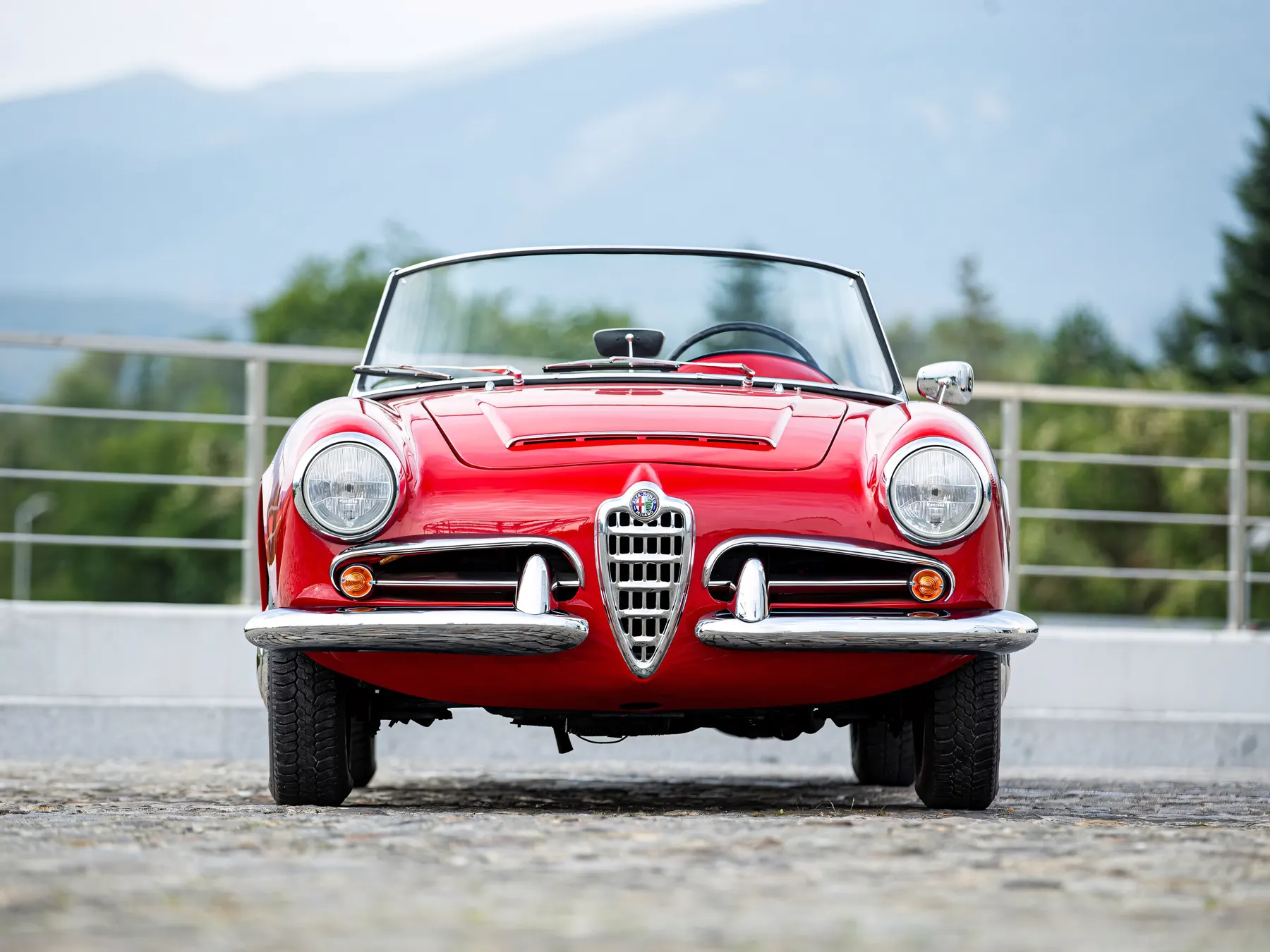
None of that makes it a flawless car, and the weaknesses are specific. The live axle is the first. SCM’s appraisal of the Giulietta Spider, whose chassis the Giulia inherited, notes that the better-balanced Sprint coupé always handled better and that the Spider can produce a fair amount of axle hop mid-corner, which matters in a car that invites hard driving. The longer wheelbase of the 101-series cars gives a more relaxed ride, according to the same writer, but many enthusiasts still prefer the sharper reactions of the earlier 750-series Giulietta, so the Giulia is not the purist’s Spider. Early Normales relied on uprated drum brakes. SCM describes three-leading-shoe fronts that were awkward to adjust and costly to maintain, with three wheel cylinders per hub, and recommends upgrading to the front discs that arrived in 1964. Hagerty adds that second-gear synchromesh in these Spiders is commonly weak, forcing a pause on quick shifts, and that rust is a fact of life: there is probably no such thing as a rust-free 101-series Spider, only ones that have been repaired well or badly, with floors, boot floors, wing bottoms, sills and jacking points, battery trays and front valances all suspect. There is also a performance gap inside the model itself. SCM judged the Veloce so far superior that a clear price premium over the Normale was fair, which is an awkward verdict on the version that made up most of production.
The larger criticism is strategic. Supercarnostalgia notes that Pininfarina could easily have turned its early design studies into a production successor, but the continuing success of the Giulietta meant an updated, visually almost identical Tipo 101 was introduced for 1962 instead, and the all-new Spider did not arrive until 1966. The Giulia 1600 Spider was therefore a holding action: a seven-year-old body, a cabin little changed from the Giulietta’s, and a mechanical update that, however welcome, left the underlying chassis layout exactly as it was.
The replacement was not an easy sell. The Tipo 105 Spider 1600 was unveiled at Geneva in March 1966 and, as Supercarnostalgia puts it, was not well received at first. It kept the same 2,250 mm wheelbase and launched officially as the Spider 1600 because a Milan court ruled that Pavesi had registered the intended name first. That is why “1600 Spider” now describes two different cars, and why a search for either can lead you to the wrong one. The Giulia 1600 Spider is the 1955-shaped Pininfarina car of 1962 to 1965 on the Tipo 101 chassis; the cuttlefish-bone car that followed is a separate model entirely.
Collectors have been kind to the Giulia Spider. Hagerty describes the 750/101 Spider and Spider Veloce as a well-established member of the collector market, widely recognised as representative of their era, and notes that parts for the 101-series engines are readily available and relatively inexpensive, with reproduction floors, rockers, wings and interior trim supplied by specialists. The Veloce commands a sizeable premium. SCM sees two kinds of buyer: those who care a great deal about Normale versus Veloce, and those who simply like the Pininfarina styling and do not care what is under the bonnet. Both are behaving rationally.
What the Giulia 1600 Spider offers is the 1955 idea at its most developed, and close to its end: the same elegant, rather formal Pininfarina shape, but with an engine that no longer feels like a 1.3-litre stretched to cope, a five-speed box that makes motorway distances sensible, and in Veloce form a level of pace the original car never had. It traded some of the early Giulietta’s short-wheelbase sharpness for a calmer ride, and it never solved the live-axle behaviour or the rust. It sits in an odd place, neither the original nor the new beginning, but the point at which the Giulietta’s recipe was as developed as it was ever going to get.
Technical data
Performance Specifications
| Normale (Tipo 101.23) | Veloce (Tipo 101.18) | |
|---|---|---|
| Production years | 1962–1965 | 1964–1965 (some sources: 1963) |
| Engine | 1,570 cc DOHC all-alloy inline-four, single Solex carburettor | 1,570 cc DOHC all-alloy inline-four, twin dual-throat Weber carburettors |
| Quoted power | about 92 bhp* | about 112 bhp* |
| Claimed top speed | about 109 mph | about 112 mph** |
| Gearbox | five-speed manual | five-speed manual |
| Front brakes | drums on early cars; discs from 1964 (per SCM) | discs |
| Rear brakes | drums | drums |
| Front suspension | double wishbones, coil springs, anti-roll bar | double wishbones, coil springs, anti-roll bar |
| Rear suspension | rigid axle, coil springs, trailing arms and triangular link (Giulietta architecture) | rigid axle, coil springs, trailing arms and triangular link (Giulietta architecture) |
| Wheelbase | 2,250 mm | 2,250 mm |
| Length | 3,900 mm | 3,900 mm |
| Width / height | not reliably sourced | 1,540 mm / 1,290 mm*** |
| Ground clearance | not reliably sourced | 130 mm*** |
| Kerb weight | not reliably sourced | 960 kg*** |
| Approximate production | about 8,950 (SCM) | 1,091 (SCM); 289 in 1964 and 800 in 1965 (Hagerty, from Fusi registry data) |
Sources
- Hagerty Media – Your handy 1955–65 Alfa Romeo Giulietta Spider buyer’s guide
- Sports Car Market – Alfa Romeo Giulia Spider Veloce (1993)
- Sports Car Market – 1957 Alfa Romeo Giulietta Spider Veloce (2004)
- Bonhams – Alfa Romeo Giulia 1600 Spider (model background only)
- RM Sotheby’s – Alfa Romeo Giulia 1600 Spider Veloce by Pininfarina (model background only)
- RM Sotheby’s – Alfa Romeo 1600 Giulia Spider (model background only)
- Artcurial – Alfa Romeo Giulia 1600 Spider Veloce (model background only)
- Aguttes – Alfa Romeo Giulia 1600 Spider (production total, model background only)
- ADAC Autokatalog – Alfa Romeo Giulia Spider 1600 Veloce
- Wikipedia – Alfa Romeo Twin Cam engine
- Wikipedia – Alfa Romeo Giulietta (750/101)
- Wikipedia – Alfa Romeo Spider (105/115 series)
- Supercar Nostalgia – Alfa Romeo Tipo 105 Spider Series 1: a Historical & Technical Appraisal
Join the discussion
Comments
Loading comments…
Leave a comment
Share a detail, memory, or perspective. Every comment is reviewed before publication.