Bugatti Type 57 Stelvio: Jean Bugatti's Grand Touring Cabriolet and the Art of the Open Road
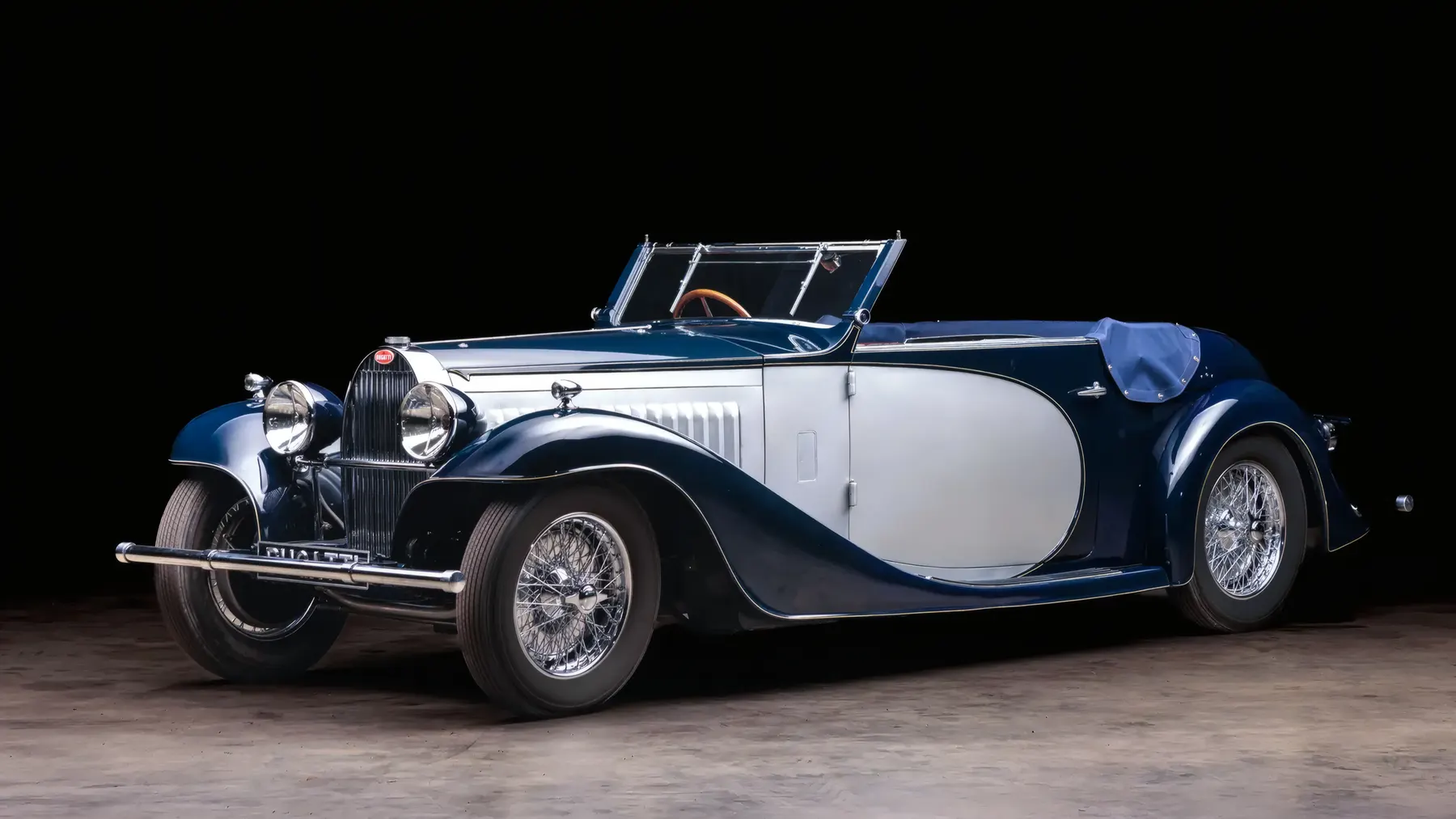
1934 Bugatti Type 57 Stelvio
Images: Theodore W. Pieper / RM Sotheby's
Some cars earn their names retrospectively, the marque grafting a geographic association onto something already finished. The Bugatti Type 57 Stelvio was different. The name was chosen with intention, invoking an Alpine pass whose switchbacks, altitude changes, and long technical descents made specific demands on both machine and driver - and which represented a vision of how the car was meant to be used: not in anger on a circuit, not in static display beneath a cover, but in sustained motion through serious mountain terrain, hood folded against the sky, the twin-cam straight-eight spinning freely between the front wheels.
The Type 57 platform on which the Stelvio was based arrived in 1934 as the product of a creative collaboration unusual for Molsheim. Ettore Bugatti had always controlled every significant design decision at his factory, from valve timing to body proportions, but by the early 1930s he was extending genuine latitude to his son Jean. Born in 1909, Jean had grown up inside the Bugatti operation and developed a sense of automotive form that was distinctly his own rather than simply an inheritance of his father’s taste. Where Ettore tended toward an almost mathematical purity of line, Jean had an intuitive feel for organic curves, for the way surfaces joined, and for the relationship between a car’s envelope and the road it sat above. The Type 57 became his greatest argument. The bodies he created for it - the Galibier four-door saloon, the Ventoux two-door coupé, the Atalante fixed-head, the riveted Atlantic, and the Stelvio cabriolet - shared a formal coherence that remains difficult to explain in purely technical terms, rooted more in eye than in formula.
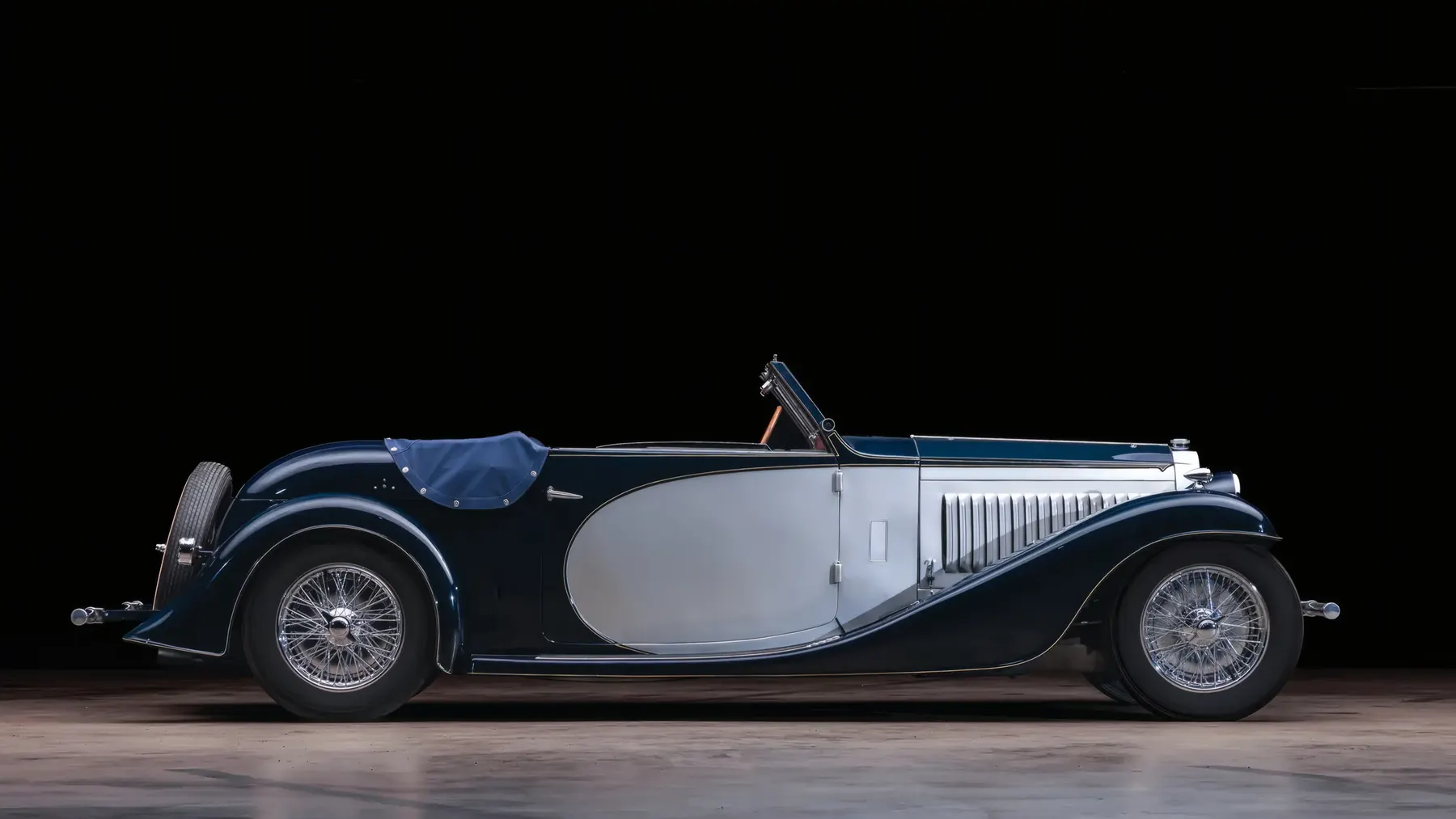
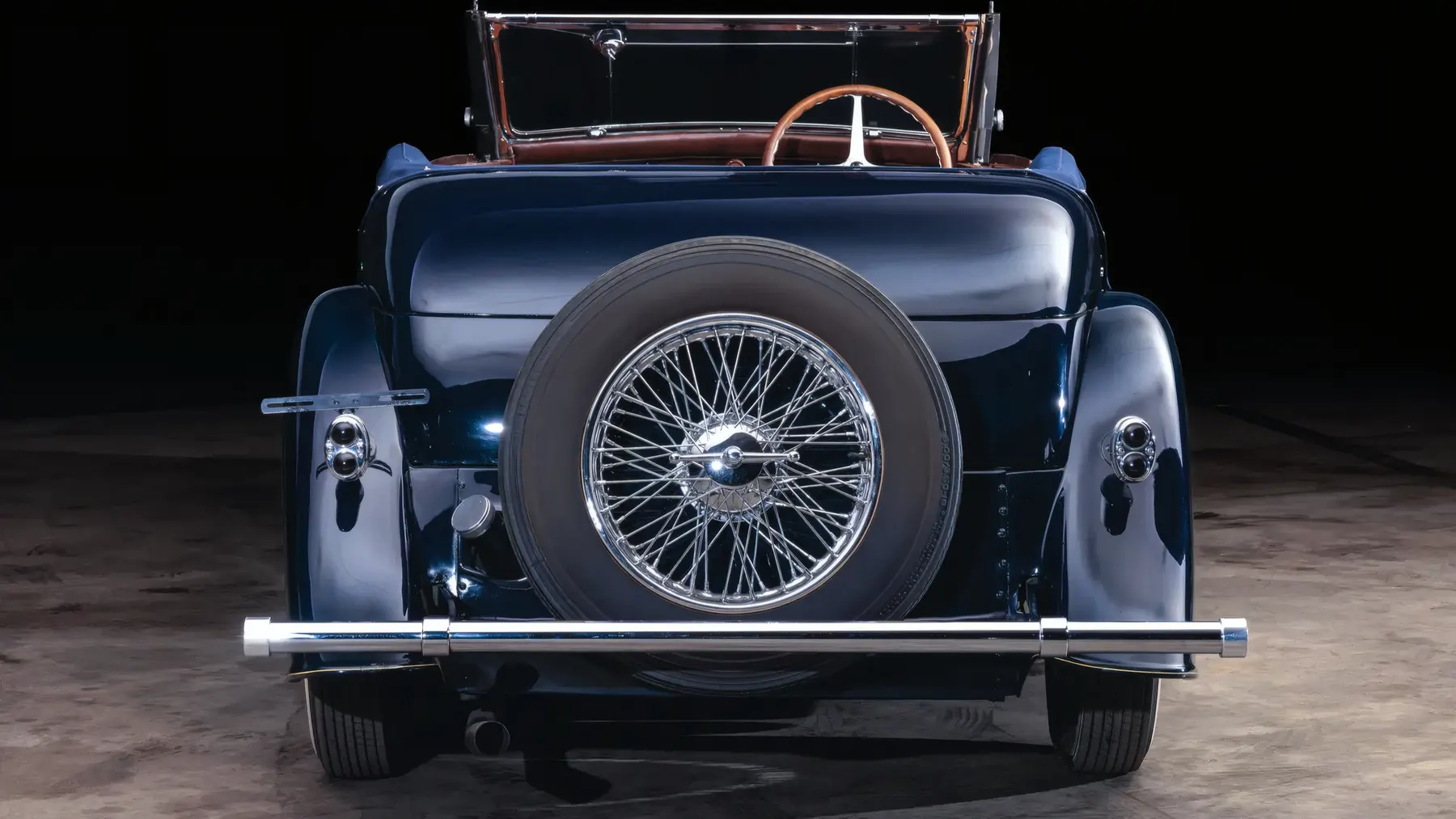
The Stelvio was the open-air expression of this programme. As a cabriolet, it occupied the position in the Type 57 range that demanded the most delicate negotiation between visual aspiration and practical compromise. Jean Bugatti met this challenge by treating the soft top as part of the car’s architecture rather than an appendage bolted to it. With the hood folded, the Stelvio presented a profile of studied elegance: the long, tapered bonnet flowing into sweeping front wings that merged cleanly with the running boards, the neat cockpit with cutaway doors, and the relatively short tail with a spare wheel carried behind it. With the hood raised, the fabric roofline completed the car’s form cleanly, without the awkward bulk or puckering that characterised so many pre-war drophead designs. The front screen was raked, the overall greenhouse impressively contained for a car designed to carry four adults across serious distances.
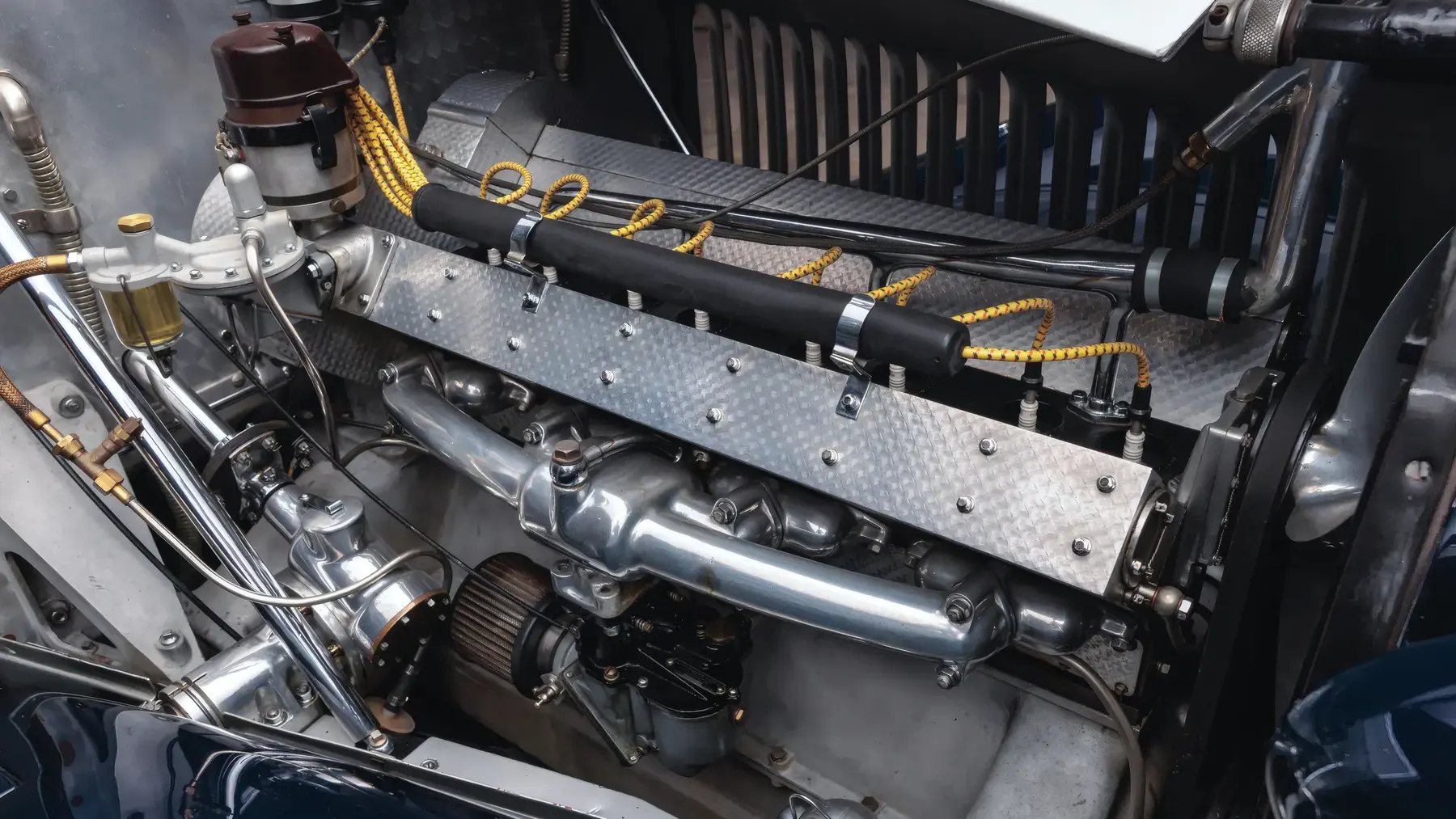
The engine beneath that bonnet was the Type 57’s defining mechanical argument. The 3,257cc twin-overhead-camshaft straight-eight was not simply more sophisticated than most of its contemporaries - it was more sophisticated than some manufacturers managed for another decade. Dual overhead cams were genuinely rare in road-car applications in the mid-1930s; here they were driven by a gear train at the front of the engine, with roller bearings throughout the bottom end, individual intake ports for each cylinder, and a delivery character that was high-revving by pre-war standards. In naturally aspirated form the engine produced approximately 135 bhp, a serious number in 1934, and it did so with a mechanical precision that set the Bugatti apart from the larger-displacement, lower-revving engines of its Bentley or American contemporaries. Power came in a manner that rewarded attentive driving: the Type 57 responded to the throttle with a crispness that reminded the driver they were operating something designed by people who understood engines as instruments, not merely sources of motion.
The Stelvio was available in two chassis configurations that mattered considerably to its character. The standard Type 57 used a conventional solid rear axle on semi-elliptic springs, tuned for long-distance suppleness over roads that were rarely as smooth as their reputations suggested. The Type 57S- the surbaissé, or lowered version - adopted a far more radical approach: the chassis rails were drilled out to allow the rear axle to pass through them rather than beneath, dropping the entire body dramatically and altering the car’s visual relationship with the road entirely. The 57S ran a higher state of engine tune producing around 175 bhp, and was equipped with a de Dion-arrangement rear axle for more consistent dynamic behaviour. A Stelvio constructed on the 57S platform was a meaningfully different car - more urgent in its responses, more dramatic in its proportions - though the cabriolet body’s additional weight and structural openness meant it never matched the tight, purposeful quality of an Atalante 57S. For those who specified the Roots supercharger of the 57C, output rose to approximately 160–165 bhp; the full-house 57SC combined the blower with the lowered S-chassis for something in the region of 200 bhp, though exact period figures varied across individual builds. The blown variants brought a characteristic supercharger whine layering beneath the engine’s mechanical rhythm, delivering their performance with a more forceful directness. Whether the open Stelvio was the most appropriate vessel for SC specification is open to question - the heavier, more flexible cabriolet body seems better suited to the standard car’s accommodating character than to the most demanding expressions of the platform.
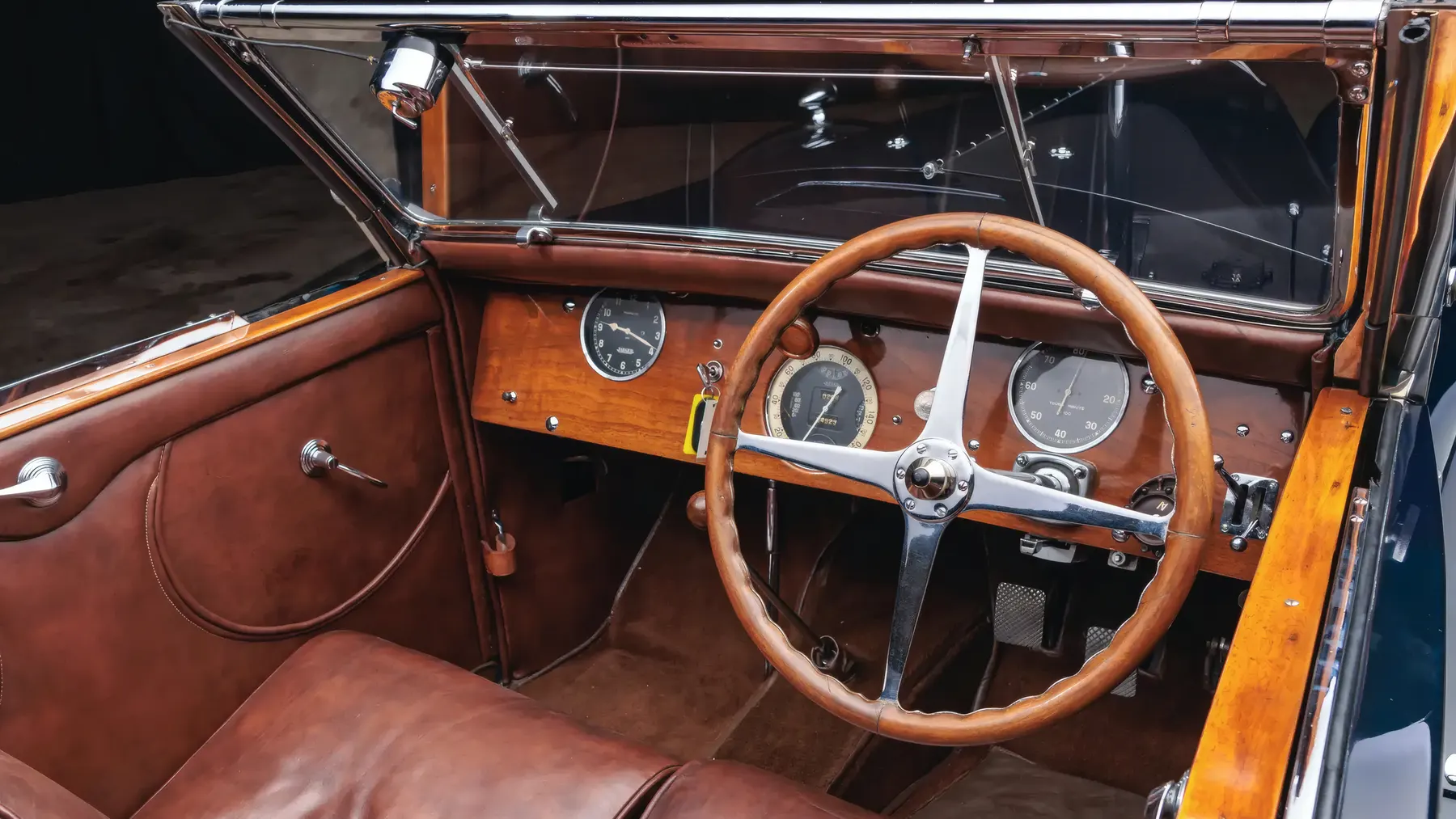
Period accounts of driving the Type 57 in any body style describe a car that was supremely precise by the standards of the day, and physically involving in ways that modern machinery has systematically designed out. The steering was unassisted and direct, communicating the road beneath with little insulation; the four-speed gearbox was operated by a separate lever, its changes requiring deliberate choreography rather than casual flicks. In the Stelvio, seated low in a cockpit from which the long bonnet stretched ahead, the act of driving was participatory in the fullest sense. The cabin itself was unmistakably Bugatti - instruments beautifully crafted and legibly placed, controls weighty and purposeful, the materials chosen for quality rather than opulence. It was a working environment rather than a luxury one, which suited the car’s grand touring character far better than the upholstered passivity of some rivals.
Here the honest appraisal must arrive. For all its sophistication, the Type 57 Stelvio carried engineering commitments that were already showing their age in 1934, and which became more conspicuous as the decade advanced. The front axle was a solid beam unit, sprung by reversed quarter-elliptic leaf springs - a Bugatti tradition that prioritised low unsprung weight and geometric predictability over compliance. By the mid-1930s, independent front suspension was no longer theoretical: Citroën had introduced it on the Traction Avant, and German manufacturers were progressively adopting it. The Bugatti arrangement was not crude by absolute pre-war standards, but it transmitted road surface information through the unassisted steering with a forthright intensity that could be demanding over rough terrain - terrain of exactly the kind that the car’s Alpine name implied. On a smooth road the front end was rewarding; on a broken one, the constant telegraphing of surface texture placed real demands on the driver’s attention over long distances. The drum brakes, operated by cable and mechanical linkage rather than the hydraulics that competitors were adopting, compounded the issue. They required regular adjustment, careful calibration, and a habitually longer anticipation of braking distances than equivalent hydraulic systems demanded. These were not catastrophic flaws, but they were choices reflecting an engineering conservatism that sat uncomfortably alongside the engine’s genuine radicalism.
The cabriolet body introduced its own structural compromise. Without a fixed roof’s contribution to body stiffness, the Stelvio was more susceptible to torsional flex than the Atalante or Ventoux, and on poor surfaces this could manifest as scuttle shake - a tremor transmitted through the fascia and steering column that reminded occupants of the realities beneath the elegant coachwork. Over extended use the open structure placed greater stress on coachwork joints, an issue requiring attentive maintenance even in period. Running any Type 57 well demanded specialist knowledge: the twin-cam straight-eight, with its roller bearings, gear-driven camshafts, and precise tolerances, was not forgiving of improvisation. Ownership in the 1930s implied a relationship with Molsheim-trained mechanics; ownership today implies a correspondingly elevated level of access to expertise. This was not a car for those content with general-purpose mechanical attention.
The competitive landscape the Stelvio entered was formidable for a wealthy European buyer seeking an open grand touring machine. Bentley’s 3½-litre and 4¼-litre offered more effortless low-speed torque and a more relaxed Continental temperament, with Vanden Plas and Park Ward cabriolet bodies delivering comparable visual presence. Alfa Romeo’s 8C 2900B, in open configuration, combined Italian sensibility with a more dynamically developed chassis. Hispano-Suiza and Delahaye made their own compelling cases. The Stelvio’s argument was primarily one of mechanical precision and engineering refinement - the Bugatti’s intentional construction quality and high-revving twin-cam character setting zit apart from the more relaxed cruising character of the British alternatives, though it conceded ground in chassis compliance and braking confidence to some of the continental competition.
Jean Bugatti did not live to see the full arc of his creation’s reputation. He was killed in August 1939 in a testing accident on a closed road near Molsheim, at thirty years old, weeks before the war began. Production of the Type 57 ended with the outbreak of conflict and never meaningfully resumed. Ettore Bugatti died in 1947, and the factory that re-emerged under Hispano-Suiza stewardship post-war never recovered the pre-war design tradition. The approximately 710 Type 57s produced across all variants between 1934 and 1940 stood as a complete and closed statement.
The Stelvio occupies its place in that statement as the model that most honestly represented what the Type 57 was designed for in sustained use. The Atlantic was an act of artistic self-declaration; the Atalante was a sporting instrument; the Ventoux was a practical coupé for owners who needed to carry luggage and passengers; the Galibier was a formal conveyance. The Stelvio was the car that took you to the pass. Jean Bugatti’s particular achievement was to make a cabriolet that felt not like the result of removing a roof from something complete, but like a car that had always been intended to exist exactly this way - open, purposeful, and named after the road it was built to climb.